
Hi Vis Motorcycle Gear Pros and Cons: Data vs. Opinion
This post contains affiliate links. As an Amazon Associate, we earn from qualifying purchases.
Wearing high-visibility motorcycle gear is associated with a 37% lower risk of crash-related injury, per a peer-reviewed study. The main pros are increased conspicuity and measurable safety gains; the cons center on rider perception, including style, fit, and a belief that other road users are at fault.
The 37% figure comes from a specific case-control study. It’s a strong number, but it doesn’t mean every hi-vis vest is a magic shield. The research also shows that effectiveness shifts with conditions, fluorescent material works differently against a grey sky than a bright sunset, and reflective strips do nothing until a light hits them. A discussion of hi vis motorcycle gear pros and cons must consider these variables.
What follows is a breakdown of what the data actually says, where riders push back, and how to integrate visibility into your kit without looking like a traffic cone. The standards, the technology effective at night, and the best placement for color or reflective material to maximize visibility from a driver’s perspective will be explained.
Key Takeaways
- A 2004 BMJ case-control study linked hi-vis gear to a 37% lower injury risk, but its effectiveness is situational and depends on contrast with the background.
- Riders cite image, cost, and poor fit as top barriers, with many believing safety is a driver’s responsibility, not a gear problem.
- For nighttime, LED and retroreflective gear significantly boosts detection distance over standard retroreflective material, with no measurable drop in wearability.
- Strategic placement on a moving rider’s silhouette, helmet, back, and limbs, matters more than covering yourself in solid neon.
- Proper maintenance of reflective strips and fluorescent fabric is essential; a dirty or peeling vest offers a false sense of security.
The Data Says It Works (But Riders Aren’t Convinced)
The most cited number in this debate comes from a 2004 study published in the BMJ. It was a case-control analysis of crash data, and it concluded that wearing high-visibility clothing is associated with a 37% lower risk of crash-related injury. That’s a substantial figure. It’s the kind of stat safety campaigns are built on.
But here’s the layer most summaries miss. The same study noted the benefit was strongest during daylight. The 2008 TRL literature review adds crucial context: colored clothing “is more effective when viewed against a contrasting” background. A fluorescent yellow jacket disappears against a field of autumn leaves or a bright sunset. It screams against a grey highway barrier or an overcast sky. The 37% is an average, not a guarantee for every road and weather condition.
A 2004 BMJ case-control study found wearing high-visibility motorcycle clothing is associated with a 37% lower risk of crash-related injury. This risk reduction is strongest in daylight conditions and when paired with a white helmet.
Rider attitudes, documented in a 2012 survey, directly clash with this data. In that study, 40% of riders wore no high-visibility gear at all. A prevailing attitude among riders was that this gear does not improve safety and it is other road users who are at fault. The disconnect is stark: researchers see a measurable drop in injury risk; a large segment of the riding community sees a fashion compromise that excuses bad driving, a core tension in the hi vis motorcycle gear pros and cons debate.
| Perspective | Key Finding | Source / Study |
|---|---|---|
| Safety Research | 37% lower risk of crash-related injury with hi-vis gear. | BMJ Case-Control Study (2004) |
| Rider Attitude | Hi-vis does not improve safety; other road users are at fault. | “Hi Viz: The Way to G(l)o?” Survey (2012) |
| Contextual Effectiveness | Colored clothing is more effective against a contrasting background. | TRL Literature Review (2008) |
| Nighttime Solution | LED/retroreflective gear significantly increases recognition distance. | Applied Sciences Study (2024) |
The takeaway isn’t that the data is wrong. It’s that the real-world benefit depends on you, your environment, and the specific gear. A hi-vis vest tossed in a top box for rainy commutes is a different tool than an integrated reflective touring suit.
Where Hi-Vis Gear Actually Helps (And Where It Doesn’t)
Breaking down “visibility” into specific scenarios cuts through the hype surrounding the hi vis motorcycle gear pros and cons. The gear that works on a bright country road isn’t the same gear that works in a rainy urban canyon at dusk.
Daytime & Variable Weather: This is where fluorescent colors (yellows, oranges, limes) earn their keep. Their job is to convert UV light into visible light, making them appear to glow. They are exceptionally effective on overcast days, in tree-shaded areas, and during dawn/dusk. Against a bright, cluttered background like a city street, their advantage shrinks. This is why strategic placement matters, a bright or reflective helmet is often the highest, most central point a driver sees.
Nighttime: While some riders are skeptical bright colors help at night, favoring reflective components, the effectiveness of fluorescent material in low-light conditions depends on having a contrasting background and some ambient light. At night, the game changes to retroreflection and active lighting. A 2012 Iowa State University study found that motorcycles with modulating headlights had longer detection distances than those with high beams or standard daytime running lights (DRLs). For gear, the 2024 Applied Sciences study is key: it found LED and retroreflective-equipped protective clothing significantly increased recognition distance in nighttime scenarios compared to conventional retroreflective gear. Crucially, wearability tests showed no significant difference in comfort or mobility.
Where this goes sideways: Assuming a fluorescent vest works at night. Without a light source to activate it, the material is just dark cloth. Night riding demands reflective strips or active lights.
Urban vs. Rural: In the city, the challenge is background clutter and driver distraction. A full hi-vis suit might get lost in a sea of signs and lights. Here, a bright helmet combined with a hi-vis vest over your jacket creates a broken, attention-grabbing pattern. On a rural highway, where the backdrop is simpler, larger blocks of color on your torso and legs can make you stand out at a greater distance.
The goal is to create a recognizable human silhouette. A 2019 NHTSA focus group with sport bike riders suggested prime locations for bright colors: the head (helmet), back of jacket, and down the side of legs and arms. When you’re hunched over a sport bike, your back and limbs are what an approaching driver sees.
The Rider’s Gripe List: Image, Fit, and Practicality
The data can say whatever it wants. If riders won’t wear the gear, it doesn’t matter. The research on attitudes is just as important as the research on crash stats.
The 2012 “Hi Viz” study nailed the top barriers: image, cost, practicality and availability. Riders in the 2019 NHTSA focus group had nicknames for riders in full neon: “High Vis Uncles,” “Highlighters,” “Traffic Cones.” The stereotype is an older, cautious rider, not the image many want to project. This isn’t trivial, gear you leave in the closet because you feel silly provides zero protection.
Fit is a major practical complaint. Riders reported that available hi-vis options were often poor fitting, causing flapping and vibration at speed. That’s a dangerous distraction. A loose vest flapping in the wind can obscure your mirrors, create noise, and pull at your neck. It feels cheap. This is why integrated hi-vis panels on a well-cut jacket, or a tailored vest like many motorcycle vests from touring brands, solve a real problem.
Cost is relative. A cheap vest is a few dollars. A high-quality touring jacket with integrated retroreflective panels and armor costs real money. Many riders in the focus groups said they’d consider hi-vis only when their current gear needed replacement, viewing it as an extra expense, not a core part of protective gear.
Finally, there’s a deep-seated skepticism. A lot of riders believe loud pipes, good lights, and skilled lane positioning are what keep you safe. They see hi-vis as a concession, or worse, a placebo. The prevailing attitude from the 2012 study says it all: it’s other road users who are at fault. Why change your look for their failure?
The Tech and Rules: LEDs, Reflectives, and Regulations
Once you move past basic vests, the technology gets interesting, and the legal landscape gets specific.
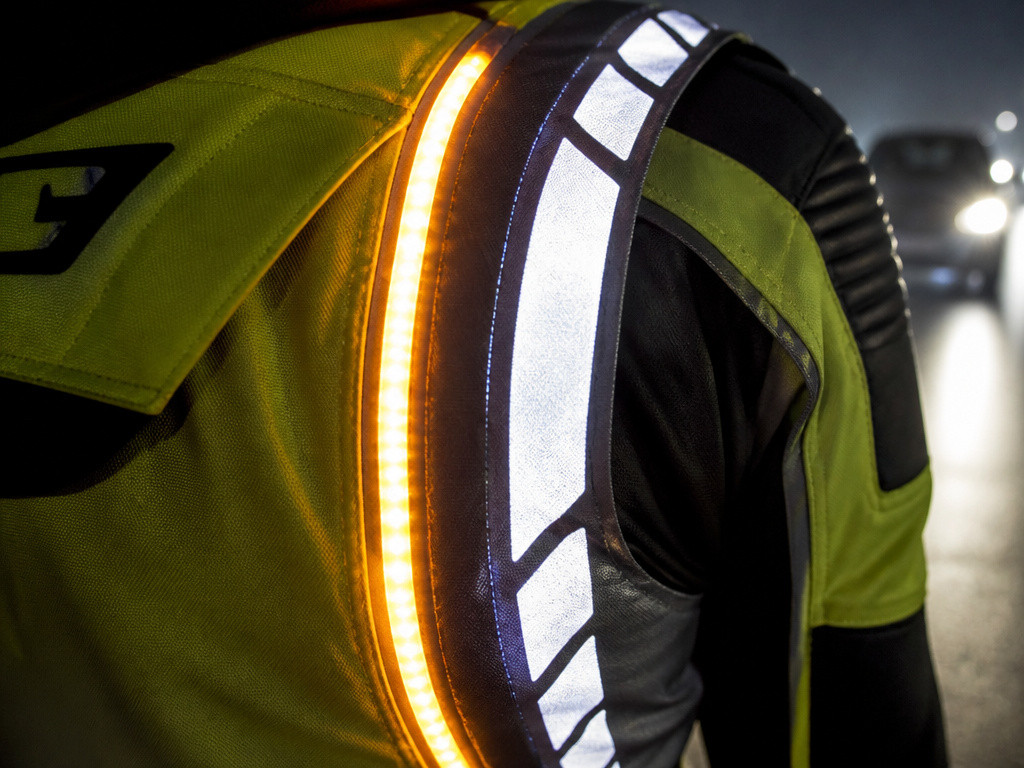
LED Gear: The 2024 study showed a clear detection-distance win for LED-equipped clothing at night. These are typically battery-powered vests or strips. The legal grey area involves color and integration. A 2010 NHTSA interpretation letter is the key document here. It states that FMVSS No. 108, S5.1.3 is the basis for prohibiting accessory lighting in colors other than red, amber, or white on vehicles. If an LED vest with, say, blue lights is wired into your bike’s electrical system, a manufacturer or dealer installing it could be violating the rule because it “would impair the effectiveness of required motorcycle lighting systems.” Battery-operated, standalone vests generally fall outside this federal vehicle equipment regulation, but state laws may vary.
Reflective Materials: This is the workhorse of nighttime visibility. Not all reflective tape is equal. The ANSI/ISEA 107-2015 standard classifies high-visibility apparel materials, including reflective performance. Quality gear uses retroreflective tape that bounces light directly back to the source (like car headlights). The European standard for protective gear, EN 17092-6:2020, includes provisions for Class C garments (undergarments or overgarments designed for protectors) that can incorporate these materials.
Certifications and Testing: Programs like MotoCAP test gear for protection and breathability. Their impact abrasion testing follows EN 13595-2:2002, and burst testing follows EN 13595-3:2002 (with a burst area diameter of 79.9mm). While MotoCAP focuses on abrasion and impact, it highlights that visibility is one layer of a garment’s job, it also has to survive a slide and let you sweat.
| Gear Type | Best For | Key Limitation / Consideration |
|---|---|---|
| Fluorescent Vest/Jacket | Daytime, overcast weather, dusk. | Useless in full dark; effectiveness depends on background contrast. |
| Retroreflective Striping | Nighttime, low-light conditions. | Only works when struck by a light source (car headlights). |
| LED-Equipped Vest | Maximum nighttime conspicuity. | Check local regulations on colors; requires battery management. |
| Integrated Hi-Vis Jacket | All-day riding with consistent visibility. | Higher cost; must balance visibility with other protective features. |
Common mistake: Buying a vest with cheap, non-retroreflective “silver” tape. It shines under a direct shop light but does almost nothing when hit by distant, angled car headlights. Look for certified retroreflective material.
The Practical Guide: Picking and Placing Hi-Vis
If you’re convinced to add more visibility, here’s how to do it without wasting money or comfort.
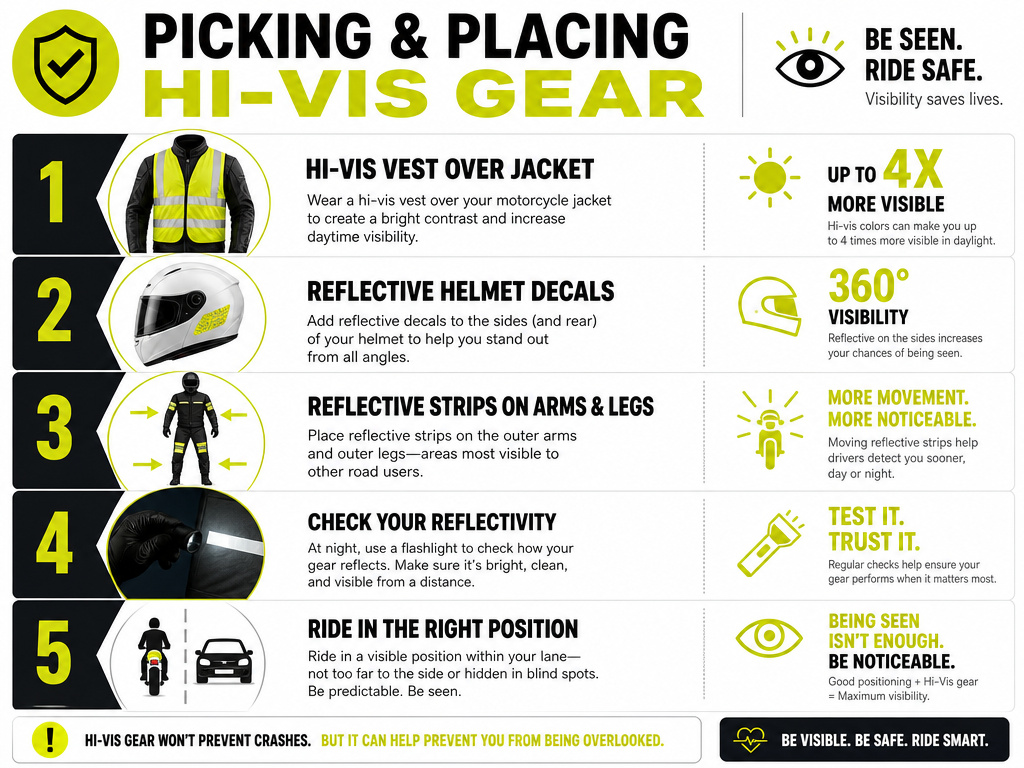
1. Layer It: Start with a hi-vis vest. It’s the cheapest, most flexible option. Wear it over your existing jacket for commutes or risky conditions. For a permanent solution, choose a jacket with integrated hi-vis panels. Many motorcycle jackets from brands like Klim and Oxford offer this.
2. Prioritize the Helmet: Your helmet is the single most visible part of your profile. A white or bright helmet is a huge win. If you love a dark helmet, add reflective decals to the sides and back. Research on helmet color and visibility consistently shows lighter colors are seen sooner.
3. Focus on Movement: Place color and reflection where drivers see motion. The back of your jacket is critical for being seen from the front in a car’s side mirror. Strips down the outsides of your arms and legs create a larger, moving visual signature. This is more effective than a static block of color on your chest.
4. Maintain It: Visibility gear fails silently. Dirt and road grime coat fluorescent fabric, dimming its glow. Reflective strips can delaminate or peel. Wash vests according to instructions (often cold, gentle, no fabric softener). Periodically check reflective strips with a flashlight at night to ensure they’re still bright.
5. Combine Strategies: Hi-vis gear is one tool. Pair it with tactical riding to increase visibility: lane positioning, headlight use, and avoiding blind spots. Our guide on how to be more visible on a motorcycle covers these active techniques in detail.
For night specialists, the equation changes. Your primary gear should be a light-up vest or jacket with extensive reflective panels. The pros and cons of LED vests balance incredible visibility against battery life and cost. The ultimate goal for nighttime visibility is to create a recognizable, human-shaped light source that stands apart from vehicle lights.
Frequently Asked Questions
Does hi-vis motorcycle gear really work?
Yes, but conditionally. Peer-reviewed research shows it can significantly reduce injury risk, particularly in daylight. Its effectiveness depends on the color contrasting with the background, the quality of the materials, and whether it’s the right tool for the conditions (e.g., reflective for night, fluorescent for day).
What is the most effective hi-vis color?
Fluorescent yellow-green (lime) is generally considered the most conspicuous color to the human eye in daylight across the widest range of lighting conditions. However, fluorescent orange can be more effective against green backgrounds (like foliage). For night, color is irrelevant; retroreflective material is what matters.
Is it illegal to have blue or green lights on my gear?
It’s complicated. Federally, a NHTSA interpretation states that connecting a device with blue or green lights to your motorcycle’s electrical system would impair the effectiveness of required lighting and is prohibited for manufacturers, dealers, or repair shops to install. Battery-operated, standalone LED vests typically aren’t regulated as vehicle equipment at the federal level, but state or local laws may restrict colors like blue. Always check local regulations.
Why do so many riders refuse to wear hi-vis gear?
The main reasons are image, fit, and skepticism. Many riders associate full hi-vis with an uncool, overly cautious stereotype. Poorly fitting vests can flap and be distracting. A significant number of riders also believe conspicuity is a secondary concern, placing responsibility for safety solely on other drivers’ attention.
How do I keep my hi-vis gear effective?
Keep it clean. Dirt and grime drastically reduce the luminance of fluorescent fabric. Wash according to the manufacturer’s label, usually in cold water without fabric softener. For reflective strips, avoid abrasive cleaners and inspect them periodically with a flashlight to ensure they haven’t cracked or peeled.
The Bottom Line
The research on hi-vis motorcycle gear pros and cons presents a clear, data-backed safety benefit that clashes with real-world rider culture. A 37% lower injury risk is a powerful argument you can’t ignore. The rider pushback on style and fit is a practical obstacle you can’t dismiss.
So here’s the honest take. Don’t think of it as an all-or-nothing uniform. Think of it as a situational tool. Stash a high-visibility vest in your luggage for long highway stints, rainy days, or foggy mountain passes. Choose a jacket with subtle reflective piping for your daily ride. Get a white or bright helmet.
The one rule that flips the standard advice: if you only invest in one visibility upgrade, make it your helmet. It’s the first thing a driver’s eyes track. Everything else, vests, strips, LED panels, is a layer you add when the risk calculus changes. The gear is proven. Wearing it is the part that’s still up to you.
