
What Is the Hump on a Motorcycle Race Suit: How to Choose
This post contains affiliate links. As an Amazon Associate, we earn from qualifying purchases.
The hump on a motorcycle race suit is an aerodynamic device designed to smooth airflow over a rider’s back and helmet at high speed, reducing drag and improving stability. It is not a primary safety feature like a back protector. Since the late 1980s, its role has evolved to also house critical electronics like the Dainese D-air® airbag system, hydration bladders, and data sensors.
That aerodynamic job is the whole point. Get the shape wrong, or use it for the wrong reason, and you add drag instead of cutting it. You also risk buying a suit that doesn’t fit your actual riding. A common question from new track riders is: What is the hump on a motorcycle race suit?
What follows: the exact timeline from foam rubber to airbag housing, the one safety trade-off every rider should know, and a clear guide on when you need a hump—and when you can safely cut it off.
Key Takeaways
.
- The hump is for aerodynamics, not crash protection. Its shape smooths turbulent air behind your helmet to reduce drag at high speed.
- Modern humps are tech housings. They hold airbag control units (like Dainese’s D-air®), hydration systems, and sensors, making them integral to the suit’s function.
- For street riding, a hump is mostly unnecessary and can be a drawback, potentially complicating emergency medical access after a crash.
- You can remove or modify most humps if they interfere with an external airbag vest or cause discomfort, but it voids warranties and requires careful seam work.
- Suits with integrated airbags have strict storage rules: never fold the suit, avoid magnetic fields, and charge the battery every two months.
The Hump’s Core Purpose: Aerodynamics First
Forget any idea that the hump is a cushion for your neck or an extra back protector. That’s not its job.
Its job is to fill the dead-air space between your helmet and your back when you’re in a full tuck. At very high speeds, the air coming off your helmet slams into your shoulders and creates a vortex of turbulence. That vortex pulls your helmet around, fights your neck muscles, and wastes energy you could use for steering.
A properly shaped hump acts as a fairing, extending the smooth line of your helmet down your spine. This laminar flow reduces pressure drag, which is the main force trying to slow you down once you’re past 100 mph. The effect is stability, not just speed—your head stays put.
The aerodynamic shape of the hump was refined by Dainese in the mid-1990s, with riders reporting improved head stability at high speed. He didn’t have to fight it. That’s the moment the hump shifted from a foam-rubber protector to an aerodynamic tool.
The difference is in the shape. Early humps from 1988 were round lumps of high-density foam rubber. By the mid-1990s, wind tunnel work had stretched them into longer, tapered profiles that better connected the tank, helmet, and rider’s back into one smooth line.
If you’re not riding at track speeds, you don’t need this. The aerodynamic benefit is negligible below highway pace, which is a central answer to what is the hump on a motorcycle race suit. On the street, a hump is mostly a style piece—or a mounting point for an airbag.
From Foam to Tech Hub: A Brief History
The hump didn’t start as an aerodynamic trick. Dainese introduced it in 1988 as a piece of safety equipment. The back protectors of the time couldn’t cover the last thoracic vertebrae without risking neck injury. Their solution was a hump made of high-density foam rubber that could absorb a shock in that unprotected zone.
It was a safety patch. Rider Pierfrancesco Chili used it first. The aerodynamic benefit was a happy accident discovered later.
| Era | Primary Function | Key Development | Example |
|---|---|---|---|
| Late 1980s | Impact Protection | High-density foam rubber hump added for lower spine coverage. | Dainese’s original foam hump. |
| Mid-1990s | Aerodynamics | Wind tunnel refinement creates longer, tapered shape for smoother airflow. | Dainese’s aerodynamic redesign. |
| 2000s+ | Tech Housing | Hump becomes a shell for airbag electronics, sensors, and hydration systems. | Dainese D-air® system integration. |
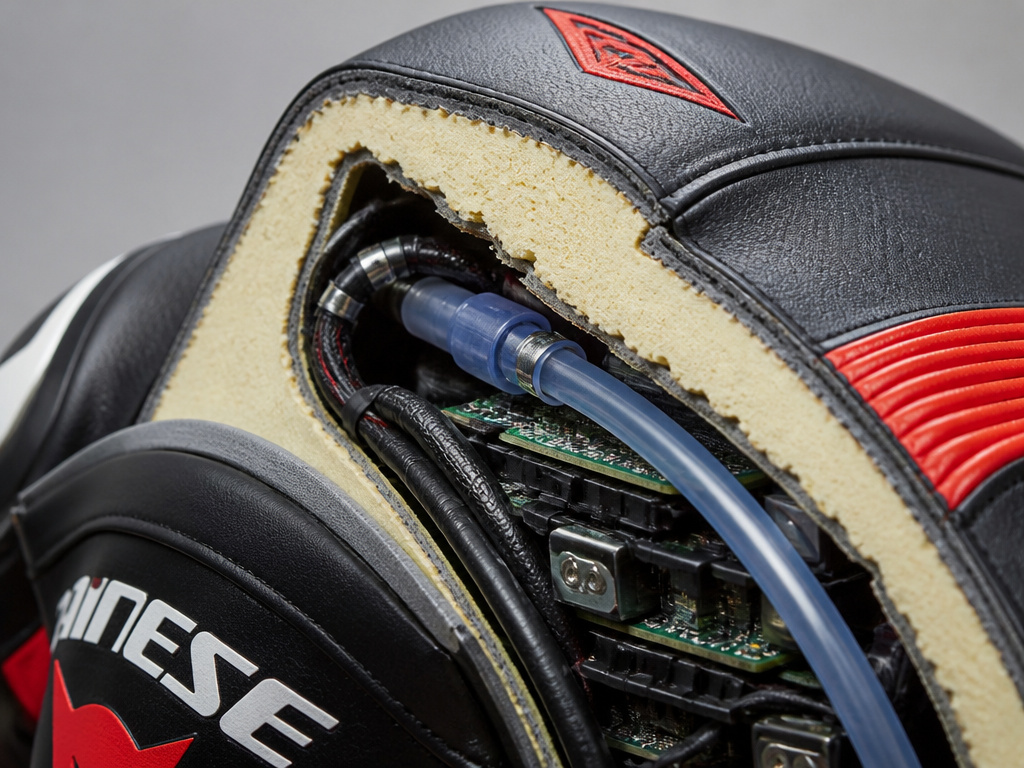
The shift from foam to electronics housing changed everything. With the new millennium, the hump’s internal space was too valuable to waste. Dainese placed the control unit and sensors for their new D-air® airbag system inside it. Later prototypes even put a small radiator in the hump to cool the rider, or a hydration bag connected to a helmet tube.
The latest evolution is the 2016 Mugello R suit, which added a crosswise LED in the hump that flashes if the rider falls. It’s a visibility aid for a crash scene.
So the hump’s story is a move from passive padding to active technology, a key evolution in the what is the hump on a motorcycle race suit narrative. Its shape is still aerodynamic, but its real estate is now prime internal storage.
Housing Tech: From Airbags to Hydration
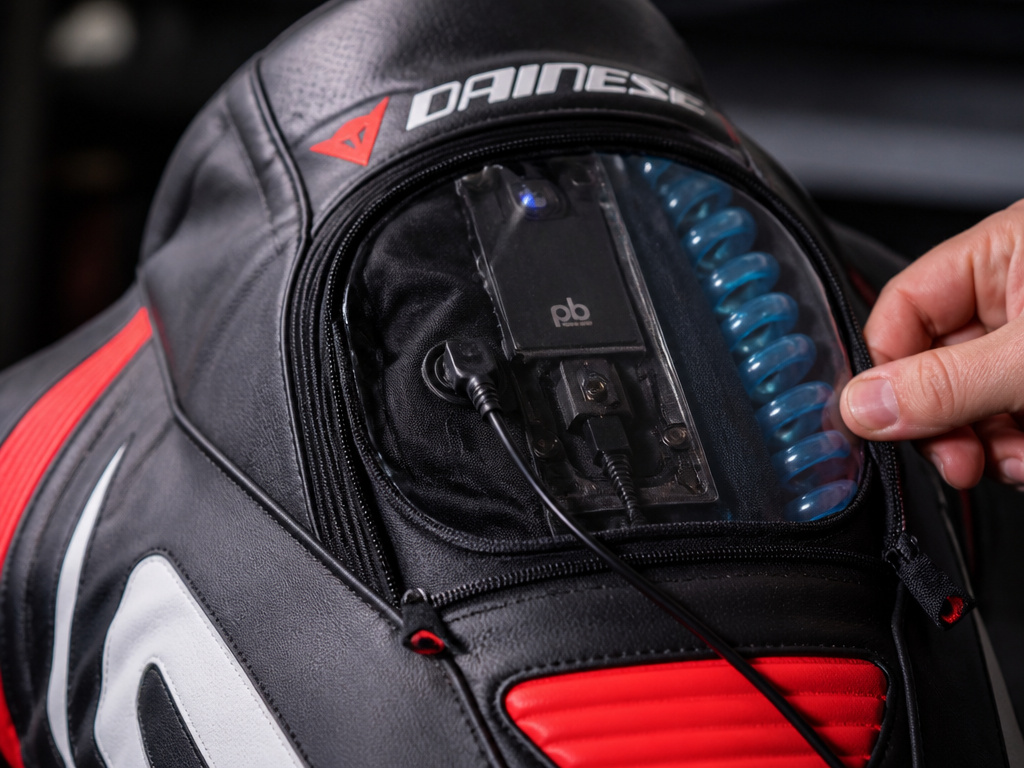
Today, if your race suit has a hump, it’s probably not hollow. It’s a motorcycle gear utility closet.
The most critical resident is the airbag system. For Dainese’s D-air Racing 1 I.P.S., the entire electronic brain lives in the hump. The USB charging port is a small hole covered by a silicone insert in the hump’s inner fabric. That system has very specific demands: a mandatory service check every 5 years from manufacture, and a battery that must be charged at least once every 2 months, even in storage.
Where this goes sideways: Storing an airbag suit like ordinary gear. The D-air manual says never fold or wrinkle the suit, avoid transport crates with heavy vibrations, keep it away from intense magnetic fields, and don’t let weight rest on only a few points. Do that, and the sensitive electronics can fail.
That’s the trade-off for integrated protection. You gain an airbag that deploys rapidly, but you inherit a piece of electronics that needs babysitting. The system is designed to remain inflated for about 5 seconds after a crash and its telemetric control can record continuously for up to 8 hours.
Beyond airbags, the hump holds hydration. A hydration bag sits inside with a tube routed up to the helmet, letting riders drink without hands. It’s a small thing, but in a long race, it’s everything.
Some brands use the space differently. The European patent EP3704981A1 for an aerodynamic hump describes a modular design: a base body for components and a removable outer shell for the aerodynamic shape. That’s the next step—humps you can swap for different tracks or to update tech without a new suit.
Hump vs. No-Hump: Do You Need One?
This is the street rider’s question. The answer is a flowchart.
You need a hump if:
- You ride on closed-circuit tracks at competitive speeds.
- Your suit has an integrated airbag system (D-air®, Alpinestars Tech-Air).
- You do frequent track days and want every aerodynamic advantage.
You can skip the hump if:
- You only ride on public roads.
- You use an external airbag vest (like a Hit-Air or Helite) that the hump would interfere with.
- You prioritize comfort and a cleaner look.
The interference point is key. A bulky hump can prevent an external vest from sitting flush on your back. Some vests won’t fit at all. If your safety plan is an external vest, a hump is your enemy.
For pure street use, a hump offers no real aerodynamic benefit and one tangible risk: it can complicate emergency spinal immobilization. EMTs cutting away a suit have to work around the rigid structure. It’s not a deal-breaker, but it’s a factor the glossy brochures don’t mention.
Your suit choice should follow your riding. Buying a full race suit with a hump for commuting is like buying a Formula 1 steering wheel for your Honda Civic. It looks the part but doesn’t help where you actually drive.
The Drawbacks and Safety Trade-Offs
No piece of gear is all upside. The hump has real compromises.
First, it can work against you in a crash. The shape is designed for a rider in a tuck. It’s not a back protector—the foam or plastic shell isn’t rated for direct impact dissipation.
Second, as mentioned, it’s an obstacle for first responders. In a serious off, every second counts. A hump adds a layer they have to assess and cut around to access your spine.
Third, it changes the suit’s fit and feel. When you’re shopping, you must fit the suit in a riding crouch, not standing up. The hump should feel integrated, not like a backpack.
Common mistake: Choosing a suit for the hump’s look or size alone. The hump’s internal capacity matters if you plan to add a hydration bladder. A tiny hump might not fit one. Check the specs.
Finally, a hump limits your storage options. You can’t just ball up a suit with an integrated airbag in the hump. That’s a space commitment.
How to Remove or Modify a Hump
Sometimes the hump has to go. Maybe it clashes with your airbag vest, or you find it uncomfortable on long rides. Removal is possible, but it’s a project.
This will void any warranty. It can also compromise the suit’s structure if done poorly.
Here’s the sequence if you decide to proceed:
- Turn the suit inside out. Find the internal stitching that attaches the hump to the suit’s main shell. It’s usually a dense box pattern.
- Carefully cut the threads, not the leather. Use a seam ripper and go slow. The goal is to detach the hump’s base panel from the suit.
- Remove the hump assembly. This may include foam, plastic shells, or wiring if it’s an airbag model. For airbag suits, do not proceed. Removal disables the safety system.
- Assess the hole. You’ll be left with an opening in the suit’s back. You need a patch.
- Create and stitch a leather patch. Use matching leather, cut to size, and stitch it over the hole from the inside. This requires a heavy-duty needle and strong thread.
- Reinforce the area. Consider adding a layer of abrasion-resistant fabric behind the patch for strength.
It’s tailor-level work. For most riders, choosing a suit without a hump from the start is the smarter path. Some brands offer sleek, hump-free race cuts.
If you just want a smaller profile, some humps are modular. Referencing the European patent EP3704981A1, you might be able to order a lower-profile outer shell from the manufacturer instead of performing surgery.
Comparing Hump Designs: Dainese vs. Alpinestars
Not all humps are the same. The two giants, Dainese and Alpinestars, approach them differently, and it affects your choice.
| Brand | Typical Hump Shape | Internal Use | Removability | Best For |
|---|---|---|---|---|
| Dainese | Longer, more tapered profile. Integrated into suit line. | Houses D-air® electronics, hydration. Often pre-wired. | Generally not removable without cutting. | Riders committed to D-air® system and full integration. |
| Alpinestars | Often rounder, more pronounced. Can be bulkier. | May house Tech-Air electronics or be hollow for hydration. | Some models have zip-off or snap-off covers. | Riders who want flexibility or use external airbags. |
Dainese’s design is more aerodynamic, a direct result of their wind tunnel work since the 90s. Their humps are built around their proprietary tech. Alpinestars sometimes treats the hump as more of a modular accessory, with removable outer shells on certain suits.
The shape impacts your tuck. A longer, flatter hump like Dainese’s might feel more streamlined. A rounder Alpinestars hump might give you more internal room for a large hydration bladder. You need to try both in your riding position.
Your leather suit fit is paramount here. A hump that’s too tall will hit your helmet when you look up. One that’s too short won’t guide airflow properly. Fit the suit first, then judge the hump.
Frequently Asked Questions
Why do motorcycle race suits have a hump?
The primary reason is aerodynamics. It smooths turbulent air between the helmet and the rider’s back at high speed, reducing drag and improving head stability. Since the 2000s, it also commonly houses electronics for airbag systems and hydration bladders.
Is the hump a safety feature?
Not primarily. It originated as foam padding for the lower spine in 1988, but its modern form is not a certified back protector. Its safety role now is as a housing for active systems like airbags, which are the real safety feature.
Can you remove the hump from a race suit?
Yes, but it is advanced tailoring that voids warranties. It involves unpicking stitches, removing the internal structure, and patching the hole in the suit’s leather. For suits with integrated airbags, removal disables the system and is not recommended.
Do I need a hump for track days?
It is beneficial but not always mandatory. Check your track’s gear for track days. The aerodynamic advantage is real at higher speeds. If you are using an external airbag vest, a hump might get in the way, so a hump-less suit may be better.
What is inside the hump?
In modern suits, it can contain the control unit and sensors for an airbag system (like Dainese D-air®), a hydration bladder, or wiring for telemetry sensors. In simpler suits, it may just be hollow or filled with lightweight foam.
Before You Go
One rule cuts through the history and tech: if you don’t ride at sustained track speeds, you don’t need a hump for its core purpose. Its value for you is either as an airbag housing or zero.
If you are buying a suit with an integrated airbag, you’re buying a sensitive electronic device. The hump isn’t just a bump; it’s a computer case. Follow the storage and charging rules in the manual to the letter, or the system might not work when you need it.
For everyone else, the choice between a hump and a smooth back often comes down to comparing suit styles. Try both. Get in a tuck on a bike or stool in the shop. Feel where the hump touches your helmet and how the suit’s shoulders hang. The right fit, with or without the hump, keeps the armor where it belongs during a crash. That matters more than any aerodynamic trick.
