
How Should a Motorcycle Leather Suit Fit: The 2-Inch Rule
This post contains affiliate links. As an Amazon Associate, we earn from qualifying purchases.
Aerostich advises that a touring suit should be loose enough to be used as coveralls when standing, while race suit manufacturers like Alpinestars recommend a ‘snug but comfortable’ fit. The armor must stay fixed over your shoulders, elbows, and knees when you tuck. You should be able to raise your arms to a 90º angle. For a sport bike, you may need a suit 2 inches longer in the torso than your street-clothing size.
That’s the manufacturer line from Aerostich’s own R-3 manual. It’s a functional fitting philosophy, not a style tip. The suit is a wearable chassis. A loose fit allows the armor to move in a slide, and a too-tight fit restricts blood flow before you reach the first corner. This is the core of how should a motorcycle leather suit fit.
What follows: the two schools of thought on how to measure (standing vs riding), the three physical tests that decide a correct fit, and the one warning from Dainese that changes everything if your suit has an airbag.
Key Takeaways
- Aerostich advises fitting the suit in a riding position, while BMW Motorrad’s sizing guide recommends taking measurements while standing. Raising your arms to the bars pulls the torso up about 1.5 inches.
- Armor must stay in place when you crouch. If it slides off your knee or shoulder, the size or cut is wrong.
- Use the 90º arm test. If you can’t raise your arms parallel to the ground, the shoulders are too tight.
- An airbag suit demands exact sizing. A Dainese D-AIR suit that’s too large can interfere with your helmet when triggered.
- Leather will stretch and mold to your body with wear. Extreme pressure that restricts breathing is a size issue, not a break-in issue.
The Riding Position Test (Why Standing is Wrong)
Aerostich states it plainly: the suit should fit and look best when sitting on a motorcycle, not standing in front of a mirror. Raising your arms to the handlebars moves the garment body upward about 1.5 inches. That’s why a suit that feels perfect in a shop can bunch uncomfortably at the waist on the bike.
Where this goes sideways: Buying for a standing fit. The armor pulls away from your knees and elbows the moment you assume a riding crouch, leaving those joints unprotected in a slide.
This conflicts with the measurement approach from brands like BMW Motorrad, whose sizing guide asks for height, chest, and waist measurements taken while standing in a relaxed position. The difference isn’t a mistake. It’s a design goal. Aerostich’s one-piece touring suits are built as functional coveralls. BMW’s sport-oriented cuts are often closer to a second skin.
The fix is simple. Bring your bike or sit on a similar one in the shop. Get into your normal riding posture to answer the how should a motorcycle leather suit fit question. Have a helper check where the seams and armor sit. The waist shouldn’t pinch. The shoulders shouldn’t bind. The knee armor should remain centered on your kneecap.
How Tight is “Snug”? The Break-In vs. Wrong Size Divide
New leather is stiff. It will soften and mold to your body with wear. This leads to the most common fitting mistake: accepting a suit that’s painfully tight, assuming it will “break in.”
Leather stretches about 5-10% with use, primarily in areas of high movement like the knees and elbows. It does not magically gain inches in the chest or torso. A rule of thumb: if you cannot take a full, deep breath while standing in the suit, it is too small. That kind of restriction won’t vanish.
That’s from the same Aerostich manual. It describes a touring suit fit, one answer to how should a motorcycle leather suit fit. For a race-replica suit from Dainese or Alpinestars, the language shifts to “snug but comfortable.” The armor should make firm contact without floating. You should feel hugged, not strangled.
Here’s how to tell the difference:
| Symptom | Likely Cause | Test |
|---|---|---|
| General stiffness everywhere | New leather | The suit feels like a stiff shell, but you can move freely. |
| Extreme pressure in chest/back, can’t breathe deeply | Wrong size | The restriction is localized and doesn’t ease when you move. |
| Tight shoulders that limit arm lift | Wrong cut or size | You fail the 90º arm test (below). |
| Knee armor slides off when crouching | Wrong leg length or cut | The armor migrates away from the bone on a bike. |
If the problem is break-in, wear the suit at home for short periods. Do squats, stretch, simulate riding motions. The leather will warm and begin to conform. If the problem is size or cut, exchange it. Forcing the wrong size risks the armor being useless when you need it most.
The 90º Arm Rule and Range of Motion
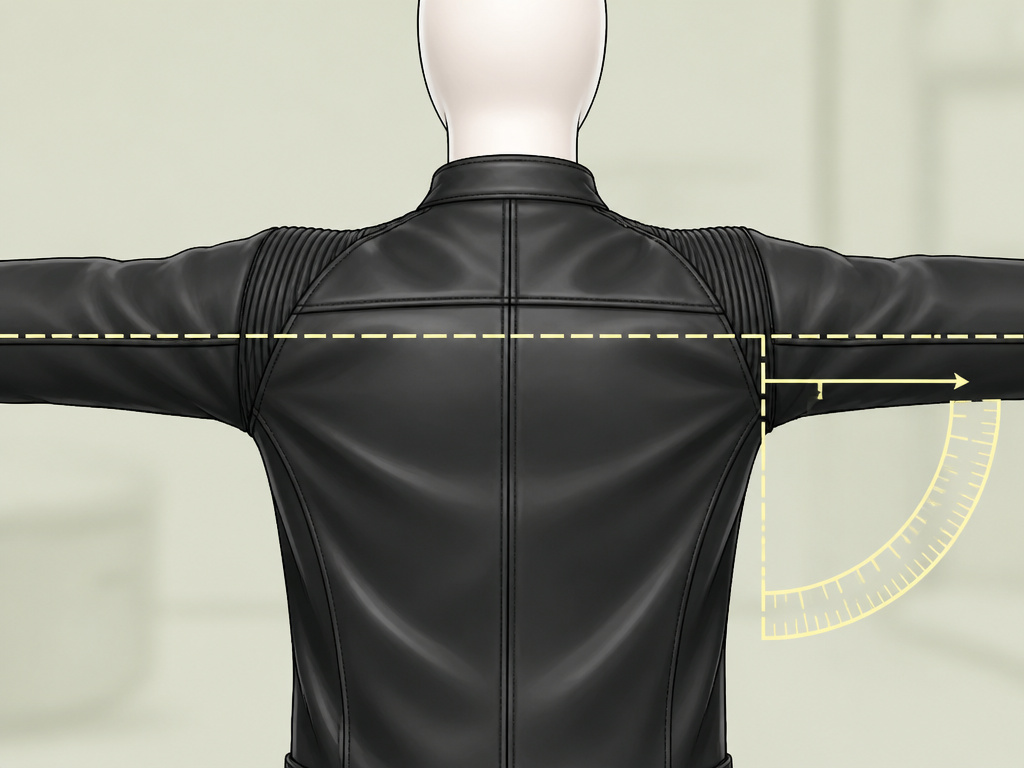
Your shoulders and arms do the work of riding. The suit must allow that. Aerostich’s fit check is specific: you should be able to raise your arms to a 90º angle (parallel with the ground).
This isn’t about comfort alone. It’s about control. If the shoulders are too tight, you’ll fight the suit to reach the handlebars, especially on a sport bike. That fatigue distracts you, and over a long ride, it can lead to input errors.
Perform this test with the suit zipped up and any base layers you plan to wear. Stand normally. Raise your arms straight out to your sides, level with the floor. There should be no significant pull or binding across the upper back or chest. A slight resistance from new leather is fine; a hard stop is not.
This test also reveals sleeve length. In the riding position, the cuff should end at the wrist bone, not ride up your forearm. A sleeve that’s too short will expose your wrist in a slide.
Armor Placement: The Non-Negotiable
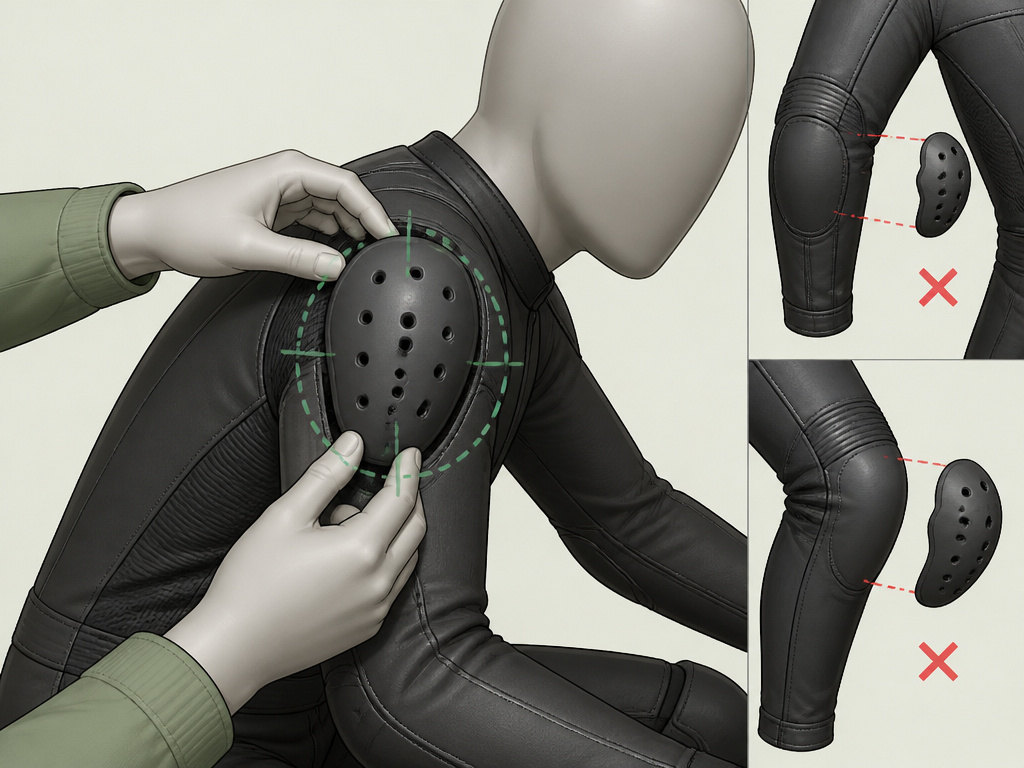
The CE-rated armor in your shoulders, elbows, knees, and hips is the point of the suit. If it isn’t in the right place, you might as well wear a leather onesie.
Common mistake: Armor that floats. You can pinch an inch of suit material between the armor pad and your body. That gap means the pad will shift on impact.
Armor must make firm, continuous contact with the body part it’s meant to protect. When you crouch on the bike, have a helper check each pad:
- Shoulders: Centered on the ball of your shoulder.
- Elbows: Centered on the point of your elbow when your arm is bent at 90º.
- Knees: Centered directly on your kneecap.
- Hips: Over the hip bone.
Most suits use hook-and-loop (Velcro) pockets to hold the armor. You can often adjust the pad’s position within the pocket. Do this before deciding the suit is wrong. If, after adjustment, the armor still won’t stay put, the suit’s cut doesn’t match your anatomy.
This is where understanding how motorcycle armor should fit becomes critical. The suit is just the carrier.
Sizing Charts, Lengths, and Body Types
Manufacturers use different size charts. A European 54 is not the same as a US 44. Always consult the specific brand’s chart. BMW Motorrad suits are available in a choice of over 40 different sizes and, for items after 2014, the cuts are divided into ‘Comfort Fit’ and ‘Regular Fit’.
The most crucial adjustment is often torso and sleeve length. Aerostich notes the difference between a Regular (R) and Long (L) of the same chest size is about 2 inches in torso length and about 1.2 inches in the sleeves. If you ride a sport bike and wear a ‘Regular’ in street clothes, you may need that Long.
For women, the grading is different. Aerostich states its women’s suits have shorter trunks, longer limbs, and wider hips than a men’s suit for a man of the same height. But it adds that many women may find a better off-the-rack fit from a men’s size. This is why trying on is essential.
If your body type, very tall, very short, muscular, or with a long torso, doesn’t match off-the-rack proportions, consider custom. Companies like Leather Collection offer made-to-measure custom sizing that ships in 4-6 weeks from spec confirmation. Another custom suit maker uses 1.2-1.4mm leather. It’s a significant investment, but for track use, a perfect fit is part of the performance.
The Airbag Suit Warning: Fit Becomes Safety
A standard leather suit has a fit tolerance. An airbag suit does not. The Dainese D-AIR RACING 1 manual includes a critical safety warning that redefines “snug.”
If a D-AIR RACING 1 suit is too large, it can interfere with your helmet when triggered, increasing injury risk or causing loss of control. If it is not the correct size, it can cause unexpected inflation.
An airbag system deploys in milliseconds. A loose suit allows the bag to inflate away from your body, potentially jamming against your helmet’s chin bar or failing to support your neck and chest correctly. The fit must be exact. There is no “room to grow” or “break-in allowance” here.
If you’re investing in an airbag suit, follow the manufacturer’s fitting guide to the letter. This often means a fit that feels tighter than a conventional race suit. The armor and the airbag system must be in a fixed, known position relative to your body at all times.
What to Wear Underneath and Break-In Process
The layers under your suit affect the fit. Wear the base layers you intend to ride with when trying on the suit. For track days, that’s usually a moisture-wicking undershirt and leggings. For touring, it might be a light shirt and jeans.
Skip this if: You try on the suit over a t-shirt and then plan to wear a heavy sweater underneath. The armor will float.
A proper base layer to wear under leathers is smooth and close-fitting to prevent bunching and allow the suit to slide on easily. It also provides a thermal barrier, as leather can generate friction heat in a slide.
The break-in process for a new leather suit is straightforward. Wear it around the house. Sit in a chair in a riding pose. Bend, squat, and stretch. The leather will warm from your body heat and begin to soften at the stress points. Don’t force it with oils or conditioners right away, you can damage the stitching or finishes. Just wear it.
For more stubborn areas, some riders use a leather conditioner after the first few wears. Apply sparingly to the inside of stiff panels like the knees and elbows. The goal is to soften the hide, not saturate it.
One-Piece vs. Two-Piece: Does Fit Differ?
The fundamental fit principles are the same. Armor must stay in place. Range of motion must be full. However, a two-piece suit connected by a 360-degree zipper introduces another variable: the waist junction.
When you try on a two-piece, zip the jacket and pants together. Get into a riding crouch. The connection should not create a hard pressure point at your lower back or allow the jacket to ride up and expose skin. The best choice between a one-piece and two-piece suit for you often comes down to this junction comfort and your riding style.
A one-piece is simpler, it’s a single garment. A two-piece offers more versatility but requires checking two separate fits that also work as a unit. For pure track use, the one-piece is the standard because it eliminates any risk of separation in a slide.
Measuring yourself for sizing
To find your size, you’ll need to take several key body measurements. The standard procedure is to measure your height, chest, waist, hips, outside leg, and inside leg while standing in a relaxed and natural position. These measurements are crucial because manufacturers offer suits in a wide range of sizes; some lines are available in over 40 different stock sizes. Remember that these standing measurements are just the starting point. The final fit is judged in the riding position, as raising your arms to the handlebars moves the garment body upward significantly.
Frequently Asked Questions
How tight should a leather motorcycle jacket fit?
The jacket should be snug enough that the shoulder and elbow armor cannot shift out of position when you move your arms. You should not have excess material billowing at the back or chest. When zipped to pants, there should be no gap at the waist.
How do you know your motorcycle suit size?
Start with the manufacturer’s size chart, using your measurements. Then, try the suit on in a riding position. The final arbiter is the physical test: 90º arm lift, armor contact in a crouch, and the ability to breathe deeply. Never buy based on the tag number alone.
What do you wear under a leather motorcycle suit?
Smooth, moisture-wicking base layer is ideal. Avoid cotton, as it retains sweat and can cause chafing. Purpose-made motorcycle undershirts and leggings are designed to be slippery, making suit entry easier, and to manage temperature.
What size is 44 in bike leathers?
European size 44 typically corresponds to a US men’s size 34 chest. However, this conversion is not universal. An Italian brand’s 44 may fit differently than a German brand’s 44. Always check the specific brand’s size chart, measurements in centimeters are the only reliable guide.
How long does a leather suit last?
With proper care, a leather suit can last 5 to 10 years or 50,000 to 100,000 miles, according to Aerostich. This assumes regular cleaning, conditioning, and repairs as needed. Crash damage, of course, can shorten that lifespan immediately.
The Bottom Line
Fit the suit on the bike, not on your feet. If the armor moves when you crouch, the size is wrong. Use the 90º arm test as your pass/fail.
For most track riders, a one-piece suit from Dainese, Alpinestars, or a similar race brand, fitted exactly to your measurements in a riding crouch, is the answer. For sport-touring, an Aerostich Roadcrafter-style suit with its defined roominess is the default.
The one rule that overrides all others comes from Dainese: if your suit has an airbag, the fit tolerance is zero. A loose airbag suit is a safety hazard, not a comfort choice. Everything else, the break-in, the stretch panels, the base layers, exists to serve that final, fixed position of the protective gear on your body. Get that right, and the rest is maintenance.
