
One Piece vs Two Piece Motorcycle Suit: How to Choose
This post contains affiliate links. As an Amazon Associate, we earn from qualifying purchases.
The one-piece vs two-piece motorcycle suit choice comes down to a single seam. A one-piece suit is a single garment, mandatory for sanctioned racing, offering the highest certified protection with no separation point. A two-piece suit is a jacket and pants that zip together, ideal for street riders who mix in track days, trading a small amount of structural integrity for daily convenience and versatility.
That seam at the waist is the whole argument. On a track, your body hits the pavement at over 100 mph. The force wants to find any weak point and tear it open. A one-piece suit has no such point between your chest and your knees. A two-piece suit relies on a zipper, a very strong zipper, but still a mechanical connection. The debate often centers on the choice of a one piece vs two piece motorcycle suit.
The rest of this guide walks through what that seam means for your protection, your comfort, and your wallet. We’ll look at specific suits like the Alpinestars GP Force V2 and the Dainese Laguna Seca 4, explain the CE certification classes (AAA, AA, A), and clarify which track organizations actually allow a two-piece—see our picks for the best motorcycle suits. By the end, you’ll know which type fits your riding, not just the marketing claims.
Key Takeaways
.
- The waist seam is the only difference that matters for crash integrity. A one-piece suit cannot separate; a two-piece relies on its 360-degree connection zipper (like a YKK #10) holding under extreme shear force.
- For any sanctioned road racing (MotoAmerica, FIM), a one-piece suit is mandatory. Local track day organizations may allow a certified two-piece, but the rulebooks for competition are clear.
- Leather thickness (1.3mm vs 1.4mm) is a poor solo metric for protection. Modern kangaroo leather and advanced bovine hides offer equal abrasion resistance with better flexibility at lower weights.
- Fit the suit in a riding tuck, not standing up. Armor shifts if the suit bunches at the knees or shoulders. A suit that’s comfortable standing can be dangerously loose in a crash posture.
- A two-piece suit wins for mixed street/track use. The ability to wear the jacket separately for commuting or touring adds real versatility that a one-piece cannot match.
The Core Safety Difference: One-Piece vs Two-Piece Construction
Technical Spec: Motorcycle suits must meet the European standard EN 17092, with performance classes from A (lowest) to AAA (highest). One-piece race suits typically achieve AA or AAA certification. They are constructed from 1.3mm-1.4mm premium bovine or kangaroo leather and include CE-certified protectors at shoulders, elbows, knees, and often hips and back. Higher-end models feature proprietary armor systems and are ‘airbag-ready’ with internal connections for systems like Alpinestars Tech-Air®.
The safety debate isn’t about leather quality or armor levels, as detailed in our guide to the best riding suits. When you compare a one piece vs two piece motorcycle suit, both top-tier options use premium leather and armor, though specific armor levels can vary by model. The Alpinestars GP Force V2 2-Piece Suit uses Nucleon Flex Plus armor and is certified to EN 17092-4:2020 Class AA.
The difference is the zipper. A one-piece suit is a single piece of hide from collar to cuff. In a slide, the forces are distributed across the entire garment. The central question in the one piece vs two piece motorcycle suit debate is this waist connection, which on a two-piece suit is a full-circumference zipper, a YKK #10 on premium models. OEM marketing claims state this creates “equivalent” protection, while some owners and forums contest this, citing potential zipper failure risks.
Owners on forums like Sharp Leathers contest that. They argue the zipper is a potential failure point not emphasized in marketing. In a multi-impact tumble, could the zipper teeth shear or the tracks separate? The evidence is found in the rulebooks, not in controlled, single-impact crash tests: the Fédération Internationale de Motocyclisme (FIM) requires one-piece construction or specially certified two-piece suits for homologated racing. They don’t trust the zipper at the highest levels.
| Construction Aspect | One-Piece Suit | Two-Piece Suit |
|---|---|---|
| Crash Integrity | Single garment, no separation point. | Relies on connection zipper (e.g., YKK #10). |
| Typical CE Rating | AA or AAA common. | AA achievable (e.g., Alpinestars GP Force V2 2-Piece). |
| Racing Rule Acceptance | Universally mandated for sanctioned competition. | Often excluded by FIM rules; may be allowed at local track days. |
| Armor Placement Security | Fixed within single-piece panels. | Dependent on jacket staying connected to pants. |
Where this goes sideways: Assuming a two-piece suit is “just as good” for pure track use. For a dedicated circuit rider, the one-piece’s seamless construction is the gold standard. A two-piece is a compromise, sometimes a very good one, but a compromise.
So, who is the two-piece for? The rider who does six track days a year and commutes on the bike. The convenience of wearing the jacket alone is a real advantage. But if your goal is sanctioned road racing, the choice is dictated by organizations like the FIM.
How Should a Motorcycle Suit Actually Fit?
Fit is about keeping the armor over your bones when you’re sliding, not about comfort before a slide. A suit that feels good standing in a shop will bunch at the knees when you tuck, pulling the knee armor up your thigh. The elbow protector can drift toward your forearm.
You must fit the suit in a riding crouch. Squat down, mimic holding clip-ons, and have someone check where the hard parts sit. The knees should cup your kneecaps perfectly. The shoulders should not bind when you reach forward. There should be no excess material wrinkling across your back, that’s slack that will gather in a crash.
Leather stretches in key wear areas, but the amount varies by material and tanning process. Don’t buy a size too small hoping it will “break in” to perfection. It will break in to the shape you ride in, so that initial fit in the tuck is critical. Brands cut their patterns differently; Dainese suits often fit a taller, leaner build, while Alpinestars can accommodate a more muscular frame.
Here is a blunt checklist for trying on any suit, one-piece or two-piece:
- Wear your base layer. Try it on with the same lightweight shirt you’d ride in.
- Get into a tuck. Kneel on the floor if you have to. Check knee and elbow armor placement.
- Have a helper. They need to see the back and shoulders while you’re crouched.
- Move your arms. Reach forward, grab imaginary bars. The suit should not restrict you.
- Zip it all the way. For a two-piece, connect the jacket and pants fully and repeat steps 2-4.
Common mistake: Buying a suit that fits your standing dimensions but not your riding posture. The armor shifts, and you’ve paid for protection that won’t be there when you need it.
A poorly fitted one-piece is worse than a well-fitted two-piece. The armor has to stay put. That’s the only rule.
Comfort and Daily Use: The Practical Trade-Offs
A one-piece suit is a commitment. You wear it to the track, you ride, you take it off. Walking any significant distance in one feels like wearing a stiff leather sausage casing. Using a bathroom requires a choreographed dance. They are hot off the bike and restrictive on it.
Two-piece suits are built for real life. You can wear the jacket to work, unzip it at lunch, and re-connect for the ride home. The Dainese Laguna Seca 4 D-Dry 2-Piece Suit includes a removable waterproof liner. Ventilation is often better because you can open the jacket vents independently.
But that convenience has a thermal cost. The connection zipper is another layer, another seam that blocks airflow. In peak summer heat, a perforated one-piece can feel cooler than a connected two-piece because air flows over a single, uninterrupted surface.
| Use Case | One-Piece Suit | Two-Piece Suit |
|---|---|---|
| Commuting / Errands | Impractical. Cannot separate. | Excellent. Wear jacket alone. |
| Track Day Logistics | Change at track. Limited mobility off bike. | Ride to track in suit, more mobility in paddock. |
| Weather Versatility | Limited. Single garment. | High. Can use jacket with different pants or liners. |
| Heat Management | Can be superior with full perforation. | Zipper seam can impede airflow; jacket-alone option helps. |
The REV’IT! Quantum 2 suit design is aimed at sport-touring riders, a category explored in our touring suit pros and cons guide. It uses a full-circumference zipper to prevent jacket ride-up and offers near one-piece protection. Owners who ride long distances swear by this hybrid approach. It’s a suit for the rider who wants to tour on Tuesday and hit the track on Saturday.
For the pure street rider who never sees a circuit, a two-piece suit is almost always the right answer, especially when considering the best suits for cruisers. The versatility outweighs the tiny theoretical risk at street speeds. For the dedicated track junkie, the one-piece’s uncompromising design is worth the hassle.
Airbags, Armor, and Tech: What’s Inside Matters

The shell is one thing. What’s inside it is where modern suits earn their price. CE-certified armor is the baseline, but specific levels (Level 1 or Level 2) vary by model and placement. But proprietary systems like Alpinestars’ Nucleon series are thinner, lighter, and often more protective than the standard foam-and-plastic inserts.
The bigger leap is integrated airbags. Suits that are “airbag-ready” have internal loops and channels to secure systems like the Alpinestars Tech-Air 5 PLASMA. This system weighs 1.53 kg, over 25% lighter than its predecessor. The suit becomes the housing, and the airbag deploys in milliseconds to protect your neck, chest, and back in a crash.
This tech is now filtering down from MotoGP. It’s a significant investment, but it represents the highest tier of active protection. Both one-piece and two-piece suits can be airbag-ready. The key is ensuring the suit you buy is compatible with the specific system you want.
When comparing armor, don’t just count the pieces. Check their size and coverage. A small, square knee protector is inferior to a large, curved one that wraps around the joint. The armor should be sewn into a pocket, not just floating in a liner, floating armor moves.
What most people get wrong: Focusing on the leather’s thickness instead of the armor’s quality and placement. A 1.4mm hide with cheap, floating armor is less protective than a 1.3mm kangaroo suit with sewn-in, CE Level 2 Nucleon pads.
Your money is best spent on the best armor you can afford, inside a shell that fits you perfectly. The brand name on the chest is less important than the certification label on the tag.
Making the Choice: Track Rules, Budget, and Your Riding Life
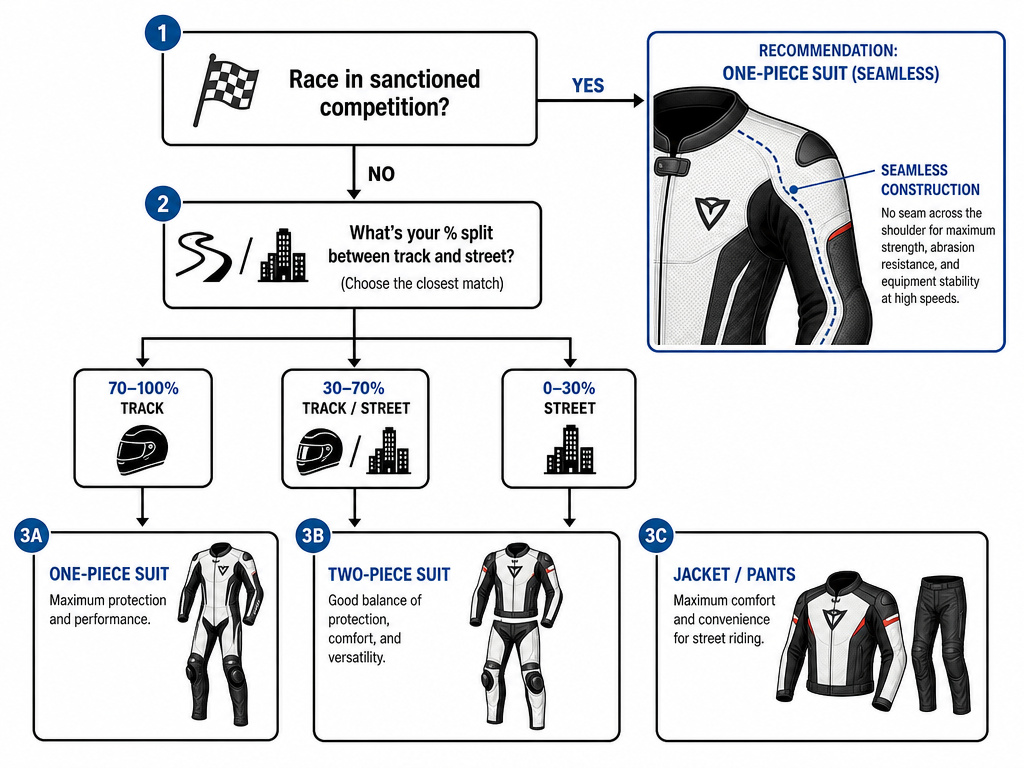
This is the decision tree. Start with the hardest rule: Do you plan to race in sanctioned competition (e.g., MotoAmerica, CCS, WERA)?
If yes, your answer is a one-piece suit. The rulebooks are not flexible. You need a suit that meets the specific FIM homologation requirements for your class. Full stop.
If no, your choice opens up. Now ask: What percentage of your riding is on a track versus the street?
- 80%+ Track (Dedicated Track Day Rider): Get a one-piece suit. The performance benefit and safety margin are worth the inconvenience. Look at the Alpinestars GP Force V2 or equivalent.
- 50/50 Mix (Sport Rider / Occasional Track Day): A high-end two-piece suit is your best tool. It protects at the track and lives with you on the street. The Alpinestars GP Force V2 2-Piece or Dainese Laguna Seca 4 are benchmarks here.
- 20% or less Track (Street Rider with Aspirations): You likely don’t need a full leather suit yet. A premium textile or leather jacket and pants that zip together will serve you better and cost less. Save the suit purchase for when track days become a regular habit.
Budget is the final gate. A premium one-piece suit is a significant investment. A comparable two-piece from the same brand is often slightly less expensive, but not by a huge margin. The real cost savings come in the mid-tier, where two-piece options offer more features for the money.
TL;DR: Sanctioned racer → One-piece. Dedicated track addict → One-piece. Sport rider who tours → Two-piece. Street rider curious about tracks → Don’t buy a suit yet; get a zippable jacket and pants.
How much do one piece and two piece suits cost
Cost isn’t just about the initial price. Both one-piece and two-piece suits can be constructed from premium 1.3mm leather and achieve high CE certifications like Class AA. The value proposition depends on your primary use. A one-piece suit is the gold standard for dedicated track use and is universally mandated for circuit racing. A two-piece suit is ideal for a mix of street riding and track days, offering modularity. If you plan to ride mostly on the street with occasional track visits, a two-piece may offer better overall value by functioning as separate jacket and pants.
How to clean and maintain a motorcycle suit
Proper care maintains the protective qualities of your suit’s materials. Both one-piece and two-piece suits use premium leather and feature accordion stretch panels at key stress points like the knees and shoulders. Follow the manufacturer’s specific cleaning instructions for the leather and any removable liners, like a waterproof lining. Regularly check the integrity of all seams and connection points. For a two-piece suit, pay special attention to the full-circumference connection zipper to ensure it remains free of debris and functions smoothly, as this zipper is key for preventing jacket ride-up and maintaining suit integrity.
Are one piece suits practical for street riding
Practicality is a major differentiator. Owner feedback contests manufacturer claims that one-piece suits are suitable for extended touring, citing difficulty walking and heat buildup off the bike. Using a bathroom or taking a break requires nearly fully removing the suit. A two-piece suit solves this with its separate jacket and pants, connected by a zipper. You can easily remove the jacket for comfort during stops without compromising the lower half of your protection. This modularity makes the two-piece far more practical for street riding, cafe stops, or long days where you’ll be on and off the motorcycle frequently.
Frequently Asked Questions
Can you wear a two-piece suit on the track?
Yes, at most local track day organizations. However, they often require that the jacket and pants connect via a full 360-degree zipper. Always check the specific rules of the organization you’re riding with. For any FIM-sanctioned road racing, a standard two-piece suit is not allowed.
Is a one-piece suit safer than a two-piece?
For certified abrasion and impact protection, a top-tier two-piece can match a one-piece (both can achieve CE AA rating). The safety difference is structural: a one-piece has no waist seam, eliminating the risk of separation. For extreme crashes at race speeds, that seamlessness is considered safer.
Are one-piece suits uncomfortable for street riding?
They can be. They are designed for a hunched riding position, so walking or standing can feel restrictive. Ventilation is also a challenge off the bike. Manufacturer marketing positions certain one-piece suits as suitable for ‘sport riding,’ while owner feedback contests this, citing impracticality for daily use.
How do I connect a two-piece suit?
Look for the connection zipper, usually a large-toothed YKK #10, around the inside waistline of the jacket and the top of the pants. Align them and zip them together fully, from the front all the way around the back. A connection secured with a YKK #10 zipper should feel secure and not allow the jacket to ride up.
What does CE AAA, AA, A mean?
These are performance classes under the EN 17092 European standard for motorcycle garments. AAA is the highest level of protection, followed by AA, then A. The rating reflects the suit’s performance in abrasion, burst, and impact tests. Most race-oriented suits are AA or AAA.
The Bottom Line
The one-piece vs two-piece motorcycle suit decision is about which is right for the riding you actually do, not about an objective better choice.
If your bike lives on a trailer and your weekends are defined by lap times, the one-piece suit is your uniform. Its uncompromising design exists for that world. Buy the best fit you can afford, ensure it’s compatible with your chosen airbag system, and never look back.
If your bike is your daily companion that occasionally visits a circuit, the two-piece suit is your multitool. The convenience is real, and the protection from a model like the Alpinestars GP Force V2 2-Piece is formidable. Just respect its limit: that waist zipper, while incredibly strong, is the one variable the fastest riders in the world choose to eliminate.
For everyone else, the street rider eyeing a first track day, skip the suit purchase for now. Invest in a great jacket and pants that zip together. Learn the lines, learn your limits. If you catch the track bug, you’ll know it’s time for the single-piece leather. And you’ll know exactly why.
