
Motorcycle Riding Shoes Pros and Cons: Is It Worth It?
This post contains affiliate links. As an Amazon Associate, we earn from qualifying purchases.
Motorcycle riding shoes protect against abrasion and impact cuts, reduce fracture risk by 53%, and offer casual walkability, but they cannot prevent twisting, crushing, or shin injuries the way taller boots can. The choice isn’t about “better,” it’s about matching the shoe’s certified protection profile to your riding speed, style, and the specific hazards you’re likely to face.
That 53% fracture reduction is from a 2019 Journal of Orthopaedic Trauma study. It’s the single biggest number in the gear decision, and it’s why the question shifts from “are they safe?” to “safe for what?” Shoes certified to EN 13634 are tested against 60-grit sandpaper at 8 meters per second. They have to last at least 1.5 seconds at Level 1 or 2.5 seconds at Level 2 before the material wears through. That’s the lab measure of how long the shoe might save your skin in a slide, which is a key part of any discussion about motorcycle riding shoes pros and cons.
What follows is the trade-off laid bare: where the protection starts, where it stops, and the three riding situations where shoes make sense. We’ll break down the standard’s four test numbers, compare real models like the TCX Ikasu and Dainese Speedtrek, and name the one mistake that burns out a good shoe in a season.
Key Takeaways
- Look for the CE EN 13634 label inside the shoe, it’s the only proof the protection was lab-tested. A leather upper isn’t certification.
- Riding shoes cut foot and ankle fracture risk by over half compared to regular sneakers, but offer no guarantee against twisting or crushing injuries.
- The 5-year shelf-life rule applies even to unworn shoes, materials degrade, and a boot stored in a closet for five years should be replaced.
- For urban commuting under 50 mph, a Level 1 shoe is a valid choice. For motorway speeds or track use, the missing shin coverage of a tall boot becomes a critical gap.
- Fit decides function. Ankle armor that sits above or below your actual ankle bone provides zero protection at the point of impact.
The EN 13634 Standard Decoded
You see a CE label inside a shoe. It has four little numbers on it, like 1-2-1-1. Most riders glance and move on. Those numbers are a spec sheet for your skin.
EN 13634:2017 is the European standard for “Protective footwear for motorcycle riders.” It’s Category 2 PPE, medium risk. The certification means the shoe was literally taken apart in a lab. Samples of the upper, sole, and armor were tested separately. The label indicates performance levels for specific tests, such as shaft height and impact abrasion.
The EN 13634 label reports: 1) Shaft Height (≥45mm L1, ≥100mm L2), 2) Impact Abrasion resistance (≥1.5s L1, ≥2.5s L2 according to EN 13634:2017, though Dainese cites 5s L1 and 12s L2), 3) Impact Cut resistance, and 4) Transverse Rigidity (resistance to crushing). Each test is graded individually; a shoe can be Level 2 in abrasion but Level 1 in rigidity.
Here’s where a source disagreement matters. The Dainese technical page states Level 1 abrasion requires 5 seconds and Level 2 requires 12 seconds. The Castiron Ride guide and other interpretations of EN 13634 cite 1.5 and 2.5 seconds. This likely reflects different testing phases or annexes within the same standard. The brutality of the test matters more than the correct number. The sample is abraded against 60-grit sandpaper moving at 8 m/s (about 18 mph). If your shoe slides at 30 mph, the real-world time is shorter. The certification gives you a baseline, not a guarantee.
| EN 13634 Test | What It Measures | Level 1 Minimum | Level 2 Minimum |
|---|---|---|---|
| Shaft Height | Height of the upper above the sole | ≥45 mm | ≥100 mm |
| Impact Abrasion | Time before material wears through under abrasion | ≥1.5 seconds* | ≥2.5 seconds* |
| Ankle Energy Absorption | Force transmitted through ankle armor | <5.0 kN | <2.5 kN |
*Note: Dainese cites 5s (L1) and 12s (L2). Check the manufacturer’s technical notes.
The ankle energy absorption number is quietly the most important. It measures how much force is transmitted through the ankle cup in an impact. Level 2 (<2.5 kN) transmits less force than Level 1 (<5.0 kN).
Where the Protection Actually Is (And Isn’t)
A manufacturer’s PDF for CE boots states it plainly: “The boots offer LIMITED protection of the foot against cuts, lacerations and abrasions.” The next sentence: “These boots cannot guarantee protection against traumas caused by bending, twisting, torsions… They also cannot prevent crushing.”
That’s the boundary. The shoe’s job is to protect the foot’s surface and absorb direct impacts. Its construction can’t stop your ankle from twisting in a tangle or your foot from being crushed under a vehicle. Protective footwear is designed to protect areas like the foot and ankle. The shin isn’t a zone for shoes. That’s boot territory.
This is where technology like D3O® or TCX’s ZPLATE® comes in. D3O is a non-Newtonian material, soft and flexible until impact, when it stiffens to absorb energy. ZPLATE is an insert designed for transverse rigidity (against crushing) but longitudinal flexibility (for walking). These are the innovations that try to push the boundary within the shoe’s short height.
Where this goes sideways: Assuming armor placement. The ankle cup must sit directly over your malleolus. If you buy a shoe a size too big for comfort, the cup shifts, and in a slide, your bone hits the ground first. The protection was present. It was just in the wrong place.
RoSPA data notes lower limb injuries are a significant part of serious motorcycle trauma in the UK. The Journal of Orthopaedic Trauma study found that protective footwear correlated with a 53% lower rate of foot and ankle fractures. That’s the proven value. Shoes won’t make you crash-proof, but they dramatically change the math of a common injury.
Shoes vs. Boots: The Real-World Comparison
This isn’t an abstract “more vs. Less” debate. It’s a checklist of what gets covered. A tall boot protects the shin and ankle. A shoe protects the ankle only. This difference depends on mechanical advantage as much as the material itself. A boot’s higher shaft can brace against twisting forces a shoe can’t resist.
| Protection Aspect | Riding Shoe (e.g., TCX Ikasu) | Tall Boot (e.g., Full-height Sport Boot) |
|---|---|---|
| Abrasion Coverage | Ankle, toe, heel | Shin, ankle, toe, heel |
| Twisting/Torsion Support | Minimal | Significant (via high shaft and internal structure) |
| Crush Protection | Moderate (via transverse rigidity test) | High (often with steel or composite shanks) |
| Weather & Debris | Ankle-high seal | Full calf seal |
| Walkability | High (feels near-normal) | Low to Moderate (stiff, requires break-in) |
For a deep dive on how regular work boots stack up, see our comparison of motorcycle boots vs regular boots.
The “active safety” Dainese mentions is real. A stiff, tall racing boot can feel clumsy at a coffee stop, but on a sport bike at lean, that rigidity gives precise control. A flexible shoe is comfortable walking but offers less feedback and support at the peg. Your riding style is a key factor in the motorcycle riding shoes pros and cons choice.
For urban commuting and errands: A certified riding shoe can make sense. The speeds are lower, the walkability is a genuine daily benefit, and the certified ankle protection addresses the most common impact.
For motorway commuting, sport riding, or track use: The missing shin coverage is a deal-breaker. At higher speeds, the risk of leg entanglement or direct shin impact rises. This is where you step up to a dedicated street motorcycle shoe designed for higher performance or a full boot.
The Three Riding Scenarios Where Shoes Make Sense
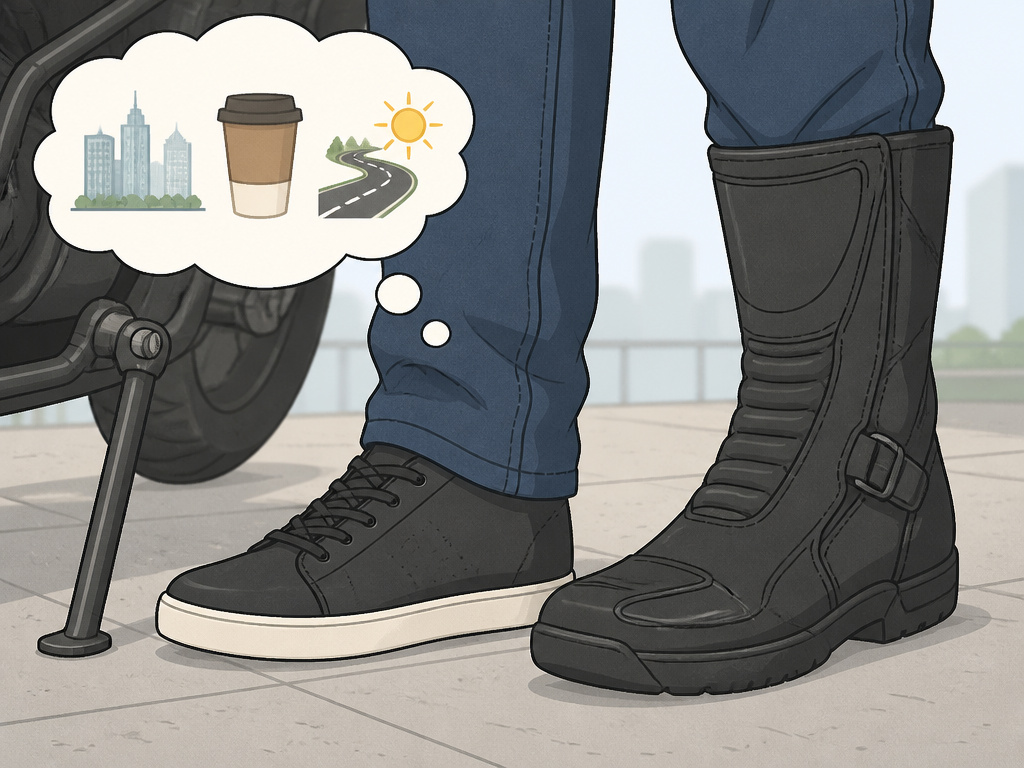
Your bike and your typical ride decide this. Not marketing.
1. The Urban Commuter (Under 50 mph)
You’re riding to work, class, or errands in city traffic. Speeds are lower, but so is attention, cagers, intersections, and sudden stops are the hazards. A CE Level 1 shoe provides verified abrasion and impact protection for the foot and ankle, the areas most likely to hit the ground in a low-side. The walkability may encourage consistent wear, which is important for safety. For this rider, a commuter motorcycle boot with better walkability might also be a perfect fit.
2. The Casual/Café Rider
You’re on a standard or cruiser, riding for pleasure on back roads. The riding position is more upright, and the bike’s controls may be less aggressive. Style is a factor, but so is protection. A well-made riding shoe blends in off the bike but still carries the CE label. The compromise here, central to the motorcycle riding shoes pros and cons, is accepting less torsional protection for the sake of a ride that’s about enjoyment, not lap times.
3. The Summer/Good-Weather Tourer
You’re taking a long trip in fair weather. Packing space is tight, and you want something comfortable for walking around at stops. A ventilated shoe or a shoe with a waterproof membrane can serve a dual-purpose. It’s a shoe for the bike and for the destination. The limitation is weather, a shoe won’t keep heavy rain out for hours like a sealed boot will.
Common mistake: Using a summer shoe in cold/wet conditions. The low cut lets water in over the top, and the minimal insulation leads to cold feet, which distracts from control. Shoes have a climate window.
If your riding fits one of these three boxes, shoes are a rational choice. If you regularly ride in rain, cold, or at sustained high speeds, you’re asking the shoe to do a job it wasn’t built for. Look at the types of motorcycle boots to find the tool for rain, cold, or high speeds.
The Fit, Care, and Shelf-Life Rules Nobody Reads
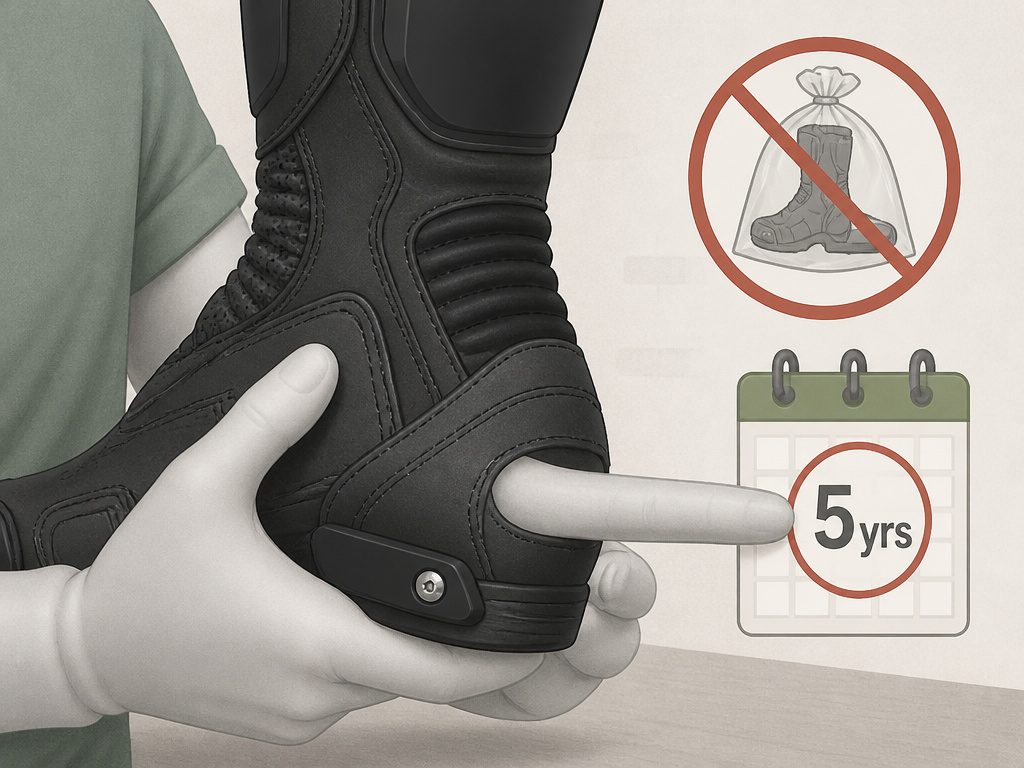
The manufacturer PDFs have a stack of warnings most riders never see. They’re not suggestions.
Fit is Non-Negotiable
The PDF states: “The boot should fit the foot closely but leave sufficient mobility for the toes.” It also says: “Under no circumstances is the boot allowed to slip off the heel, not even partially.” Try shoes on with the socks you ride in. Sit in a riding position. Your toes should not touch the end, and your heel must not lift. Ankle armor alignment is everything. A poor fit turns certified gear into expensive sneakers.
Cleaning and Storage: The Five-Year Clock
The instructions are specific: .
- Clean with lukewarm water (max 40°C). Do not wash under running water.
- Do not use hot water, solvents, or chemicals.
- Do not leave exposed to direct sunlight or extreme temperatures.
- After use, dry at room temperature in a well-ventilated place. No dryers.
- Store completely dry, not in airtight containers like plastic bags.
Then there’s the shelf-life: “It is recommended to replace boots that are stored under normal conditions after 5 years from the date of purchase.” Materials degrade. Glues dry out. Armor compounds can crystallize. This applies even if the shoes look new in the box. Date your gear when you buy it.
Pre-Ride Checks
- Visually inspect for breaches, unstitching, or damage. “If a Velcro closure is present, it should be checked for wear and tightness at regular intervals.”
- Ensure all closures are fully fastened before mounting. “Never ride with main closures open during hot weather.”
- Use with other certified PPE. Your jacket should overlap the shoe’s top to prevent water ingress.
These are the essential conditions that maintain the lab certification’s validity. Ignore them, and you’re back in trainers.
How Motorcycle Shoes Affect Shifting and Bike Control
Motorcycle shoes are designed to protect your feet while still allowing you to operate the controls. A fit that ensures the shoe moves with your foot as a single unit is critical for control. This ensures the shoe moves with your foot as a single unit.
Frequently Asked Questions
Do I really need motorcycle shoes?
Compared to regular sneakers, yes. Sneaker materials fail in under a second against asphalt. The 53% lower fracture rate for protective footwear is a stark statistic. Shoes are a minimum sensible barrier for your feet. Whether you need shoes or boots depends on your riding, boots protect more leg.
What is the 12 second rule for motorcycles?
This refers to a discrepancy in interpreting the EN 13634 Impact Abrasion test. Dainese states Level 2 certification requires the material to withstand 12 seconds of abrasion against 60-grit sandpaper at 8 m/s. Other sources cite the standard’s minimum as 2.5 seconds. The higher number may represent a more stringent internal test. The rule underscores that certification involves a brutal abrasion test, not a casual claim.
What type of shoes are best for motorcycle riding?
The best type is the one that fits your riding and fits your feet. For most urban riders, a CE Level 1 certified shoe from a brand like TCX or Dainese is the balanced choice. Look for specific features that match your needs: Gore-Tex membrane for weather, D3O ankle cups for impact absorption, and a ZPLATE sole for crush protection and walkability. Our guide to the best motorcycle shoes breaks down the top options.
Can I wear regular shoes to ride a motorcycle?
You can, but you’re opting out of verified protection. Regular shoes offer no abrasion resistance, no impact absorption, and no reinforcement at the toe or heel. Laces are a snag hazard. In a get-off, they provide about as much protection as a sock. The data says foot and ankle injuries are common and severe. Riding shoes are the baseline.
The Bottom Line
Motorcycle riding shoes are a tool for a specific job. They are not “boot-lite.” They are certified PPE that dramatically reduces fracture risk in the zones they cover, the foot and ankle. Their trade-off is the lack of shin coverage and limited resistance to twisting forces.
So here’s the honest take. If you ride in the city, value walkability, and will actually wear them every time, a pair of CE-rated shoes is a smart, life-changing investment. If your riding involves higher speeds, longer distances, or a sportier style, the taller boot is the right tool, the shoe’s compromises become gaps.
Fit them right. Check the label. Remember the five-year clock. And understand what you’re buying: not invincibility, but a calculated, proven layer between your skin and the road.
