
How to Wash a Textile Motorcycle Jacket: Step-by-Step
This post contains affiliate links. As an Amazon Associate, we earn from qualifying purchases.
Wash a textile motorcycle jacket by stripping all armor and liners, closing every fastener, using a technical detergent without softeners on a gentle cold cycle, and air-drying away from heat. Machine drying is only for reactivating DWR on specific waterproof membranes, a 20-minute warm tumble, and skipping that step leaves the shell soaked through on your next wet ride.
That last clause is where riders wreck a $500 jacket. The drying method isn’t a suggestion; it’s a binary switch. Get it wrong and the waterproofing turns to a sponge, the seams stay damp inside for days, and the armor pockets never fully dry. This is why knowing how to wash a textile motorcycle jacket correctly is critical.
What follows is the manufacturer-sourced breakdown of how to wash a textile motorcycle jacket: the pre-wash strip-down, the detergent debate, the temperature conflicts between REV’IT! (30°C) and Aerostich (40°C), and the one drying rule that flips based on your jacket’s membrane.
Key Takeaways
- Strip every removable part, armor, thermal liners, waterproof liners, before the jacket touches water. Leaving them in twists the fabric and warps the foam.
- Use a technical textile detergent like REV’IT! Textile Wash or a mild liquid soap. Never use fabric softener; it coats the membrane and kills breathability.
- Wash on a gentle, cold cycle (30°C/86°F) unless your specific label says 40°C/105°F. Heat degrades DWR and adhesive seams.
- Air-dry away from sun and heat for general textile jackets. Tumble dry on low for 20 minutes only to reactivate DWR on specific jackets where the manufacturer (like Aerostich) recommends it; other manufacturers like REV’IT! And Icon advise against machine drying.
- Re-waterproof every 5–10 washes with a wash-in or spray-on treatment. The outer shell’s beading effect wears off first.
The Pre-Wash Checklist (What to Strip Off)
Open the jacket and empty the pockets. Then remove everything that isn’t permanently sewn in.
That means the back protector, the shoulder and elbow armor, any insulated or waterproof drop-liners, and the kidney pads if your jacket has them. Icon’s care sheet is blunt: “Remove all body armor from the jacket.” Aerostich says the same for its proprietary armor: “You should always remove the impact pads when laundering.”
Why? Three reasons. Wet armor foam absorbs water and takes days to dry inside a pocket, creating a mildew smell you can’t scrub out. The weight of waterlogged pads stretches and twists the pocket fabric while the machine agitates. And hard plastic armor plates can crack against the drum.
Common mistake: Leaving the back protector in. It’s the bulkiest piece, and it blocks water and detergent from reaching the jacket’s spine panel. That spot stays greasy while the rest gets clean.
After the armor is out, close every zipper, Velcro flap, and cuff adjuster. REV’IT! Instructs you to “close all zippers and hook-and-loop fixtures to avoid damaging other fabrics on your garment.” An open zipper tooth will chew up the inner mesh lining in the wash cycle. A loose Velcro strip will latch onto the outer shell and leave a fuzzy patch.
If your jacket has a removable hood or a collar with a wire structure, check its specific label. Some are hand-wash only.
Detergent: The “No Softener” Rule That Actually Matters
Your kitchen sink dish soap is wrong here. So is regular laundry detergent with brighteners and softeners.
The membrane inside a waterproof textile jacket is a microscopic lattice. Fabric softener deposits a waxy coating that clogs those pores. REV’IT! States it plainly: “NEVER use any fabric softeners. They destroy the functionality of the membrane.” Dainese agrees, warning that softeners “could significantly worsen the properties of the surface waterproofing.”
You need a technical detergent. Brands make their own. REV’IT! Textile Wash, Nikwax Tech Wash, because they’re formulated to rinse completely without residue. Residue left on the fabric acts as a wick, drawing water through the DWR coating.
| Detergent Type | Best For | Risk If Used |
|---|---|---|
| Technical Textile Wash (e.g., REV’IT! Textile Wash) | Waterproof membranes (Gore-Tex, D-Dry) | None when used as directed. Rinses clean. |
| Mild Liquid Laundry Soap | General textile shells without a membrane | Possible residue if not double-rinsed. |
| Powder Detergent / Bleach | Never | Powder clogs membrane; bleach destroys fabric coatings and stitching. |
| Dish Soap / Degreaser | Never | Strips DWR coating in one wash. |
For heavy road grime or bug stains, pre-treat. REV’IT! Advises: “For heavier dirt and stains, use a very little amount of REV’IT! Care – Textile Wash. Work up light foam; do not saturate.” A soft toothbrush on the spot before the wash cycle works.
Water Temperature: The 30°C vs. 40°C Split
Here’s where the manufacturers disagree. You must check your own label first.
REV’IT! Sets a firm ceiling: “Wash textile garments with waterproof and breathable membranes in the washing machine at a maximum of 30° Celsius.” That’s 86°F. Dainese also says “lukewarm water (max. 86 degrees).”
Aerostich’s manual for its Darien jacket says “Wash on a warm permanent press cycle (105º F/40º C).” That’s a 14-degree difference.
Why the split? It likely comes down to the specific membrane and seam-sealing adhesive. When you don’t know, go cold. 30°C is safe for all technical textiles.
Where this goes sideways: Assuming “warm” means whatever your machine’s default is. That’s too hot. Select the “cold” or “30°C” cycle explicitly.
Machine Wash vs. Hand Wash: When to Choose
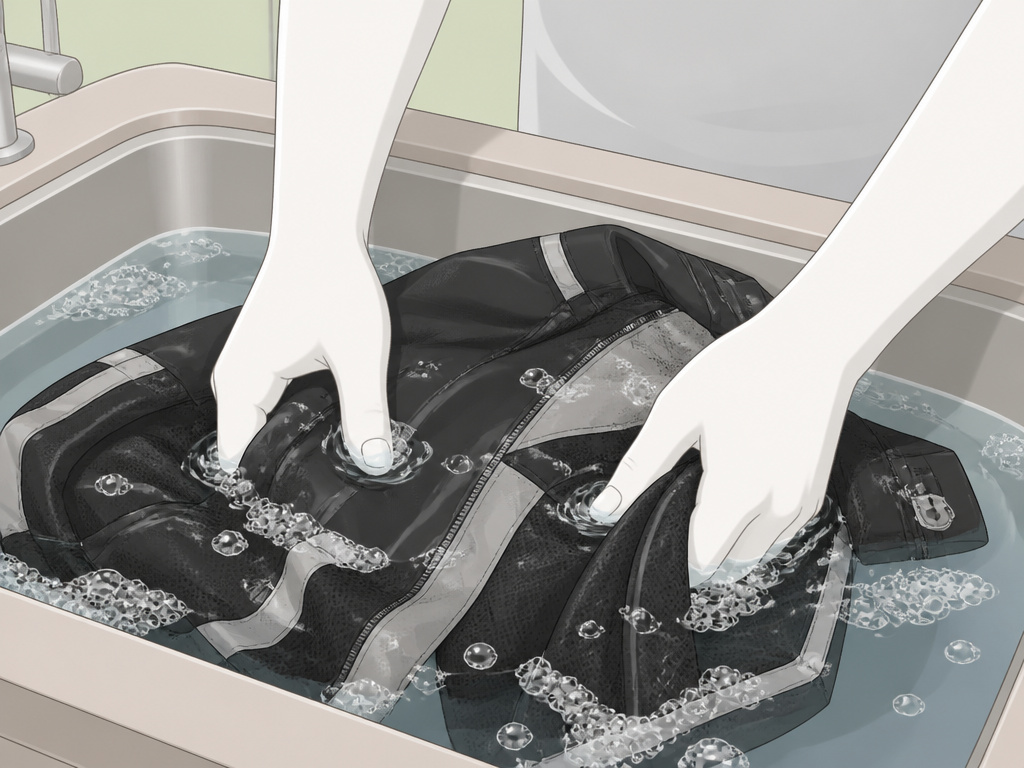
The machine is fine for most fully textile jackets when you follow the steps for how to wash a textile motorcycle jacket. Gentle cycle, slow spin.
Hand-wash is the safer choice for two scenarios: jackets with leather or suede panels, and jackets where the care label is missing or damaged. Icon’s care guide specifies hand-washing for its textile areas: “Hand wash the jacket with warm water (85˚F/30˚C) and a mild liquid laundry detergent.”
The process is simple. Fill a tub or large sink with cool water and detergent. Submerge the jacket, gently agitate it, and Drain, refill with clean water, and rinse until the water runs clear. No wringing, just press out the excess water.
The Drying Method That Decides Waterproofing
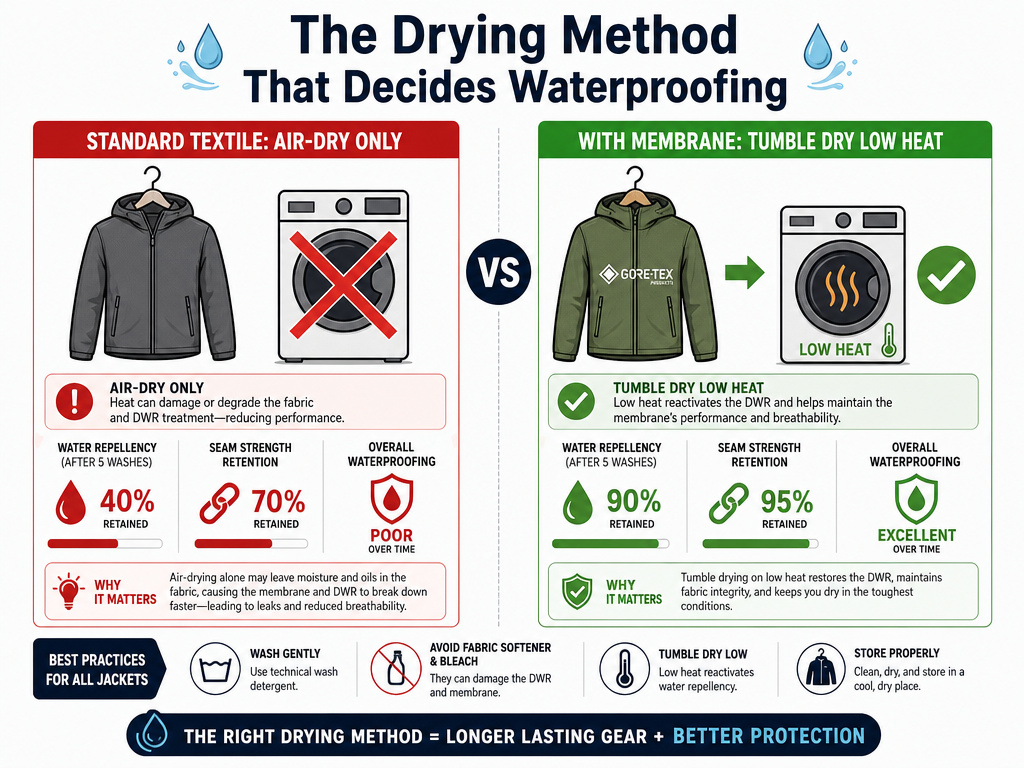
This is the step that flips based on your jacket’s technology. Get it right and the DWR reactivates. Get it wrong and you’ll need a reproofing treatment immediately.
For standard textile jackets without a named waterproof membrane (like Gore-Tex), air-dry only. REV’IT! Is absolute: “DO NOT dry your REV’IT! Textile garment in a dryer.” Icon echoes this: “DO NOT use a machine dryer. The only recommended method for drying the jacket is drip drying.”
For jackets with a waterproof breathable membrane (Gore-Tex, D-Dry, etc.), you need heat to reactivate the DWR. The rule is a short, low-heat tumble. Aerostich instructs: “Once dry, tumble dry your garment for 20 minutes to reactivate the DWR treatment on the outer fabric.” Aerostich recommends this for its Gore-Tex garments.
Why? The DWR treatment is heat-activated. When you wash, the coating gets disrupted. Skip the tumble and the jacket will wet out instantly in the next drizzle.
| Jacket Type | Dry Method | Reason |
|---|---|---|
| General Textile (no membrane) | Air-dry only, away from sun/heat. | Prevents shrinkage, glue failure, and fabric damage. |
| Waterproof Membrane (Gore-Tex, etc.) | Air-dry until damp, then tumble dry on low for 20 mins. | Reactivates DWR coating. Essential for performance. |
| Mixed Materials (textile with leather panels) | Air-dry only. Never direct heat. | Heat cracks and dries out leather. |
Never use direct sunlight, a hair dryer, or a heater. Dainese warns: “Drying with direct light and heat should be avoided at all costs.”
The DWR Dilemma: Reactivate vs. Reapply
After 5 to 10 washes, the DWR coating on the outer shell wears off completely. Water stops beading and starts soaking in. REV’IT! New Zealand notes: “After approximately 5 to 10 washes, depending on the quality of the textile impregnation and the detergent, a garment’s waterproofing has been washed out.”
The 20-minute tumble dry is a temporary reactivation. For a full restore, you need a dedicated DWR product. There are two types: wash-in and spray-on.
A wash-in treatment like REV’IT! Textile Waterproofing Wash-In or Nikwax TX.Direct is added during the final rinse cycle. It coats the entire garment evenly, including the inside of the membrane in some cases.
A spray-on treatment like REV’IT! Textile Waterproofing Spray-On is applied to the clean, dry outer shell. Aerostich suggests “about a half a can of one of these products, applied every year or two.”
Easy to miss: Spraying leather or mesh panels. REV’IT! Cautions: “Apply a thin film on the textile material (NOT on any mesh/leather/protective parts!) and wipe off excess material.” DWR on leather makes it stiff; on mesh, it blocks airflow.
If you’re reproofing, our guide on how to waterproof a textile motorcycle jacket walks through the spray-on process step-by-step.
Post-Wash Armor & Storage
Let the jacket cool completely after drying before you re-install the armor.
Check each armor pocket for dampness. If any spot feels cool or clammy, let it air out longer. For safe methods of drying your gear after a rain ride, the principles are the same: airflow, no heat.
Store the jacket on a wide, padded hanger in a dark, ventilated closet.
If your jacket has a removable liner, store it separately. This prevents unnecessary compression of the insulation.
Frequently Asked Questions
Can you machine wash a textile motorcycle jacket?
Yes, most fully textile jackets are machine-washable. Use a gentle cycle with cold water (30°C/86°F) and a technical detergent. Always remove all armor and liners first, and close all zippers and Velcro.
Is Dawn dish soap okay to wash a motorcycle jacket?
No. Dish soap is a degreaser designed to strip oils. It will remove the factory DWR coating in one wash, leaving the outer shell permanently absorbent. Use a technical textile wash or a mild liquid laundry detergent without softeners.
How often should you wash a textile motorcycle jacket?
Wash it when it’s visibly dirty or after a particularly grimy ride. Avoid washing it too frequently, as each wash gradually degrades the DWR. For cleaning related gear like pants, the process for washing riding jeans is very similar.
Can you tumble dry a textile motorcycle jacket?
Only if it has a waterproof breathable membrane like Gore-Tex, and only to reactivate the DWR. Tumble dry on a low, warm setting for 20 minutes after the jacket is mostly air-dried. For general textile jackets without a membrane, never use a dryer, air-dry only.
How do you restore waterproofing after washing?
Use a DWR (Durable Water Repellent) wash-in or spray-on product. Apply it to the clean, dry jacket according to the product instructions. For membrane-specific care, see our guide on reproof Gore-Tex gear. The jacket’s water beading should return after treatment.
The Bottom Line
Washing a textile motorcycle jacket isn’t laundry. It’s maintenance. The goal is to remove grime without removing protection.
Strip the armor. Pick a technical detergent. Choose 30°C unless your label insists on 40°C. Then decide the dryer question: if your jacket has Gore-Tex or an equivalent membrane, a 20-minute low tumble is mandatory, not optional. That’s the step that separates a jacket that sheds rain from one that absorbs it.
For everything else, air-dry in the shade. Reinstall the armor only when the jacket is fully cool and dry. And plan to re-waterproof with a spray or wash-in treatment once a season, or whenever water stops beading on the shoulders.
If you’re comparing materials from the start, our leather vs textile guide breaks down the long-term care differences. And if you need a new one, our reviews of the best textile jackets list models built to handle this cleaning cycle for years.
