
How to Waterproof a Textile Motorcycle Jacket
This post contains affiliate links. As an Amazon Associate, we earn from qualifying purchases.
To waterproof a textile motorcycle jacket, you must clean it first with a technical detergent, then apply a spray-on or wash-in DWR (durable water repellent) product, and finally dry it according to the product’s instructions, heat often boosts the effect. The jacket’s outer shell, not the membrane inside, needs the treatment. Water beading stops after 5 to 10 washes according to REV’IT! New Zealand, so reproofing is a regular maintenance task, not a one-time fix.
That “outer shell” detail is where most riders get the process backwards. The waterproof membrane sits behind the textile. You maintain the shell to protect the membrane. A key part of this is knowing how to waterproof a textile motorcycle jacket correctly. A wet outer fabric feels cold and heavy, and it blocks breathability even if the GORE-TEX layer underneath is perfect.
What follows: the spray-on versus wash-in choice that decides your weekend, the exact steps that keep armor and zippers safe, and the one sign that tells you to stop trying and start shopping.
Key Takeaways
. Use a technical detergent like REV’IT! Textile Wash for cleaning, never fabric softener, which destroys water repellency. . Reapply DWR treatment every 5 to 10 washes, when water stops beading on the shell. . For most jackets, a spray-on product is simpler and avoids mesh or leather panels; a wash-in product gives more uniform coverage on complex, multi-layer garments. . Heat can reactivate or boost DWR for many products, a short, low-temperature tumble dry or careful ironing can boost performance, but always check your jacket’s care label first. . Waterproofing cannot repair a physically damaged membrane, if water is coming through the seams or the fabric is delaminating, reproofing is a waste of time and product.
Read the Care Label First
Your jacket’s care label is the law. This is general advice, but that sewn-in tag has the final say for your specific model, its materials, and its construction.
Manufacturers disagree on the details. REV’IT! Says wash at a maximum of 30°C and hang dry. Aerostich says wash at 40°C (105°F) and allows machine drying. Dainese says avoid direct heat and sunlight for drying; REV’IT! New Zealand says sunlight can help boost waterproofing. Your label cuts through that noise.
Where this goes sideways: Skipping the label and following generic advice. A jacket with a specific laminate might need a brief tumble dry to reactivate its DWR, while another could be ruined by the heat. The label knows which one you have.
Before you touch a bottle of cleaner, find the tag, usually inside the main zipper or in a pocket. If your jacket has a removable waterproof liner, that liner has its own label, check it too.
The Spray-On vs. Wash-In Choice
This isn’t about which product is “better.” It’s about which method fits your jacket’s design and your own tolerance for mess. Get this wrong and you’ll waste an afternoon and a bottle.
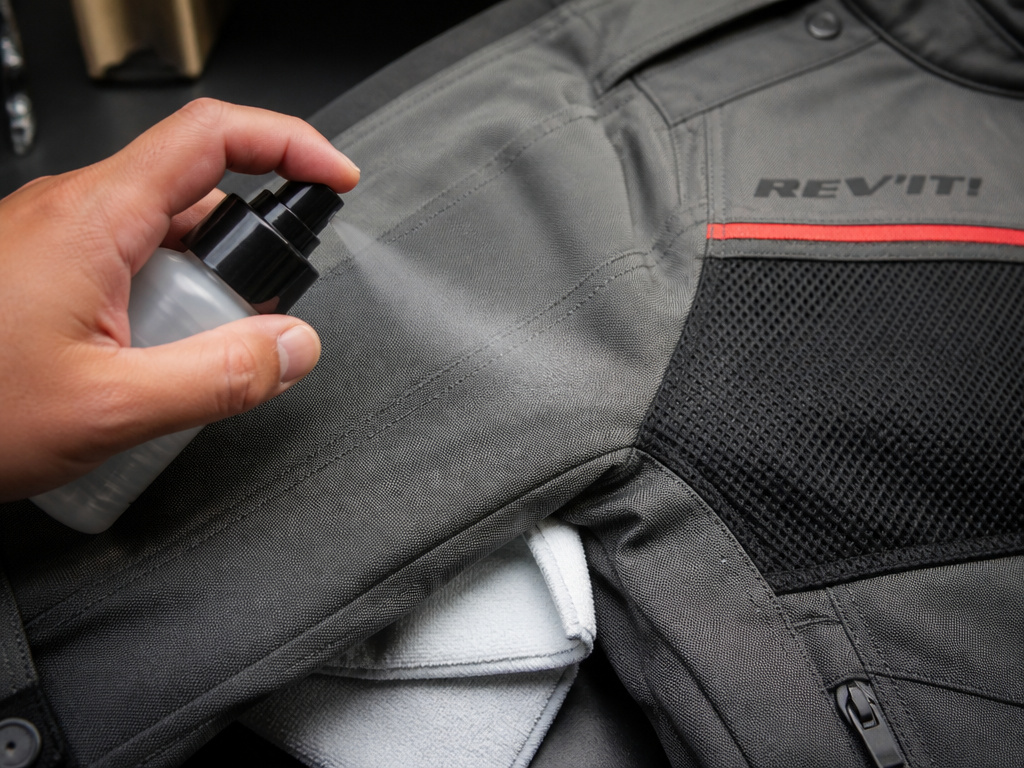
Spray-on products (like REV’IT! Care Textile Waterproofing Spray-On) are applied directly to the dry, clean outer shell. You work in sections, spray a thin film, and wipe off excess. The control is the advantage.
- Best for: Jackets with mixed materials (textile panels, mesh sections, leather accents). You can avoid spraying the non-textile parts.
- Also best for: Spot treatment. If only the shoulders are wetting out, you can hit just those areas.
- The catch: It’s easy to apply unevenly. A missed patch becomes a leak channel.
Wash-in products (like REV’IT! Care Textile Waterproofing Wash-In or Nikwax TX.Direct) go in the washing machine’s rinse cycle. The jacket soaks in the solution, and the treatment bonds to the fibers throughout the garment.
- Best for: Complex jackets with lots of seams, pockets, and layers. The wash-in solution reaches everywhere.
- Also best for: Uniform coverage. You don’t have to worry about missing a spot.
- The catch: It treats everything the wash water touches. If your jacket has a removable thermal liner you forgot to take out, that liner gets waterproofed too, which might not be desirable.
| Method | Best Use Case | Main Risk |
|---|---|---|
| Spray-On | Jackets with mesh/leather panels, spot repairs | Uneven application, missed spots |
| Wash-In | All-textile jackets, complex multi-layer designs | Treating non-target layers (like insulation) |
I keep both types on my shelf. For a simple touring jacket, I use the wash-in. For my adventure jacket with acres of mesh, I use the spray-on and take my time masking off the vents.
Prepare Your Jacket: The Clean Start
Waterproofing will not stick to dirt, sweat, or old detergent residue. The first step is always a thorough clean, and it’s the step most people rush.
First, strip the jacket. Remove all armor, liners, and pocket contents. Close every zipper, Velcro strap, and flap. An open zipper will beat against the drum and can damage the fabric or the machine.
Now, wash it. Use a gentle cycle and a technical detergent like REV’IT! Textile Wash. These detergents are formulated to clean without leaving a residue that blocks DWR bonding. Never use regular laundry soap, powder detergents, or, critically, fabric softener. Fabric softener coats fibers and “significantly worsens” waterproofing, according to Dainese.
The temperature debate matters here. REV’IT! Caps it at 30°C. Aerostich recommends 40°C. When in doubt, go cooler. Hot water can set stains and stress taping. Cool water with a good tech wash gets the job done.
Run a complete wash/rinse cycle a second time with no soap. This ensures all detergent residue is flushed out, which is critical for the DWR to bond properly. (Aerostich Darien Jacket manual)
After the wash, you have a decision. Some wash-in waterproofing products go in the rinse cycle of this same wash. If you’re using a spray-on, you need the jacket clean and completely dry before the next step.
Step-by-Step Application
Follow the product’s instructions on the bottle. They paid for the testing. But here’s how those steps play out in a real garage.
If using a wash-in product:
- After the main wash cycle, during the final rinse, add the measured amount of wash-in waterproofing to the machine’s dispenser or directly into the drum.
- Let the cycle complete. The jacket soaks in the solution.
- Proceed immediately to drying. Do not let the jacket sit wet.
If using a spray-on product:
- Lay the dry, clean jacket on a flat surface or hang it up.
- Shake the bottle well. Spray a thin, even film from a short distance away, working section by section, sleeves, shoulders, back, front.
- Avoid spraying mesh panels, leather accents, or reflective trim. The product is for the textile shell only.
- Use a clean, dry cloth to gently wipe off any excess product that pools or drips. A little goes a long way.
- Let the product soak in for the time recommended on the label before drying.
The goal is a uniform treatment, not a soaked jacket. Saturation can affect breathability.
The Drying Debate: Heat vs. Air
This is the most conflicted part of the process, and your product’s label is your guide again.
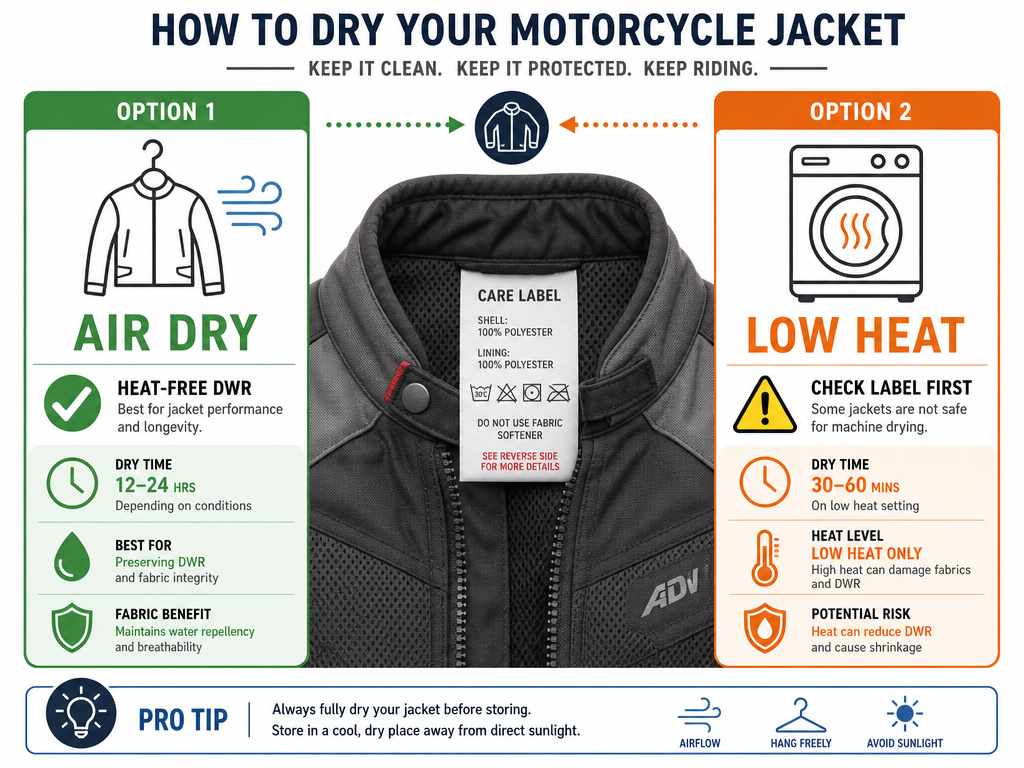
Some DWR technologies, like REV’IT! Care, do not require heat to activate. Air drying at room temperature will restore water repellency. However, the same manufacturer notes that warm drying in a tumble dryer often boosts the durability and effect of the treatment.
Other brands and jacket manuals are explicit: heat is needed. The Aerostich Darien Jacket manual says to tumble dry for 20 minutes after dry to reactivate the DWR.
| Drying Method | When It’s Allowed | What It Does |
|---|---|---|
| Air Dry (Room Temp) | Safe for all jackets; required by some labels (REV’IT! Sport). | Restores water repellency for heat-free DWR tech. |
| Tumble Dry (Low Heat) | Only if the care label explicitly permits it (Alpinestars). | Reactivates heat-activated DWR; can boost durability. |
| Iron with Tower | Alternative if no dryer is available (Aerostich). | Provides focused heat to reactivate DWR on dry garment. |
Never put a jacket in the dryer if the label says not to. The blanket “DO NOT dry” instruction from REV’IT! Sport International is a real warning for some models, while other manufacturers or product lines may allow it under specific conditions.
If your label allows low-heat drying and your product benefits from heat, run a short, low-temperature cycle. If you have no dryer, the Aerostich manual offers an alternative: iron the dry garment on a gentle, warm setting (no steam) with a towel between the iron and the jacket.
When Waterproofing Isn’t Enough
Reproofing is maintenance, not magic. It cannot fix physical damage to the waterproof membrane or its sealed seams.
You’ll know it’s time for a new jacket when: . Water comes through the seams or stitching. This indicates the seam tape has failed. No amount of spray will reseal it. . The fabric delaminates. If the outer shell is peeling away from the inner layer, the structural integrity is gone. . The interior wets out immediately in a light spray. After cleaning and reproofing, water should bead for a few minutes at least. Instant soak-through means the membrane is compromised.
A hose test in the driveway is a check, but it’s not the final word. I stopped trusting hose tests. These days, I ride in actual rain for a substantial time before I call anything waterproof. That’s the test that matters.
Dealing with Mixed Materials and Liners
Modern jackets aren’t just textile. They have mesh panels for ventilation, leather reinforcements, and removable waterproof liners. Each part needs a different approach.
Mesh Panels: Do not apply waterproofing spray or wash-in solution to mesh. It will clog the pores and kill breathability. Mask these areas off if spraying, or ensure a wash-in product is not recommended for mesh (most aren’t).
Leather Accents: Treat leather separately with a leather-specific conditioner. Waterproofing products for textiles are not formulated for leather and can stiffen or discolor it.
Removable Waterproof Liners: These are often a thin, coated nylon layer. Check their care label. Some can be machine washed with a tech detergent, but they rarely need DWR reproofing, their waterproofing is usually a coating, not a DWR-treated shell. Care for them separately.
How to test/check waterproofing effectiveness
Check the jacket’s outer shell, not the membrane behind it. The durable water repellent (DWR) coating on the shell causes water to bead up and roll off. A simple test is to sprinkle clean water on the jacket’s surface. If the water soaks in or darkens the fabric immediately, the DWR has likely worn off. This typically happens after several washes. If the water beads up, the waterproofing is still effective. For a more thorough check, you can test the entire jacket in light rain, but the sprinkle test is a quick way to spot-check areas like the shoulders and sleeves.
Frequently Asked Questions
Are textile motorcycle jackets waterproof?
Most are water-resistant out of the box, not fully waterproof. They rely on a DWR-treated outer shell to bead water away, and a waterproof membrane (like GORE-TEX) inside to block water that gets through. When the DWR wears off, the shell wets out, making the jacket feel cold and less breathable, even though the membrane is still intact.
What is a good waterproofing spray for textiles?
REV’IT! Care Textile Waterproofing Spray-On and Nikwax TX.Direct Spray are two proven, motorcycle-gear-specific options. The key is to use a product designed for technical fabrics, not a general outdoor spray, as the formulations differ.
How to waterproof a polyester jacket?
The process is the same as for any textile motorcycle jacket: clean with a technical detergent, apply a spray-on or wash-in DWR product, and dry properly. Polyester often holds DWR treatments longer than natural fibers, according to REV’IT!.
How often should I re-waterproof my jacket?
Reapply DWR when water stops beading on the outer shell. This typically happens after 5 to 10 washes. Visual inspection is your best guide, when it soaks up instead of shedding, it’s time.
Before You Go
One rule cuts through all the manufacturer disagreements: if your jacket’s care label explicitly forbids the dryer, do not use heat to reactivate DWR. The risk of damaging the membrane or its taping outweighs the potential boost. In that case, a heat-free product like REV’IT! Care and patient air-drying is your only safe path.
The rest is straightforward. Clean it right. Pick your potion, spray for control, wash-in for coverage. Dry it with the label in hand. Do that, and your knowledge of how to waterproof a textile motorcycle jacket will keep you dry for another season of miles.
When it stops working, when the seams leak or the fabric breaks down, no bottle will fix it. That’s the sign to start reading waterproof jacket reviews for a replacement.
