
How to Keep Your Legs Warm on a Motorcycle
This post contains affiliate links. As an Amazon Associate, we earn from qualifying purchases.
Here’s how to keep your legs warm on a motorcycle: block the wind first, then insulate. Wear a snug base layer and an insulating layer under a windproof shell. Cycle World’s 1964 numbers show wind dropping a touring rider’s effective temperature by 20 degrees. Add a heated pant liner only if your charging system can carry the load.
That 20-degree drop is why jeans that feel fine at the gas pump go useless once you’re rolling. Your legs sit out in the airstream with nothing ahead of them but a tank and maybe a fairing. Cycle World’s math put it plainly: legs need insulation in the same proportion as your upper body.
What follows: the layer order that works, the shell that matters most, how your bike’s front end changes the math, and the wiring numbers to check before you plug in a heated liner.
Key Takeaways
- Put the windproof layer on the outside, every time. Insulation under a shell that leaks air barely works.
- Fully waterproof rain pants trap your own sweat, and on a long ride that moisture soaks the insulation underneath.
- Heated pant liners from Firstgear and Venture Heat draw 35 to 39 watts. A Gerbing jacket liner draws 77, so the two together add up fast on a small alternator.
- One rider with leather chaps reports his thighs went cold first, because the engine’s warm air reached his shins and missed everything above the knee.
- Stop before a deep chill sets in. Cold riders lose concentration and reaction time.
Why Do Your Thighs Feel 20 Degrees Colder Than the Forecast?
Twenty degrees is the wind penalty Cycle World calculated for a touring rider back in 1964. In plain terms, 40F in a stiff wind felt like 20F in still air.
Wind chill on a motorcycle combines air temperature with airflow from road speed. The National Weather Service formula applies only at 50F or below with wind above 3 mph, and it’s calibrated for exposed facial skin, not clothed legs. At 0F with a 15 mph wind, the index reads -19F, and exposed skin can freeze in 30 minutes.
That chart is the best public tool we have, and it still misses the mark for your legs. Your face is bare skin. Your legs sit under fabric, so the real number on your thighs depends on how much air gets through.
The 1964 Cycle World article on cold-weather clothing explains why moving air hurts so much. A still body carries a thin sheath of warm air around it. Road wind strips that sheath away. Gone.
Riding in a winter jacket and summer jeans is like gluing up a cabinet and leaving the back panel loose. The cold finds the weak joint. Cycle World’s writer said legs need insulation in the same proportion as the upper body, and I’ve never seen a reason to argue with that.
Does the Wind Keep Getting Worse With Speed?
The sources split on this one. Cycle World’s John P. Covington wrote that wind’s cooling effect tops out at about 20 mph and doesn’t climb at higher speeds. The NWS formula keeps pushing the number lower as speed rises, and its chart shows no plateau at 20 mph.
I can’t settle that argument. Honestly, I don’t think it changes much for your legs. Above 20 mph, Cycle World says the wind’s effect has topped out, while the NWS formula keeps lowering the effective temperature as speed rises, and you’re above 20 mph on nearly every road worth riding. Plan for the full hit.
How to Keep Your Legs Warm on a Motorcycle: Four Layers in Order
Four layers, skin out: ventilating, ordinary clothing, insulation, windproof cover. That order comes from Cycle World’s 1964 advice for the trunk and limbs, and it still works for any setup without electric heat.
- A ventilating layer next to the skin. Cycle World pointed to Norwegian fishermen in knotted fishnet shirts, which let sweat evaporate before it reached anything else. Skip this layer and moisture goes straight into your insulation. Today that job falls to a thin thermal base layer.
- Ordinary clothing. Your regular trousers or the riding pant’s own liner.
- One thick insulating layer. Cycle World said it’s better to put all the thickness into a single garment, because air between several thin layers gets pushed around when you move. Stack five thin layers and you lose to one quilted one.
- A windproof cover on the outside. Leave it off and the wind blows through the first three layers like they aren’t there.
Thickness is what keeps you warm, and the filler matters less than you’d expect. Cycle World noted that cotton, wool, dacron and down all insulate equally at the same thickness.
A full layering system covers your torso too, and the leg rules stay the same. Thick, dry and windproof.
The One-Layer Rule When You Add Heat
Harley-Davidson’s own heated clothing guide says something different. It says to wear only one layer of clothing under its Heated Clothing, with the heated liner worn under windproof clothing. That’s a long way from Cycle World’s four-layer stack.
Both make sense in context. A heated liner has to touch you to work, and webBikeWorld says heated gear should be snug so the heat transfers to your body. Firstgear builds its pant liner form-fitting from Spandex for the same reason. So with heat: one thin layer, the liner, then the windproof pant. Without heat: the Cycle World stack.
Where this goes sideways: Stuffing thick layers under armored riding pants. The knee armor rides up off the kneecap the moment you sit on the bike, and you won’t notice until it’s in the wrong place during a slide. Size up the pants or thin the layer.
Buy the Windproof Shell Before Anything Else
The thickest fleece you own turns into a sieve once you pass 20 mph without a wind layer over it. Cycle World warned that plenty of coats sold as “windproof” weren’t built for motorcycle-speed wind. WebBikeWorld boils staying warm down to two jobs: block the wind and hold body heat. Do the first one first.
This is the step I see skipped constantly. Riders buy a warmer base layer, then wonder why nothing changed.
Leather vs Fabric Overpants: Pick by Temperature
Leather wins on wind. Cycle World called it the best clothing material for wind protection, and it adds abrasion resistance if you go down. The trouble starts when you try to fit real insulation under it. Thick layers under leather get awkward fast.
So here’s my pick, and it follows Cycle World’s line. Above 40F, leather pants or chaps over a base layer. Below 40F, Cycle World says a tightly woven fabric cover is more manageable, so switch to fabric overpants over proper insulation. Chaps keep the front of your legs out of the wind but leave the seat and the back of your thighs on their own.
Rain Pants Block Wind and Trap Sweat
Rain pants are the cheapest wind layer you can buy. They also come with a catch. Cycle World explained that a fully waterproof garment won’t let water vapor out, so perspiration condenses inside and soaks the insulation.
Peel them off at a fuel stop after a long stint and the inside is slick with condensation. The fleece underneath feels damp and cold against your knees. Cycle World cautioned that sealed rainwear traps perspiration, which can soak the insulation over a long ride.
Skip this if: you plan to wear sealed rain pants as your only winter shell on a full-day ride. Save them for short commutes and actual rain, and get out of them as soon as you can.
Commuter Options You Can Pull Off in a Parking Lot
Commuting is where layering gets awkward, because there’s often nowhere to change. These come off fast:
- Overpants with full-length side zips. Off in a minute without taking your boots off.
- Leather chaps.
- Insulated hunting or mountaineering pants in a loose fit, which Cycle World suggested backing up with quilted underwear inside. They work well as a budget winter option if you’re not stuck sitting at a desk in them all day.
- A nylon ski-style coverall. Cycle World called a windproof coverall “always a wise addition.”
- Snowmobile bibs or cycling leg warmers, if you already own them. Ugly. Effective.
If you ride cold most of the year, dedicated insulated motorcycle pants with a removable liner beat any of these on protection, since the armor stays where it belongs. The broader guide on how to dress for cold weather riding ties the legs into the rest of your kit. Whatever you pick, ride it before you trust it. Do a short cold loop before you commit to a long one.
Your Bike’s Front End Decides Where the Cold Gets In

One webBikeWorld reader rides a Triumph Speed Triple with no fairing and no wind protection at all. Wearing a heated jacket, he ended up turning the heat down because he got too hot. Another reader at -5C wore leather engine-guard chaps. His feet and shins stayed warm, but his thighs got chilly on longer trips, because the engine’s warm air never reached them.
Put those two reports together and a pattern shows up. Engine heat and lower-leg coverage protect shins. Thighs hang out in clean, cold air.
Fairings change the math the most. Cycle World estimated that a full touring fairing can equal a 30-degree increase in temperature for net heat loss. It blocks wind and traps a little engine warmth where it helps. A windshield alone does less, since Cycle World noted windshields curl the air over your head and down your back.
The data here is thin. I couldn’t find any measurements of leg temperature on naked bikes versus faired ones, so the reports above are individual riders, not tests. Cruisers with forward controls put your shins out front in the wind, and that’s my read from the saddle, not a measured number.
On an unfaired bike, I’d fix the wind on my thighs before I’d buy watts. Heat pumped into a liner that’s getting blasted by cold air is heat your battery pays for twice.
Heated Pant Liners: What the Firstgear and Venture Heat Specs Say
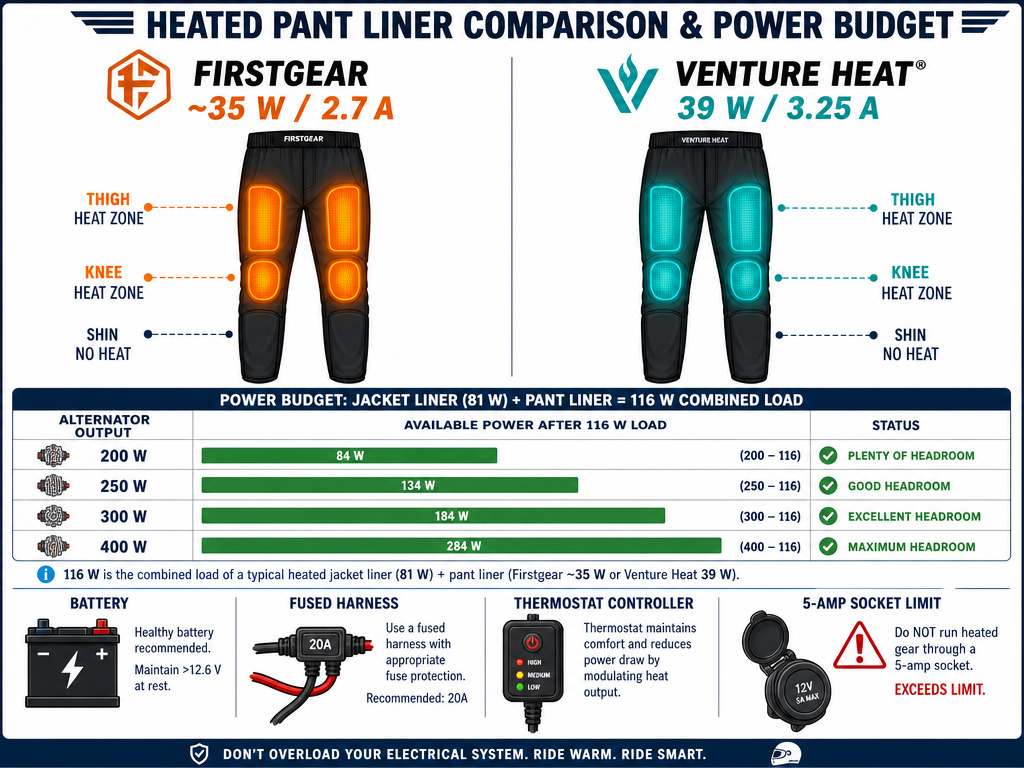
The Venture Heat 39W pant liner draws 3.25 amps from a 12V battery and heats the thighs and knees on three settings. Firstgear’s heated pant liner runs about 35 watts, or 2.7 amps at 12.8 volts, over the same thigh and knee zones.
Here’s my caveat. I test helmets, jackets, gloves and boots far more than I test electronics. Treat this section as a careful read of the spec sheets and owner reports, not a long-term review. I can miss a software or battery quirk.
Firstgear vs Venture Heat: Which One Fits Your Setup
| Garment | Power draw | Heat zones | Control |
|---|---|---|---|
| Firstgear heated pant liner | ~35 W, 2.7 A at 12.8 V | Thigh and knee | Needs a Heat-Troller |
| Venture Heat 39W pant liner | 3.25 A / 39 W | Thighs and knees | Button or HeatSync app |
| Gerbing jacket liner (reference) | 77 W, ~6.4 A | Torso | Separate controller |
My pick depends on what you already own. If you run a Firstgear Warm & Safe jacket, the Firstgear liner plugs straight into it, and it has built-in plugs in both lower legs for heated socks. Firstgear backs the liners for one year and the wiring for life.
If you’re starting from scratch, the Venture Heat liner is the simpler buy. It ships with its own fused battery harness and doesn’t need a separate controller.
Both liners heat the thighs and knees only. Your shins get nothing from them, which is why the chaps-and-engine-heat combo pairs well with a liner. The wider spread of best heated motorcycle clothing runs from liners like these up to full heated suits.
Can Your Charging System Carry the Load?
WebBikeWorld ran the numbers that matter here. With the 77 W Gerbing jacket liner on max, a 200 W alternator drained the battery below 3,000 rpm. A 250 W alternator roughly broke even below 3,000 rpm. The reviewer’s verdict: that liner needs at least 300 W of alternator output, and it worked fine at 400 W.
Add a 39 W pant liner to that 77 W jacket and you’re asking for 116 W. That’s before headlights.
Harley-Davidson warns that too many accessories can overload the charging system. If the combined draw beats what the system produces, the battery discharges and you can damage the bike’s electrical system. H-D points owners to Section 8 of the Service Manual for testing voltage output and amperage draw, and to a dealer for wiring changes.
Before you start: – Overheating connectors. Recalled heated jackets had connections that overheated and burned riders. Unplug anything that smells hot or feels warm at the plug. – Charging system overload. Too much combined draw drains the battery and can damage the electrical system. Know your alternator output before you add a second heated garment. – Pinched or loose wiring. H-D lists wire routing and connection tightness as the first things to check. Route the harness away from the seat hinge and anything that moves.
- Find your alternator output in the service manual. Skip it and you find out at a red light in traffic, when the battery runs down at low rpm.
- Add up every heated garment you’ll run at once. A jacket liner plus a pant liner is a different load from either alone.
- Use the harness built for the garment. H-D says to use only harnesses, switches and thermostats made for its Heated Clothing, and Venture Heat ships a fused harness. A random plug-in skips the fuse that’s supposed to protect you.
- Check connections, routing and the harness fuse if the liner won’t heat. That’s H-D’s own troubleshooting order, and it beats guessing.
- Mount the controller where your gloved hand finds it. One webBikeWorld reader clips his thermostat pouch to a Velcro strap on his left thigh.
Accessory Socket or Direct Battery Harness?
A BMW R1200R owner on the BMW MOA forum learned the socket question the hard way. His Gerbing jacket liner draws over 6 amps. The R1200R’s accessory socket has a 5 amp limit, enforced electronically rather than by a fuse, and it cut power as soon as the liner switched on. He wired a harness straight to the battery and called the cap a serious defect.
Easy to miss: A capped socket doesn’t blow a fuse.
The Venture Heat liner’s 3.25 amps fits under a 5 amp cap on its own. Add a jacket liner like the Gerbing and you blow straight past it. Venture Heat says to connect directly to the 12V battery with its fused harness. H-D says to use its own harnesses and see a dealer for wiring changes. Follow your garment maker’s instructions, since that’s whose fuse protects you.
Do You Need a Controller?
Researchers at the Technical University of Liberec tested electric heating in motorcyclist jackets and found the heating element effective only with a thermocontroller in the circuit. That study covered jackets, not pants. Some webBikeWorld riders ran their gear without heat control or kept it low, but those are individual reports.
I’d run a controller. H-D’s single control thermostat sits between the battery harness and the garment for exactly this job, and its Y-plug splitter lets a vest liner, pant liner and gloves share one setup.
Recalls back up the caution. The CPSC Ardica heated jacket recall from 2010 covered jackets and vests whose electrical connections could overheat. A 2013 recall reprint describes about 9,900 Gerbings heated jacket liners with a faulty connector and 2 reports of minor back burns. That detail comes from a secondary source, so confirm it with the CPSC. I found no recall specific to heated pants.
Cold Feet Will Pull Heat Out of Your Legs
Cold feet mean your body is losing the fight. Cycle World explained the mechanism: when your core starts losing heat, your body cuts blood flow to the extremities to protect itself. Your feet go cold even inside insulated boots, and the chill climbs from there.
For socks, Cycle World recommended a thin cotton or nylon sock against the skin with a heavy wool sock over it. Good wool socks are the cheapest warmth upgrade in this whole article. Pick insulated boots over unlined ones.
Heated insoles aren’t automatically the answer. A webBikeWorld rider reported that his boot insoles burned his heels while his toes stayed cold. Uneven heat is still cold toes.
Calf width trips up more winter setups than any sock choice. I’ve watched riders with wide calves fight boots that won’t zip or close comfortably, often enough that I ask about calf width before I recommend any boot. Pile a base layer and insulation inside the boot shaft and the problem gets worse, so try boots on wearing your winter layers.
- Pull your overpant cuff over the boot, never tucked inside it.
- Check that you can still work the brake and shift levers with everything on. Cycle World flagged this for bulky winter boots, and it matters more than any degree of warmth.
- Firstgear’s pant liner has heated sock plugs built into both lower legs, if you go the electric route.
What Should You Do When Your Thighs Go Numb Mid-Ride?
Stop. Cycle World’s first rule for long cold rides was never let yourself get really cold. Pull over for coffee, soup or a meal before a deep chill sets in. If there’s nowhere to stop, get off and do some exercises, but quit before you start sweating.
Numbness creeps in slowly. A patch of thigh goes dull, then the knee stiffens, and you notice it only when you stand up at the next light. The Liberec researchers warned that constant wind exposure can lead to hypothermia, which costs a rider concentration and reaction time. That’s a crash risk, not just discomfort.
While riding, wriggle your toes to keep blood moving. Cycle World added that fatigue and anxiety both cut your tolerance for cold, so sleep and eat properly before a winter ride.
Stop at the first numb patch, not the second. A stiff, slow-reacting body makes the ride home longer and more dangerous.
| Symptom | Likely cause | Fix |
|---|---|---|
| Thighs cold, shins fine | Engine heat and chaps miss thighs | Wind layer or heated liner on thighs |
| Cold despite thick layers | Wind getting through | Add a windproof outer cover |
| Damp, clammy insulation | Sweat trapped by waterproof shell | Vent or swap to breathable shell |
| Heated liner won’t warm | Loose plug, bad routing, blown fuse | Check connections and harness fuse |
| Power cuts after a second | Socket current cap | Fused harness direct to battery |
How cold is too cold? A short commute is different, since you lose body heat for a limited time. My own cold-weather miles are mostly temperate commuting and backroads, so take my take below freezing with that in mind.
How do I stop cold air getting in between my jacket and pants?
The gap at your waist is where a lot of riders lose the battle. You sit forward, the jacket rides up, and a ribbon of road wind pours straight onto your lower back and the tops of your thighs. Moving air strips away the thin layer of warm air your body builds, so even a small opening matters.
Start with overlap. Pick a jacket that runs long enough to cover your hips when you lean into the bars, and test it in the riding position, not standing in the garage. A pair of pants with a high back or bib style helps too. If your gear has a zipper that joins the jacket to the pants, use it. It is the most reliable seal you can get.
Beyond that, keep one windproof outer layer as the final barrier, and cinch waist adjusters and cuffs so nothing flaps open. Snug gear also helps heated liners pass warmth to your body.
Frequently Asked Questions
What temperature is too cold to ride a motorcycle?
Cycle World’s 1964 advice was to never let yourself get really cold and to stop before a deep chill sets in. Short commutes can tolerate more, since you’re only losing heat for a limited time. For reference, the NWS rates 0F with a 15 mph wind as a -19F wind chill, where exposed skin can freeze in 30 minutes.
Can I plug a heated pant liner into my bike’s accessory socket?
Sometimes. The BMW R1200R’s socket cuts power above 5 amps, so a 3.25 amp Venture Heat liner fits alone, but adding a jacket liner trips it. Venture Heat says to connect directly to the battery with its fused harness.
Are rain pants enough to keep my legs warm?
They block wind well and work for short rides. Fully waterproof pants trap sweat, though, and Cycle World warned that the condensation eventually soaks your insulation. On long rides, a breathable windproof shell is the better pick.
Do I need a controller for heated gear?
Use one. A Technical University of Liberec study of motorcyclist jackets found electric heating effective only with a thermocontroller in the circuit. Harley-Davidson’s setup uses a single control thermostat between the battery harness and the garment for the same reason.
Why are my thighs cold when my shins feel fine?
Engine heat and leather chaps protect your lower legs, and one rider at -5C reported exactly that split. The warm air off the engine misses your thighs. A windproof layer over the thighs or a heated liner covering thighs and knees fixes it.
The Bottom Line
Do one thing this week before buying anything with a plug: look up your alternator output in your service manual. If it’s under 300 W, think hard about running a 77 W jacket liner and a pant liner together in city traffic, because webBikeWorld saw a 200 W system drain the battery below 3,000 rpm.
Everything else about how to keep your legs warm on a motorcycle comes back to wind. A cheap windproof shell over a thick insulating layer beats an expensive base layer under jeans. Heat comes last, and only once the wind is handled.
One limit on all of this: my riding leans toward temperate commuting, not multi-day trips below freezing. If that’s your plan, lean on the numbers from your garment maker and your service manual over my opinion.
Bottom line: buy a windproof overpant and a real insulating layer first if you ride a naked or standard bike, and skip heated liners entirely until you’ve confirmed your charging system can carry them.
