
How to Improve Motorcycle Fuel Economy: Step-by-Step
This post contains affiliate links. As an Amazon Associate, we earn from qualifying purchases.
To improve motorcycle fuel economy, stick to manufacturer-scheduled maintenance, keep tires at the spec cold pressure, and smooth out your throttle hand. The biggest gains come from knowing your actual miles per gallon with a manual log, not a dashboard guess. The factory service intervals for chain tension, bearing grease, and engine tuning are designed for safety and longevity—skip them and you risk increased wear and potential damage.
That gap between the spec and reality is where most riders lose miles per gallon without noticing. A dashboard display often reads optimistically compared to a manual calculation at the pump. Understanding how to improve motorcycle fuel economy starts with recognizing this difference, which can add up to significant extra fuel costs over time.
What follows: the factory maintenance specs that actually matter, the single best habit for tracking real economy, and why chasing expensive gadgets is a waste of money. By the end, you will have a checklist to run this weekend and a method to prove whether it works on your bike.
Key Takeaways
- Track fuel economy with a manual log or spreadsheet; dashboard computers are often optimistic by 5-10%.
- Follow the factory chain inspection interval (every 1000 km / 600 mi for Yamaha) and use a special O-ring chain lubricant.
- Keep tires at the cold pressure spec in your manual (e.g., 15 psi for a Honda CRF250X); under-inflated tires increase rolling resistance and reduce fuel economy.
- A smooth throttle hand beats aggressive acceleration and braking every time; ride like you have an egg between your wrist and the grip.
- Skip the fuel additives and “economy” gadgets; the manufacturers’ own manuals don’t recommend them, and the money is better spent on fresh tires.
What the Manuals Actually Say About Efficiency
Open any owner’s manual past the safety warnings and you will find a maintenance schedule. It is not there just to sell dealer service. Yamaha, for instance, states you must check the drive chain slack, alignment, and condition every 1000 km (600 mi) and after riding in the rain or washing the bike. They specify lubricating it with a special O-ring chain lubricant thoroughly. This is not a suggestion. A dragging, dry, or misaligned chain wastes engine power as heat and friction before it even reaches the rear wheel. You compensate with more throttle.
The drive chain should be checked for slack, alignment, and condition every 1000 km (600 mi) and after washing the motorcycle, riding in the rain, or riding in wet areas. It should be adjusted and lubricated with a special O-ring chain lubricant thoroughly. – Yamaha YZF690/R7 Owner’s Manual
The same logic applies to everything that spins, rolls, or pivots. Yamaha says to check and moderately repack steering bearings with lithium-soap-based grease every 19,000 km (12,000 mi). Swingarm pivot bearings need the same check and lubrication every 50,000 km (30,000 mi). These are not arbitrary numbers. A gritty steering stem bearing or a dry swingarm pivot creates drag you fight with the bars and the throttle. The manual gives you the fight schedule.
Suzuki and Honda are just as specific, but with different priorities. The Suzuki ADDRESS 110 manual stresses fuel quality for the life of the catalytic converter: use unleaded gasoline with an octane rating of 91 or higher (Research method), and never use leaded fuel. It warns that engine misfiring from poor tuning can overheat and permanently damage the catalyst. A sick engine is a thirsty engine.
Honda’s manual for the CRF250X adds altitude to the mix. It notes that above 6,500 feet (2,000 m), driveability and performance may drop and fuel consumption may rise. More critically, it warns that running altitude-modified carburetor settings below 5,000 feet (1,500 m) can cause engine overheating and damage. If you ride in the mountains and the valleys, generic tuning does not cut it.
Bottom line: The manual is your first and best guide to fuel economy because it targets the mechanical losses that steal power. Follow its intervals with the specified fluids and you remove the hidden drains on your tank.
How Do You Track Fuel Economy Accurately?
Your bike’s dashboard lie is polite, but expensive. Most fuel computers are calibrated optimistically, showing a higher MPG than a manual calculation at the pump reveals. The only way to know your real economy, and whether your changes are working, is to log it manually.
I keep a simple spreadsheet: date, odometer reading, gallons added, calculated MPG. After two years, the purchase price of my bike was not the biggest line item. Fuel was. That log proved something else. A few months of checking tire pressure weekly and keeping the chain properly lubed improved my fuel economy by a couple of MPG over my sloppy months. It was not dramatic, but it was free and the data did not argue.
| Log Entry | Odometer (mi) | Gallons Added | Calculated MPG | Note |
|---|---|---|---|---|
| May 1 | 10,250 | 3.2 | 41.2 | Post-winter, low tire pressure |
| May 15 | 10,510 | 3.1 | 43.5 | Tires corrected to 36 psi, chain lubed |
| May 29 | 10,765 | 3.0 | 44.3 | Riding style smoothed out |
The process is simple. Fill the tank until the pump clicks off. Reset your trip meter or note the odometer. Ride until you need fuel again. Fill up, note the gallons, and do the math: miles traveled divided by gallons used. Tracking this over time reveals your true fuel economy.
Where this goes sideways: Trusting the dash computer over manual calculation. The computer’s estimate is based on average injector pulses, not actual fuel burned. Over a season, that optimism can mask a drop in real efficiency, leading to higher fuel costs.
This is about evidence, not obsession. Before you spend money on a fuel additive or a new exhaust, spend five minutes at the pump with a notepad. You might find the fix is already in your garage.
The 3 Maintenance Tasks That Matter Most
You can read a hundred tips about hypermiling. These three move the needle because they attack measurable mechanical loss. They are also in your manual.
- Tire Pressure (Weekly Check). Honda specifies a cold tire pressure of 15 psi (100 kPa) front and rear for the CRF250X. Your bike’s spec is on a label, usually on the swingarm or in the manual. Under-inflated tires have a larger contact patch and greater rolling resistance, causing the engine to work harder and reducing fuel economy. Use a digital gauge to ensure accurate pressure readings.
- Drive Chain (Every 600 Miles / After Rain). Per the Yamaha manual, this is a three-part job: check slack, check alignment, then lubricate with a special O-ring chain lubricant. A chain that is too tight binds and robs power. One that is too loose can skip and damage the sprockets. Misalignment wears the chain and sprockets unevenly. A dry chain grinds itself away. The factory interval exists because these conditions develop predictably. Ignoring it costs power first, then money for parts.
- Air Filter (Seasonally or as Specified). A clogged air filter suffocates the engine. It has to work harder to pull in air, leaning out the mixture and often triggering the engine control unit to add more fuel to compensate. The service schedule in your manual lists the interval. The service schedule in your manual lists the air filter inspection and replacement interval. Replacing the air filter with a clean, properly oiled unit (if applicable) is like letting the engine breathe deeply again.
These are not glamorous. They will not make your bike sound faster. They will make it actually use less fuel to go the same speed. The manual gives you the timetable. Your logbook proves it works.
Riding Style: The Throttle Is a Dimmer, Not a Switch
Engineering can only do so much. The rider controls the biggest variable: the right wrist. Think of the throttle as a dimmer switch for a light, not an on/off button. Smooth, progressive inputs keep the engine in its efficient zone. Jerky, full-throttle bursts dump fuel for noise and acceleration you often do not need.
The goal of how to improve motorcycle fuel economy is momentum conservation. Every time you brake hard, you are throwing away the fuel you just burned to get up to speed. Anticipate stops, ease off the throttle early, and let engine braking do some of the work. Look ahead for traffic lights changing or cars turning. This is efficient riding, not slow riding. You arrive just as quickly, with less brake wear and a lighter fuel bill.
Common mistake: Using the brakes to adjust speed instead of the throttle. If you’re constantly tapping the brakes on the highway, you’re converting momentum (fuel) into heat, then using more fuel to regain speed. Ease off the throttle a half-second sooner.
Your gear selection matters too. Lugging the engine in too high a gear at low RPM strains it and can hurt fuel economy. So can buzzing it at the redline in a low gear. Most modern fuel-injected motorcycles are tuned for best efficiency in the mid-range RPMs, often where peak torque is made. Find that sweet spot for your bike and try to cruise there. If you are constantly shifting, you might be a gear off for the speed you want to maintain.
The Truth About Fuel, Additives, and Gadgets
The fuel section of your owner’s manual is brief and precise. Suzuki says use unleaded gasoline with an octane rating of 91 or higher (Research method). Honda specifies unleaded gasoline with a pump octane number of 91 or higher.
The manuals are silent on aftermarket fuel additives and economy gadgets for a reason. If a tank of fuel system cleaner once a season gives you peace of mind, it likely will not hurt. But do not expect a miracle MPG bump. The fuel already contains detergents mandated by law. The real solution for dirty injectors or passages is proper maintenance, not a chemical hope.
Gadgets that plug into your OBD port or promise to “reprogram” your fuel map for efficiency are risky. They can interfere with the carefully calibrated emissions and engine management systems. The factory engineers tuned your bike to meet strict efficiency and emissions standards across a range of conditions. A gadget that claims to beat that is often just leaning out the mixture, which can lead to engine damage over time. Your money is better spent on a quality tire pressure gauge and the correct chain lubricant.
Carburetor vs Fuel Injection: Does It Matter for MPG?
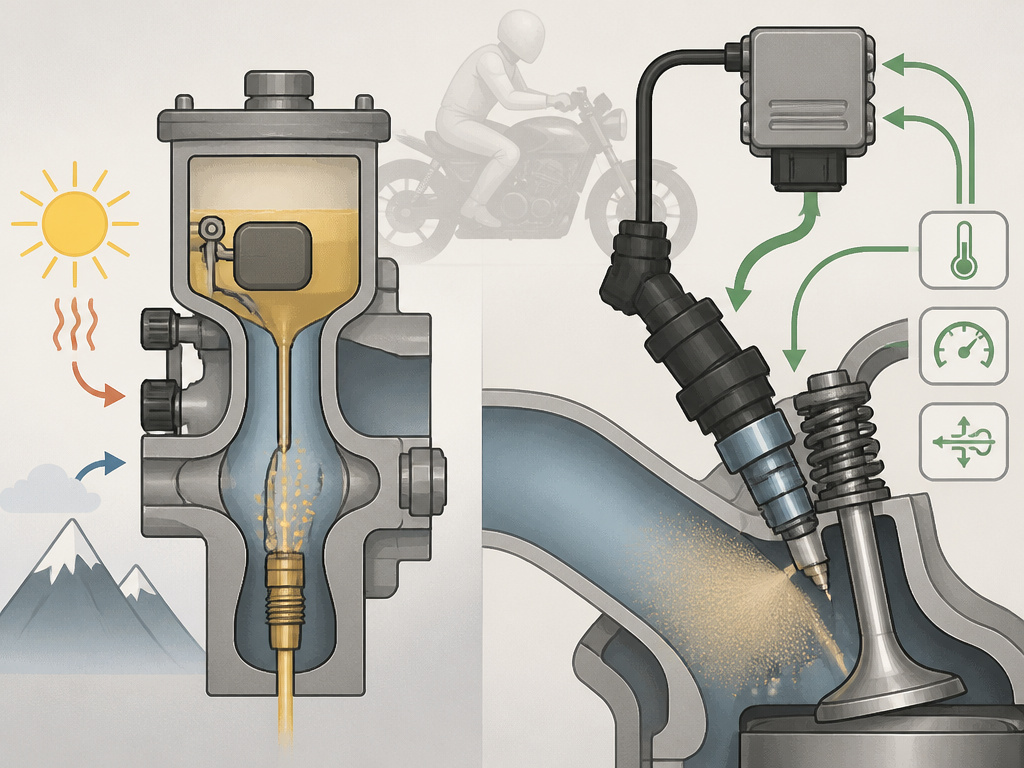
For fuel economy, fuel injection wins. It is not magic, just precision. A carburetor relies on mechanical vacuum signals and fixed jets to meter fuel. It can be tuned wonderfully, but changes in altitude, temperature, and humidity affect its mixture. Fuel injection uses sensors and a computer to adjust the mixture constantly, aiming for the ideal ratio for both power and efficiency under all conditions.
This is why Honda’s manual has a specific warning for the carbureted CRF250X about altitude. It states you must return the carburetor to standard specs if you ride from high altitude back down below 5,000 feet (1,500 m), or risk overheating. A fuel-injected bike adjusts automatically. If you own a carbureted bike, understanding this limitation is key. A tune that is perfect at sea level will be rich and wasteful in the mountains. For consistent fuel economy across a varied riding area, a key part of how to improve motorcycle fuel economy is that fuel injection removes a major variable.
That said, a well-maintained and properly tuned carburetor can still deliver excellent fuel economy. It just requires more owner awareness and adjustment. The debate between carburetor vs fuel injection often centers on simplicity versus adaptability. For pure, set-and-forget efficiency, fuel injection is the clear choice.
Before You Go
Forget the gadgets and the hype. Improving your motorcycle’s fuel economy is a mechanics-and-rider game. Start with the specs in your own owner’s manual: tire pressure, chain maintenance, and filter service. Follow them like a prescription. Then, build the one habit that reveals everything else: keep a simple fuel log. Three fill-ups will tell you your baseline. A change in your maintenance or riding will show up in the next three.
The goal is to eliminate the waste you cannot feel, such as the dragging chain, the soft tire, and the anticipatory braking you did not do, rather than turning every ride into a fuel-sipping chore. When your bike runs right and you ride smoothly, the fuel economy is just a happy side effect. The real prize is a machine that lasts longer and costs less to enjoy, mile after mile.
How Does Aerodynamics Affect Motorcycle MPG?
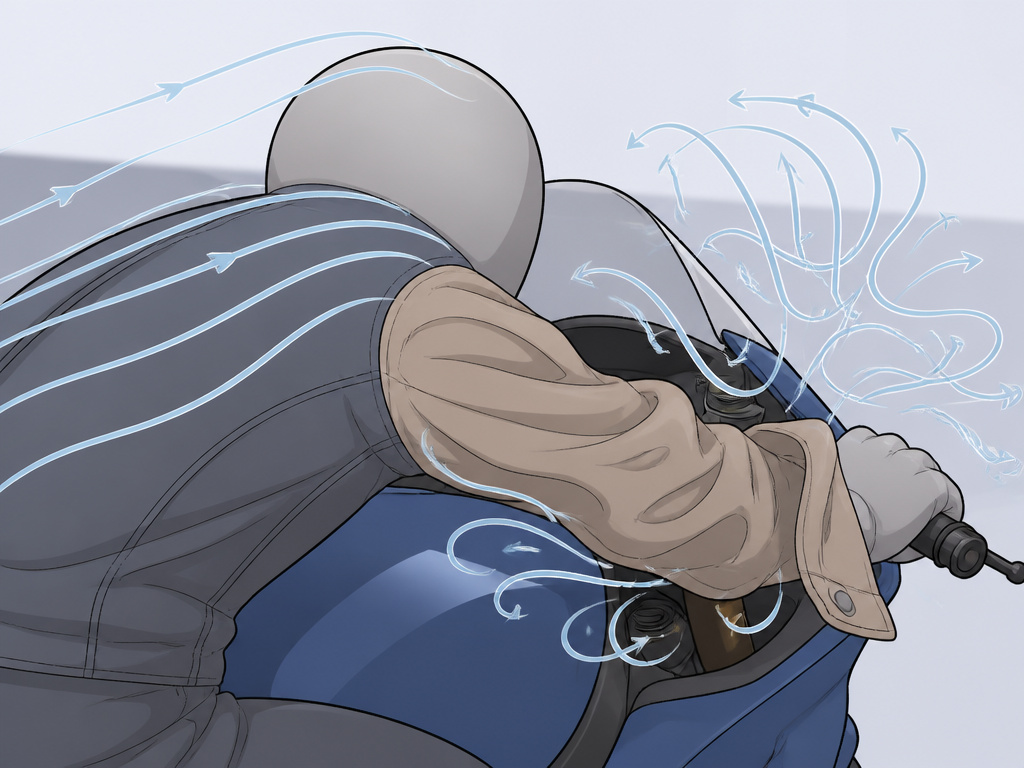
Wind resistance is the main force your engine fights at higher speeds. Tucking in reduces your frontal area, letting the bike cut through the air with less effort. Adding a windscreen can streamline airflow over both you and the motorcycle, but its effectiveness depends on your riding position and the screen’s design. Your riding gear matters too; loose, flapping jackets and bags create significant drag. Smooth, close-fitting gear helps you slip through the air. Since the fact sheet has no specific aerodynamic data, the principle is simple: a smaller, smoother profile requires less fuel to maintain speed.
Can Route Planning Improve Fuel Economy?
Absolutely. The most efficient ride is a steady one. Constant acceleration and braking in stop-and-go traffic burns fuel without covering much distance. Planning a route that avoids known congestion, traffic lights, and steep hills helps you maintain a consistent speed. Riding at a steady pace allows the engine to operate in its most efficient range. While the fact sheet doesn’t discuss routing, it does note that engine performance and fuel consumption are affected at high altitudes. The core idea is the same: minimizing variables that force the engine to work harder directly saves fuel.
Frequently Asked Questions
How much can I really improve my motorcycle’s fuel economy?
Realistic gains can be achieved through combined maintenance and riding changes. Dragging brakes, low tire pressure, and a neglected drive chain can significantly reduce fuel economy. Smoothing out a choppy throttle and anticipating stops can improve fuel economy. Chasing beyond 15% often requires drastic, impractical changes like changing sprocket gearing for pure highway cruising.
Is premium fuel worth it for better gas mileage?
Only if your owner’s manual requires it. Suzuki and Honda specify unleaded gasoline with an octane rating of 91 or higher. Using a lower octane than specified can cause engine knocking and potential damage. Using a higher octane than required provides no benefit for fuel economy or performance in a standard engine. The detergent packages are similar across grades.
Does cleaning my fuel injectors help with MPG?
It can, but only if they are dirty. Modern gasoline contains detergents that keep most injectors clean under normal use. If you have a performance issue like hesitation or rough idle, a fuel injector cleaner might help. For general fuel economy maintenance, ensuring you use quality fuel and keeping up with air filter and spark plug service is more impactful.
What is the single best riding habit for fuel economy?
Anticipation. Look as far down the road as possible and plan your throttle inputs. Instead of accelerating up to a red light and then braking hard, ease off the throttle early and coast. This conserves momentum, reduces brake wear, and directly saves fuel. It is the “dimmer switch” approach versus the “on/off” button.
