
Carburetor vs Fuel Injection on a Motorcycle
This post contains affiliate links. As an Amazon Associate, we earn from qualifying purchases.
Carburetor vs fuel injection: a carburetor mixes fuel and air using engine vacuum and mechanical circuits, while fuel injection uses a computer-controlled pump and injectors to spray pressurized fuel directly into the intake. Fuel injection is the standard on all modern street bikes and most competition off-road machines for its superior fuel efficiency, lower emissions, and consistent performance across varying conditions.
The key difference isn’t abstract; it’s in the pressure. A carburetor works on a vacuum of 0.04 to 0.05 MPa, while electronic fuel injection runs at 0.25 to 0.45 MPa. That 5-10x pressure jump is why FI can atomize fuel into a finer mist, leading to cleaner, more complete combustion. The real-world question isn’t which is better in a lab, but which is better for your bike, your budget, and your wrenching skills, making the debate of carburetor vs fuel injection on a motorcycle a practical one.
What follows: the raw mechanics of each system, the cold hard numbers on efficiency and emissions, a clear verdict on which bikes still use carbs, and the specific storage and tuning pitfalls that decide whether your next ride is a project or a daily driver.
Key Takeaways
- Fuel injection won the street bike war. Nearly 100% of new street motorcycles are fuel injected, with mandates for emissions compliance driving the change since 2010.
- Real-world cold-engine fuel economy favors fuel injection by a 7% to 18% margin over carburetors, based on Bosch testing of real-world urban drive cycles.
- Peak power isn’t a guaranteed win for FI. Early systems and emission-focused retrofits can trade top-end grunt for cleaner running, a trade-off less common with a well-jetted carb.
- Altitude and temperature changes require zero adjustment on a fuel-injected bike. The ECU compensates automatically, while a carburetor needs re-jetting.
- Long-term storage is the carburetor’s Achilles’ heel. Ethanol fuel gums up jets and passages; a quality fuel stabilizer is non-optional, and it only works if run through the system before storage.
The Core Difference: How Each System Works
Look at the business end of an engine. For a carburetor, it’s a brass-and-aluminum box bolted between the airbox and the cylinder head. For fuel injection, it’s a black plastic throttle body with a wiring harness and a fuel line. The visual tells you everything about the mechanical reality inside.
A carburetor is an analog air-flow calculator. It uses the engine’s own intake vacuum, about 0.04 to 0.05 MPa, to pull fuel from a bowl through precisely sized jets. It has five separate circuits to handle different jobs: a Main jet for wide-open throttle, a Mid-Range circuit for cruising, an Idle circuit, an Accelerator pump for throttle snaps, and a Choke for cold starts. The pilot who gets all those circuits perfectly balanced for your altitude, temperature, and humidity earns his pay. Get one wrong, and the bike runs rich, lean, or just won’t start.
Where this goes sideways: Assuming a carburetor is “set and forget.” A significant change in elevation or temperature can push the air-fuel mixture outside the optimal window, requiring a jet change or at least an adjustment screw turn. The bike will still run, but poorly, hesitating on throttle roll-on or surging at steady cruise.
Fuel injection replaces vacuum with voltage. An electric pump pressurizes fuel to 0.25–0.45 MPa and sends it to injectors mounted in the intake manifold. An Engine Control Unit (ECU) acts as the brain, reading inputs from sensors, throttle position, engine temperature, intake air temperature and pressure, crankshaft position, and deciding exactly how long to hold each injector open. The Hyosung service manual notes its ECU makes hundreds of changes per second. This is closed-loop control: oxygen sensors in the exhaust pipe report back, allowing the ECU to adjust the mixture on the fly for the cleanest burn.
The hands-off nature is the killer app. You can ride across large changes in altitude or temperature, and the bike adapts without a hiccup. There are no jets to swap, no screws to turn. That’s why, as the Fox Motorcycle Institute training material states, by 2010 all street bikes were required to have fuel injection. An EPA compliant engine turning 5,000 rpm would require 2,500 perfect air-fuel mixtures per minute in a four-stroke engine.
Performance and Power Delivery: The Trade-Off
Everyone assumes fuel injection means more power. The data says it’s more complicated.
For modern, clean-sheet OEM designs, FI usually wins. It meters fuel more precisely, can deliver extra fuel for cooling under high load, and supports advanced strategies like ram-air pressure compensation. But history and retrofit projects show a different story. When Honda introduced fuel injection on the 2009 CRF450, the motocross press was underwhelmed. Motocross Action Magazine’s testers said the fuel-injected version “didn’t hit as hard in the middle, make as much horsepower on top, or deliver excess fuel when needed compared to EFI.” In their opinion that year, it was not better than a well-jetted carburetor. Similarly, a retrofit study using OEM Yamaha parts found a minor reduction in peak torque and power compared to the original carburetor.
Why? Early FI mapping was conservative, often optimized for emission compliance and smoothness over raw power. A retrofit study using OEM Yamaha Vixion parts on a carbureted engine confirmed this trade-off. While the conversion significantly improved fuel economy and reduced HC and CO emissions, it also resulted in a minor reduction in peak torque and power output. The researchers pinned the blame on the OEM ECU’s conservative, emission-optimized fuel and ignition maps.
| Scenario | Likely Winner (Power) | Why |
|---|---|---|
| Modern OEM Sportbike | Fuel Injection | Advanced mapping, precise control, compensates for atmospheric changes. |
| Early FI Adoption (Pre-2010) | Well-Jetted Carburetor | Conservative OEM mapping prioritized smoothness/emissions over peak output. |
| DIY Retrofit / Conversion | Carburetor (or needs Programmable ECU) | OEM donor ECUs are mapped for different engines, often losing peak power. |
| High-Altitude Riding | Fuel Injection | Automatic compensation; carburetor requires re-jetting, often to a leaner state that can cost power. |
The feel is different, too. A perfectly dialed carburetor can have a sharper, more immediate throttle response, the “hit” that riders love. Fuel injection, by design, is often smoother, with progressive power delivery that can feel deceptively slow. That smoothness is why a rider jumping from a carbureted 2003 YZ250F to a fuel-injected 2020 model might think the new bike is slower. It’s not; it’s just not delivering the power in the same explosive package.
Fuel Economy and Emissions: The Numbers Don’t Lie
This is where fuel injection’s precision pays the bills, especially in the real world where engines are rarely fully warmed up.
A Bosch-led study compared a 125cc motorcycle with a constant vacuum carburetor against port fuel injection (PFI) using real-world drive cycles from places like Bangalore. The result? Under urban driving with a cold engine, the carburetor showed 12% to 17% higher fuel consumption. The researchers concluded the real-world benefit relevant to most riders is between 7% and 18%. They also noted this disadvantage diminished once the engine was fully hot, but in city traffic, the engine often doesn’t reach that ideal temperature.
Emissions are the other half of the regulatory equation. An experimental conversion of a Honda Wave 125cc from carburetor to EFI recorded dramatic drops: CO reduced by 62.6% to 75.86%, Hydrocarbons (HC) by 29.75% to 30.1%, and CO2 by 11.33% to 47.71% across different load tests. Another study on a 110cc CVT bike found EFI produced better quality emission gas, with decreases in CO and HC and increases in CO2 and O2 above 2000 rpm due to more complete, leaner combustion.
A carburetor simply cannot produce an acceptable low level of emissions with respect to today’s strict emissions standards. It is not smart enough or fast enough to create a perfect combustion mixture thousands of times per minute. Fox Motorcycle Institute training material
The math forced the industry’s hand. Meeting modern EPA and Euro standards with a carburetor is nearly impossible, which is why its use on new road-going vehicles has all but vanished.
Reliability, Maintenance, and Cost of Ownership
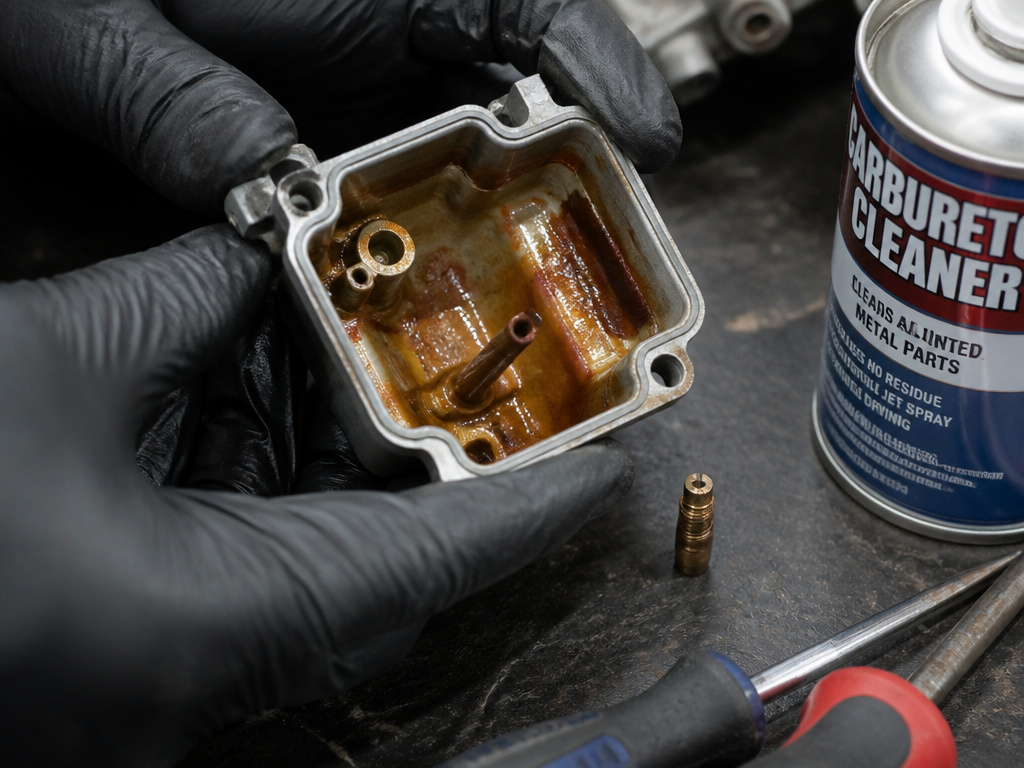
Simplicity is the carburetor’s last bastion. Its components are mechanical: floats, needles, jets, springs. When it fails, you can often see why, a clogged jet, a stuck float, a worn diaphragm. The parts are cheap, and a carburetor cleaning can be a satisfying afternoon project with basic tools and a can of carburetor cleaner. The downside is that it needs that maintenance. Ethanol-blended fuel leaves behind a varnish that clogs tiny passages. Leaving a bike with a half-full carbureted tank over winter is a guaranteed springtime repair.
I learned this the hard way. Parked a bike with untreated fuel for four months. The float bowl had an amber, tacky film and one pilot jet was half-blocked. The cleaning job cost me a weekend. A ten-dollar bottle of fuel stabilizer run through the system first would have saved it.
Fuel injection trades mechanical complexity for electronic reliability. There are fewer moving parts in the fuel delivery itself, just the pump and injector solenoids. The system is sealed, so fuel doesn’t evaporate or gum up in the same way. The major maintenance item is keeping the fuel clean; a periodic fuel injection cleaner run through the tank can help. But when an FI system fails, it’s often a sensor or the ECU itself. Diagnosis requires a multimeter, possibly a scan tool, and a more nuanced understanding of electronics. The parts are also more expensive. A new throttle position sensor can cost what an entire carburetor rebuild kit does.
| Aspect | Carburetor | Fuel Injection |
|---|---|---|
| Initial Purchase Cost | Lower (simpler components) | Higher (pump, injectors, ECU, sensors) |
| Diagnostic Complexity | Medium (mechanical inspection) | High (requires electrical knowledge, scan tools) |
| Common Failure Points | Clogged jets, stuck floats, worn diaphragms | Failed fuel pump, clogged injectors, faulty sensors |
| Tuning Flexibility (DIY) | High (jet kits, adjustable needles) | Low (requires software, often locked ECUs) |
| Long-Term Storage Risk | High (fuel gumming) | Medium (pump/injector seals can dry) |
For the home mechanic on a budget, a carbureted bike is more accessible. For the rider who wants to get on and go for years with minimal tinkering, fuel injection is the clear choice. It’s the difference between a relationship and a appliance.
Which Motorcycles Still Use Carburetors Today?
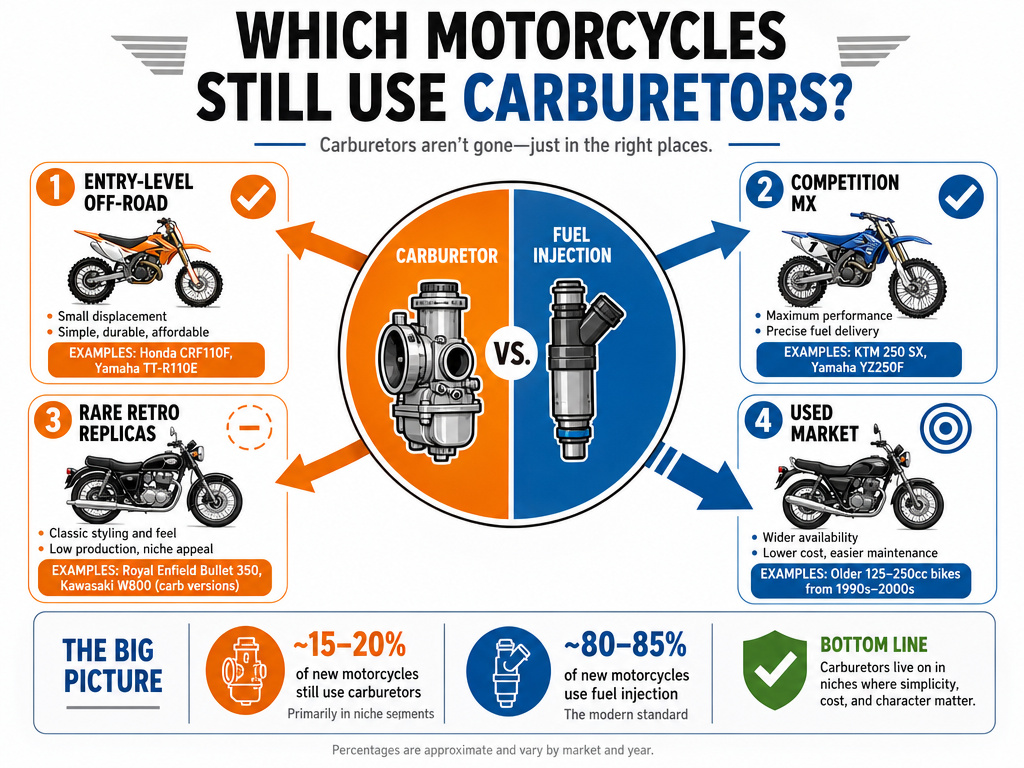
Look at a dealership floor. For street bikes, the answer is virtually none. The Fox Motorcycle Institute material is clear: Nearly 100% of street motorcycles currently manufactured today are fuel injected. The shift happened rapidly; BMW was using Bosch systems on the K100 in the 1980s, Ducati had the 851 with Magnetti Marelli injection in 1987, and Kawasaki pioneered it with the KZ 1000 in 1980. By 2010, emissions laws sealed the deal.
The last holdouts are in specialized niches: – Small-Displacement Off-Road & Dirt Bikes: Some entry-level trail bikes aimed at beginners or markets with extreme cost sensitivity still use carbs. They’re cheaper to produce and simpler for low-tech repairs.
- Competition Motocross: This one flipped. As of 2013, all competition motocross bikes in the 250cc and 450cc classes from the four major Japanese manufacturers are equipped with fuel injection. The performance and consistency benefits outweighed the cost for this premium segment.
- Vintage & Retro Replicas: Some modern bikes designed to mimic classic aesthetics might use a carburetor for authenticity, but this is exceedingly rare.
- The Used Market: This is where you’ll find them. Any street bike from the mid-2000s or earlier is likely carbureted. Many popular street bikes from the mid-2000s or earlier are carbureted.
If you’re buying new, you’re almost certainly getting fuel injection.
Making the Choice: What’s Right For Your Garage?
The debate of carburetor vs fuel injection on a motorcycle isn’t really about which technology is superior in a vacuum. It’s about matching a system to your priorities.
Choose a Carbureted Motorcycle If:
- Your budget is tight, and you’re shopping the used market (pre-2007).
- You enjoy mechanical tinkering and view maintenance as part of the hobby.
- You have a simple, older bike for which tuning is straightforward.
- You live in a stable climate and don’t ride across significant elevation changes.
- You are disciplined about using fuel stabilizer and proper storage.
Choose a Fuel-Injected Motorcycle If:
- You value convenience and consistent performance above all else.
- You ride in varied climates or regularly change altitude.
- You want the best possible fuel economy and lowest emissions.
- You are buying a modern bike, especially one with performance aspirations.
- Your diagnostic skills extend to a multimeter and you’re comfortable with more complex systems.
For the vast majority of riders today, fuel injection is the better answer. It’s why the industry abandoned the carburetor. The fuel efficiency gain is real, the emissions benefit is legally mandatory, and the hassle-free operation is a tangible quality-of-life improvement. But for the hobbyist, the restorer, or the bargain hunter, the carburetor’s simplicity and repairability keep it alive in countless garages. It’s not obsolete; it’s just niche.
How modern fuel affects carburetors and fuel injection
Modern fuel with ethanol is tough on carburetors. The alcohol attracts moisture, leading to corrosion inside the small jets and passages. When the bike sits, the fuel evaporates and leaves behind a sticky varnish that clogs these circuits. A gummed-up carburetor will cause poor starting, rough idle, and hesitation. Fuel injection systems handle modern fuel better due to their sealed, pressurized design, but they are not immune. Injectors can still clog from deposits if the bike is stored for long periods with untreated fuel. For any motorcycle, using a fuel stabilizer and running the engine periodically is the best practical defense against fuel-related problems.
Frequently Asked Questions
Is a fuel injected motorcycle better than a carbureted motorcycle?
For most riders and most use cases, yes. Fuel injection provides better fuel economy (7-18% in real-world studies), significantly lower emissions, and automatically adjusts for altitude and temperature changes. It’s more reliable for daily use and long-term storage with modern fuel. The only areas where a carburetor might be considered “better” are in extreme low-cost applications or for enthusiasts who enjoy and are skilled at mechanical tuning.
Which new motorcycles still use carburetors?
Virtually none for the street. The Fox Motorcycle Institute material states nearly 100% of street motorcycles currently manufactured are fuel injected. Some very small-displacement, off-road-only trail bikes or niche vintage replicas might still employ them, but they are exceptions. The used market is where carbureted bikes dominate.
When did motorcycles stop using carburetors?
The transition was gradual but accelerated due to emissions regulations. Landmark fuel-injected models appeared in the 1980s (Kawasaki KZ1000, BMW K100). A major turning point was around 2010, when all street bikes were required to have fuel injection.
Can I convert my carbureted bike to fuel injection?
Yes, but it’s a significant project. Kits and retrofit solutions exist. One study used OEM Yamaha components (Vixion ECU, Jupiter Z1 injector and pump). Be aware of a potential performance trade-off: one study of such a retrofit found it improved fuel economy and reduced emissions but also caused a minor reduction in peak torque and power due to conservative OEM mapping, while general manufacturer positioning often claims FI is superior in all performance aspects.
How do I tell if a motorcycle is carbureted or fuel injected?
Look for three things:
- Fuel Lines: Carbureted bikes have small-diameter fuel lines running from the tank to one or more carburetors mounted between the engine and airbox. Fuel-injected bikes have a high-pressure fuel line (often with a ribbed rubber cover) running to a fuel rail or throttle body.
- Throttle Cables: Carbureted bikes have one or two physical cables (push/pull) running from the throttle grip directly to the carburetor(s). Fuel-injected bikes have an electronic connection to the throttle body.
- The Component Itself: A carburetor is a recognizable, finned metal box with screws and bowls. A throttle body for FI is usually a sleek, black aluminum or plastic housing with a single electrical connector and an injector sticking out of it.
The Bottom Line
Forget the hype about which system is “better” in absolute terms in the carburetor vs fuel injection on a motorcycle question. Your choice today is almost always dictated by the era of bike you’re buying. Want a modern machine with turn-key operation and compliance? You’re getting fuel injection. Drawn to the character, simplicity, and lower entry cost of an older classic? You’re getting a carburetor.
The essential rule for both systems is preparing the engine for storage. Whether you use a fuel stabilizer religiously, letting today’s ethanol fuel sit untreated is the surest way to turn a minor maintenance item into a major repair. Everything else, the power delivery nuances, the fuel savings, the diagnostic headaches, is just detail. Choose the bike that fits your riding life, then maintain the system it came with. The rest is just noise.
