
How Do Motorcycle Airbag Vests Work? The Two Main Systems
This post contains affiliate links. As an Amazon Associate, we earn from qualifying purchases.
Motorcycle airbag vests work by detecting a crash and inflating a protective bladder around your torso, neck, and back within milliseconds. Electronic systems use sensors (accelerometers and gyroscopes) to trigger a gas canister. Tethered systems deploy when a lanyard connected to your bike pulls a mechanical trigger. The inflated bag spreads impact forces to reduce the risk of broken ribs, collarbones, and spinal injuries.
The difference between those two triggers is the whole game. One relies on a $5 cable and a yank. The other uses a tiny computer analyzing your motion a thousand times a second. Both get the job done, but they fail in different ways and cost you differently over the life of the vest. To understand this, it helps to know how do motorcycle airbag vests work.
What follows is a walk through the sensors, the gas, and the physics of how do motorcycle airbag vests work. By the end, you’ll know why a vest can save your collarbone but won’t help your wrist, and how to pick a system that fits your actual riding.
Key Takeaways
- Electronic systems deploy before impact using predictive algorithms, while tethered systems only trigger after separation from the bike.
- The Dainese D-air® airbag must remain at a minimum protective pressure for at least five seconds after deployment, with pressure typically lasting 30–60 seconds depending on the model.
- You can replace only the gas canister after a deployment on most systems, but the airbag bladder itself has a finite life, usually 3 deployments.
- A low battery or a loose tether means a vest that’s just a heavy sweater. You must do the pre-ride check.
- For most street riders, a standalone electronic vest offers the broadest protection and works with any jacket that fits over it.
The Two Main Systems: Tethered vs. Electronic
You have two paths to an inflated vest. The cheaper, simpler one has been around for decades. The smarter, pricier one is what MotoGP riders trust.
Tethered vests use a physical lanyard, usually a coiled cable, that clips to your motorcycle’s frame. When you fall and separate from the bike, the lanyard pulls taut and yanks a mechanical pin. That pin triggers a CO2 canister, flooding the airbag bladder with gas. The entire sequence, separation, pull, inflation, happens rapidly.
The part nobody mentions: A tethered system cannot deploy until you are physically separated from the motorcycle. In a low-side where you slide with the bike, or a collision where you stay mounted, the lanyard never gets the pull it needs.
Electronic systems ditch the cable. A small electronic control unit (ECU) sewn into the vest houses the brain: a combination of accelerometers and gyroscopes. The Alpinestars Tech-Air 10 system, for example, packs three triaxial accelerometers and one triaxial gyroscope. This sensor array monitors your body’s movement in three dimensions.
Systems like In&motion analyze data at 1,000 times per second. It’s looking for motion patterns that match a crash: a sudden, violent rotation combined with a rapid deceleration. When it sees that signature, it sends a signal to fire the inflator. For systems like In&motion, the whole process, from detection to full inflation, takes less than 60 milliseconds.
Electronic systems inflate that fast, so they are ready before you hit the ground. The protection is already in place at the moment of first impact. This is the core advantage, and it’s why serious riders lean electronic.
| System Type | Trigger Mechanism | Deployment Speed | Best For | Main Limitation |
|---|---|---|---|---|
| Tethered | Physical lanyard pull | ~300-500 ms | Commuters, tourers, budget-conscious riders | Only works after rider-bike separation |
| Electronic | Sensor algorithm | ~45-60 ms | Sport riding, track days, riders wanting pre-impact protection | Requires battery charging and periodic servicing |
Inside the Brain: How Sensors Decide to Deploy
An electronic vest’s ECU is a marvel of miniaturization. It’s not just counting G-forces. It’s building a real-time model of what normal riding looks like for you.
When you first zip up a system like the Alpinestars Tech-Air 3, it enters a calibration mode. It needs to feel you walk, mount the bike, and start riding. Standing still or sitting on an idling bike won’t pass this check. The system is learning your baseline so it can ignore normal bumps, hard braking, and aggressive cornering.
The algorithm is looking for impossible motions. A high-side crash, where the bike flips and throws you over the top, creates a sharp vertical rotation. A low-side slide involves a sudden lateral roll. The sensors measure both the rate and the axis of this rotation. When the values exceed a carefully calibrated threshold, the verdict is “crash.”
The Dainese D-air® system’s electronic control unit is equipped with a GPS detector, accelerometer, and gyroscope. The GPS helps the system understand context, like whether you’re on a track or a public road, to fine-tune its sensitivity.
This is not a simple G-force switch. If it were, every pothole or curb check would set it off. The software has to be sophisticated enough to ignore a crash-like event that happens to the bike but not your body, like a tank-slapper you manage to save. Riders don’t realize how much logic is packed into that little black box.
Step 3: The Deployment Sequence
When the algorithm says “go,” the response is instantaneous and violent.
An electrical signal fires a pyrotechnic gas inflator. Think of a shotgun shell, but instead of pellets, it releases pressurized argon or CO2. This isn’t a slow fill. The gas charges into the airbag bladder, which is made from a tough, tear-resistant nylon material. Brands like Dainese use a patented microfilament technology inside the bag to control its shape and prevent balloon-like deformation.
The bag is strategically folded and sewn into chambers that direct its expansion. It’s designed to inflate around, not over, your existing armor. You’ll feel a hard shove against your chest and back as it pops. The deployment creates a distinct sound, often described as a loud WHUMPH.
Once inflated, the bag must do its job. Certification standards require it to maintain a minimum protective pressure for at least five seconds. This ensures it can absorb the energy of a multi-impact crash, like a tumble. In reality, they hold pressure longer. Dainese states its Street airbags (vests) begin to lose pressure after about 60 seconds; its Racing suit airbags deflate after about 30 seconds.
The bag spreads the impact energy from a point, like your collarbone hitting the pavement, across the entire surface area of the bag on your torso. It can significantly reduce impact forces on covered areas. This is why they’re so effective against thoracic injuries. One source cites that among users injured on two-wheeled motor vehicles, 17% are considered very serious injuries, of which 75% affect the thorax.
What Happens After a Crash
The ride isn’t over when you slide to a stop. Your vest is now a deflated, bulky garment with a spent cartridge inside. Here’s the reset drill.
First, check yourself. The vest did its job, but you might still be hurt. Once you’re safe, you’ll need to deal with the gear. A deployed electronic vest will show a solid red light on its LED display. The system is locked out until serviced.
For most major systems, you don’t need a whole new vest. You need a gas canister replacement. Alpinestars states its Tech-Air 5 airbag bladder is tested to withstand at least 3 deployments, but requires specific service procedures after each one. After each one, you can replace just the canisters for the first two incidents, provided a pressure test verifies the bladder’s integrity. On the third deployment, a full service, replacing both canisters and the bladder, is mandatory.
In&motion takes a similar stance, stating its vest is designed to withstand three inflations without a mandatory return to the manufacturer, as long as a post-inflation inspection is done.
This is where cost of ownership gets real. A replacement gas canister for a tethered system and a new inflator cartridge for an electronic system incur costs, with electronic system parts typically being more expensive. You’ll ship the vest to an authorized service center. The service process takes time and incurs costs for parts and labor.
Where this goes sideways: Trying to reset a system yourself without the proper tools or test equipment. A bladder with a micro-tear you can’t see will fail to inflate on the next crash. That’s a $800 mistake that looks like a broken rib.
Practical Limitations and What an Airbag Won’t Do
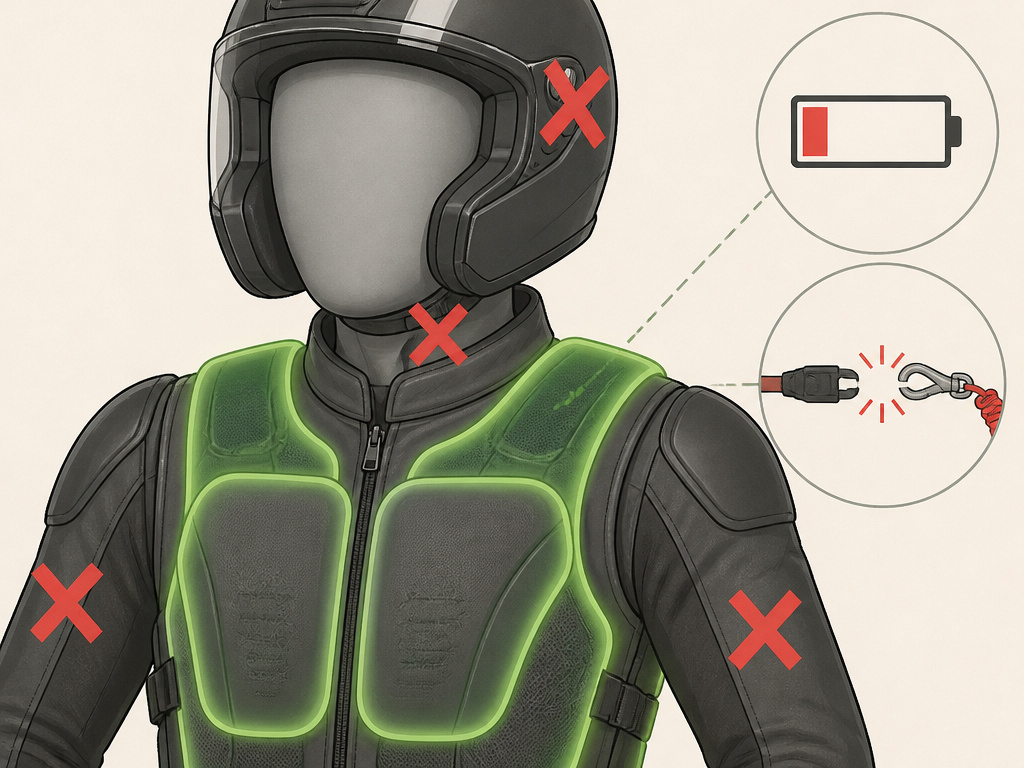
An airbag vest is a brilliant piece of safety gear. It is not a force field.
The protection zone is specific: shoulders, collarbones, chest, ribs, and full back. Your arms, legs, neck (above the collar), and head are completely unprotected. You still need a full-face helmet, a armored jacket, gloves, and riding pants with knee and hip protection. The vest is a supplement, not a replacement.
Deployment isn’t guaranteed in every scenario. As noted in Alpinestars’ own manual, if you collide with your own motorcycle’s windscreen or handlebars before the sensors finish their analysis, the airbag won’t help. Certain crash geometries can defeat the algorithm.
There are also environmental limits. Outside those ranges, sensor accuracy or battery performance can drop. Most systems also have an altitude limit, the Tech-Air 10 shouldn’t be used above 4,000 meters.
Finally, remember the human factor. An electronic vest with a dead battery is a very expensive windbreaker. A tethered vest with an unclipped lanyard is just a vest. The gear only works if you do the simple, boring maintenance.
The Pre-Ride Checklist: Making Sure It Actually Works
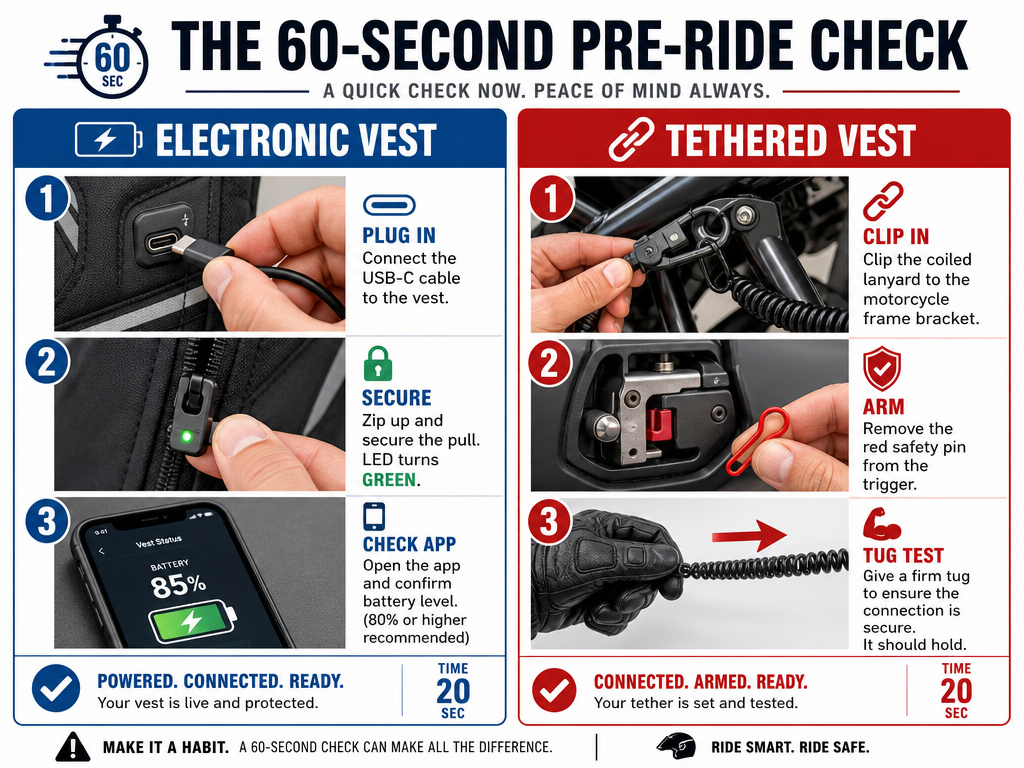
Trust the system, but verify it every single time. This takes 60 seconds.
For Electronic Vests:
- Charge: Plug it in the night before a big ride. Use only a charger compliant with EN 62368-1 standards (most quality phone chargers are).
- Zip & Check: Close the activation zip fully. You should feel a short vibration (~1 second) and see the LED display light up with a solid color (usually green or blue) indicating “system on.”
- App Sync (Optional): Pair with the brand’s app if you have it. This can show battery percentage, firmware status, and let you force the system off for off-road riding. You can’t turn it back on via the app, though, you have to re-zip.
For Tethered Vests:
- Clip In: Attach the lanyard to a solid, non-moving point on your motorcycle’s frame. Test that the coil can extend fully without snagging.
- Visual Inspection: Look at the trigger mechanism. Ensure the safety pin is removed (if applicable) and nothing is obstructing the pull cord.
- Tug Test: Give the lanyard a firm, quick pull to ensure it’s securely fastened to both you and the bike. It should come free with a clean break-away force.
Skip any of these, and you’re betting your collarbone on a hope.
What is it like to crash with an airbag vest?
Riders who have experienced a deployment often report the inflation as a sudden, firm hug. The airbag must stay inflated at protective pressure for several seconds to cushion the initial impact and any secondary tumbles. After that, it will slowly deflate over the course of about a minute for street gear, or faster for racing suits. Following a crash, the system needs service. Some vests are designed to withstand a few deployments with just a canister change and an inspection with a pressure test tool, while others require a full service after a set number of uses. Always check your specific system’s manual for post-crash procedures.
Frequently Asked Questions
Are airbag vests one-time use?
No. After a deployment, you typically only need to replace the gas canister (inflator). The airbag bladder itself is rated for multiple deployments, often three. Each deployment requires a professional inspection and reset, which costs money, but the vest itself is reusable.
How much does it cost to reset an airbag vest?
Resetting a deployed electronic vest typically costs between $250 and $400. This covers the replacement gas inflator cartridge, labor, shipping, and a system diagnostic. Tethered system cartridge replacements are cheaper, often $30-$80 for the part, and can sometimes be done by the rider.
How effective are motorcycle airbag vests?
Extremely effective for the body areas they cover. Studies and real-world data show they dramatically reduce the risk of broken ribs, collarbones, spinal fractures, and internal organ injury. They are considered the single most effective piece of protective gear for the torso after the helmet.
Can you wear an airbag vest over any jacket?
You can wear it over any jacket that is not too tight. The outer jacket must be loose enough to allow the airbag to fully inflate (about 4-6 inches of expansion) without restriction. A jacket that’s too tight can pin the bag, reducing protection and increasing pressure on your body. Always check the vest manufacturer’s guidelines for layering.
Before You Go
An airbag vest changes the physics of a crash for your most vulnerable area. This is the simple, central idea behind how motorcycle airbag vests work. It turns a concentrated, bone-breaking impact into a distributed shove you can walk away from.
One final rule. However much you spend, the vest is only as good as your last pre-ride check. Charge it. Clip it. Zip it. That ten-second habit is what makes the whole system real.
