
Can You Wear a Motorcycle Airbag Vest OVER Any Jacket?
This post contains affiliate links. As an Amazon Associate, we earn from qualifying purchases.
Whether you can wear a motorcycle airbag vest over a jacket depends on the specific model. The Alpinestars Tech-Air 3 (Leather) is specifically designed to be worn OVER any protective garment, while the Dainese Smart Air is a versatile garment you can wear over or under any jacket. The Alpinestars Tech-Air 3 (Leather) is built for this. The Dainese Smart Air is a versatile garment that can be worn over or under any jacket, but if worn underneath, the outer garment must allow it to inflate. The far more common Alpinestars Tech-Air 5 and Tech-Air 10 are not abrasion-resistant, they must be worn under a jacket, and that jacket needs a minimum of 4 cm (1.6 inches) of extra space around your chest to let the airbag inflate.
For the Alpinestars Tech-Air 5, the 4 cm rule is critical when worn under a non-ready jacket. It’s not a suggestion. A tight jacket can restrict deployment, reducing protection. This leads to a common question: can you wear a motorcycle airbag vest over any jacket?
What follows is a breakdown of which vests go where, the exact measurement you need to take on your current jacket, and what happens when you get the layering wrong. This process focuses on matching the product’s design to your gear so the safety system you paid for actually works, rather than brand preference.
Key Takeaways
- The 4 cm (1.6 inch) chest clearance is mandatory for wearing an under-jacket vest like the Alpinestars Tech-Air 5 or 10 with a non-ready jacket. Skip this, and the airbag can’t inflate.
- Only abrasion-certified vests are designed as outer garments to be worn over a jacket. The Alpinestars Tech-Air 3 (Leather) is EN 17092 certified. The Dainese Smart Air is a versatile garment that can be worn over or under any jacket.
- Wearing a non-abrasion-resistant vest over a jacket exposes it to damage and is not its intended use. A vest like the Tech-Air 5 is not abrasion resistant and must be worn under an outer protective garment.
- After two deployments, a Tech-Air 5 needs a full service (canister and bladder replacement for $299), not just a $179 canister swap.
- Fit your outer jacket to the vest, not the other way around. If your vest is sized for under-jacket wear, buying a larger jacket is cheaper than a new vest or a hospital bill.
The 4 cm Rule That Decides Everything
For vests designed to be worn under a jacket, which is most of them, a single measurement decides if your current gear is compatible. The Alpinestars Tech-Air 5 fitment guide states it needs a minimum of 4 cm (about 1.6 inches) of extra room around the rider’s chest circumference when worn under a jacket that isn’t a “Tech-Air Ready” model.
A properly fitting under-jacket airbag vest requires the outer garment to have sufficient space to accommodate inflation. For the Alpinestars Tech-Air 5, this is defined as 4 cm (1.6 inches) of clearance around the chest when the vest is worn. Insufficient space can restrict deployment, reducing protection and increasing the risk of injury.
This rule is based on physics, not comfort. The airbag needs volume to inflate and create a protective cushion. If your jacket is too tight, it can restrict the airbag’s deployment, reducing its effectiveness.
Here’s how to check your jacket. You need a helper and a soft tape measure.
- Put on everything you ride with. This means your normal base layer and the airbag vest, powered on.
- Stand in your riding posture. Sit on your bike or mimic the stance, arms forward, back slightly rounded.
- Have your helper measure your chest. Wrap the tape around the widest part of your chest, over the vest. Don’t pull it tight; just let it sit snugly. Note this number (e.g., 110 cm).
- Now measure the jacket’s chest. Zip and close all the jacket’s closures. Lay it flat on a table, smooth out any wrinkles, and measure straight across the chest from armpit seam to armpit seam. Double this number (if it’s 57 cm across, the jacket’s chest circumference is ~114 cm).
- Do the math. (Jacket circumference) minus (Your vested chest circumference). Is the difference at least 4 cm? If not, the jacket is too tight for safe use with that vest.
| Jacket Type | Tech-Air 5/10 Compatible? | Critical Check |
|---|---|---|
| Standard Leather Jacket | Only if it has ≥4 cm chest clearance | Must be measured in riding posture with vest on. |
| “Tech-Air Ready” Leather | Yes, no extra clearance needed | Manufacturer has pre-built the necessary space. |
| Textile / Mesh Jacket | Usually, but must be measured | These often have more give, but measure to be sure. |
| One-Piece Race Suit | Only if specifically designed for it (e.g., Tech-Air 10) | Must accommodate vest in torso and hips. |
The jacket that fit you perfectly before the vest is now too small. That’s the required trade-off. The alternative is a jacket specifically engineered as “Tech-Air Ready,” where the manufacturer has already designed that expansion space into the pattern.
The Over-Jacket Contradiction: Tech-Air 3 & Dainese Smart Air
Most vests go under. Two major exceptions flip the script, and they do it for opposite reasons. This is where the blanket advice from forums falls apart.
The Alpinestars Tech-Air 3 (Leather) is built like a jacket. Its manual states it is “specifically designed to be worn OVER any protective garment.” The key is the leather outer shell, which carries an EN 17092 certification for abrasion resistance. However, it provides only limited impact protection in the covered areas and is not a substitute for other protective gear.
The Dainese Smart Air takes a different path. Dainese calls it a “versatile, independent garment, you can wear it over or under any jacket.” Its design is a hybrid, it’s not a certified outer garment like the Tech-Air 3, but Dainese engineered it to be flexible. If you wear it underneath, they specify the “outer garment needs to allow Smart Air to inflate and expand.” So the 4 cm rule still applies in that configuration.
Where this goes sideways: Assuming any vest can be worn over a jacket because you saw one model that allows it. The Tech-Air 5 and 10 have zero abrasion resistance. Wearing them over a jacket leaves the vest’s critical sensors and airbag bladder exposed to direct impact and road abrasion, which can cause catastrophic failure.
Why would brands have such different rules? It comes down to product segmentation and intended use. Alpinestars sells the Tech-Air 3 as an all-in-one solution for riders who don’t want to buy a new jacket. They sell the Tech-Air 5 as an upgrade for riders who already own a jacket they love. Dainese, with the Smart Air, is betting on flexibility as the primary selling feature.
What Happens When You Layer It Wrong?
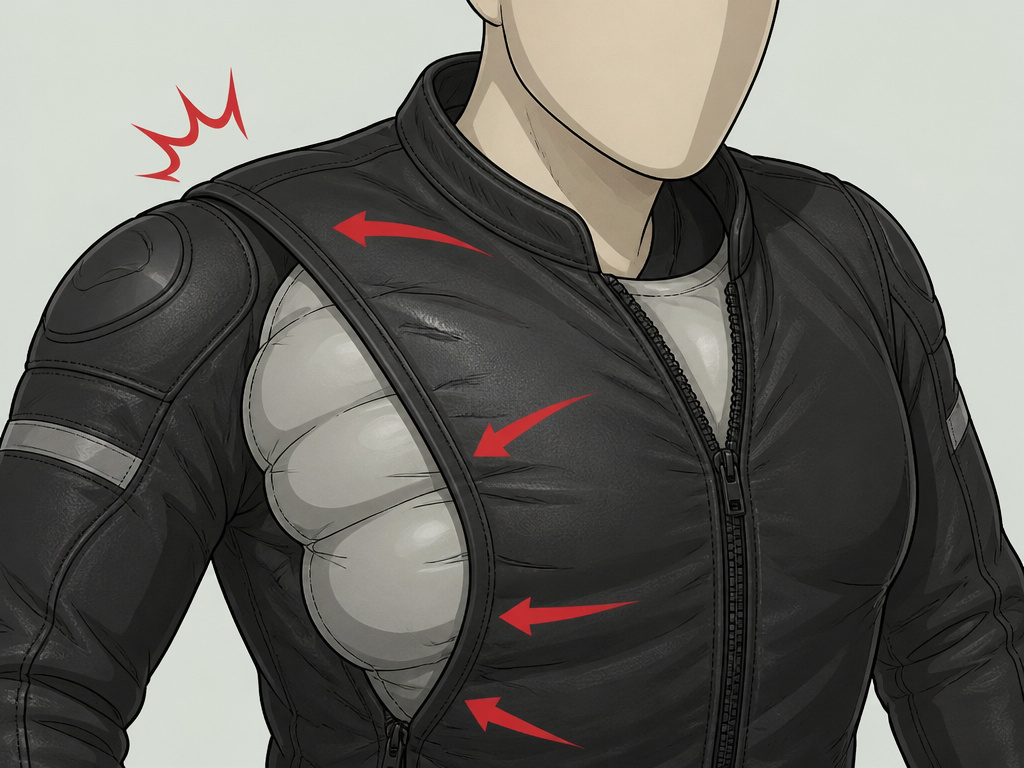
Getting the order wrong isn’t a style foul. It directly compromises the safety you paid for. The consequences are mechanical and immediate.
If you wear a non-abrasion-resistant vest (like a Tech-Air 5) over your jacket, you create two failure points. First, the vest’s soft outer shell provides no slide protection. In a crash, it will shred instantly, potentially tangling the airbag bladder. Second, the vest’s electronic control unit and sensors are now on the outside, vulnerable to a direct impact that could damage them before they even trigger.
If you wear any vest under a jacket that’s too tight, you risk restricted deployment. The airbag needs to inflate to a specific pressure and volume to be effective. A tight jacket acts like a clamp. This can cause uneven inflation, leaving areas unprotected. In a worst-case scenario, the extreme pressure against a rigid jacket seam could even rupture the airbag bladder.
The sensor logic can also be fooled. Some systems, like the Tech-Air, use a network of accelerometers and gyroscopes that read movement 1,000 times per second.
Step-by-Step: Choosing and Fitting Your Vest-and-Jacket Combo
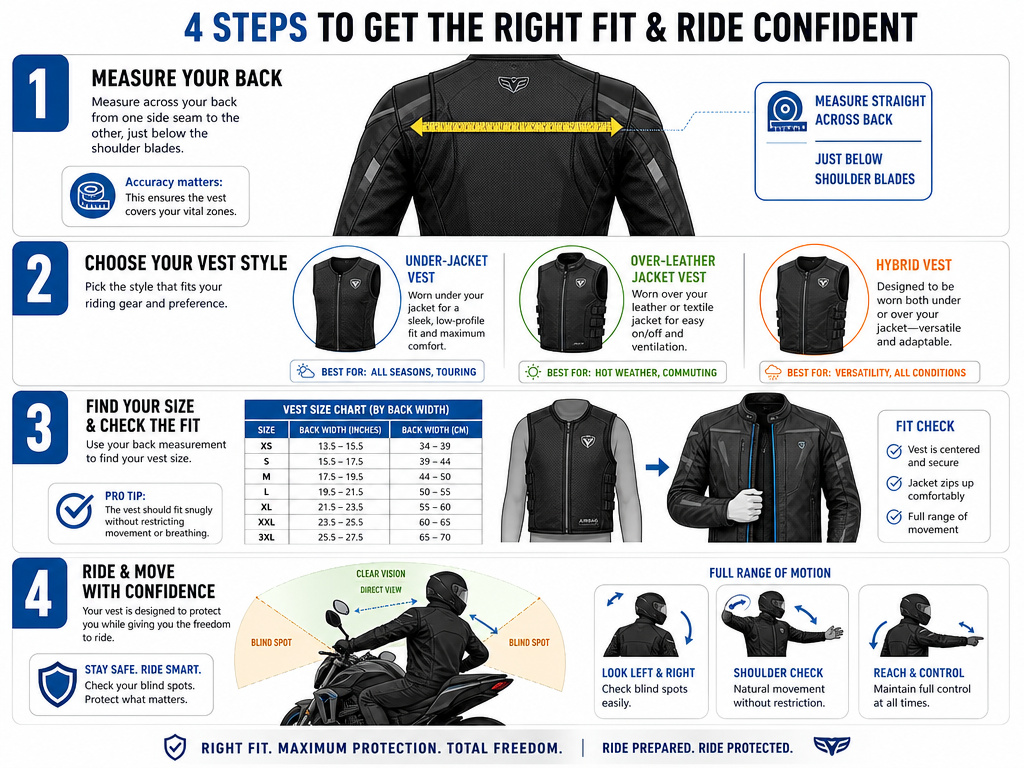
Don’t start with the vest. Start with your closet and your riding style. This sequence keeps you from buying a system you can’t use.
1. Audit Your Current Jacket.
Take the 4 cm measurement described earlier. Be brutally honest. If your favorite jacket fails, you have two choices: retire it from use with an airbag vest, or buy a new jacket that is either “Ready” or large enough.
2. Match the Vest Type to Your Riding Wardrobe.
- If you have a jacket you love and it passes the 4 cm test: An under-jacket vest like the Alpinestars Tech-Air 5 is your logical upgrade path.
- If you don’t want to replace your jacket and ride mostly on-road: The Alpinestars Tech-Air 3 (Leather) is the over-jacket solution. Remember to match its size to your jacket size.
- If you want maximum layering flexibility across seasons: The Dainese Smart Air is built for that “over or under” promise, but you still must respect fit rules for each mode.
3. Size the Vest First, Then the Jacket.
This is the most common mistake. People buy a vest, try it under their existing jacket, and when it’s tight, they think the vest is too big. It’s not. The jacket is too small. Size the vest to your body according to the manufacturer’s chart. Then, find a jacket that fits over it with the required clearance.
4. Do the Mobility Test.
Once you have both pieces, suit up. Get on your bike. Reach for the bars, turn your head to check blind spots, and stand on the pegs if that’s part of your riding. You should not feel any binding or excessive pressure across the chest or shoulders. Any “pinch point” will be excruciating after an hour and dangerous in a crash.
The Long-Term Reality: Maintenance and Cost
An airbag vest is a safety system with ongoing needs, not a one-time purchase, and the costs are spelled out in the manuals. Ignoring them turns your high-tech gear into a very expensive cotton vest.
Let’s talk about deployments. For the Tech-Air 5, after a crash, you can replace just the twin gas canisters for $179 for the first two deployments. On the third deployment, the system requires a Full Service at $299, where both the canisters and the airbag bladder are replaced. After a deployment, it is possible to replace only the canisters up to 2 system deployments. At the 3rd deployment, a Full Service is always needed (canisters AND airbag bladder replaced).
Routine maintenance isn’t optional. Alpinestars recommends the system be serviced every 2 years or 500 hours of operation, whichever comes first. This isn’t a battery check. For the Tech-Air 3 (Leather), the internal high pressure gas inflator must be changed approximately every 4 years.
Easy to miss: The battery slowly drains even in storage. The Tech-Air 10 manual explicitly says to recharge it at least once every 18 months even if you’re not riding, Letting the battery die completely can permanently damage it.
These costs and schedules are part of the real ownership equation. A cheaper tethered vest might not have a battery or service cost, but it has a different set of compromises. The key is to buy the system whose ongoing requirements match your willingness to maintain it.
What do the manufacturer instructions say about over or under the jacket?
The answer to can you wear a motorcycle airbag vest over any jacket depends entirely on the specific vest model. Some systems are explicitly designed for one configuration. For instance, the Alpinestars Tech-Air 3 (Leather) is specifically designed to be worn OVER any protective garment, as its outer layer provides abrasion resistance. In contrast, Alpinestars states that the Tech-Air 5 and Tech-Air 10 must be used with an outer protective garment because the vests themselves are not abrasion resistant, meaning they are intended to be worn underneath. Always check your specific airbag system’s manual for its intended use.
How do you layer heated gear or base layers with an airbag vest?
When adding heated gear or cooling layers, placement is key to avoid interfering with the airbag’s function. For Alpinestars Tech-Air systems, the guidance is clear: cooling vests must be worn underneath the Tech-Air vest, not between the airbag and the rider’s body. This principle applies to other base layers and heated liners as well. The airbag needs to be positioned directly against your outer gear or jacket to inflate properly, so any temperature-control layer should sit between you and the airbag vest itself.
Should you remove your jacket’s back protector when wearing the vest underneath?
If your airbag vest has its own integrated back protector, you should remove the standard back protector from your jacket. Wearing two rigid protectors in the same spot can create pressure points, affect the vest’s fit, and potentially hinder the airbag’s deployment and protection. The airbag system is designed to work as a complete unit. For example, Alpinestars notes that for their off-road vest, if worn under a street jacket, the shoulder or elbow armor can be removed from either the airbag or the jacket to avoid excessive bulk.
Frequently Asked Questions
Can you wear an airbag vest under any jacket?
No. You can only wear an under-jacket airbag vest under a jacket that has sufficient space for the airbag to inflate, at least 4 cm (1.6 inches) of extra room around the chest while wearing the vest. Tight jackets restrict deployment and are unsafe.
What is the difference between tethered and electronic airbag vests?
Tethered vest (like many from Helite) deploys when a physical lanyard attached to your bike is pulled during a separation. It’s simple, has no batteries, but only works if you are thrown from the bike. An electronic vest (like Alpinestars or Dainese) uses onboard sensors and an algorithm to detect a crash and can deploy even in certain low-side or collision scenarios while you remain on the bike.
Are motorcycle airbag vests worth it?
Yes. Independent studies and manufacturer data show they significantly reduce the risk of serious torso, back, and collarbone injuries. They provide impact protection far beyond standard foam armor, which offers minimal defense against the forces in a motorcycle crash.
Can I wear a backpack with an airbag vest?
Yes, but with strict limits. The Alpinestars Tech-Air 10 manual states the system has been tested with backpacks worn over the outer garment loaded up to a maximum of 6 kg (13 lbs). A heavier or improperly positioned backpack can interfere with airbag deployment and protection zones.
How long does an airbag vest last?
The materials have a finite lifespan. Alpinestars strongly recommends replacing any Tech-Air system 10 years from the date it was first worn, regardless of use, due to material degradation. Regular servicing every two years is required to ensure functionality within that period.
The Bottom Line
The real question behind can you wear a motorcycle airbag vest over any jacket isn’t “can you,” it’s “should you wear this specific vest over that specific jacket.” The answer is in the manual, and it’s not open to interpretation. For under-jacket vests, the 4 cm rule is your bible. For over-jacket wear, only the vests built as outer garments qualify.
Fit the jacket to the vest, budget for the $300 service every few years, and recharge the battery even when it’s on the shelf. An airbag vest is the single most effective piece of torso protection you can buy, but only if you follow the engineering that makes it work. Trust the manual, not the marketing.
