
6 Best Motorcycle Air Vests in 2026
This post contains affiliate links. As an Amazon Associate, we earn from qualifying purchases.
The Alpinestars Tech-Air 5 Plasma System is our best overall motorcycle air vest for its exceptional combination of ultra-lightweight protection and full upper-body coverage. For dedicated street riders, the REV’IT! Avertum Street Tech-Air offers top-tier autonomous operation, while the Hit-Air RS-1 Racing Airbag System is the premier choice for track and racing safety. These vests provide a critical layer of impact protection, cushioning your torso, spine, and neck in a crash.
Choosing the right air vest means balancing your primary riding style with factors like weight, coverage, and system complexity. A vest that’s perfect for daily street commuting may not be ideal for aggressive track days or off-road adventures.
Our recommendations are based on extensive research into manufacturer specifications, safety certifications, and patterns in expert and owner feedback. This guide breaks down the key differences to help you select a vest that fits your specific needs and riding environment.
Top 6 Motorcycle Air Vests in the Market
Certain content that appears on this site comes from Amazon. This content is provided "as is" and is subject to change or removal at any time.
The Best Motorcycle Air Vests, Reviewed
Alpinestars Tech-Air 5 Plasma System

What We Like
- Ultra-lightweight at 2.2 pounds for minimal fatigue
- Full coverage protects shoulders, chest, ribs, and back
- Slim design provides an invisible feel under a jacket
- Breathable mesh construction enhances comfort on long rides
Trade-offs
- At 26 inches long, it may be bulky for very short torsos
- More complex system than simple tethered vests
The Alpinestars Tech-Air 5 Plasma System weighs 2.2 pounds, which contributes to its ultra-slim, invisible profile designed to disappear under a riding jacket. It provides full upper body coverage for the shoulders, chest, ribs, and back, supported by a CE Level 1 Nucleon Plasma back protector for force dispersion. This combination of coverage and a minimalist design aims to deliver protection without restricting movement or breathability during long rides.
This system uses an algorithm-based approach with multiple modes for different riding conditions, including Street, Enduro, and Rally. This design is intended to distinguish between low-speed incidents and serious crashes, particularly for off-road use. The adaptive stretch fit and mono-layer stretch mesh construction are engineered to enhance ventilation and moisture-wicking for rider comfort.
Product photos
REV'IT! Avertum Street Tech-Air Airbag
What We Like
- Autonomous operation needs no external connections
- Provides comprehensive chest and back protection
- All-weather functionality with waterproof electronics
- Fast 50-millisecond inflation time in a crash
Trade-offs
- At 1.0 pound, it adds weight to your riding setup
- Its autonomous system relies solely on internal sensors
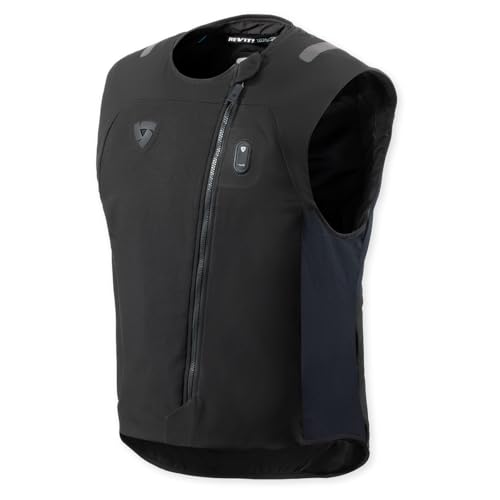
An autonomous system with six sensors means this vest can detect a crash and inflate in 50 milliseconds without you connecting it to your bike. That makes it a serious choice for street riders who want protection that works no matter what motorcycle they ride. The CE Level 2 certification covers both your chest and back, offering substantial impact absorption. Its water-resistant build also means you don’t have to worry about getting caught in the rain, and the design is versatile enough to wear under or over a compatible jacket.
Weighing one pound, this autonomous airbag vest has a noticeable presence, but its self-contained operation means no external connections are required. Its 19-inch length is a factor for storage when the vest is not being worn. For riders who prioritize a fully independent safety system over minimal weight, the REV’IT! Avertum delivers CE-certified Level 2 protection with a 50-millisecond inflation time.
Product photos
Hit-Air RS-1 Racing Airbag System

What We Like
- Expanded neck airbag for head and neck protection.
- Protects ribs, chest, and spine from impact shock.
- Lightweight 1.2-pound build fits over race suits.
- Back-mounted key box prevents wire interference.
Trade-offs
- Weighs 1.2 pounds.
- Track-optimized, not street-versatile.
Superior head and neck protection comes from an expanded neck airbag, a track-optimized feature critical during high-speed crashes. Designed specifically for racers and track riders, the system provides comprehensive impact coverage for the ribs, chest, and spine by absorbing shock. High-performance materials endure demanding race environments while a lightweight structure maintains comfort over a race suit. The key box is strategically located on the back to ensure the wire does not interfere with the rider.
That track focus is the trade-off. Avertum, and its protection profile is optimized for the specific impacts of racing. For riders who split time between the track and the street, a more versatile system might be a better fit. But if your primary goal is maximum safety on a closed course, this vest’s design speaks directly to that need.
Alpinestars Stella Tech-Air 3 Women's Vest

What We Like
- Full upper-body coverage with a CE Level 1 back protector
- Lightweight, streamlined design for an invisible under-jacket feel
- Stretch mesh construction enhances ventilation and moisture-wicking
Trade-offs
- Requires electronic system charging and maintenance
- Women's specific fit may not accommodate all body types
- Minimalist design offers less structure than a traditional armored vest
Alpinestars’ electronic airbag system provides enhanced upper body protection by detecting imminent impacts through continuous monitoring of riding dynamics. This independent operation means it deploys based on sensor data rather than requiring a physical tether. The vest offers full protection for shoulders, chest, ribs, and back, and its streamlined profile is engineered for an invisible feel under a jacket. This combination delivers comprehensive safety without restricting movement or adding noticeable bulk.
The trade-off for its sophisticated, independent protection is the need to manage an electronic device. You must keep it charged and serviced, unlike purely mechanical options. For riders who prefer a simpler, tether-activated system without electronics, the Hit-Air VHR Slim Airbag Vest offers a more straightforward approach, though it requires a physical connection to the motorcycle to function.
Hit-Air VHR Slim Airbag Vest
What We Like
- Slim design fits comfortably over riding gear
- Provides full-body impact protection in a crash
- Velcro closure enables a quick reset after inflation
- Reflective strips enhance low-light visibility
Trade-offs
- Velcro system may wear with repeated resets
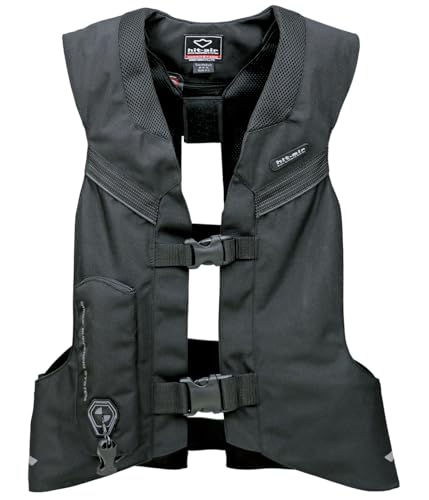
A weight of 0.9 pounds makes the Hit-Air VHR Slim easy to wear over a jacket without adding bulk. Its slim, unobtrusive design and adjustable Velcro waist strap deliver a secure, custom fit for motorcycle or equestrian use. This approach prioritizes comfort and freedom of movement, so the vest provides protection without restricting the rider.
The vest’s impact-activated system provides full-body coverage for the neck, spine, ribs, and hips in a fall. Its full Velcro closure enables a quick and easy reset after inflation. For riders, this results in straightforward protection that’s ready to go without electronic calibration or charging.
Flyastar Reusable Airbag Vest
What We Like
- Reusable design saves on long-term cost
- Rapid 0.2-second inflation for immediate protection
- Breathable canvas material for comfort
- Clear size guide and manufacturer contact for fitting
Trade-offs
- Requires separate purchase of a specific gas cylinder
- Cylinder sold separately
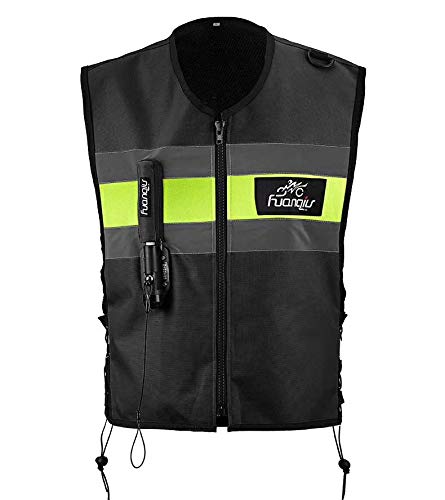
The Flyastar vest’s reusable design is its most compelling feature, letting you reset the system with a new gas cylinder instead of replacing the entire unit after a deployment. This makes it a standout for riders who want the critical protection of an airbag system but need to manage long-term expenses. It’s a practical choice for those entering the airbag gear market, offering core impact protection with a straightforward, mechanical operation. The breathable canvas construction also means it’s a vest you can comfortably wear for longer rides without overheating.
This vest can be reused after inflation, which means a single investment can cover multiple incidents, though you must replace the gas cylinder each time. It inflates in 0.2 seconds during a fall, offering rapid deployment to cushion the body. Constructed from canvas, the material provides breathability and durability for regular wear. Remember, the necessary 35g cylinder with a 1/2 inch thread is sold separately, so you’ll need to source that locally or from the seller as an additional step.
Product photos
How We Evaluated Motorcycle Air Vests
We conducted a research-based evaluation, comparing specifications, manufacturer safety data, expert round-ups, and consistent feedback from verified owners. Our goal was to identify which vests deliver reliable protection tailored to different riding disciplines.
The most important criteria were the type of deployment system (algorithm-based versus tethered), the areas of body coverage, the vest’s weight and profile, and its intended use case. We prioritized vests with clear safety certifications and designs that address common rider needs, from track racing to casual street use. Our research into airbag vest pros and cons helped clarify the fundamental trade-offs between different technologies.
A limitation of this approach is that real-world deployment accuracy or long-term durability cannot be verified. Riders are encouraged to consult the latest reviews of the best motorcycle airbag vests for ongoing updates.
What To Look For In Motorcycle Air Vests
Air vests add a vital safety layer by inflating in milliseconds to absorb and distribute impact forces. The right choice depends on how and where you ride.
Focus on the deployment system, protection zones, and overall fit. Algorithm-based vests offer autonomous, multi-scenario protection but require charging. Tethered systems are simpler and reliable but physically connect to your bike. Ensure the vest covers your critical areas, spine, chest, and often neck, without restricting movement.
Deployment System
Modern vests use one of two main systems: algorithm-based or tethered. Algorithm-based, or electronic, systems like those from Alpinestars and REV’IT! Use internal sensors to detect a crash autonomously. They don’t require a physical tether to the motorcycle and often offer different protection modes for street, track, or off-road riding.
Tethered systems, like the classic Helite design, use a lanyard that clips to your bike; a sudden separation pulls a trigger to inflate the vest. They are mechanically simple with no batteries to charge but offer less versatility for low-speed tip-overs.
Protection & Coverage
Not all vests protect the same areas. Basic coverage typically includes the spine and rib cage. More comprehensive systems extend protection over the shoulders, collarbones, and include an expanding neck collar, which is crucial for preventing whiplash. Some vests come with an integrated back protector, adding constant passive safety alongside the airbag’s active protection. Reviewing different airbag systems can help you understand how coverage varies between models designed for casual street use versus professional racing.
Fit & Integration
A vest must fit correctly to function properly and be comfortable enough to wear every ride. Consider whether you want to wear the vest under a riding jacket for a low-profile look or over it for ease of use. An under-jacket vest needs to be slim and breathable. Also, check the vest’s length, as some shorter-torso riders may find certain models too long. The vest should feel secure without impeding your ability to move on the bike or operate controls.
- Confirm the vest’s sizing aligns with your chest measurement and torso length.
- For under-jacket wear, ensure your existing jacket has enough room to accommodate the vest comfortably.
- For over-jacket wear, verify the vest’s closures (zipper, straps) are compatible with your gear.
The best vest is the one you’ll wear consistently. Prioritize comfort and compatibility with your primary riding gear.
Motorcycle Air Vests Compared
The following table compares the key features of our top picks to help you see the differences at a glance.
| Product | Weight | Coverage | Design Profile |
|---|---|---|---|
| Alpinestars Tech-Air 5 Plasma System | 2.2 pounds | Full upper body | Ultra-slim, invisible under jacket |
| REV'IT! Avertum Street Tech-Air Airbag | 1.0 Pounds | N/A | N/A |
| Hit-Air RS-1 Racing Airbag System | 1.2 pounds | Ribs, chest, spine | N/A |
| Alpinestars Stella Tech-Air 3 Women's Vest | N/A | Shoulders, chest, ribs, back | Super-slim, minimalist |
| Hit-Air VHR Slim Airbag Vest | 0.9 pounds | Neck, spine, ribs, hips | Slim, unobtrusive design |
| Flyastar Reusable Airbag Vest | N/A | N/A | N/A |
Frequently Asked Questions
What is the best air vest for motorcycles?
The best air vest depends on your riding style. For most riders seeking lightweight, full-coverage protection that works on street and light off-road, the Alpinestars Tech-Air 5 Plasma System is an excellent overall choice. Track riders should prioritize the Hit-Air RS-1 for its expanded neck protection, while budget-conscious riders can start with a reusable system like the Flyastar vest.
Are motorcycle airbag vests worth it?
Yes, for most riders. Airbag vests are a proven supplemental safety layer that can significantly reduce the risk of serious thoracic and spinal injuries in a crash. They absorb and disperse impact forces that traditional armor cannot. While an investment, many riders find the added protection provides invaluable peace of mind, making them a worthwhile part of a complete motorcycle safety gear setup.
What is the difference between tethered and electronic air vests?
Tethered vests use a physical lanyard connected to the motorcycle to trigger inflation during a separation. They are mechanically simple with no batteries but are typically single-use per crash. Electronic vests use internal gyroscopes and accelerometers with an algorithm to detect a crash autonomously. They offer more versatility, often with multiple riding modes, but require regular charging and are more complex.
Can you wear an air vest under a jacket?
Many modern air vests, particularly electronic models, are designed specifically to be worn underneath a riding jacket. They feature slim, breathable constructions to minimize bulk. It’s essential to verify that your jacket has enough room to fit over the vest without being overly tight, as this could restrict the airbag’s proper deployment.
What maintenance does an electronic air vest require?
Electronic air vests require periodic charging, with ride time per charge varying by model. The system’s firmware may need occasional updates via a smartphone app. It’s also crucial to inspect the vest regularly for wear and to follow the manufacturer’s service schedule, which may involve sending the unit in for inspection after a set period or following a crash deployment.
The Bottom Line
For riders seeking the pinnacle of lightweight, algorithm-based protection suitable for mixed use, the Alpinestars Tech-Air 5 Plasma System is our top recommendation. Its full coverage and minimal under-jacket profile make it a versatile choice for serious enthusiasts.
If your budget is a primary concern, consider the reusable Flyastar vest as an affordable entry point. For those dedicated to track days, the Hit-Air RS-1’s expanded neck protection is non-negotiable.
Ultimately, the most critical factor is choosing a vest with a deployment system and fit that matches your primary riding discipline, ensuring you’ll wear it on every ride. This single decision adds a profound layer of safety to your essential protective riding gear.
