
Can Riding a Motorcycle Cause Hemorrhoids? The Evidence
This post contains affiliate links. As an Amazon Associate, we earn from qualifying purchases.
No study I could find shows that riding a motorcycle causes hemorrhoids. The only rider study, a self-report survey of commercial motorcyclists in Kaduna, Nigeria, had 90.5% say they’d had them, with no clinical exam. Long hours of sitting and straining have better support, and rubbing against a seat can worsen symptoms you already have.
That Kaduna figure matters to the can riding a motorcycle cause hemorrhoids question, but it comes from riders who work the bike for a living, with 58.3% of them in the saddle 6 to 15 hours a day. A weekend rider doing two hours to a diner and back lives in a different world. The question that matters for you is narrower: how much seat time, on what seat, with what going on at the toilet?
What follows: the handful of studies that touch riders, the spots where they disagree, the seat and gear changes I’d try first, and the symptoms that mean you park the bike and book a doctor.
Key Takeaways
- Riding does affect the groin region: one study found 69% of 234 motorcyclists scored in the erectile dysfunction range, though it never looked at hemorrhoids.
- A Sudanese case-control study tied 5 or more hours of sitting a day to hemorrhoids and fissures, but it measured sitting in general, not riding.
- Colorectal surgeons point first at constipation and straining, and their guidance says more fiber cut persistent symptoms by 53% against usual care.
- Vibration is the untested piece: older, smaller bikes on slow roads shake riders harder, but nobody has linked that shaking to hemorrhoids.
- Bleeding that keeps coming back after treatment is a reason to see a doctor, because colon cancer bleeding gets mistaken for hemorrhoids.
So Can Riding a Motorcycle Cause Hemorrhoids, or Just Make Them Worse?
Nobody has tested motorcycle riding as a cause in a study that actually examined riders. What exists is a scatter of surveys, sitting studies, and vibration data, and each one answers a slightly different question.
Hemorrhoids are vascular structures around the anus, classed as internal or external by position relative to the dentate line. Current ASCRS guidance centers on constipation, straining, and prolonged time on the toilet. No available study has examined motorcycle riders clinically for hemorrhoids; the only rider survey, of commercial motorcyclists, relied on self-reported symptoms.
The dentate line is the spot inside the anal canal where the lining changes. Internal hemorrhoids sit above it and external ones below. The ASCRS hemorrhoid practice guidelines summary notes the two types frequently show up together.
I test gear for a living, not bowels. So I did what I do with a jacket that claims to be “protective”: I went looking for the actual test behind the claim. The NIDDK hemorrhoid causes overview says too much straining, rubbing, or cleaning around the anus can make symptoms worse.
Motorcycles aren’t on it.
Here’s what I’m comfortable saying. Riding puts you on a seat for hours, and seat time is the exposure researchers have started to measure. Rubbing is the other one. NIDDK says too much straining, rubbing, or cleaning around the anus can make symptoms worse, and a grippy seat cover plus a thick pants seam rubs.
The 90.5% Rider Survey, and the Studies Around It
90.5% is the headline number, and it comes from one place. Nassa and colleagues surveyed commercial motorcyclists in Kaduna State for the World Journal of Preventive Medicine in 2016. They sent the survey to 290 riders and got 283 responses back.
I couldn’t get the full text. The figures here come from the abstract excerpt, and they rest on what riders reported, with no doctor checking anyone.
I don’t trust that number on its own, and you shouldn’t either. A rider with an itch, a small tear, or a raw spot from the seat might tick the hemorrhoid box. That’s how self-report works.
Here’s how the rest of the research lines up against what you actually want to know:
- Gruber, NIOSH, 1976. A federal report on interstate truck drivers. It put forward vibration, forced posture, cargo handling, and poor eating habits as possible contributors to several disorders in drivers with more than 15 years on the job, hemorrhoids among them. The report calls this a hypothesis.
- El Shallaly and colleagues, 2022. A Khartoum hospital study on sitting time. Not riding.
- Moreno and colleagues, 2011. Vibration readings from motorcycles in Colombia, with no hemorrhoid outcome at all.
- Ochiai and colleagues, 2006. Motorcyclists and erectile dysfunction, which sounds off-topic until you read it.
Why an Erection Study Matters to Your Backside
The Ochiai team scored 234 motorcyclists and 752 healthy controls on a standard five-question erection questionnaire. 161 riders, or 69%, landed in the erectile dysfunction range. The rate climbed with age, from 58% of riders in their 20s to 93% in their 50s.
Motorcycling came out as the strongest risk factor in their statistics, though the authors described most cases as mild. That’s the perineum, the patch of tissue between your legs that the seat presses into. The study shows riding is linked with trouble in that region.
It measured erections. It says nothing about hemorrhoids, and the abstract doesn’t explain the cause either.
Cyclists have more research of their own, including a PubMed study on cyclists’ sphincter function in professional riders. I couldn’t get past the abstract page, and a pedaling cyclist loads a saddle differently than you load a motorcycle seat. So I’m not leaning on it here.
I’d love to tell you the rider data is solid. It’s one self-report survey of people riding for a living, plus studies of truck drivers, general sitters, and bike vibration. Anyone selling you a seat as “hemorrhoid-proof” is filling that gap with marketing.
Where the Sources Disagree: Sitting, Toilet Time, or Vibration
Every riding forum agrees that sitting is the culprit. The researchers who finally tested that idea wrote that it had been assumed for years with no evidence behind it, and they found no earlier study that checked it.
El Shallaly’s team compared 81 patients diagnosed by endoscopy (a camera exam of the rectum) with 162 people who had no anal symptoms. 54 of the patients, or 66.67%, sat 5 or more hours a day. Only 57 of the controls did, or 35.18%.
That works out to an odds ratio of 3.7. In plain terms, the patients had 3.7 times the odds of being heavy sitters compared with the symptom-free group.
Two catches. The patient group mixed 46 hemorrhoid cases with 23 anal fissures, which are small tears in the lining, plus 12 with both. And the controls never got an exam; they filled in a questionnaire.
Easy to miss: The 5-hour cutoff is total sitting across a whole day, and the authors picked it because it falls halfway between the two groups’ average sitting times. Reading it as a safe single-stint limit on the bike misreads the study.
Line the sources up and they point at different exposures:
| Source | What it points at | Strength of evidence |
|---|---|---|
| El Shallaly et al., 2022 | 5+ hours of sitting a day | One case-control study |
| ASCRS guideline (via AAFP) | Constipation, straining, long toilet sits | Clinical guideline; general sitting not listed |
| NIDDK | Straining, rubbing, over-cleaning worsen symptoms | Agency page; no mention of vehicles |
| Gruber, NIOSH 1976 | Truck vibration plus posture, cargo handling, diet | Hypothesis only |
| Indonesian bus driver study | Sitting without changing position | Background reasoning, not a finding |
My read: the sitting link is plausible and lightly tested. The toilet advice rests on firmer clinical ground. The vibration idea is a 1976 hypothesis that, as far as I can find, nobody has followed up in motorcyclists.
That’s three different exposures. You can manage all three.
Does Vibration From Your Bike Make Hemorrhoids Worse?
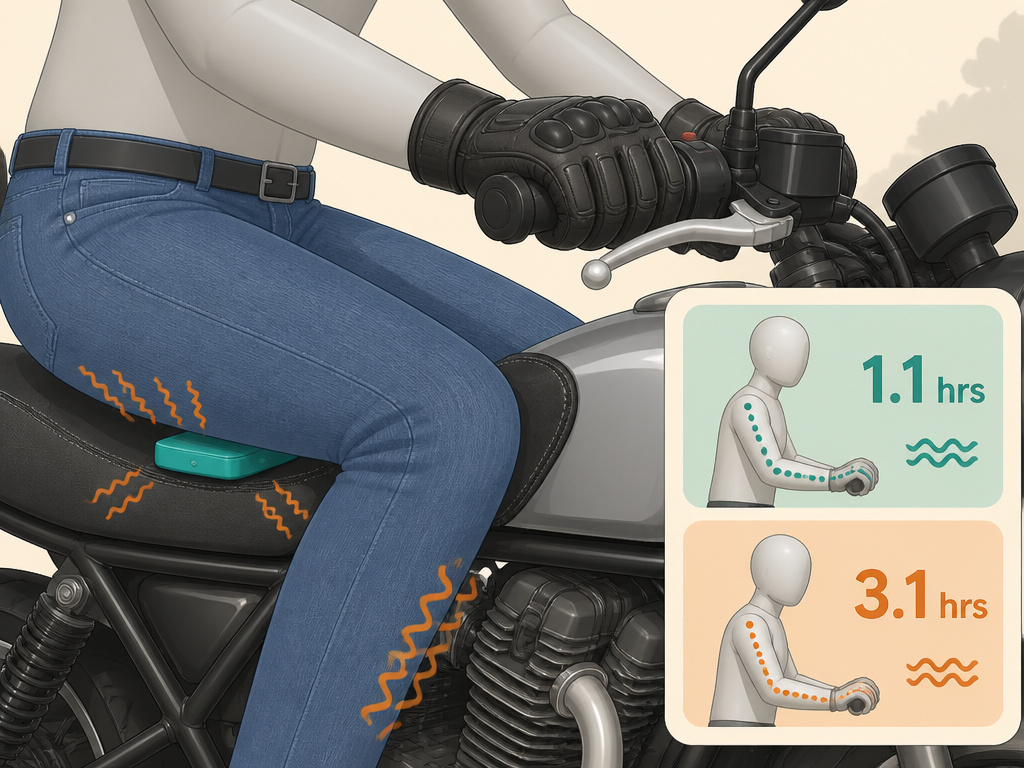
Moreno and colleagues put a seat-pad accelerometer, a vibration sensor that sits between rider and seat, on motorcycles in Medellin, Colombia. They didn’t look at hemorrhoids. They measured how long a rider can go before hitting the exposure action value, the daily vibration dose where workplace rules say it’s time to cut back.
The spread surprised me. On an old bike with a small engine on slow roads, riders hit that action value in 1.1 hours. On a new bike with a bigger engine on fast roads, it took 3.1 hours.
Newer bikes allowed 36.3% more riding time than older ones before that point. The 125cc engines allowed 22.5% more than smaller ones, and fast roads gave 44% more than slow roads. These were small commuter machines, so a big-bore tourer sits outside what they tested.
You know the feeling on a tired commuter. At one engine speed the seat starts to buzz, and an hour later your backside goes numb and tingly like a foot that fell asleep.
Gruber’s idea was that vibration causes small repeated injuries and swings in pressure inside the abdomen and bowel. The Indonesian bus driver study frames sitting the same way: stay put without shifting and pressure in the veins around the anus rises. That’s why the guess makes sense.
It’s still a guess.
Riders also ask about engine heat under the seat, and whether a cruiser’s laid-back posture beats a sport bike’s forward lean. I found no study on either. Anyone giving you a confident answer is guessing too.
My take: if you ride an older, small-displacement bike on stop-and-go roads, assume you’re at the high-vibration end and break up your seat time more.
Seat, Shorts, and Posture: What I’d Change First
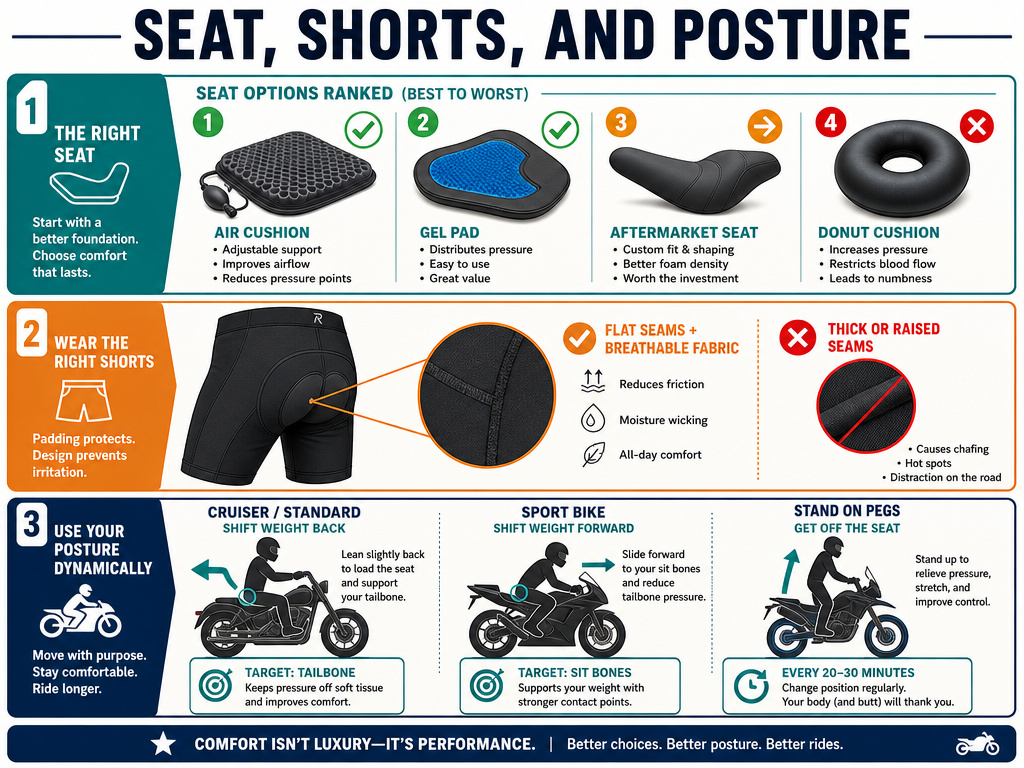
Start with the seat.
Stock seats get shaped to look good in the brochure and to hit a seat height number. Whether yours spreads your weight or drives it into one hot spot is something you only learn at hour two. A black vinyl seat parked in summer sun gets hot enough to feel through denim, and heat plus sweat plus a seam is how chafing starts.
Cushions Before Custom Seats
I’d try a removable cushion before paying for a rebuild. A removable air cushion sits on top of the stock seat and comes off when you want it gone. If it helps, you’ve learned the seat is your problem; if it doesn’t, you skipped an expensive mistake.
Your options, roughly in the order I’d try them:
- Air cushions: adjustable, removable, easy to test.
- Gel pads: the cheap test, and easy to move between bikes.
- Aftermarket seats: a bigger step and a permanent one. Worth it if you ride long days every week and the cushion test already told you the stock seat is the problem.
- Donut cushions: skip.
Skip the donut cushion. It’s built for a chair that doesn’t move under you. On a motorcycle it raises you, slides on the vinyl, and parks all your weight on a narrow ring.
You can make your seat more comfortable long before you need a new one. The cushion test comes first.
Ride it before you trust it. One full day on a new cushion or seat tells you more than any product photo, so test before you commit to anything permanent.
Shorts and Seams
Riding pants are joinery under load. A thick doubled inseam sits like a proud glue line on a tabletop, and you feel it every time your weight drags across it. That’s rubbing, the same thing NIDDK flags for making symptoms worse.
A pair of padded riding shorts under your pants puts a smooth layer between you and the seat. I’d pick flat seams and breathable fabric over thick padding. Thick padding traps heat.
Can shorts prevent hemorrhoids? Nobody has tested that. What they do is cut rubbing, and rubbing is the part with some evidence behind it.
Posture and the Pegs
Your riding posture decides where your weight lands on the seat. Slump back on a cruiser with forward controls and more weight rolls onto your tailbone. Lean hard on a sport bike and it shifts toward the front of the seat.
When did you last check whether your hips, knees, and bar reach actually fit you? Standing on the pegs for a minute on a clear straight takes your weight off the seat entirely. That’s the one move that directly cuts the exposure the Khartoum study measured.
What Does Bleeding or a Lump After a Ride Mean?
You get off after a long afternoon, stop at a gas station restroom, and see bright red on the paper. Or you feel a tender lump that wasn’t there this morning.
Internal hemorrhoids that haven’t prolapsed (slipped down out of the canal) don’t hurt in most cases, according to NIDDK. A painful lump that won’t push back in fits a thrombosed external hemorrhoid, meaning one with a clot inside.
| What you notice | What the sources say | What to do |
|---|---|---|
| Painless bright bleeding with bowel movements | Typical of internal hemorrhoids (ASCRS) | Get it examined once, even if mild |
| Painful lump at the opening that won’t go back | Thrombosed external hemorrhoid (ASCRS) | See a doctor soon |
| Soreness or swelling after a ride | External symptoms clear within days for many (NIDDK) | Shorter rides, gentle cleaning |
| Bleeding with belly pain or new constipation | Colonoscopy worth considering (ASCRS) | Book the appointment |
| Bleeding that continues after treatment | Possible other bowel disease (NIDDK, ASCRS) | Stop blaming the seat |
NIDDK warns that rectal bleeding can signal Crohn’s disease, ulcerative colitis, or colon or rectal cancer. The ASCRS summary adds that colon cancer bleeding gets misattributed to hemorrhoids. Riders are good at explaining pain away as seat time.
Don’t do that with blood.
Doctors diagnose hemorrhoids from symptoms and an exam, including a gloved-finger check that rules out other problems. If your issue is trouble with erections after riding rather than a lump or bleeding, that’s the Ochiai territory and a separate conversation.
At-Home Relief That Has Evidence Behind It
Before you start: Creams with anesthetics, steroids, or antiseptics can cause allergic reactions and long-term skin sensitization with prolonged use, so keep them to a short course. Rectal bleeding can come from Crohn’s disease, ulcerative colitis, or colon cancer, so get bleeding examined before weeks of self-treatment. And don’t scrub, because over-cleaning makes symptoms worse.
- Deal with constipation first. The ASCRS guidance says hemorrhoid patients should be checked and treated for it. Skip this and every other fix is fighting the main cause.
- Add fiber and fluids. A Cochrane review of about 380 patients found more fiber cut persistent symptoms by 53% compared with usual care. Skip it and the next hard stool undoes your rest days.
- Use an OTC cream with hydrocortisone, phenylephrine, or pramoxine for pain, itch, and swelling. Stay on it too long and you risk the skin reactions above. ASCRS lists hydrocortisone and pramoxine as safe and effective in late pregnancy.
- Clean gently. Pat, don’t scrub.
- Ask your doctor about flavonoid supplements, plant extracts that ASCRS says can ease itching, bleeding, discharge, and leakage. Nobody knows exactly how they work yet, and skipping the conversation means missing an option with evidence behind it.
Still symptomatic after all that? The guidance is a referral for rubber band ligation, where a doctor places a small elastic band above the hemorrhoid in the office to choke off its blood supply. Office procedures like banding, injection sclerotherapy, and infrared coagulation are preferred over surgery because they give similar benefit with fewer complications.
Warm soaks and stool softeners show up on every home-remedy list. The guideline summary I read doesn’t rate either one, so that’s a question for your pharmacist, not a gear tester.
A Long-Ride Plan If You Already Have Hemorrhoids
Three things decide how a long day goes: how long you sit between stops, what you eat and drink on the road, and what happens when you finally reach a restroom.
Fair warning: most of my riding is shorter days, not multi-day tours. Treat this as a sensible plan rather than a touring veteran’s playbook. Good long-distance riding habits already build in stops, and with hemorrhoids you can’t skip them.
- Get off the bike at every fuel stop. The Khartoum numbers were daily totals, and every stop chips away at yours.
- Stand on the pegs when the road is clear and you can’t stop yet.
- Drink and eat fiber at stops, because a dry, low-fiber travel day sets up a hard stool tomorrow.
- Don’t rush the restroom. Skipping stops to make time and then forcing it at the next one is straining, and straining is what both NIDDK and the ASCRS guidance warn about. Leave the phone in the tank bag too, since ASCRS also advises against long sits on the toilet.
Planning rest stops on long rides around fuel and food turns all of this into routine instead of a willpower test.
Where this goes sideways: Riding a full day on a fresh, painful lump because the trip is already booked. External symptoms clear within a few days for many patients, per NIDDK, so trimming or pushing back the ride for those days is cheap insurance.
My rule is blunt. A dull ache, I’d ride short and see how it feels. A hard, painful lump or any blood, I’d park the bike.
Frequently Asked Questions
Do motorcycle riders get hemorrhoids?
Some do, but nobody knows whether they get them more than anyone else. The one rider survey, from Kaduna, Nigeria, had 90.5% of commercial motorcyclists report having had them. Those answers were self-reported, with no exam.
Why would I suddenly get hemorrhoids?
Sudden, painful lump at the anal opening that won’t push back in fits a thrombosed external hemorrhoid, according to the ASCRS guidance summary. Constipation and straining are the usual suspects behind flare-ups. If it’s painful or bleeding, see a doctor.
Does riding a bike make hemorrhoids worse?
Long sitting and rubbing are the plausible links. NIDDK says rubbing around the anus can make symptoms worse, and a Khartoum study tied 5 or more hours of daily sitting to hemorrhoids and fissures. No study has tested riding itself.
What shrinks a hemorrhoid the fastest?
No source I found ranks treatments by speed. The ASCRS guidance says OTC creams with hydrocortisone, phenylephrine, or pramoxine improve pain, itch, and swelling, and a Cochrane review found more fiber cut persistent symptoms by 53%. If symptoms continue, rubber band ligation in a doctor’s office is the next step.
Should I stop riding while I have hemorrhoids?
Not always. External symptoms clear within a few days for many patients, per NIDDK, so short rides on a cushioned seat are reasonable for a mild flare. Bleeding or a hard, painful lump means park the bike and see a doctor first.
Before You Go
Can riding a motorcycle cause hemorrhoids? Nobody has proved it, and one self-report survey can’t settle it. What the evidence does support is narrower: long daily seat time, straining, constipation, and rubbing are the things you can actually manage.
Here’s the trigger I’d use. If bleeding keeps coming back after you’ve fixed the fiber, the fluids, and the seat, stop blaming the bike. The ASCRS guidance treats that pattern, or bleeding with belly pain or new constipation, as the point where colonoscopy gets considered.
This week, do one thing. Put a removable cushion on your stock seat and ride your normal loop with it. If nothing changes, the seat wasn’t your problem, and that’s worth knowing before you buy anything permanent.
Bottom line: riders who log long days on older, buzzy bikes should break up their seat time and fix their toilet habits first, and riders with any bleeding should see a doctor before they buy a single piece of gear.
