
How to Avoid Fatigue on a Long Motorcycle Ride: Eat Light
This post contains affiliate links. As an Amazon Associate, we earn from qualifying purchases.
To avoid fatigue on a long motorcycle ride, match your break schedule to your body’s time-to-fatigue, roughly 85 minutes, not an arbitrary clock. Combine that with strategic hydration, a relaxed grip, and a caffeine plan that starts days before you leave. Ignoring the early signs like a wandering lane or numb hands turns a manageable stop into a mandatory one.
That 85-minute figure comes from a real study measuring muscle fatigue, not from a generic “take a break when you’re tired” guide. It’s a ceiling, not a suggestion. Your job is to stop before you hit it, because by the time you feel mentally foggy or physically cramped, your reaction time and decision-making have already dropped. A key part of planning how to avoid fatigue on a long motorcycle ride is understanding this. Fatigue isn’t about willpower; it’s a physiological debt that only rest repays.
What follows is the breakdown: why your forearms give out first, how to drink before you’re thirsty, the one adjustment that stops back pain before it starts, and how to plan a day that leaves you ready for the next one.
Key Takeaways
- Sources disagree on the optimum riding duration before a break. One study recommends a break schedule of 85 minutes, while other advice suggests taking a break every one to two hours.
- Drink at least one quart (one liter) of water the moment a dehydration headache starts. If you wait until you’re thirsty on the bike, you’re already behind.
- Keep your elbows bent and shoulders down. A death grip on the bars transfers your body weight through your arms and into your hands, fatiguing the forearm extensors within the first hour.
- For maximum alertness, stop caffeine for several days before your trip, then use 100-200 mg (4-8 oz of coffee) about 30 minutes before you need a boost. Regular users get diminished effects.
- Avoid alcohol for several days prior to riding. Its effects on hydration and brain function linger far longer than the hangover, directly undermining your stamina and focus.
The 85-Minute Rule for Breaks
Forget the old “stop every two hours” advice. A study from the Universiti Teknologi MARA institutional repository analyzed simulator sessions and rider surveys to establish a data-driven threshold. One study concluded the optimum riding duration before a break is 85 minutes.
Research on optimum riding duration recommends a break schedule of 85 minutes for maintaining performance. This conflicts with the common 1-2 hour guideline.
That 85 minutes is a ceiling, not a target. Your personal limit may vary, but using a planned break schedule is smarter than guessing. When the Viking Bags blog says take a break every one to two hours, they’re giving you a wide safety net. The academic data says aim for the tighter end of that range.
The consequence of ignoring this is cumulative fatigue. You might feel fine pushing to two hours on the first leg. By the third leg, that fatigue debt compounds, and your “recovery stop” needs to be longer than a quick gas-up. You’ll need real rest, walking around, hydrating, maybe even a short nap, to reset. A core principle of how to avoid fatigue on a long motorcycle ride is to plan your fuel stops around this 85-minute rhythm, not the other way around. If your tank lasts longer, stop anyway. Stretch, drink water, and look at something that isn’t asphalt.
Your Body is a Sensor, Not a Gauge
You don’t have a fatigue gauge on your dashboard. Your body sends signals, but most riders learn to ignore them until it’s too late. Recognizing these signs early is the difference between a proactive stop and a dangerous situation.
The Dairyland Insurance guide breaks the warnings into two categories: mental and physical. Mental fatigue shows up as wandering in your lane, not remembering the last few miles, or missing a turn. Your brain is skipping frames. Physical fatigue signals are more tactile: excessive blinking, yawning, muscle cramps, or tingling in your hands and feet.
A numb hand or foot is often a circulation issue from a static position or tight gear, but it’s also a direct fatigue signal. That tingling means your body is diverting resources, and your fine motor control, the kind you need for smooth clutch and brake work, is fading.
Where this goes sideways: Treating numbness by shaking out your hand and riding on. The tingling is a symptom of a tense posture cutting off circulation. If you don’t change that posture, it comes back faster and stronger each time.
The most insidious sign is the mental blank. You roll into a town and realize you have no memory of the last 15 minutes of highway. That’s not zoning out; it’s your brain entering a low-power mode because it’s exhausted. When that happens, the only correct action is to stop. Right now. No “I’ll make it to the next exit.” Pull over, get off the bike, and walk for five minutes.
Hydration: Drink Before the Headache
Dehydration doesn’t just make you thirsty. It directly causes muscle weakness, decreased concentration, and headache, symptoms that perfectly mimic fatigue. The LDR guide by Don Arthur is blunt: if you have a headache from dehydration, you need to drink at least one quart (one liter) of water immediately.
Your goal is to never get to that point. Sipping water consistently is more effective than gulping a large amount at a stop. Many riders use a hydration bladder with a hose in their helmet. It’s less about convenience and more about maintaining a steady intake, a critical tactic for how to avoid fatigue on a long motorcycle ride. If you’re relying on stopping to drink, you’re already operating in a deficit.
| Drink Choice | Pros | Cons | Best For |
|---|---|---|---|
| Plain Water | Rehydrates directly, no additives | No electrolytes to replace what you sweat out | Short rides in moderate temperatures |
| Electrolyte Drink (e.g., Gatorade) | Replaces lost salts, can improve water absorption | Often high in sugar, which can cause an energy crash later | Long, hot rides where you’re sweating heavily |
| Caffeinated Drink (Coffee, Tea) | Can provide a mental alertness boost (see next section) | Diuretic effect can increase fluid loss if over-consumed | Strategic use during a planned stop for a focus boost |
Avoid heavy consumption of sugary sodas or energy drinks. The sugar spike is followed by a crash, and the diuretic effect of caffeine in large doses can work against you. The best strategy for long days is to stay hydrated with plain water or a light electrolyte mix, saving the caffeine for a specific, timed tactical boost.
Strategic Caffeine and the Alcohol Ban
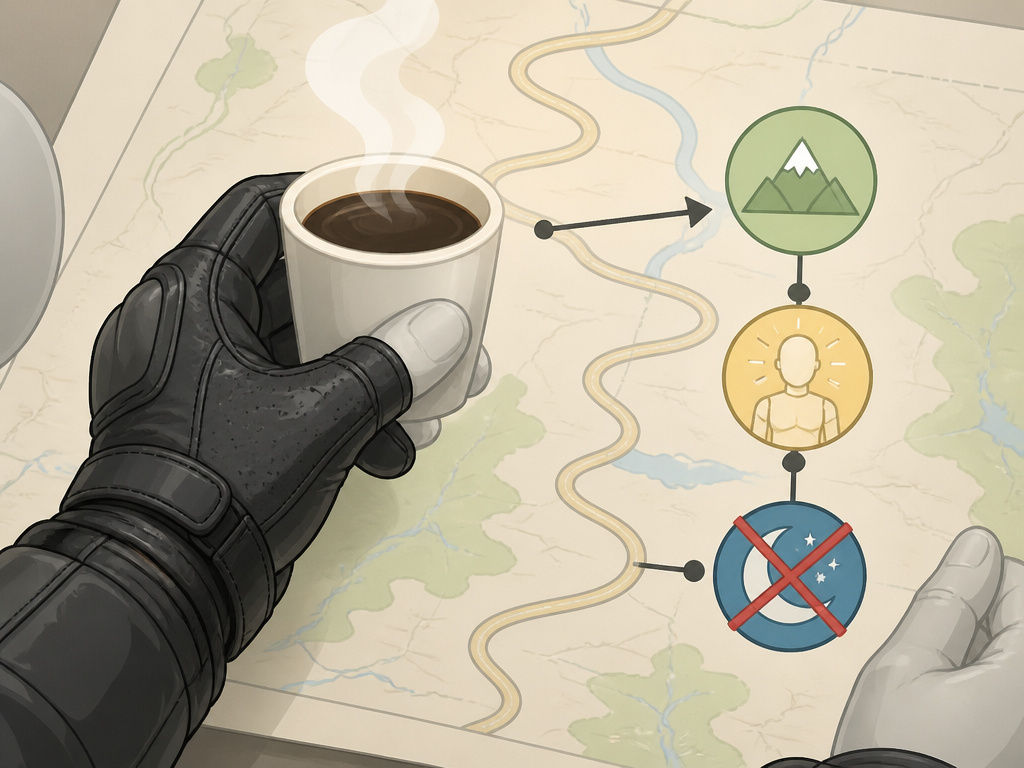
Caffeine and alcohol are the two most mismanaged substances in motorcycle touring. Used wrong, they amplify fatigue. Used right, caffeine can be a precise tool.
The research from the LDR guide gives specific numbers. Caffeine is most effective for mental awareness in the 100-200 mg range (about 4-8 ounces of coffee). It takes approximately 30 minutes to peak, and its effects last 3-4 hours. The critical rule: avoid caffeine within 8 hours of sleep, as it disrupts sleep quality.
Here’s the non-commodity insight everyone misses: if you drink coffee daily, you’ve built a tolerance. To get the maximal alertness effect when you need it on the road, you should stop ingesting caffeine for several days prior to your trip. This resets your sensitivity. Then, a single cup at a planned mid-afternoon stop becomes a genuine performance aid, not just a habit.
Alcohol requires a longer lead time. The common advice is “don’t drink the night before you ride.” The LDR guide pushes further: avoid alcohol for several days prior to a ride due to its prolonged effects on brain activity and hydration. Alcohol has prolonged effects on brain activity and hydration, so it’s advised to avoid it for several days prior to a ride. For a multi-day tour, this means considering your consumption days before you even pack.
Ergonomics: It’s in Your Elbows
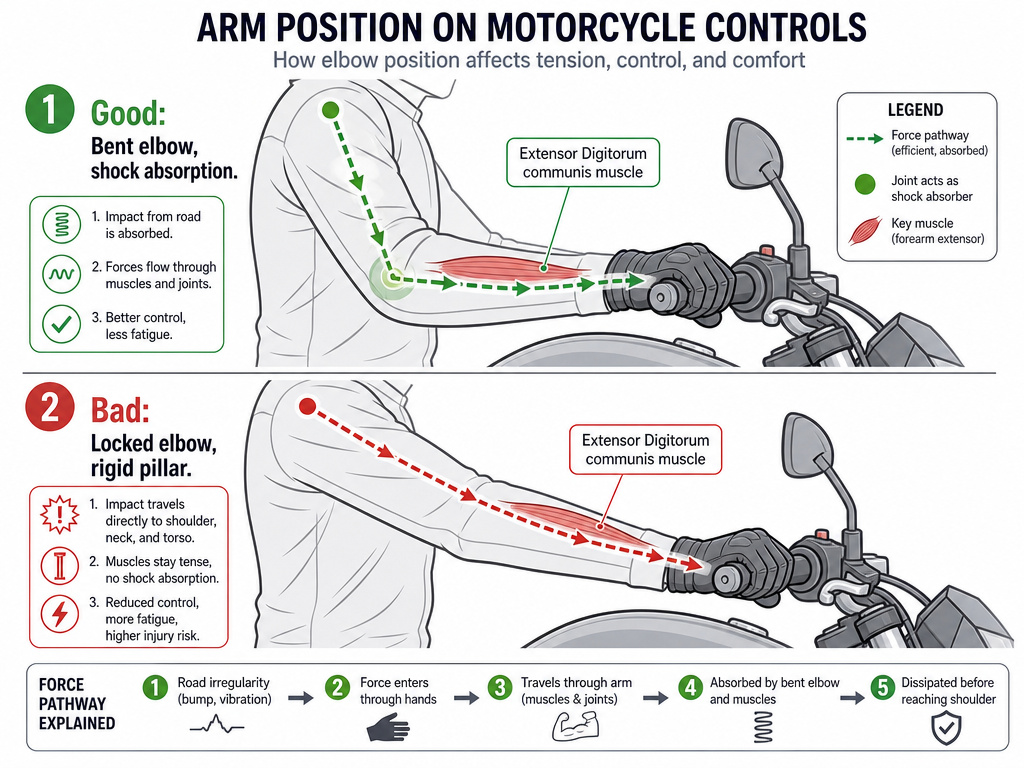
Physical fatigue starts at your contact points: hands, feet, and seat. The VOGE manufacturer guide zeros in on the upper body. Keep your shoulders and arms relaxed. Avoid gripping the handlebars too tightly. Do not use your hands to support your body weight.
The mechanism is simple. When you lock your elbows and push down on the grips, you turn your arms into rigid pillars. This tenses everything from your shoulders to your fingers, but it specifically fatigues the Extensor Digitorum communis, the muscle that opens your fingers. A PMC case study on racetrack riding found this muscle was fatigued in 84% of cases. When it tires, maintaining a relaxed grip becomes physically impossible, leading to a vicious cycle of tension.
Keep your elbows naturally bent. This allows your arms to act as shock absorbers and forces your core and legs to support your weight, which is what they’re designed for.
Your lower body matters too. Avoid keeping your knees excessively bent or your legs rigid for long periods. On a cruiser, this might mean adding highway pegs to alternate your leg position. On an adventure bike, stand on the pegs for a minute or two when it’s safe. The goal is to avoid any single muscle group being under static tension for an hour straight.
This is where bike ergonomics and simple modifications pay off. Handlebar risers or a different seat can change the geometry of your “rider triangle” (seat, pegs, bars) to promote a neutral spine and relaxed arms. Even a small change here does more for all-day comfort than any amount of willpower.
The Bike and Gear That Fight Fatigue
The machine itself is a fatigue factor. Wind resistance, vibration, and seat design either work for you or against you over hundreds of miles.
| Bike Type | Posture | Common Fatigue Points | Best Mitigation |
|---|---|---|---|
| Adventure (ADV) | Upright, neutral | Lower back (if core is weak), wrists (if gripping tank) | Use legs to grip tank, engage core, add a seat cushion |
| Cruiser | Relaxed, feet-forward | Lower back (slouching), hamstrings, neck (if no windshield) | Add a quality windshield, use highway pegs, support lower back |
| Sport | Aggressive, forward-lean | Wrists, knees, neck, lower back | Strengthen core, use tank grips for support, limit daily mileage |
Gear is part of the system. A helmet that’s too noisy causes auditory fatigue.
The seat is the most personal interface. A pressure point you notice in the first 30 minutes will be a deep, distracting pain by hour three. Don’t just endure it; fix it.
Nutrition: Eat Light to Stay Light
Digestion competes for blood flow and energy. A heavy meal makes you sleepy because your body is working hard to process it. The Dairyland Insurance advice is clear: avoid heavy foods and large meals that cause after-meal sleepiness. Also, avoid too much sugar.
Think of eating on the road as fueling, not feasting. Small, frequent snacks are better than one big lunch. Aim for light snacks instead of heavy meals.
Easy to miss: The gas station snack trap. It’s easy to grab a candy bar and a soda for a quick sugar rush. A sugar rush is often followed by an energy crash that leaves you more drained than before. Pack your own snacks.
Time your main meal for the end of the day. A larger dinner when you’re done riding helps with recovery and doesn’t impact your alertness on the bike. Hydration continues here, too. Pair that meal with more water, not a beer.
How much sleep do you need before a long motorcycle ride?
Getting a solid eight hours of uninterrupted sleep is good for your health and safe riding. Build this habit for several nights before your trip starts. Avoid alcohol for several days prior to a ride due to its prolonged effects on brain activity and hydration, and avoid caffeine within eight hours of sleep. Sources disagree on how long meaningful rest or sleep should be. The LDR guide (Don Arthur) states meaningful rest cannot be accomplished without sleeping longer than 5 minutes, while Dairyland Insurance recommends getting a solid eight hours of uninterrupted sleep. Plan for proper overnight sleep to recover fully for the next day’s ride.
How can I prepare my body for a long motorcycle ride?
Physical fatigue often starts in your hands and arms. A study found the finger extensor muscle was fatigued in most cases during riding. To combat this, keep your shoulders and arms relaxed and avoid gripping the handlebars too tightly. Do not rely on your hands to support your body weight. Keep your elbows naturally bent and your legs in a natural position, avoiding excessively bent knees or rigidity. The goal is to avoid keeping the body tense for too long. When safety allows, adjusting your sitting position occasionally helps distribute pressure.
How to plan a daily motorcycle route to avoid fatigue
Plan rest stops along your route and take a short break, walk around, and drink some water before fatigue becomes significant. Recognize mental fatigue warning signs like wandering in your lane, not remembering the last few miles, or missing a turn. To maintain energy, avoid heavy foods, large meals, and too much sugar during riding days. For mixed road conditions, an ADV motorcycle can help reduce strain. Build your daily distance around regular breaks and stop for the day well before you reach a point of significant exhaustion.
Frequently Asked Questions
What is the 12 second rule on a motorcycle?
The 12-second rule is a visual lead-time guideline for safe riding. It means you should be looking 12 seconds ahead down the road, scanning for potential hazards. This gives you ample time to identify, evaluate, and react to dangers like debris, slowing traffic, or curves. It’s a foundational skill taught by the Motorcycle Safety Foundation to combat complacency and improve reaction time.
Can riding a motorcycle cause fatigue?
Yes, absolutely. Riding a motorcycle is both physically and mentally demanding. Physically, you’re holding a static posture against wind resistance and vibration, which fatigues core, back, and arm muscles. Mentally, the constant demand for vigilance, scanning, and decision-making depletes cognitive resources. This is why specific strategies for breaks, hydration, and ergonomics are critical for any ride longer than an hour.
How many miles can you comfortably ride a motorcycle in a day?
There’s no universal number, as it depends on road type, weather, bike comfort, and rider fitness. The number of miles you can comfortably ride in a day depends on road type, weather, bike comfort, and rider fitness. The key is to plan by time, not distance. A solid, sustainable day of riding depends on planning by time with regular breaks, not just distance. Planning excessively long riding days often leads to exhaustion and diminished enjoyment.
What is the 70/30 brake rule for motorcycles?
This is a guideline for braking technique, especially on conventional (non-ABS) motorcycles. It suggests using approximately 70% of your braking force with the front brake and 30% with the rear brake. The front brake provides the majority of stopping power due to weight transfer, while the rear brake helps stabilize the bike. The exact ratio varies with conditions and bike geometry, but the principle emphasizes relying more on the front brake for effective stopping.
Before You Go
The one adjustment that prevents more fatigue than any other is bending your elbows. It sounds trivial. It changes everything. A relaxed upper body stops the tension chain that leads to numb hands, sore shoulders, and a tired back. Try it for your next hour on the bike. Consciously drop your shoulders, put a slight bend in your elbows, and let your legs and core hold you up. The difference is immediate.
All the planning about hydration and breaks hinges on listening to the early signals. A slight headache, a wandering thought, a tingling foot, these are not things to push through. They are your body’s unambiguous memos that a debt is accruing. The only currency that pays it back is rest. Stop, walk, drink water. The road will still be there in 15 minutes, and you’ll be in a much better state to ride it.
Fit your gear and your bike to you before a long trip. A helmet that whistles, a seat that numbs you, or gloves that are too tight will each shave miles off your day. Your gear should disappear when you’re wearing it, not constantly announce its presence. That’s the real test.
