
How Long Does Motorcycle Armor Last? The Manufacturer Data
This post contains affiliate links. As an Amazon Associate, we earn from qualifying purchases.
Motorcycle armor should be replaced based on its condition, a crash history, or a specific manufacturer timeline. The official numbers from major brands disagree: Leatt Corporation states 3 years under normal use, while Knox advises 5 years regardless of condition. Peer-reviewed studies show that proper care, especially avoiding hot washing, is more critical than a calendar date for maintaining protective properties.
The 3-year vs. 5-year split isn’t a mistake. It’s two different engineering philosophies colliding, one based on material aging under lab conditions, the other on a conservative real-world schedule, which directly informs the how long does motorcycle armor last debate. Your armor’s actual lifespan hinges on three things: the plastic’s chemical stability, the foam’s physical rebound, and the abuse you put it through between rides.
Here is the honest take. This guide walks through the manufacturer data, the science on what degrades armor, and the hands-on checks that tell you when a pad is done. You’ll leave knowing whether to follow a brand’s calendar or trust your own inspection.
Key Takeaways
- Manufacturer replacement intervals are not universal. Leatt says 3 years, while Knox states 5 years, both are correct for their specific products.
- Inspect before every ride. Look for cracks, permanent deformation, or foam that doesn’t spring back. A 2023 study confirmed that laundering, especially a hot wash and tumble dry, degraded polyurethane-based protectors and reduced their energy absorption performance.
- Replace immediately after any crash where the armor took an impact. The Alpinestars manual warns that plastic lightening in color at the impact point means the material’s structure is compromised.
- Upgrade your armor independently of the jacket. A worn-out shell with perfectly good CE Level 2 inserts is a candidate for an armor transplant, not the landfill.
- Cleaning methods vary: Alpinestars says a damp cloth with soapy water is acceptable, while Leatt says never use cleaners or detergents and to only wipe with a damp cloth.
How Long Does Motorcycle Armor Last? The Official Numbers
Forget the generic “3 to 5 years” you see everywhere. The real answer lives in product manuals, and it’s not consistent.
Leatt Corporation prints the same line in multiple knee guard and chest protector manuals: “Leatt Corporation recommends that the Leatt product is replaced every three (3) years under normal use conditions.” Knox takes the opposite stance on its maintenance page, advising “that the protectors are replaced every 5 years regardless of condition.”
The 2019 study in Polymers found that armor samples maintained their protective properties after accelerated aging tests simulating 3 years of use.
This isn’t a case of one brand being more cautious. It reflects different materials, construction, and testing philosophies.
Some sources argue against any fixed calendar interval, promoting condition-based assessment. Their stance is purely condition-based: if it looks and feels intact, and hasn’t been crashed, it’s fine.
So who is right? They all are, for their specific product. Your job is to know which one you own and what its manual says. The safest path is to use the shortest interval that applies to you, if your Knox pad is 5 years old but looks new, it’s likely fine per their own rule. If your Leatt pad hits the 3-year mark, their manual says it’s time.
The 4 Factors That Actually Shorten Armor Life
Calendar dates are easy. The real killers are silent, and understanding them is key to the how long does motorcycle armor last question. They work on the polymers and foams while your gear hangs in the closet.
Heat and UV Exposure: This is the big one. The Alpinestars EN 1621-1:2012 manual explicitly warns that “different environmental conditions including high or low temperatures can change the characteristics of the protector and may reduce performance.” Knox echoes this, telling you not to leave armor in direct sunlight or permanently exposed to high temperatures. Storing your jacket in a black saddlebag over summer or on a peg in a sun-baked garage accelerates the plastic’s embrittlement. The foam inside stiffens and loses its ability to rebound.
Improper Cleaning and Laundering: Here the sources disagree, and the science is clear. The Alpinestars manual says you can use a damp cloth with soapy water. The Leatt manual is absolute: “Never use cleaners or detergents, or launder the knee guards.” A 2023 study in the Journal of The Textile Institute settled the debate for polyurethane-based armor. It found that laundering, especially a hot wash and tumble dry, degraded the protectors and reduced their energy absorption performance. The mechanical agitation and heat break down the material’s cellular structure.
Physical Stress and Poor Storage: Armor isn’t meant to be bent. The Alpinestars manual stresses taking “care to avoid bending the protector, particularly during storage.” Knox is even more specific: “Do not fold jacket or back protector in half as this may cause damage to the back protector.” Throwing a heavy toolbox on top of your jacket, or letting it get crushed under other gear in a closet, can create stress fractures in hard shells and permanently compress foam. Hang your gear.
Moisture and Chemical Exposure: Sweat is mildly corrosive. So is road salt. Over years, consistent moisture against the back of a foam pad can break down its surface layer. The manuals unanimously ban solvents, oils, and harsh chemicals, which can plasticize or crack the shells.
| Factor | What It Does | Source Warning |
|---|---|---|
| Heat & UV | Embrittles plastic, stiffens foam | Alpinestars: High/low temps reduce performance. Knox: Do not leave in direct sun. |
| Hot Washing | Degrades polyurethane, reduces energy absorption | Journal of The Textile Institute 2023 study |
| Bending/Folding | Creates stress fractures, damages back protectors | Knox: Do not fold jacket/back protector in half. |
| Solvents/Chemicals | Can weaken or crack material integrity | All manuals: Never use strong cleaners or solvents. |
How to Check Your Armor’s Condition (The Pre-Ride Inspection)
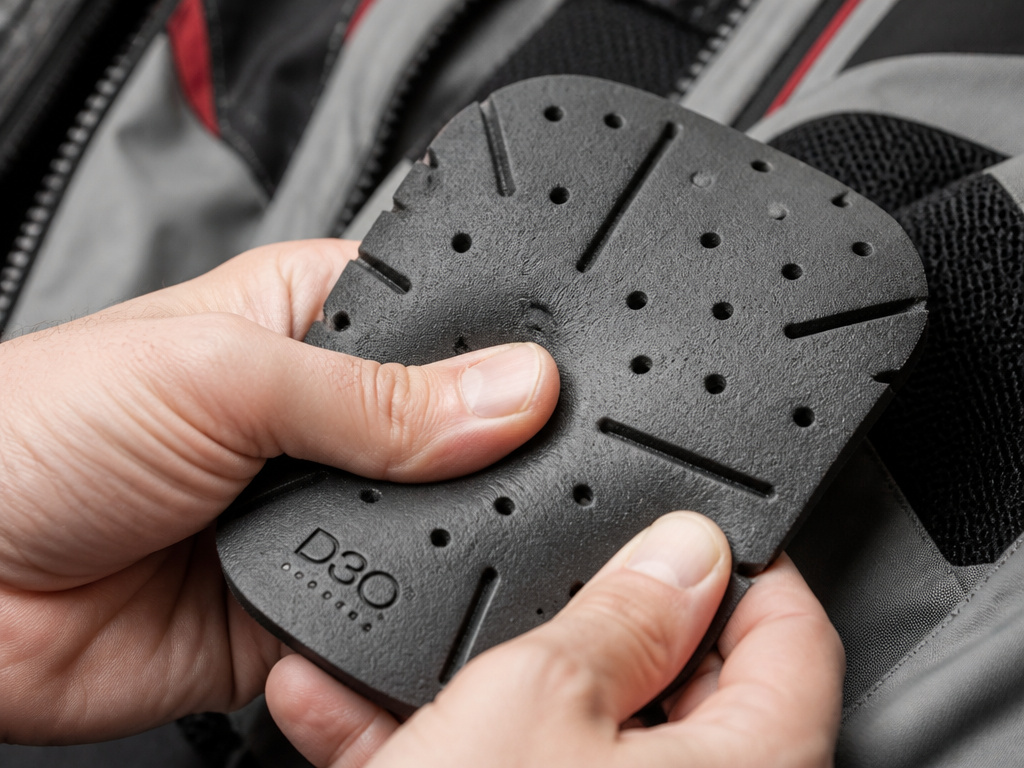
Manufacturer timelines are a backup. Your primary tool is a two-minute visual and tactile check before you suit up. The Alpinestars manual calls for periodic inspection; Leatt says to inspect prior to each use for maximum performance.
- Remove the pads. You cannot inspect armor through a pocket. Take out the back protector, shoulder, and elbow pads.
- Look for cracks and deformation. Hold hard plastic shells up to a light. Look for hairline cracks, especially around mounting points or edges. Check for any permanent bending or warping. The rule is clear: if it’s cracked, chipped, or delaminated, it must be replaced.
- Perform the thumb test on foam. Press your thumb firmly into the center of a soft foam pad (like D3O or similar). Apply steady pressure for three seconds, then release.
- PASS: The foam rebounds completely within 1-2 seconds, leaving no visible dent.
- FAIL: Your thumb leaves a slow-filling dent, or the foam feels stiff and unyielding. This foam has taken a set and lost its energy-absorbing crush zone.
- Check the cover and seams. Look for torn mesh covers, deteriorated stitching, or padding that’s breaking down into crumbs. Leatt says to stop use if the inside padding has deteriorated.
- Smell it. This sounds odd, but armor that’s been stored damp or is breaking down chemically often has a faint, sweet, or sour odor. It’s a last-ditch warning sign.
Where this goes sideways: Skipping the thumb test on foam. A pad can look pristine but have lost all its protective give. That failure shows up in the first hard impact, not during your inspection.
If your armor passes all these checks, it’s likely still functional regardless of its age. This is the core of the condition-based argument. The inspection is what matters.
When You Must Replace Armor Immediately (No Exceptions)
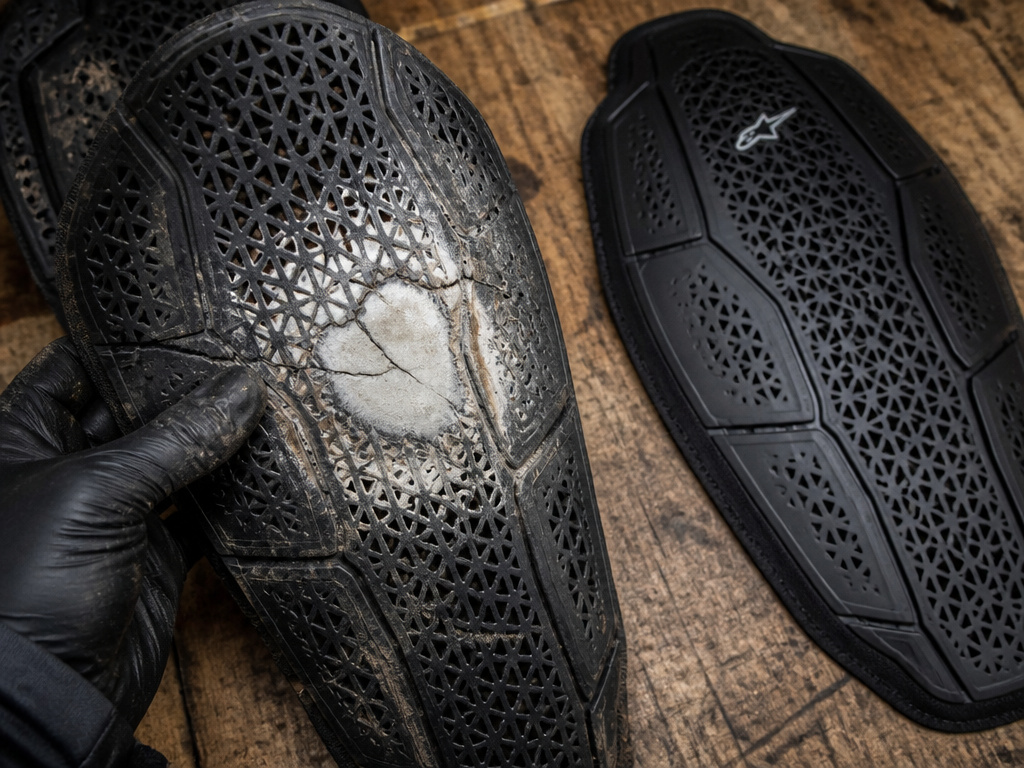
Some damage cannot be inspected away. It’s binary.
After Any Crash or Direct Impact: This is the essential rule from every manufacturer and expert. Knox states it plainly: “If the protectors have at any time received an impact due to an accident scenario they should be replaced immediately.” The Alpinestars manual adds a critical visual cue: replace the protector if “the plastic has lightened in colour at the impact point.” This color change indicates the polymer’s microstructure has been crushed and altered. It will not perform the same way twice.
If You Have Any Doubt: The manuals are filled with phrases like “if there is any doubt as to their condition, they should be replaced immediately.” Trust it.
This is also the moment to consider a full post-crash inspection of all your gear, not just the armor.
Upgrading vs. Replacing: How to Handle Old Gear
Your jacket is frayed, but the armor looks fine. Or the armor is shot, but the leather is barely broken in. You have options.
Scenario 1: Good Armor, Worn Shell. This is the perfect case for an armor transplant. Remove the CE Level 2 pads from your old jacket and install them into a new, compatible one. Many riders don’t realize that upgrading jacket armor is a standard, simple procedure.
Scenario 2: Good Shell, Worn Armor. The easier fix. Purchase new CE-rated motorcycle armor in the correct size and type for your jacket’s pockets. Swapping in fresh CE-rated armor pads can rejuvenate an old garment.
Scenario 3: Everything is Worn Out. Time for disposal. Do not throw armor in the regular trash if you can avoid it. Check with local recycling centers, some accept plastics and foams.
Frequently Asked Questions
Can I wash motorcycle armor in the washing machine?
No. Do not machine wash hard armor shells. The 2023 study confirmed that hot washing degrades polyurethane-based protectors. Every manufacturer manual instructs you to wipe armor with a damp cloth only. For soft armor removable from a garment, Knox recommends hand washing only.
Does CE Level 2 armor last longer than Level 1?
Not necessarily. The CE level (1 or 2) indicates how much force is transmitted during a standardized impact test, not the material’s longevity. Lifespan is about the specific material and construction, not the performance rating.
How does armor lifespan compare to a motorcycle helmet?
They are different. Armor lifespan is driven more by physical damage (cracks, compression) and specific chemical degradation from heat and washing.
My armor is past the manufacturer date but looks perfect. Is it safe?
If it passes a rigorous thumb test and visual inspection, and has never been impacted, the material may still be viable. This is the heart of the condition-based argument. However, for absolute certainty, replacing it is the only way to reset the clock.
The Bottom Line
Here is the thing. The “how long” question has three answers, and you need to listen to all of them. Listen to your manufacturer’s manual, if it says 3 years, that’s your starting point. Listen to the science, keep your armor cool, dry, and never, ever hot wash it. Most importantly, listen to the armor itself. Your thumbs and eyes are the best test equipment you own.
If a pad is cracked, stiff, or has taken a hit, its job is done. Replace it without a second thought. If it’s clean, rebounds, and has lived a sheltered life, the calendar matters less. It’s about using real, tangible data, not a fear of a date, to make a safety call.
