
Heated Motorcycle Grips vs Heated Gloves: Which Is Right?
This post contains affiliate links. As an Amazon Associate, we earn from qualifying purchases.
Heated motorcycle grips vs heated gloves comes down to heat distribution, power source, and the specific temperature you ride in. Heated grips warm your palms directly from the bike’s electrical system, offering unlimited runtime and simple controls. Heated gloves warm your whole hand, fingers and backs included, via battery or a 12V connection, providing superior coverage but requiring charging and management. For most riders above 20°F (-6°C) dealing with chilly mornings, grips are the more convenient and cost-effective winner. Below that line, or if your fingertips go numb first, gloves become the necessary tool.
The 20°F threshold isn’t arbitrary; it’s where wind chill overcomes palm-focused heat. Above that line, blocking airflow with handguards and warming your palms is often enough. Drop below it, and you need heat wrapped around your entire hand, including the fingertips that are most exposed to the wind. This is a thermal mapping problem, not a preference.
What follows: the exact electrical loads (2.8 amps), adhesive cure times (24 hours before riding, 48 before heat), and the waterproofing quirk that can make grips a liability in rain. We’ll name specific gloves with their proven runtimes and temperatures, and explain when combining both systems isn’t overkill, it’s the only sane choice.
Key Takeaways
- Choose heated grips for convenience, unlimited power, and chilly-weather riding above 20°F (-6°C), they’re always there when you turn the key.
- Choose heated gloves when temperatures drop below 20°F or your fingertips go numb, they’re the only way to get heat to the backs of your hands and fingers.
- A modern grip like the Harley-Davidson Empire draws up to 2.8A, check your stator and wiring before installing.
- For wet-weather riding, heated gloves have a distinct advantage: heat inside a waterproof membrane seals it, while heat from grips on the outside can reverse the seal and let water in.
- The best setup for deep cold is both: use grips to warm your palms so your gloves can run on a lower, battery-saving setting.
How They Work: Palm Heat vs. Whole-Hand Wrap
The heated motorcycle grips vs heated gloves debate centers on how they attack the cold-hand problem from opposite directions. Grips are a vehicle accessory. Gloves are rider gear. That fundamental difference changes everything from installation to daily use.
Heated grips transfer heat through direct contact between your palm and the handlebar. The heating elements are embedded in the rubber or built into a replacement grip, powered by the motorcycle’s 12V electrical system via a controller usually mounted on the handlebar.
You control them from the bike. Once installed, they’re a permanent fixture, no batteries to charge, no extra gear to pack. That’s the core of their appeal. The heat is concentrated exactly where your hand makes contact. It’s immediate, adjustable, and draws from a source that never runs out as long as the engine is turning.
The installation, however, is not a five-minute job. You’re dealing with the motorcycle’s electrical system. A set like the Harley-Davidson Empire Heated Hand Grips requires up to 2.8 A additional current from the vehicle’s electrical system. That’s not trivial for an older bike or one already loaded with accessories. You also have to route wires through the handlebars, mount a controller, and let the grip adhesive cure. According to installation instructions cited by Shinywing, the grip adhesive needs to cure for 24 hours before the motorcycle is used and 48 hours before heat is applied. Skip that timeline and you risk the grips spinning on the bar.
Heated gloves work differently. The heating elements, thin wires or carbon-fiber panels, are woven into the lining. They target specific areas: the back of the hand, each finger, often the fingertips. Power comes either from a rechargeable battery pack sewn into the cuff or a wire that plugs into a 12V outlet on your bike.
The heat surrounds your hand. It’s less intense at any single point than a grip on high, but it covers the whole hand. This is why they win in deep cold. Your fingertips, which are furthest from your core and have the least blood flow, get direct heat. The trade-off is the battery. You have to remember to charge it, and its life is finite. A glove like the Merlin Curborough claims a battery life of 3.5 hours on high from its two 7.4V 2200mAh batteries.
Heated Grips: Always-On Convenience
For the rider who hates extra steps, heated grips are a revelation. They turn a key, push a button, and get warmth. There’s nothing to pack, forget, or charge. This makes them perfect for the shoulder seasons, those cool spring mornings and crisp fall evenings where the cold is a nuisance, not a barrier.
The convenience is psychological as much as physical. Because they’re part of the bike, you use them more often. A quick blast of heat at a stoplight, a lower setting for a long highway stretch in drizzle. They encourage you to ride in conditions you might otherwise avoid, effectively extending your riding season.
But that “part of the bike” status is also the biggest limitation. They only work on that bike. If you own multiple motorcycles, you’re buying and installing a set for each one. They also offer zero warmth the moment you take your hands off the bars. Paying for gas, adjusting your helmet, checking your phone at a stop, your hands are back in the cold.
Where this goes sideways: Assuming they’re enough for any temperature. The heat pattern is the problem. On a cold day, you can have palms that are almost too hot while your fingertips are numb and white. Turning the grips up to max just makes the palms sweat, which then gets cold. This is why the professional consensus draws the line at 20°F (-6°C). Below that, the wind chill on the backs of your unheated fingers and knuckles pulls away more heat than your palms can absorb.
| Grip Model | Key Spec | Best For |
|---|---|---|
| Harley-Davidson Empire | Up to 2.8A draw, ~20°F warmer than older models | Touring bikes with robust electrical systems |
| Oxford Heaterz | Wrap-on design, universal fit | Riders wanting a removable, non-permanent option |
| OEM Factory Grips | Integrated with bike’s control cluster | Buyers who want a seamless, factory-installed look |
If your riding is mostly commuting or day trips in temperatures that hover above freezing, a quality set of heated grips is probably your best investment. Start there before you even look at gloves.
Heated Gloves: Full-Hand Warmth, With Strings Attached
Heated gloves solve the distribution problem. A pair heats the back of your hand, all five fingers, and critically, the fingertips. This is the only way to combat the wind chill that attacks the thin, exposed parts of your hand. For riders with poor circulation, Raynaud’s syndrome, or anyone venturing into true winter conditions, they are not a luxury, they are essential gear.
The technology has gotten impressively specific. The HearthRide glove, for example, targets heating elements at the back-of-hand joints and each fingertip. The Merlin Curborough offers three precise temperature settings: High 70°C, Medium 59°C, Low 48°C. This control allows you to adjust the heat for the conditions, which saves battery life.
That battery life is the central tension. You’re trading unlimited bike power for portability. Options break into two camps:
- Battery-Powered: Like the Merlin Curborough or Held Inuit. You charge them like a phone. They’re ideal for multi-bike owners, commuters, or anyone who wants warmth off the bike (like at a cold campsite). The Held Inuit’s manufacturer claims a runtime for Turbo mode of 1.5 hours.
- 12V Wired: Like the Gerbing Vanguard or many Tour Master models. You plug into a 12V outlet on your bike. Runtime is unlimited, but you’re tethered. This is the classic choice for long-distance winter touring.
Before you start: If you choose 12V wired gloves, verify your bike’s electrical capacity. The Gerbing Vanguard manufacturer requires a motorcycle stator rated for a minimum of 300 Watts for use with 12V systems. Plugging high-draw heated gear into a small bike can drain the battery, especially at idle.
The other major advantage is for wet weather. A review of the Held Inuit gloves highlighted a counterintuitive fact: having heat on the outside of a glove’s waterproof membrane (like from a heated grip) can reverse the membrane’s action, potentially letting water seep in. Heat generated inside the membrane, as with a heated glove, reinforces the seal. If you do a lot of cold-rain riding, this tips the scales toward gloves.
The downside is bulk and feel. Even the best heated gloves add wiring, batteries, and lining. They can feel clumsier than a standard winter glove, potentially muffling feedback from the controls. It’s a trade-off: warmth for tactility.
The Temperature Threshold Where the Choice Flips
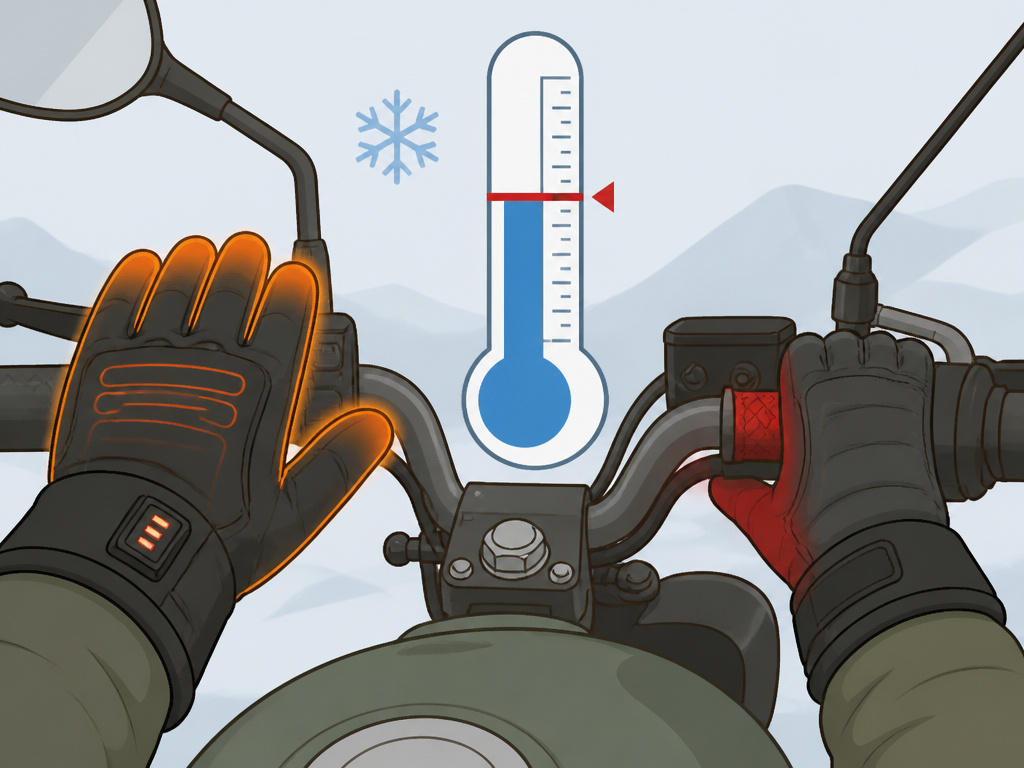
The debate isn’t abstract. There’s a concrete temperature where the math changes, and it’s backed by both rider experience and technical analysis.
Above 20°F (-6°C), heated grips combined with a good pair of insulated winter gloves are usually sufficient. The goal here is to take the biting edge off the cold, not to simulate a July afternoon. Your core palm heat, provided by the grips, is enough to keep overall hand temperature manageable, especially if you also use handguards to block the wind.
Below 20°F (-6°C), the equation flips. The wind chill factor becomes extreme, and the small surface area of your palms can’t transfer enough heat to warm the massive cooling surface of your fingers and knuckles. This is where heated gloves become necessary. They apply heat directly to those cold spots. Professional guides explicitly state that for temperatures below this point, or for riders whose fingertips go numb first, heated gloves are superior.
This threshold explains why so many seasoned winter riders end up using both systems together. The grips handle the palm heating efficiently off the bike’s unlimited power. This allows the heated gloves to be set on a low or medium setting, drastically extending their battery life, perhaps from 2 hours on high to 5 or 6 hours. The combination provides deep, balanced warmth without overtaxing either system.
The part nobody mentions: Your body adapts. On the first 30°F ride of the year, heated grips feel miraculous. By the end of a winter of riding, you might find yourself wanting more heat even at 35°F. What feels “warm enough” is a moving target based on your acclimation.
Cost, Installation, and Real-World Trade-Offs
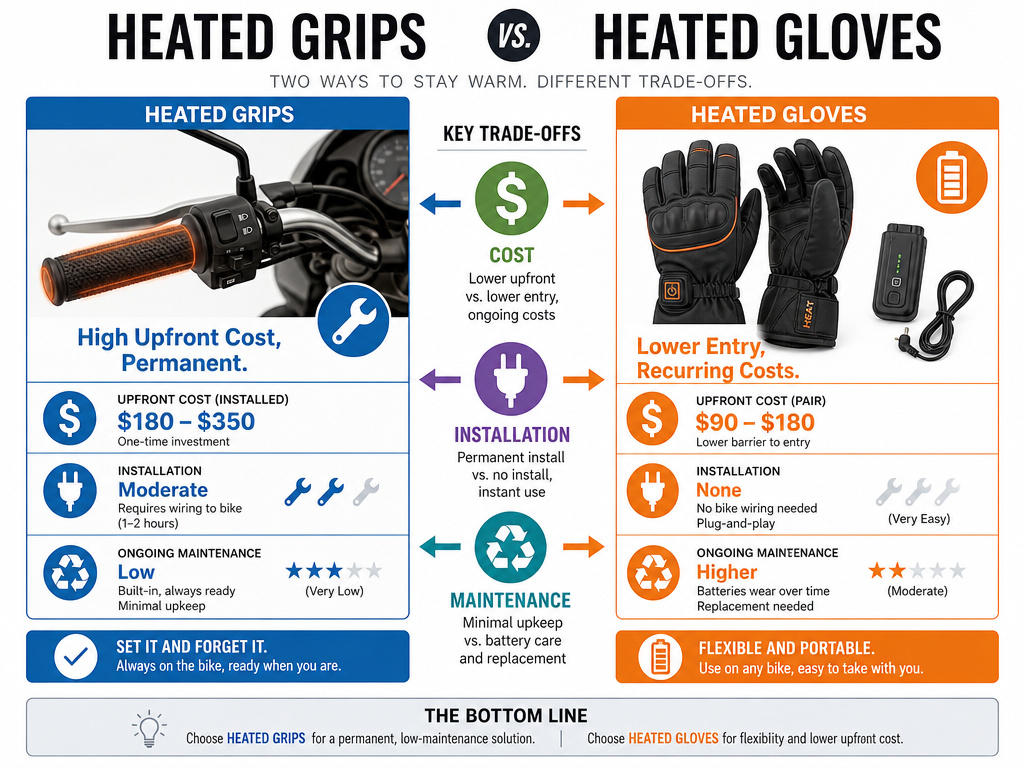
Consider what it actually takes to get these systems on your bike and hands. The difference here is stark, and it often decides the matter before any thermal analysis.
Heated Grips: Higher Upfront Cost, Permanent Solution
A kit from Oxford or a dealer-installed OEM set like the Harley-Davidson options represents a significant investment. You’re paying for the grips themselves, a controller, and all the wiring. Then you either pay a mechanic for a couple hours of labor or dedicate an afternoon to the install heated grips process yourself. It’s a permanent modification to your motorcycle. The benefit is that once it’s done, your cost of ownership is nearly zero, just the negligible extra fuel to spin the alternator.
Heated Gloves: Lower Entry, Recurring Friction
You can buy a solid pair of battery-powered heated gloves for less than a full grip installation. There’s no wiring, no tools needed. The “installation” is pulling them on. But the costs are recurring and subtle. You must remember to charge them before every ride. Batteries degrade over 2-3 seasons and are expensive to replace. If you go the 12V route, you need a power source on your bike, which might mean installing a 12V outlet if you don’t have one.
| Factor | Heated Grips | Heated Gloves (Battery) | Heated Gloves (12V) |
|---|---|---|---|
| Upfront Cost | High (Kit + Labor/Time) | Medium | Medium (Gloves + possible outlet install) |
| Ongoing Cost | Very Low | Medium (Battery replacement, electricity) | Low |
| “Installation” | Complex, permanent | None | Simple wiring for outlet |
| Daily Hassle | None | Charging, bringing gloves | Plugging/unplugging |
| Portability | None (Bike-specific) | High (Take them anywhere) | Low (Tethered to bike) |
For the rider with one main bike who hates managing gear, the grips’ higher upfront cost pays off in simplicity every single day. For the rider with multiple bikes, or who only needs heat occasionally, the gloves’ flexibility wins.
When To Combine Both Systems (And When To Skip One)
When considering heated motorcycle grips vs heated gloves, the forum advice to “get both” is common, but it’s not always the right call. It’s a solution for a specific problem: sustained riding in deep cold. If you’re a winter tourer or your commute regularly involves sub-freezing temperatures for an hour or more, the combination is unbeatable.
Here’s the synergy: Set your heated grips to a medium level. They provide a steady, power-free base of palm warmth. Then, set your heated gloves to low. This direct finger heat complements the grips without needing to draw massive battery power. You get warmth across your whole hand, the gloves last all day, and you have a backup system if one fails. It’s the most robust and comfortable setup possible.
However, there is a legit warning about combining them. As noted in the Held Inuit review, external heat from grips can, in theory, compromise some waterproof membranes. If you have a premium waterproof glove and ride in heavy rain, test the combination before you rely on it in a downpour. The heat-from-inside advantage of gloves alone might be safer.
Skip heated gloves if: You only ride in cool, not cold, weather (think 40°F and up). A good pair of insulated gloves and heated grips will be more comfortable and less bulky.
Skip heated grips if: You own several bikes and can’t justify installing them on all, or your bike’s electrical system is already at its limit. A pair of battery-powered heated gloves you can move between bikes is the smarter, simpler play.
The choice between battery vs 12v heated gear adds another layer. For combination use with grips, battery gloves are fantastic because the grips extend their life. For long-distance cold touring where you’ll be plugged in for hours, 12V gloves eliminate range anxiety entirely.
How do heated grips work with handguards and gloves?
Using heated grips with standard motorcycle gloves is straightforward, but there are compatibility considerations. Some manufacturers, like Daytona, advise always wearing gloves when using heated grips for safety, while other installation instructions do not give this warning. Handguards are highly recommended as they block wind, helping to retain the heat from the grips around your whole hand. However, a key technical warning exists: applying external heat from grips to the outside of a waterproof glove membrane can potentially reverse it, allowing water to seep through. For heated gloves, the heat does not need to penetrate the grip material, so palm heating remains effective. Some riders find using both systems together allows them to run the gloves on a lower, battery-saving setting.
Frequently Asked Questions
Are heated gloves better than heated grips?
It depends on the temperature. Below 20°F (-6°C), yes, heated gloves are better because they heat your entire hand, including the fingertips that get coldest. Above that temperature, for general chilly-weather comfort, heated grips are often more convenient and cost-effective. “Better” is defined by how and where you ride.
Will heated grips drain my motorcycle battery?
If the engine is running, the charging system should cover the draw. Specific Harley-Davidson heated grip models, like the Empire and Contoured Chrome, draw up to 2.8 amps. The risk is idling with grips on high alongside other accessories (lights, heated seat). If your bike has a marginal charging system, it’s possible to drain the battery at a long stoplight. The real danger is leaving them on with the engine off, which will flatten a battery quickly.
Can I wear heated gloves with heated grips?
Absolutely, and for extreme cold it’s the recommended approach. The grips provide free palm heat from the bike, allowing you to run the gloves on a lower, battery-saving setting. This extends the gloves’ runtime and provides more balanced warmth. Just be aware of the potential interaction with the gloves’ waterproof membrane.
How long do battery-powered heated gloves last?
It varies wildly by brand, battery size, and heat setting. Using real examples: The Merlin Curborough claims 3.5 hours on high. The Held Inuit claims 1.5 hours in Turbo mode (though independent testing showed longer). The HearthRide claims a heating duration from 3 to 12 hours depending on battery and setting. Always treat manufacturer runtimes as best-case scenarios and plan for less, especially as the batteries age.
Are heated grips worth it?
For a rider looking to extend their season and combat chilly weather without the fuss of extra gear, yes. They are a “fit and forget” solution that adds immediate comfort and is always available. The value is highest if you have one primary bike and ride in the 30°F to 50°F range regularly. If you only ride in deep cold or own multiple bikes, the value proposition shifts toward heated gloves or other heated gear.
Before You Go
Here’s the honest take. Don’t overthink this based on hypotheticals. Match the tool to your actual conditions.
If your winter riding is mostly about chilly commutes and weekend rides where the mercury dips toward freezing, install a set of heated grips. They’re the single biggest comfort upgrade you can make for that scenario. Pair them with a solid wind-blocking handguard and good insulated gloves, and you’ve solved 90% of the problem.
If you see your breath fogging your visor before you start the bike, or you’re planning a tour where the forecasts include the word “windchill,” you need heated gloves. Look for models with specific heating for the fingertips and backs of the fingers, that’s where you’ll feel the failure. And seriously consider the 12V wired versions if touring; battery anxiety in the cold is a real mood killer.
For everyone else in the middle, the year-round riders, the adventure seekers who don’t let a calendar dictate their fun, the answer is both. It feels like overkill until you’re three hours into a mountain pass at 25°F, perfectly comfortable, and watching your buddy with just gloves or just grips do the cold-hand dance on the bars. That’s not luxury. That’s control.
One final, grounded tip from the garage: before you spend a dollar, focus on blocking the wind. A simple set of handguards or even hand deflectors can raise the effective temperature by 10-15 degrees. No electric system can win a fight against a 70-mph blast of cold air. Stop the wind first, then add heat.
