
How to Keep Hands Warm on a Motorcycle: The 20-Minute Rule
This post contains affiliate links. As an Amazon Associate, we earn from qualifying purchases.
To keep your hands warm on a motorcycle, you need a system, not a single product. The cold wins by attacking from multiple angles: wind chill steals heat, metal controls conduct it away, and poor circulation numbs your fingers. Your defense is a layered strategy of insulation, active heating, wind blocking, and keeping your core warm to maintain blood flow. Heated grips or gloves handle the palm; handguards or muffs stop the wind; and proper winter gloves with a gauntlet cuff seal the deal.
That system view is what most riders miss. They buy the warmest gloves they can find and wonder why their fingers are still frozen after an hour, which highlights the importance of learning how to keep hands warm on a motorcycle. Cold isn’t just a temperature—it’s wind speed plus moisture plus contact with freezing metal. Solve for all three.
What follows is the garage breakdown: why each layer works, the specs that actually matter (like a 1-3 amp draw for heated grips), and how to pair them for your riding conditions. This practical guide answers the how to keep hands warm on a motorcycle question. You’ll see when to spend on heated gear and when a $20 pair of lever wraps does more than a $300 glove.
Key Takeaways
- Insulation and sealing come before heat. A wet glove or an open cuff drains warmth faster than any heater can replace it. Your first investment is a gauntlet-style winter motorcycle glove with a waterproof, windproof membrane.
- Heated grips need 20 minutes to reach their final operating temperature, per Harley-Davidson’s service manual. Plan your ride around that warm-up period.
- Block wind before you add watts. Handguards or handlebar muffs create a still-air pocket around your hands. This is often more effective than cranking heated grips to their highest setting.
- Cold metal levers suck heat directly from your fingertips. Inexpensive neoprene lever wraps or covers are a high-return, low-cost upgrade that most riders overlook.
- Your core temperature dictates hand warmth. If your torso is cold, your body restricts blood flow to your extremities. Layer a thermal base layer and insulated jacket before you worry about your hands.
The 20-Minute Warm-Up Rule That Matters
You turn on the heated grips, feel a little warmth in a minute, and assume they’re working. They’re not. Not fully.
According to Harley-Davidson’s official service procedure, heated hand grips require approximately 20 minutes to reach final operating temperature. The thermostatic controls in both grips work to maintain a consistent and comfortable grip temperature, but they need that time to stabilize, especially in cold ambient air.
That’s the first reality check. If you’re shivering after five minutes of highway riding, the grips aren’t broken—they’re just climbing. This isn’t a design flaw; it’s physics. The heating element warms the grip material, which then warms your glove, which then warms your hand. Each step takes time.
The second is the engine rule. Most OEM heated grip systems, like those from Harley-Davidson, are only operational while the engine is running to prevent battery drain. They’re designed to deliver peak heat at cruising RPM. If you’re stuck in traffic on a cold day, the heat output will drop.
What does this mean for your ride?
Start the bike, turn on the grips, and let the bike idle for a few minutes before you go. If you can, plan the first segment of your ride to be lower-speed. The grips will be closer to full temp by the time you hit the highway. This is why riders who rely solely on heated grips often complain about cold fingertips on fast, cold starts.
Your First Layer: The Winter Glove That Actually Seals
Heat is useless if it escapes. Your glove’s job is to create a stable, insulated environment for your hand. That means stopping wind, blocking water, and sealing at the wrist.
A short-cuff glove is a mistake for winter street riding. Cold air shoots up your sleeve, replacing any warm air in seconds. You need a gauntlet. Choose a glove that closes snugly over or under your jacket sleeve with an adjustable strap or zipper. Many major motorcycle gear brands build this into their touring lines.
The palm is essential. It needs armor or a slider patch, but it also needs to be pre-curved. A flat palm forces your hand to fight the glove’s shape, cutting circulation and creating pressure points that get cold first. Try the glove on and hold a grip shape. It should feel natural, not tight across the knuckles.
Leather with a waterproof, breathable membrane (like Gore-Tex) is the standard for a reason. It blocks wind, sheds water, and breathes enough to manage sweat. A so-called “waterproof” textile glove often wets out in a long ride, and once the lining is damp, you’re done.
| Glove Feature | Why It Matters for Warmth | What Happens If You Skip It |
|---|---|---|
| Gauntlet Cuff | Seals out wind rushing up the sleeve. | Cold air intrusion chills the entire forearm, defeating any palm heat. |
| Pre-Curved Palm | Reduces muscle tension and improves blood flow. | Hand fatigues faster, grip tightens, circulation slows, fingers numb. |
| Windproof Membrane | Stops convective heat loss (wind chill). | Wind strips heat away faster than your body or heater can produce it. |
| Quality Wrist Closure | Keeps the glove seated during a slide and seals the cuff. | A loose glove lets in air; in a crash, it can roll off or fail to protect. |
Heated gear does not replace a winter glove that provides impact protection and weather sealing, a fundamental principle when you compare a how to keep hands warm on a motorcycle system to a single product. The glove still has to provide impact protection and weather sealing. A thin summer glove with a heated liner will still freeze you in the wind.
Heated Grips vs. Gloves: The Real Trade-Off
This is the core gear decision. Both add active heat, but they work in fundamentally different ways and lock you into different riding compromises.
Heated Grips warm your palms through contact with the handlebar. The heat is controlled from the bike, draws power from the bike’s charging system, and is always there when you ride. Per the NHTSA technical service bulletin for Harley-Davidson, a healthy system should draw a total of 1-3 amps. They’re simple, integrated, and convenient.
But that heat is localized. As the retailer Nippy Normans notes, handle heating “only warms the palms of the hands.” Your fingertips and the backs of your hands are exposed to the wind. If your gloves are poor insulators, that palm heat never radiates to your fingers.
Heated Gloves place heating elements in the fabric, often across the fingers and back of the hand. This can distribute warmth more evenly. They also provide heat when you take your hand off the bar at a stop. The trade-off is bulk, batteries, and wires. Bulk can reduce control feel, and dead batteries leave you with cold, cumbersome gloves.
Where this goes sideways: Choosing heated gloves based only on their highest temperature claim. A glove that claims 120°F but has stiff, poorly placed heating elements will make your throttle hand clumsy. Control feel always trumps peak heat.
So which should you buy?
- Choose heated grips if you want always-available warmth, simple on-bike control, and a dedicated system. They pair best with a quality winter motorcycle glove. This is the better everyday solution for most riders.
- Choose heated gloves if your fingertips remain chronically cold despite warm grips, or if you do repeated winter touring where off-bike warmth matters. Choose heated gloves with a slim profile and flexible wiring.
For serious cold, using both at moderate settings is the expert move. The grips warm from the inside, the gloves reduce heat loss. You can read a deeper comparison in our guide on heated grips versus heated gloves.
The Wind-Blocking Layer: Handguards and Muffs
Wind chill is the biggest heat thief on a motorcycle. Wind chill dramatically increases heat loss from exposed skin, making effective wind blocking essential. Stop the wind, and you instantly feel significantly warmer.
Handguards (or hand protectors) are the first line of defense. They’re standard on adventure bikes but can be added to many street bikes. They deflect wind and rain away from the back of your hands. They don’t create a fully sealed environment, but they dramatically reduce the airflow your gloves must fight. Our review of the best motorcycle hand guards covers the mounting options.
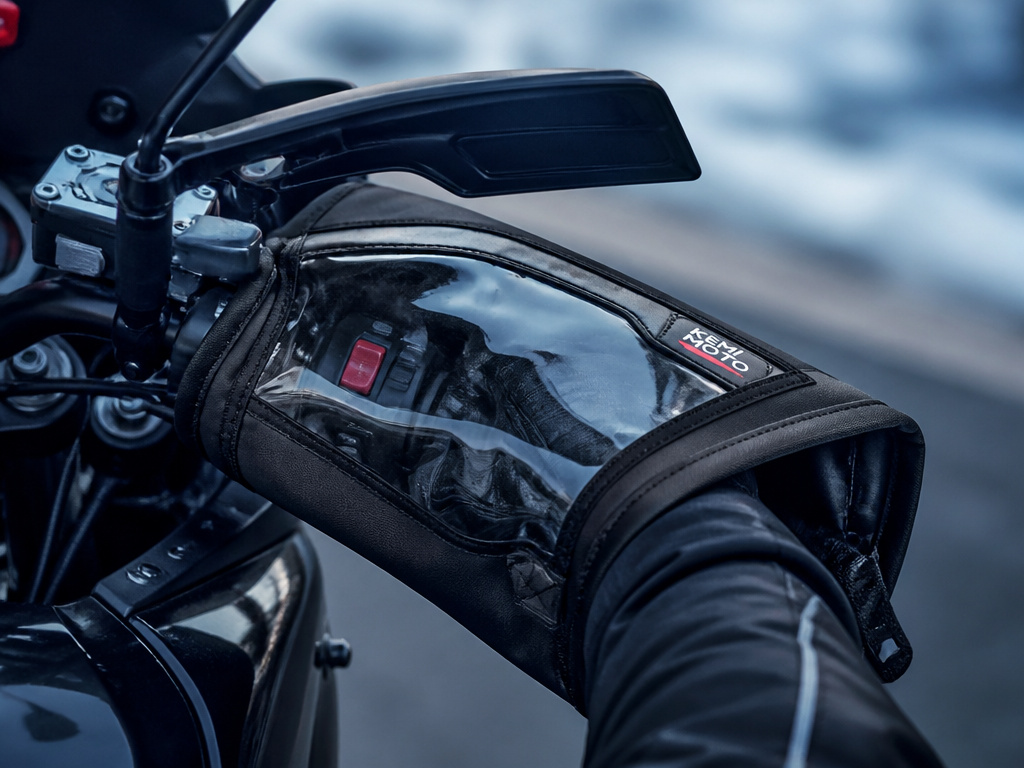
Handlebar Muffs (sometimes called Hippo Hands) are the ultimate solution. These are insulated, weatherproof covers that slip over the ends of your handlebars, creating a still-air pocket around your entire hand and the controls.
“The best protection for cold hands is reliable heat insulation and the avoidance or exclusion of convection. The best means for this: Well thought out, constructed, high-quality handlebar muffs.” — Nippy Normans retailer description, which advocates for muffs as a highly effective solution.
High-quality muffs often have shaped inserts to hold their form at speed, transparent windows for seeing switches, and seals around the handlebar and your jacket cuff. They work with or without handguards. The feeling is transformative—it’s like riding with your hands in a sheltered, warm tent. They make heated grips vastly more efficient, as the heat isn’t being blown away.
The downside is the “dork factor” and a slight learning curve to feel the levers through the material. For all-day comfort in freezing temps, they are unbeatable.
The Low-Cost Upgrades Everyone Forgets

Before you spend hundreds on heated gear, address these two cheap points of failure. They cost little and fix the specific cold spots that cause misery.
Lever Wraps. Your brake and clutch levers are metal. On a cold morning, they are heat sinks, sucking warmth directly from your fingertips the moment you touch them. Neoprene lever wraps or slip-on covers insulate that metal. They are an inexpensive upgrade. Your fingertips will thank you immediately.
Wrist Seals. Cold air finds the path of least resistance. If your glove cuff and jacket sleeve don’t seal, you have a constant cold draft. A simple elasticated wrist seal or a length of Velcro-closing gaiter worn over the junction can block it. It’s the same principle as sealing a drafty window.
These aren’t magic. They’re basic insulation. But they solve the specific, localized cold that even the best gloves can miss.
Why Your Core Temperature Decides Everything
Cold hands are often a symptom of a cold core. Your body’s survival response is to restrict blood flow to the extremities (your hands and feet) to preserve warmth for vital organs. If your torso is chilled, your hands will be cold no matter what you put on them.
This is why a complete winter layering system is critical. Start with a moisture-wicking thermal base layer. Add an insulating mid-layer like a fleece or synthetic jacket. Your outer motorcycle jacket should be windproof and waterproof. When your core is warm, blood flows freely to your hands.
A common mistake is wearing a bulky, non-breathable jacket that makes you sweat. That sweat then chills you, triggering the blood-restriction response. Breathability is as important as insulation. You can explore a full head-to-toe approach in our roundup of cold weather riding gear.
Managing Moisture and Sweat with Heated Gear
Heated gear can make you sweat, especially if you crank it too high. Damp hands inside a glove get cold very fast. Moisture management is a critical, overlooked part of the system.
First, avoid cotton glove liners. Cotton holds moisture like a sponge. Use a thin, synthetic or wool liner that wicks sweat away from your skin. Merino wool is excellent—it stays warm even when damp.
Second, don’t max out your heated grips or gloves. Start on a low or medium setting. Your goal is to take the edge off the cold, not to make your palms sweaty. Let your body and your insulating layers do the rest of the work. If you feel yourself getting clammy, turn the heat down a notch.
The Step-by-Step System for Any Ride
Here’s how to put the layers together for a cold morning departure. The order matters.
- Dress your core first. Put on your thermal base layer, insulating mid-layer, and windproof jacket. If your torso is warm, your hands have a fighting chance.
- Prepare your bike. Start the engine and turn on the heated grips. Let it idle for a few minutes while you do your final checks. Remember the 20-minute rule.
- Put on your glove system. If using heated gloves, ensure batteries are charged and the controller is accessible. Pull on your winter gloves, ensuring the gauntlet seals tightly over your jacket sleeve.
- Block the wind. If you have handguards, they’re already on. If using muffs, slide your hands into them after you’re seated on the bike.
- Start riding conservatively. The first few miles are the coldest. Give the heated grips time to work and your body to adjust.
- Adjust heat based on feel, not numbers. If your fingertips are cold, check your grip pressure and posture before cranking the heat. Are you squeezing the bar too tight? Is wind getting up your sleeve?
The short version: Core warmth, then insulation, then wind blocking, then active heat. In that order.
How do glove liners and heated gloves work?
Heated gloves place their heating elements directly in the clothing, distributing warmth across the fingers and back of the hand, not just the palm. This means they continue to provide heat even when you briefly take a hand off the grip at a stop. Remember, a heated glove or liner does not replace a proper winter motorcycle glove. The outer glove must still provide weather sealing, impact protection, and good control feel. Heating cannot compensate for a wet glove, an open cuff, or cold air being channeled up your sleeve.
Are disposable hand warmers a good option?
Disposable warmers are a simple, portable heat source that can be used inside your gloves. They provide warmth directly to your hands, independent of your motorcycle’s electrical system. For the best effect, place them where you feel the coldest, often on the back of the hand or in the palm. To maximize their benefit, ensure your gloves have a seal at the wrist to stop cold air from rushing in and displacing the warm air. They work alongside your primary gear, adding an extra layer of heat on particularly brutal days.
Frequently Asked Questions
How do you keep your hands warm while riding a motorcycle?
You keep your hands warm by attacking cold from all sides: wear insulated, gauntlet-style winter gloves; use heated grips or gloves for active warmth; install handguards or handlebar muffs to block wind; and ensure your core body is layered warmly to maintain blood flow to your extremities.
What is the 12 second rule for motorcycles?
The “12-second rule” is a following-distance guideline, not a warmth technique. It advises maintaining at least a 12-second gap between you and the vehicle ahead in adverse conditions like rain, ice, or fog, to allow for longer stopping distances. It’s about safety, not comfort.
What is the best hand warmer for motorcycles?
The best “hand warmer” is a system, not a single product. For integrated, always-ready heat, heated motorcycle grips are the best choice for most riders. For flexible, distributed heat that works on and off the bike, heated motorcycle gloves are the best choice. The ultimate solution for extreme cold is handlebar muffs paired with either heated grips or gloves.
What temperature is too cold for motorcycle riding?
There is no universal “too cold” temperature—it depends entirely on your gear and tolerance. With a full system of heated grips, insulated gloves, handguards, and a warm core, many riders comfortably tour in very cold temperatures. Without proper gear, riding in cold temperatures can become dangerously uncomfortable and impair control due to numb hands.
Before You Go
One rule most guides skip: if your hands are chronically cold, check your grip before you buy new gear. A death grip on the handlebars tenses your forearm muscles and restricts blood flow. Consciously relax your hands on the straightaways. Sometimes the cheapest fix is the one you already have.
The next step is to diagnose your weak point. Are your fingertips cold? Look at lever wraps. Are the backs of your hands frozen? Handguards are your answer. Is your palm warm but your whole hand chilly? Your glove insulation or cuff seal has failed. Go after the specific symptom.
Everything above assumes you’re starting with a glove that fits. A glove that’s too tight or too loose will fail. Fit first, heat second. Now you know what to look for.
