
Battery vs 12V Heated Motorcycle Gear: Key Differences
This post contains affiliate links. As an Amazon Associate, we earn from qualifying purchases.
Battery-powered (7V) heated motorcycle gear runs on a rechargeable pack you carry, offering 2–8 hours of portable heat. 12V heated gear plugs into your motorcycle’s electrical system, providing unlimited runtime while you ride. According to RIPS & RIDES, the 12V platform supports bigger heating zones and higher peak output for serious cold, while 7V gear excels in versatility for shorter trips and off-bike use.
The core difference isn’t just about cords versus batteries. It’s about which system in the battery vs 12v heated motorcycle gear question can keep up with the specific cold you ride in, for as long as you ride. Highway wind chill at 60 mph can drop a 60°F day to a 30°F feel, a gap that separates adequate gear from essential gear.
What follows: the real runtimes, the electrical math your bike needs to handle in the battery vs 12v heated motorcycle gear debate, and the one hybrid system that tries to bridge the gap. By the end, you’ll know whether to reach for a portable battery or a wiring harness.
Key Takeaways
- 12V systems win for long, cold rides, they pull continuous power from your motorcycle for unlimited heat, as confirmed by sources like the Harley-Davidson BTC overview and RIPS & RIDES.
- Expect 1.5 to 8 hours from a 7V battery, runtime varies wildly. Gerbing cites 2–8 hours, while a Volt Heat Fusion Vest review measured just 1.5 hours on high.
- Always check your bike’s charging capacity first, a 12V jacket liner can draw 3.5 to 6.5 amps; overloading your system kills the battery mid-ride.
- Dual-source gear exists for a reason, products like the Volt Heat Fusion line let you run on 12V power or a 7V battery, solving the portability versus runtime trade-off.
- A temperature controller is non-optional, running 12V gear at full power, as a Bennetts BikeSocial review of a Gerbing vest found, gets “very hot” and a separate controller is “a must.”
The 60-60-30 Rule That Changes Everything
Wind chill isn’t a suggestion; it’s the arithmetic that makes heated gear necessary. Harley-Davidson’s product overview spells it out with the 60-60-30 rule: at 60 mph in 60°F weather, the wind chill factor can drop to 30°F.
That’s the gap your gear must fill. A system that feels cozy at a stoplight can become utterly inadequate twenty minutes into a highway blast. This is where the fundamental difference in the battery vs 12v heated motorcycle gear choice shows up. A battery has a finite charge. Your motorcycle’s alternator, if it has the capacity, does not.
The 60-60-30 rule explains why layering often fails at speed. Stationary insulation traps body heat; moving air strips it away faster than your metabolism can replace it. Heated gear actively replenishes that lost heat, which is why it’s the only reliable solution for extended cold-weather riding.
This rule reframes the entire choice. Are you buying heat for a chilly commute, or for a three-hour ride in falling temperatures? Your answer points directly to 7V or 12V.
Battery (7V) Heated Gear: Portable Heat, Finite Runtime
This is the cordless system. A rechargeable lithium battery, usually 7V or 7.4V, tucks into a pocket in the vest, jacket, or gloves. You get complete freedom from the bike, wear it walking, at a game, or under your riding jacket. The trade-off is in the clock.
Sources like Gerbing and RevZilla state that 7V gear typically provides roughly 2–8 hours of runtime depending on heat level and conditions. Other data is more precise and less optimistic. A review of the Volt Heat Fusion Vest clocked its 7.4V battery at 1.5 hours on high, 2.75 hours on medium, and 4 hours on low.
The takeaway? Assume the low end of the range for planning. If your ride is 90 minutes in deep cold, a 7V system on high might barely make it.
Where 7V gear makes sense:
- Short commutes under an hour.
- Errand running where you want heat off the bike.
- Early season or late season rides where the cold is brisk, not brutal.
- As a supplemental layer for your core when your main heat comes from heated motorcycle grips.
Where it falls short:
- All-day touring in near-freezing temperatures.
- High-wind-chill situations where you need maximum, sustained heat output.
- Multi-piece systems (jacket + pants + gloves) that would drain a single battery rapidly.
Fit recommendations vary. Harley-Davidson states its BTC heated clothing is not required to be worn snug, while general thermal principles often advise a closer fit for efficient heat transfer.
12V Heated Gear: Unlimited Power, Tethered to the Bike
Plug in and forget. A 12V system draws power directly from your motorcycle’s battery via a fused harness. As long as the engine runs, the heat flows. This is the platform for serious cold-weather riding.
Sources like RIPS & RIDES label 12V as the “strongest choice for long cold days and full multi-piece systems” because it can support bigger heating zones and higher peak heat. Harley-Davidson states its BTC 12V gear offers “continual power allowing for unlimited riding.”
Common mistake: Assuming all 12V gear includes a controller. A review of the Gerbing 12V vest noted it can be plugged straight in but runs at a “very hot” full power, making a separate temperature controller “a must.” Some brands, like Harley’s BTC line, include a built-in controller.
The performance specs show why it’s the power choice. Power draw varies by model. For example, a Gerbing 12V EX Pro jacket liner draws 6.4 amps (77W) and a Venture Heat liner pulls 6.5 amps (78W), but a Mosko Moto Ectotherm jacket uses 3.5 amps (42W).
Where 12V gear is non-negotiable:
- Winter touring and long-distance rides in temperatures at or below freezing.
- Riders using a full suit (liner, pants, gloves).
- Any situation where running out of heat is a safety or major comfort issue.
The tether is a real constraint. You’re plugged in. Dismounting for fuel or food means unplugging and losing your heat source unless you have a dual-source system. For pure, ride-length warmth, it’s the clear champion. Choosing the right 12V heated gear is the next step.
Heat Output and Performance: What the Specs Actually Mean
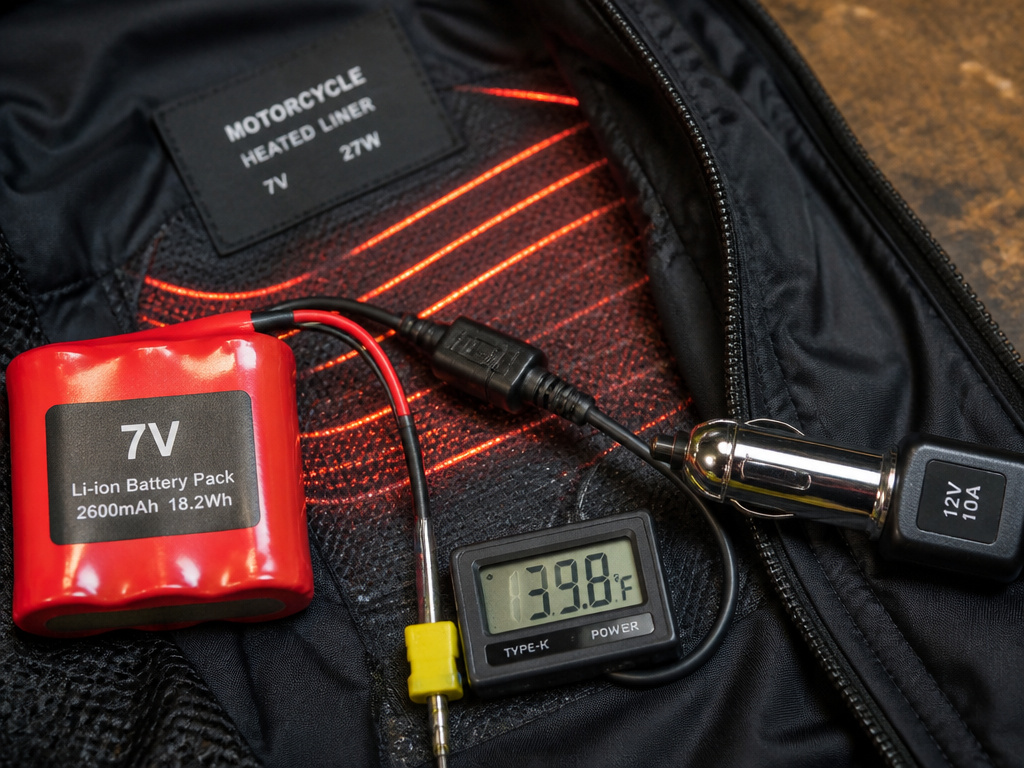
Peak temperature numbers vary by brand. Gerbing says its 7V gear hits ~140°F and its 12V gear hits ~135°F, while a review of Volt Heat Fusion Gloves claims 150°F.
The more telling spec is wattage. It’s a measure of power input, not warmth output, but it correlates with the system’s ability to fight wind chill.
| Product Example | Voltage | Power Draw | Key Differentiator |
|---|---|---|---|
| Gerbing 12V EX Pro Jacket | 12V | 6.4A / 77W | High-draw, full-coverage liner for sustained cold. |
| Mosko Moto Ectotherm Jacket | 12V | 3.5A / 42W | Lower-power, insulated design for efficient heating. |
| Volt Heat Fusion Vest (7V mode) | 7.4V | N/A (Battery) | ~1.5-4 hr runtime per charge. |
| Typical 7V System | 7V | N/A (Battery) | 2-8 hr portable runtime (mfr. Estimate). |
Why does wattage matter? A higher-wattage element can replenish heat lost to high-speed convection faster. In practice, a 77W jacket liner will maintain its core temperature against a bitter headwind better than a lower-power system might. It’s not that the lower-power gear isn’t warm; it’s that it may not be able to keep up under extreme demand.
This is the “cold-weather authority” that reviews mention. It’s why dedicated heated jacket liners for touring are almost exclusively 12V.
How to Check Your Bike’s Charging Capacity (The 5-Minute Test)
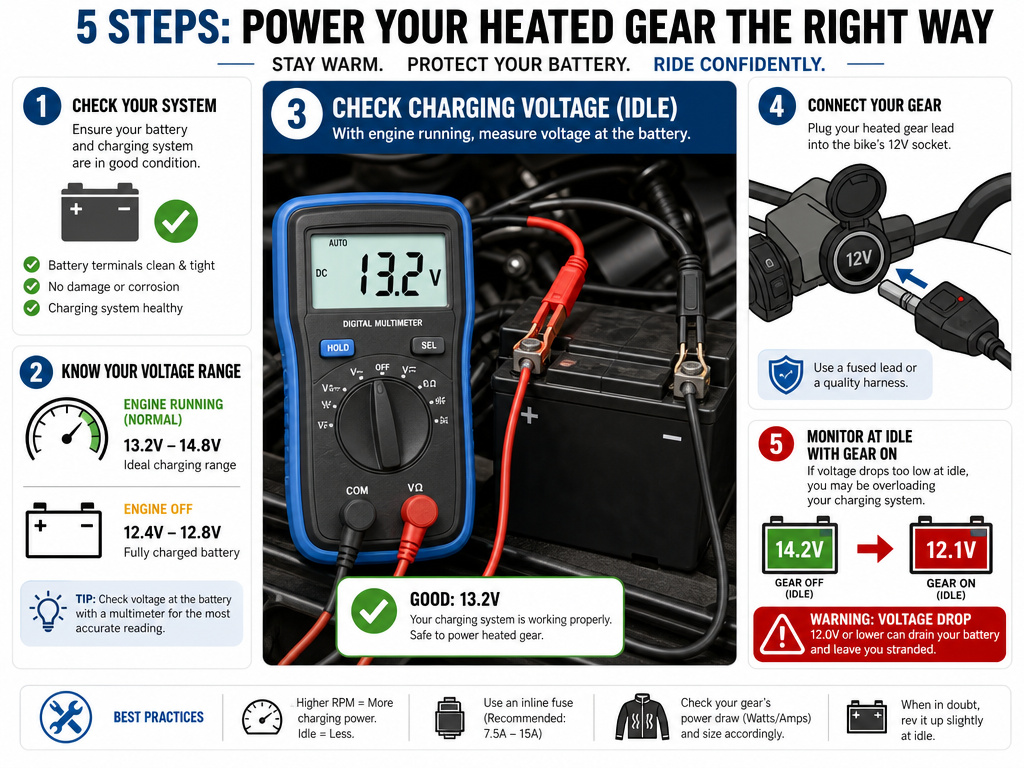
Before you buy a single piece of 12V gear, do this. Your bike’s electrical system is a finite resource. The headlights, ECU, fuel pump, and ignition are drawing power before you plug in your heated gear. You need to know what’s left.
Here’s a simple test you can do with a multimeter:
- Start with a fully charged motorcycle battery.
- Start the bike and let it idle.
- Measure the voltage at the battery terminals.
- Now, plug in your heated gear and turn it to maximum.
- Watch the voltage. The voltage should recover as you rev the engine.
If the voltage stays low, you risk draining the battery over a long ride. The solution isn’t to skip heated gear, it’s to manage your electrical load. You might opt for a lower-power 12V liner like the 42W Mosko Moto, or choose 7V battery-powered gear for your core heat instead.
This check takes five minutes. Skipping it can leave you stranded with a dead battery. For a detailed walkthrough, see our guide on how to wire heated gear.
The Dual-Source Hybrid: Best of Both Worlds?
What if you refuse to choose? Dual-source gear, like the Volt Heat Fusion line, builds both systems into one garment. It includes a 7.4V rechargeable battery and a 12V plug. Ride plugged in for unlimited power; unplug and the internal battery takes over for up to 1.5 hours on high.
The appeal is obvious. It solves the portability problem for touring riders who make frequent stops. It also acts as a backup; if your bike’s electrical system has an issue, you still have heat.
There are compromises. The integrated battery adds weight and bulk. And you’re managing two power systems and their respective chargers.
For a commuter who also wants to wear the vest off the bike, it’s a brilliant solution. For a pure tourer who lives in the saddle for hours at a time, a dedicated, simpler 12V system is often more reliable. Understanding the power draw of each component helps make that call.
Cost and Long-Term Ownership: The Real Price of Warmth
Look beyond the sticker price. The long-term cost curves of 7V and 12V gear diverge sharply.
7V (Battery) System Costs:
- Upfront: Moderate.
- Long-Term: Battery replacement. Lithium-ion batteries degrade. Volt Heat covers its batteries for only 90 days. A replacement battery is an inevitable cost as lithium-ion batteries degrade over time.
- Hidden Cost: The “battery anxiety” on longer rides, and the need to remember to charge it regularly.
12V (Wired) System Costs:
- Upfront: Can be higher. You’re paying for the harness, a controller (if not included), and the garment itself.
- Long-Term: Very low. Once installed, the only cost is the negligible amount of extra fuel your alternator uses. Electrical components in quality gear like Harley’s BTC line carry a 3-year warranty on electrical components and a 1-year warranty on non-electrical components.
- Hidden Cost: Professional installation if you’re not comfortable wiring to your battery.
For a rider who puts on thousands of cold-weather miles, the 12V system almost always wins on total cost of ownership. The initial investment is higher, but it pays off in reliability and zero ongoing consumable costs. It’s a buy-once system.
Which System Is Right For Your Riding?
Stop asking which is “better.” Start asking which matches your actual rides.
Choose 12V Heated Gear if:
- Your cold-weather rides regularly exceed 2 hours.
- You ride in temperatures that flirt with or dip below freezing.
- You want to power a multi-piece system (jacket + gloves).
- Your motorcycle has a robust charging system (check it first!).
- You hate managing batteries and chargers.
Choose 7V Battery-Powered Gear if:
- Your cold rides are typically under an hour.
- You value off-bike usability (walking, camping, stadium events).
- You ride a smaller bike with minimal electrical surplus.
- You want a simple, no-installation solution for occasional use.
- You’re supplementing other heat sources like heated grips.
Seriously consider Dual-Source if:
- You tour but make frequent stops where you want to stay warm off the bike.
- You commute and want one garment for the ride and the walk to the office.
- You want a built-in backup power source.
The best gear is the gear you’ll actually use. For most dedicated cold-weather riders, that’s a 12V system. The peace of mind is worth the wire. For everyone else, a 7V battery offers a fantastic taste of heated comfort without the commitment. See our roundup of the best heated gear for specific model recommendations in both categories.
Frequently Asked Questions
Is heated motorcycle gear worth it?
Absolutely. It’s not just about comfort; it’s about safety. Cold muscles are stiff muscles, and cold hands lose dexterity and feel. Heated gear allows you to ride longer, more comfortably, and with better control in conditions that would otherwise be miserable or force you to stop. It actively creates heat, while layers only trap what your body produces.
What is the 60-60-30 rule?
It’s a rule of thumb from Harley-Davidson that illustrates wind chill’s dramatic effect. When traveling 60 mph in 60°F weather, the wind chill factor can make it feel like 30°F. This is why a “chilly” day can require serious heating, and why heated gear is valuable even in climates that don’t see deep freezes.
Can I use 12V heated gear on any motorcycle?
Technically, yes, if it has a 12V battery. Practically, no. You must ensure your bike’s charging system can handle the extra load. A full 12V jacket liner can draw over 6 amps. Small bikes, older models, or bikes already loaded with accessories may not have enough surplus power. Always check your charging capacity first.
How long does battery-powered heated gear last?
It depends entirely on the heat setting, battery size, and outside temperature. Manufacturer estimates like Gerbing’s “2–8 hours” are a wide range. Real-world tests, like one on the Volt Heat Fusion Vest, show 1.5 hours on high. For trip planning, always use the most pessimistic runtime for your chosen heat level.
Do I need a separate controller for 12V gear?
Often, yes. Some 12V kits, like Harley’s BTC line, include a built-in controller. Many others, as noted in a review of the Gerbing 12V vest, do not. Running 12V gear at full, unregulated power is usually too hot for comfort. A wired or wireless temperature controller is a critical add-on for most systems.
