
How to Keep Motorcycle Gloves Dry in the Rain
This post contains affiliate links. As an Amazon Associate, we earn from qualifying purchases.
To keep motorcycle gloves dry in the rain, wear them under a jacket gauntlet cuff or use separate waterproof over-gloves. If they get wet, dry them flat at room temperature for 24-48 hours, away from heat sources. Never machine wash leather gloves, and condition them only after they are bone dry to restore lost oils.
That cuff-over-glove detail is the single biggest leak point riders miss. A tucked cuff acts like a funnel, channeling water down your arm and straight into the glove. Flip that relationship and you block the main ingress route, which is a key part of how to keep motorcycle gloves dry in the rain.
What follows is the full breakdown: the layering sequence that works, the drying method every OEM manual agrees on, the one material difference that changes everything, and the cheap improvised covers that beat a $200 pair of gloves in a downpour.
Key Takeaways
- Wear gloves under the jacket cuff. A gauntlet-style glove worn over the sleeve is a guaranteed leak. Tucking the glove inside just makes a water reservoir.
- Dry flat at room temperature for 24-48 hours. Heat from a radiator or hair dryer cooks the leather fibers and glue, shrinking the glove and cracking the palm.
- Condition only after gloves are bone dry. Applying leather conditioner to damp gloves traps moisture inside, leading to mildew and a stiff, misshapen fit.
- Use crumpled newspaper for soaked liners. Stuffing the fingers with dry newspaper absorbs internal moisture from fixed liners that air drying alone can’t reach.
- Treat leather and textile gloves differently. Pure textile or mesh gloves can handle a gentle machine wash; any leather panel means hand-wash only.
The Layering Trick That Actually Works
Look at your jacket sleeve and glove cuff. If the glove goes on top of the sleeve, water running down the jacket has a direct path into the glove. It’s that simple.
A gauntlet cuff seals against your arm. A glove worn over it breaks that seal. The solution isn’t a longer cuff or tighter velcro. It’s flipping the order: glove on first, jacket sleeve over it. This uses the jacket’s own weather seal as a roof over the glove’s opening. On my last long tour, this switch alone kept my hands dry through two hours of interstate drizzle where my old tucked method would have soaked them in twenty minutes.
This principle extends to your entire rain strategy, including the core question of how to keep motorcycle gloves dry in the rain. Separate waterproof over-gloves, like the Dainese D-Dry or similar shells, are more effective than any built-in membrane because they create a complete external barrier. They’re also easier to dry and store than your primary gloves.
Common mistake: Putting on rain gear after you’re already wet. Once water is inside the glove, the liner holds it against your skin for the rest of the ride. The time to deploy covers is in the parking lot before the clouds open.
Material Matters: Leather vs. Textile vs. Mixed
Your glove’s material dictates its entire rain strategy, including how to keep motorcycle gloves dry in the rain. Get this wrong and you’ll damage the gloves trying to fix a problem they were never meant to solve.
SHIMA’s care booklet is blunt: “It is not recommended to use leather gloves in the rain.” Leather is water-resistant, not waterproof. It can handle a brief shower, but prolonged exposure allows water to soak through the pores, carrying away the natural oils that keep the leather supple. Once those oils are gone, the leather stiffens, shrinks, and cracks at the flex points.
Textile or mesh gloves without leather reinforcement are a different story. According to Speed Queen’s laundry guide, these can go in a washing machine at 30°C (86°F) inside a laundry bag. Their synthetic materials and waterproof membranes are designed for easier cleaning.
| Glove Material | Rain Use | Cleaning Method | Key Limitation |
|---|---|---|---|
| Full-grain Leather | Not recommended (per SHIMA) | Hand-wipe with damp cloth & mild soap | Loses oils, stiffens, cracks when soaked |
| Textile/Mesh (no leather) | Designed for wet weather | Machine wash at 30°C in a laundry bag | Membrane can delaminate with harsh detergents |
| Mixed (Leather + Textile) | Treat as leather | Hand-wipe only; never machine wash | Leather panels dictate the care protocol |
Mixed-material gloves follow the leather rule. Even if 80% of the glove is textile, the leather panels mean you must hand-clean. Machine washing will ruin the leather’s finish and fit.
For heated electric gloves, the rule is absolute: surface clean only, never immerse. The wiring inside cannot get wet. Speed Queen specifies cleaning with a damp cloth only.
The 5-Step Drying Method That Preserves Leather
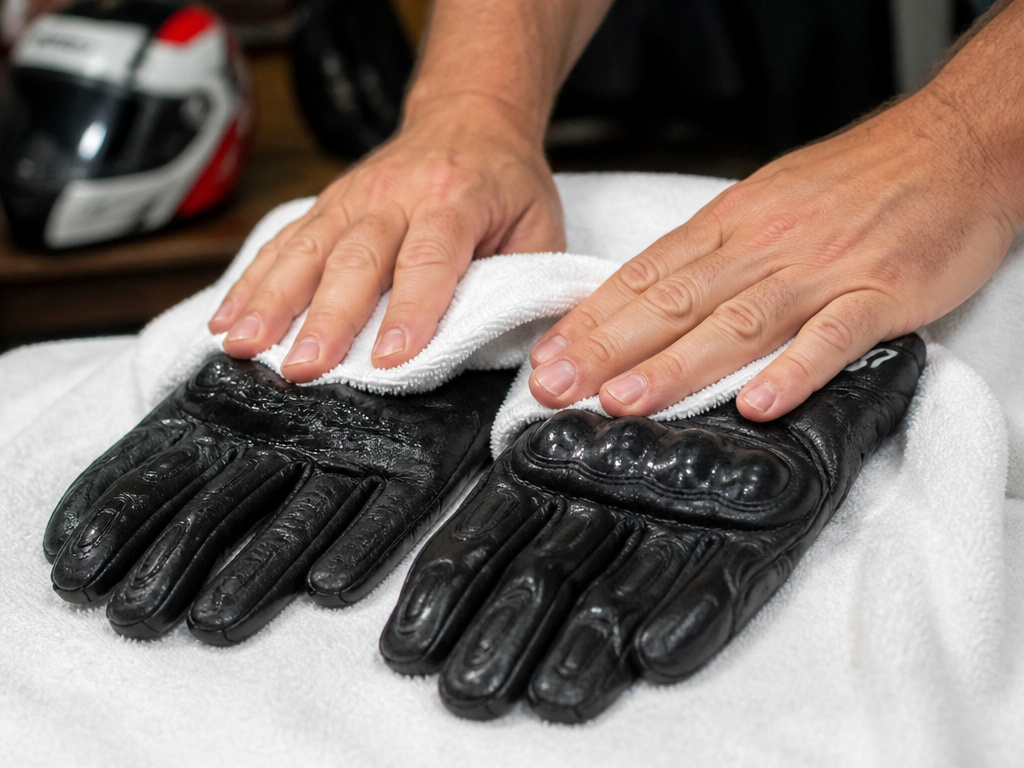
Your gloves will get wet. It happens. How you dry them decides whether they come back supple or turn into stiff, shrunken relics.
The OEMs agree on the core principle: air dry away from direct heat. BMW Motorrad, REV’IT!, and SHIMA all specify a well-ventilated area, no radiators, no tumble dryers, no sunlight. Heat bakes the moisture out too fast, pulling the oils with it and causing the leather fibers to contract and harden.
Here is the step-by-step method that synthesizes the manufacturer guides:
- Blot, don’t wring. Immediately after riding, press the gloves into a dry towel. Wringing them twists the seams and stresses the stitching.
- Pull them back into shape. Gently tug the fingers and palm to restore their natural form. If the gloves are damp, not soaking, put them on for a minute and flex your hands. This helps the leather dry to the shape of your hand.
- Stuff fixed liners. For gloves with non-removable liners, loosely stuff each finger with crumpled newspaper or paper towel. Legendary USA and Speed Queen both recommend this to absorb internal moisture that air can’t reach. Legendary USA and Speed Queen recommend stuffing soaked gloves with dry paper or newspaper to absorb internal moisture, while BMW, REV’IT!, and SHIMA do not mention this method, focusing instead on external ventilation and drying flat.
- Dry flat in a ventilated room. Lay the gloves on a rack or hang them by the cuff. Ensure airflow around them. This takes 24 to 48 hours. Lined gloves may need a longer drying period; the outer shell can feel dry while the inner lining is still damp.
- Condition only after bone dry. This is the critical timing rule from Legendary USA. Applying a leather conditioner while the leather is still damp traps moisture inside. Wait the full 24-48 hours until the gloves are completely dry through and through.
Dry gloves slowly at room temperature. Never put gloves in a washing machine or near heat. – Legendary USA care guide.
The fold test tells you when leather is too far gone. After drying, flex the palm sharply. If the leather cracks or shows a white line at the crease, the fibers are brittle and the glove is at end-of-life.
Waterproofing Treatments and Rain Covers
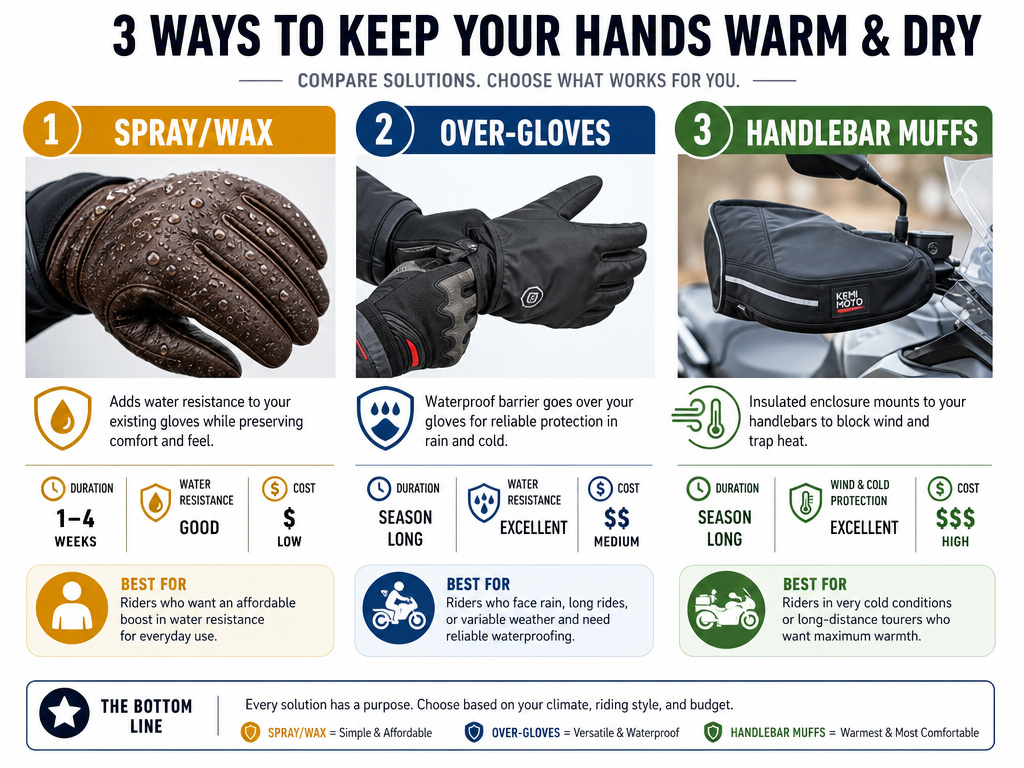
If your primary gloves aren’t waterproof, you have two paths: treat them to improve resistance, or cover them with a dedicated rain shell.
Waterproofing sprays and waxes can help. Waterproofing sprays and waxes can add a hydrophobic layer to the leather’s surface. They won’t make a leather glove fully waterproof, but they will cause water to bead and roll off longer, buying you time in a light shower.
For serious rain, external covers are the better tool. Waterproof over-gloves are thin, packable shells you pull over your riding gloves. They create a complete barrier and are trivial to dry, just wipe them off. The other alternative is handlebar muffs.
| Solution | Best For | Downside |
|---|---|---|
| Waterproofing Spray/Wax | Light, occasional rain; improving baseline resistance | Not permanent; requires reapplication; can alter leather feel |
| Waterproof Over-Gloves | Commuting, touring, predictable wet weather | Can reduce tactile feel; an extra item to pack |
| Handlebar Muffs | Extreme cold/wet; touring bikes; maximum coverage | Bulky, permanent installation; can affect handling perception |
Muffs are popular with adventure and touring riders. They enclose the entire handlebar grip, creating a still-air pocket around your hands. They’re incredibly effective but change the bike’s aesthetics and aren’t practical for short-hop commuting.
For an emergency fix, a pair of disposable nitrile gloves worn under your riding gloves works as a vapor barrier. It’s sweaty, but it keeps your hands dry for a surprise downpour.
How to Store Gloves So They Stay Dry and Ready
Storage isn’t just putting gloves away. It’s setting them up for the next wet ride.
Every source stresses a dry, well-ventilated place, out of direct sunlight and away from heat. SHIMA adds a specific temperature warning: avoid exposing gloves to temperatures above 40 degrees Celsius. A car glovebox in summer or a shelf near a heater can easily exceed that.
Store SHIMA gloves in a well-ventilated and dry place. Avoid exposing the gloves to temperatures above 40 degrees Celsius. Do not store in a closed package or box.
The “no closed box” rule is vital. Trapping gloves in a sealed plastic bin or bag invites mildew, especially if there’s any residual moisture. Legendary USA recommends a breathable cotton storage bag instead. Store them flat or on a glove dowel to maintain their shape.
Before long-term storage, like over winter, clean and condition them first. A light application of conditioner protects the leather from drying out in low-humidity indoor air.
Common leak points and sealing them
The main leak point on a gauntlet glove is the cuff seal against your jacket sleeve. A glove worn over a jacket sleeve breaks that seal at the wrist. The solution is to reverse the order: put the glove on first, then pull the jacket sleeve down over the glove cuff. This uses the jacket’s own weather seal as a roof over the glove’s opening, directing water away from your wrist. For short-cuff gloves, the gap at your wrist is even more vulnerable. Ensuring your jacket sleeve has a snug, adjustable closure that can cinch down over the glove material is critical for keeping rain from running down your arm and into the glove.
Using nitrile or latex gloves as a liner/barrier
Wearing thin nitrile or latex gloves underneath your motorcycle gloves creates a waterproof barrier for your skin. This method keeps your hands dry even if your primary gloves leak or become saturated. The thin liner prevents the wet leather or textile from chilling your hands directly. It’s a practical strategy for unexpected rain when you don’t have dedicated waterproof gear. Be aware that these liners can reduce dexterity and may make your hands sweat. They are a functional barrier, not a replacement for proper glove care, but they can provide a critical layer of protection during a wet ride.
Carrying a spare pair of gloves
Carrying a spare, dry pair of gloves is the most straightforward solution for dealing with wet weather. If your primary gloves get soaked during a ride, you can change into the dry pair for comfort and safety. Store the spare pair in a waterproof bag or a sealed compartment in your luggage to ensure they stay dry. After the ride, you can focus on properly drying your wet gloves without time pressure. This approach gives you the flexibility to let gloves dry naturally in a well-ventilated area, away from direct heat or sunlight, which is the method every manufacturer recommends for preserving the materials.
Frequently Asked Questions
Can you dry motorcycle gloves with a hair dryer or on a radiator?
No. Every manufacturer. BMW, REV’IT!, SHIMA, Legendary USA, explicitly bans direct heat sources like radiators, hair dryers, tumble dryers, and direct sunlight. Heat causes leather to shrink and crack, and can delaminate textile membranes. Always air dry at room temperature.
What are the best motorcycle gloves for wet weather?
Dedicated waterproof gloves with a gauntlet cuff designed to go under your jacket sleeve are best. Look for models with a Gore-Tex or similar waterproof, breathable membrane and sealed seams. Our review of the best waterproof gloves covers specific models tested in sustained rain.
How do bikers stay dry in the rain?
Full system approach works best: a waterproof jacket with sealed cuffs, pants with boot gaiters, a neck seal, and gloves under the jacket sleeves. Our guide on staying dry while riding details the layering sequence. The goal is to channel water over your gear, not into it.
Can you machine wash motorcycle gloves?
It depends on the material. Pure textile or mesh gloves without leather can often be machine washed on a gentle, cold cycle inside a laundry bag, per Speed Queen’s guide. Any glove with leather panels, even just a palm, must be hand-washed only. Machine washing will ruin the leather. When in doubt, hand-wipe. For a deep clean, follow our guide on how to clean leather gloves.
What is the best waterproofing for gloves?
For leather gloves, a conditioner with waterproofing properties like Nikwax Leather Restorer is effective. It feeds the leather while adding a water-beading layer. For textile gloves, a spray designed for technical fabrics can refresh the outer layer’s water resistance.
The Bottom Line
Keep the water on the outside. That means gloves under cuffs, covers before the rain, and drying without heat when the water gets in.
One threshold changes everything: if your gloves are soaked, give them the full 48 hours to dry, especially if they’re lined. Rushing the process with heat guarantees a stiff, shrunken result. And if you’re shopping, remember that a waterproof glove and a separate over-shell will outperform any single pair in versatility and longevity.
For everything else, from drying gear to choosing rain gear, the principle is the same. Control the water’s path, respect the material’s limits, and never let a marketing claim override the physics of a downpour. Your hands will thank you by the third hour.
