
Leather vs Textile Motorcycle Jacket: How to Choose
This post contains affiliate links. As an Amazon Associate, we earn from qualifying purchases.
Choose leather for pure abrasion resistance, especially for track or spirited road riding. Choose textile for weather versatility, comfort, and commuting. The right answer depends on your climate, riding style, and the specific EN 17092 certification of the jacket, not just the material.
That answer flips the old “leather is always safer” argument on its head. The debate over a leather vs textile motorcycle jacket is a key example. Modern textiles with high certifications are serious protective gear, and leather has real-world limitations most riders don’t consider until they’re caught in a downpour.
What follows is a breakdown of the hard numbers, the failure modes each material hides, and the one question that decides the choice before you look at a single brand.
Key Takeaways
- The EN 17092 garment class (AAA, AA, A, B, C) is the only objective safety spec that matters, defined by abrasion times at 75 km/h or 45 km/h.
- Fit and armor placement matter more than the material name; a loose leather jacket is less protective than a snug textile one with CE Level 2 armor.
- Leather requires a break-in period and dedicated care, while most textile jackets are ready-to-wear and machine washable.
- For year-round, all-weather commuting, a high-quality textile jacket with a drop-liner (not laminated) membrane is the practical default.
- High-performance leather (1.2–1.4mm cowhide) still sets the abrasion benchmark, but an EN 17092 AA or AAA textile can match mid-grade leather.
What is the EN 17092 Rating System?
Forget marketing claims about “race-grade” or “abrasion-resistant.” The European standard EN 17092 is the only objective measure of a jacket’s protective shell. It tests the garment’s abrasion resistance, seam strength, and tear resistance. The rating printed on the CE label tells you exactly what you’re getting.
The classes are defined by how the garment performs in tests for abrasion resistance, seam strength, and tear resistance on a concrete abrasion test rig at specific speeds.
EN 17092 defines abrasion resistance levels based on impact abrasion testing on a concrete surface at speeds of 75 km/h (for AAA and AA) or 45 km/h (for classes A, B, and C). The higher the class, the longer the material must withstand the abrasion.
| EN 17092 Class | Minimum Abrasion Time | Test Speed | Typical Use Case |
|---|---|---|---|
| AAA | ≥ 7 seconds | 75 km/h | Professional / Track |
| AA | ≥ 5 seconds | 75 km/h | Performance Road |
| A | ≥ 4 seconds | 45 km/h | General Road Use |
| B | ≥ 2.5 seconds | 45 km/h | Urban / Light Duty |
| C | ≥ 1.5 seconds | 45 km/h | Basic Protection |
This table is your cheat sheet. A class A jacket is certified for general road use. An AA or AAA jacket has been tested to a significantly higher standard. Always look for this label inside the jacket. A 2022 UK recall of Held Gladstone jackets happened specifically because the CE label incorrectly stated Class AA when it should have been Class A, proof that the rating itself is a regulated safety claim.
Don’t assume leather automatically gets a higher rating. A thick, high-quality cowhide jacket will likely achieve AA or A. A budget leather jacket might only hit Class B. Conversely, a textile jacket built with fabrics like Cordura and Kevlar, like the Furygan Tonnerre 2 with its 100% Cordura shell, is engineered to target AA or AAA. The certification, not the material, is the verdict.
Leather vs Textile: A Direct Comparison
Most articles list pros and cons. Let’s compare them head-to-head on the five dimensions that actually decide a crash, a season, or a decade of use.
Abrasion Resistance & Safety
This is the heart of the leather vs textile motorcycle jacket debate. Heavy cowhide around 1.2 to 1.4 mm thick, common in high-performance jackets, provides a dense, fibrous structure that slides well. A 2015 study in the Annals of Advances in Automotive Medicine found leather jackets were associated with a lower risk of abrasion injuries than textile jackets in real-world crashes.
Modern textiles have closed the gap. The statement that “modern textiles with a high CE garment class (EN 17092 AA or AAA) can match or beat mid-grade leather” is now true. Jackets like the Klim Badlands Pro, cited as being “at the pinnacle of the adventure riding sector,” use advanced laminates to achieve top-tier abrasion ratings. However, the Motolegends review notes that “most leather jackets are going to be more abrasion resistant than most textile ones.” The key word is “most.” The best textiles now rival good leather, but average textile still loses to average leather.
Weather Versatility & Comfort
Here, textile wins outright. Leather is not waterproof. It can be treated, but in a sustained downpour it will saturate, becoming heavy and cold. A membrane-lined textile jacket, like the REV’IT! Sand 4 with its Gore-Tex 3L Pro Shell, is designed to be waterproof, though sources disagree on the long-term reliability of laminated constructions compared to drop-liner designs.
Where this goes sideways: Buying a laminated textile jacket for waterproofing. In a laminated jacket, the membrane is bonded to the outer shell. Motolegends notes these are “far more prone to failure and leaking than drop-liner ones,” where the membrane is a separate, loose liner. A leak in a laminated jacket often can’t be repaired.
For temperature, textile is more adaptable. It’s lighter, often includes venting, and accommodates removable thermal liners. Leather is warmer in winter but can be oppressively hot in summer, even with perforations.
Durability & Maintenance
My own gear closet is the evidence. A well-maintained leather jacket can last for many years, with the hide itself often outlasting other components like stitching or zippers. The hide is scarred but intact. Textile jackets can show wear on components like zippers or stitching over time, and their synthetic materials may be more susceptible to UV degradation than leather. UV exposure can also degrade synthetic fibers.
Maintenance is the trade-off. Leather needs conditioning to prevent drying and cracking. Textile care is simpler, usually a machine wash, but using the wrong detergent can strip waterproof coatings. Our guides on how to clean a leather jacket and how to wash a textile jacket cover the specifics.
Cost & Style
Leather is typically more expensive upfront, reflecting material and labor costs. Textile offers more features per dollar. Style is subjective. Leather has the classic, timeless look. Textile jackets, especially adventure-style cuts, prioritize function over form. Your choice here depends on whether you’re buying a piece of riding equipment or a statement.
When to Choose Leather
When you compare a leather vs textile motorcycle jacket, pick leather when your primary concern is maximizing abrasion protection for high-speed or high-risk riding.
Track Days & Sport Riding
This is leather’s native environment. Racing organizations like the FIM mandate leather or specific homologated synthetics for a reason. The abrasion resistance in a high-speed slide is proven. A suit like the Rebelhorn Rebel, which uses Kevlar-reinforced seams and Sas-Tec CE Level 2 protectors, exemplifies this race-focused construction.
Prioritizing Long-Term Durability
If you want a jacket that will last for decades with proper care, a well-made leather jacket is a solid investment. It molds to your body and develops a patina, but its protective qualities remain if the integrity of the seams and hide is maintained.
The Classic Aesthetic
For many riders, the look and feel of leather are inseparable from the motorcycling experience. If that resonates with you, and your riding conditions allow for it, this is a perfectly valid reason to choose leather. Explore our curated list of the best leather jackets for options that balance style and certified protection.
When to Choose Textile

Choose textile for practical, all-weather riding where versatility and comfort are as important as protection.
Commuting & All-Weather Touring
If you ride rain or shine, textile is the only sensible choice. The inherent weatherproofing and ability to layer make it ideal. Publications like MCN state textile jackets are “better for commuting and British weather” for this exact reason. A jacket like the Alpinestars Andes V3 Drystar is built for this “year-round sport touring” role.
Adventure & Dual-Sport Riding
For off-pavement exploration where you face dust, rain, brush, and variable temperatures, durable textile jackets dominate. They are designed to be tough, feature-rich, and compatible with body armor. The use of rugged abrasion-resistant fabrics like ballistic nylon is standard here.
Comfort & Value Focus
Textile jackets are generally lighter, more breathable, and come ready to wear with no break-in. They also deliver more features, like multiple pockets, ventilation, and removable liners, at a lower price point than equivalent leather. For a broad view of the top options, see our roundup of the best textile jackets.
The 3 Critical Fit and Safety Checks (Beyond the Material)
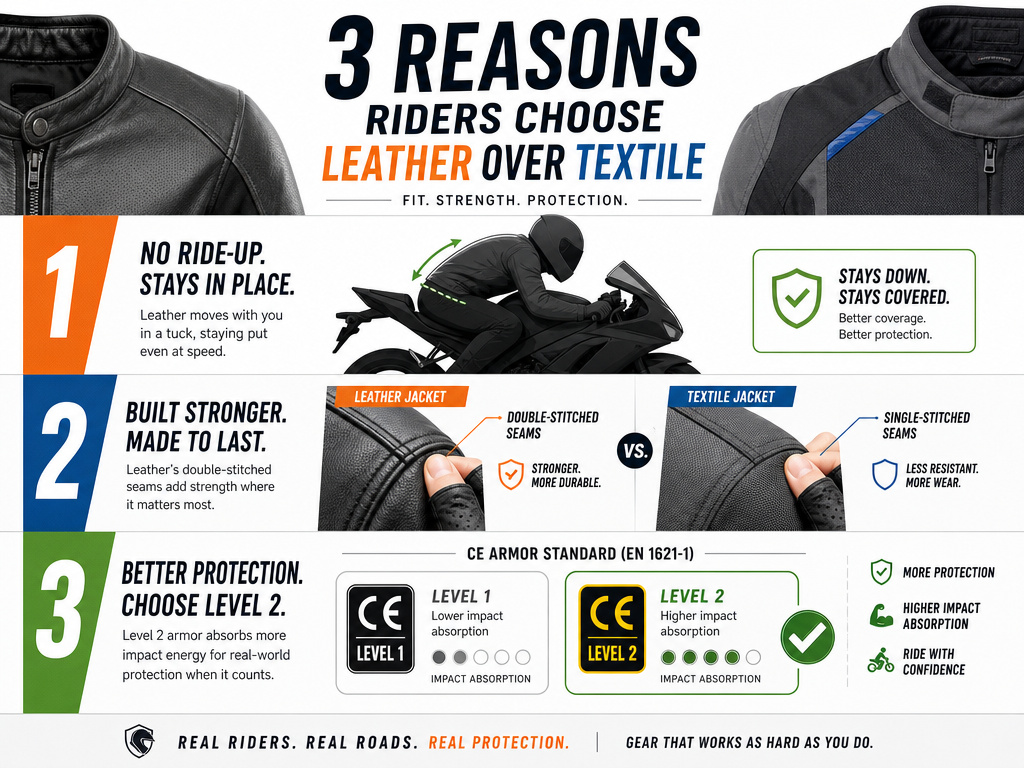
The best jacket in the world is useless if it doesn’t fit. Protection comes from the armor staying over your joints during a slide.
- Simulate the Riding Position. Crouch forward as if you’re on the bike. The jacket should not ride up excessively, exposing your lower back. The shoulder and elbow armor should remain centered over your joints. If it shifts forward or back, the jacket is too big or the armor pockets are poorly placed.
- Tug on the Seams. Look at the stitching, especially at shoulders, elbows, and along the spine. It should be tight, even, and preferably double-stitched. This is a primary failure point in a slide, as noted in the Rebelhorn construction where perforation margins end before seams to avoid weakness.
- Verify the Armor. Check that the armor is CE-certified (preferably CE Level 2, which offers higher impact absorption) and that it’s the proper size for the pockets. Flimsy, floating foam pads are a red flag.
These checks apply to all types of motorcycle jackets, from mesh to leather. The same principles apply to your other gear, which is why we also compare leather vs textile motorcycle gloves for optimal hand protection.
How good are modern textile materials like Cordura and Kevlar?
Modern textile jackets are built from engineered fabrics like Cordura, Kevlar, and Dyneema. Their protective quality is no longer a mystery; it’s defined by the EN 17092 standard. A high CE garment class, like AA or AAA, means the textile shell has been tested for abrasion resistance at higher speeds and for longer slide times. Jackets with these ratings can offer protection that matches or beats mid-grade leather. However, not all textiles are equal. The key is the certified rating on the label, not just the material name. A proper fit that keeps the armor in place during a slide matters more than any specific fabric brand.
Frequently Asked Questions
Is a leather jacket safer than a textile jacket?
It depends on the certification. A high-quality leather jacket (EN 17092 AA/A) is generally very abrasion-resistant. However, a top-tier textile jacket with an EN 17092 AA or AAA rating can offer equivalent or superior abrasion protection to a mid-grade leather jacket. The armor (CE Level 1 or 2) and, most importantly, the fit are bigger safety factors than the base material.
Can you waterproof a leather motorcycle jacket?
You can treat leather with wax or conditioner to improve its water resistance, but you cannot make it truly waterproof. In sustained heavy rain, leather will eventually soak through. For reliable waterproofing, a textile jacket with a built-in membrane (like Gore-Tex) is the effective solution.
How long does a good textile jacket last?
With proper care, a high-quality textile jacket can last for many years of regular use. Factors that shorten lifespan include frequent off-road abuse, improper washing (which strips coatings), and UV degradation. Longevity is where leather typically holds an advantage.
Why are leather jackets so stiff at first?
Leather is a stiff, natural material. It needs to be broken in through wear to soften and conform to your body’s shape. This process can take several weeks of riding. Premium leathers and pre-softened treatments can shorten this period.
Do I need different jackets for summer and winter?
Ideally, yes. However, a versatile textile jacket with a removable thermal liner and ample ventilation can cover a wide temperature range, making it a cost-effective single-jacket solution for many riders in temperate climates. For extreme conditions, dedicated seasonal gear is best.
The Bottom Line
Stop asking “leather or textile?” Start asking “what is its EN 17092 class, and does it fit my riding life?”
For the weekend canyon carver or track-day enthusiast, the abrasion confidence of a leather jacket is hard to beat. For the daily commuter, tourer, or adventure rider who faces changing skies, the all-weather capability of a high-certification textile jacket is the smarter, more comfortable choice.
Your final check is the fit. A textile jacket with an AA rating that fits well provides more protection than a loose leather jacket where the armor can shift during a crash. Try on jackets while wearing your usual riding base layers, get into a riding crouch, and move your arms. The right choice will feel like a part of you, not just a piece of gear. For a final shortlist of top performers in both categories, our guide to the best motorcycle jackets cuts through the noise with certified picks.
