
Types of Abrasion Resistant Motorcycle Fabrics
This post contains affiliate links. As an Amazon Associate, we earn from qualifying purchases.
Abrasion resistant motorcycle fabrics protect you by absorbing a slide’s energy through controlled destruction, not by being indestructible. The best fabrics, like cattle leather over 1.5mm thick, or layered textiles with fibers like Cordura, Kevlar, or Dyneema, are certified to specific performance classes through standardized lab tests. The real choice is between single-layer durability and multi-layer, lighter-weight systems, both of which can be designed to meet the EN 17092 standard.
That time-to-failure number isn’t academic. It’s the difference between your gear stopping the slide and the road finding your skin. The standards define minimum performance thresholds that correlate to real-world protection, which is a key consideration for different types of abrasion resistant motorcycle fabrics.
What follows is a breakdown of the materials that earn those seconds, focusing on the key types of abrasion resistant motorcycle fabrics: natural leathers, engineered synthetics, and the fabric blends filling the gap between them. The article explains the required CE ratings, clarifies the complex test methods, and finishes with a direct suggestion about what suits most riders.
Key Takeaways
- For high abrasion risk areas, cattle leather must be at least 1.5mm thick if it’s full grain, or 1.8mm if it’s top grain, anything thinner from the belly or legs is a weak point.
- The EN 17092:2020 standard uses the Darmstadt test; the older EN 13595-2:2002 and Australian MotoCAP use the Cambridge test, the results are not comparable, so a class rating only makes sense within its own test system.
- Layering lighter fabrics (like two 600-denier nylon layers) often provides better abrasion protection than a single, heavier layer, according to the Guide for Manufacturers, challenging the old “leather is always superior” rule debated in rider communities.
- Perforated leather for ventilation reduces its tear strength and abrasion resistance, creating a specific failure point that may not be accounted for in a garment’s zone rating.
- Sheep leather has very low abrasion resistance and should be avoided in any impact or slide zone, regardless of thickness or treatment.
The 1.5mm Minimum: Why Leather Thickness Matters
Leather isn’t just leather. The type of animal, the part of the hide, and the post-processing change everything. According to the industry’s Guide for Manufacturers, cattle leather is highly abrasion resistant. Sheep leather is not, it has very low abrasion resistance.
For high abrasion risk areas, use at least one layer of full grain leather with a cumulative thickness of at least 1.5mm. For top grain leather, that minimum jumps to 1.8mm.
That 0.3mm difference is the penalty for sanding down the top grain. Full grain leather, with its dense, intact surface fibers, is the benchmark. The hide’s origin matters just as much. Leather from the legs and belly of any animal should be avoided, these are structurally weaker areas. Artificially stretched, polished, or split leather should also be avoided. A common mistake is buying a “leather jacket” without checking the thickness or source. A jacket made from split sheep leather, no matter how good it looks, will fail in a slide due to its very low abrasion resistance.
Perforation is another hidden weak point. Punching holes for ventilation reduces the leather’s tear strength and abrasion resistance right where you might need it most.
| Leather Factor | Strong Choice | Weak Choice | Why It Matters |
|---|---|---|---|
| Animal Source | Cattle hide | Sheep hide | Cattle leather is highly abrasion resistant; sheep leather is not. |
| Hide Region | Back, side | Legs, belly | Leg and belly leather is a weaker structure with lower resistance. |
| Thickness (Full Grain) | ≥1.5mm | <1.5mm | 1.5mm is the verified minimum for high-risk zones per manufacturer guidance. |
| Processing | Full grain, aniline dyed | Top grain, split, polished | Sanding (top grain) or splitting removes the densest fiber layers. |
The feel test is simple when evaluating the types of abrasion resistant motorcycle fabrics. Pinch the leather in a high-wear area like the shoulder or elbow. If it feels thin and pliable, it’s probably under the 1.5mm mark. Thick, stiff leather is harder to break in but lasts longer in every sense.
The Three Key High-Tech Fabrics: Cordura, Kevlar, Dyneema
If leather is the old guard, these three synthetic fibers are the modern army. They don’t work alone; they’re woven into base fabrics or used as reinforcing panels in knees, shoulders, and seats.
High-tenacity nylon is known for tear resistance and abrasion durability. You’ll see it listed by denier (D), a measure of yarn thickness. Common weights are 500D, 1000D, and the burly 1680D. Higher denier generally means a heavier, more durable fabric. Cordura‘s real strength is in blends and as a shell fabric, often layered over other materials.
Para-aramid fiber is known for cut resistance and thermal stability. In motorcycle gear, pure Kevlar woven fabrics are rare because they can be stiff and uncomfortable. Instead, Kevlar is blended with other fibers like cotton or used as a reinforcing thread in high-stress seams. Its weakness? It degrades with prolonged exposure to UV light and moisture.
Dyneema (or generically, UHMWPE – Ultra-High Molecular Weight Polyethylene) is the current heavyweight champion in lab tests for pure abrasion resistance among blends. A 2024 academic study on blended fabrics found that UHMWPE resulted in the highest abrasion resistance of the blends tested. It’s also incredibly strong for its weight.
| Fabric | Base Fiber | Best Property | Common Use in Gear | Key Limitation |
|---|---|---|---|---|
| Cordura | Nylon 6,6 | Tear & Abrasion Resistance | Shell fabric, outer layer | Lower melting point (~220°C for Nylon 6) |
| Kevlar | Para-Aramid | Cut & Heat Resistance | Reinforcement panels, blend fiber | UV & moisture degradation |
| Dyneema | UHMWPE | Abrasion Resistance (Blends) | Protective liners, blend fiber | Lower melting point, bonding challenges |
You rarely buy a “Dyneema jacket.” You buy a textile jacket with a Dyneema-reinforced liner in the impact zones. This gets to the core of modern gear design: layering is the simplest form of resisting damage. The Guide for Manufacturers states that layers of materials have better abrasion protection than a single layer of heavier weight, using the example that two layers of 600-denier nylon outperform one layer of 1200-denier nylon. The outer layer sacrifices itself, dissipating energy, while the inner layer remains intact to protect you.
How Blends and Layering Change the Game
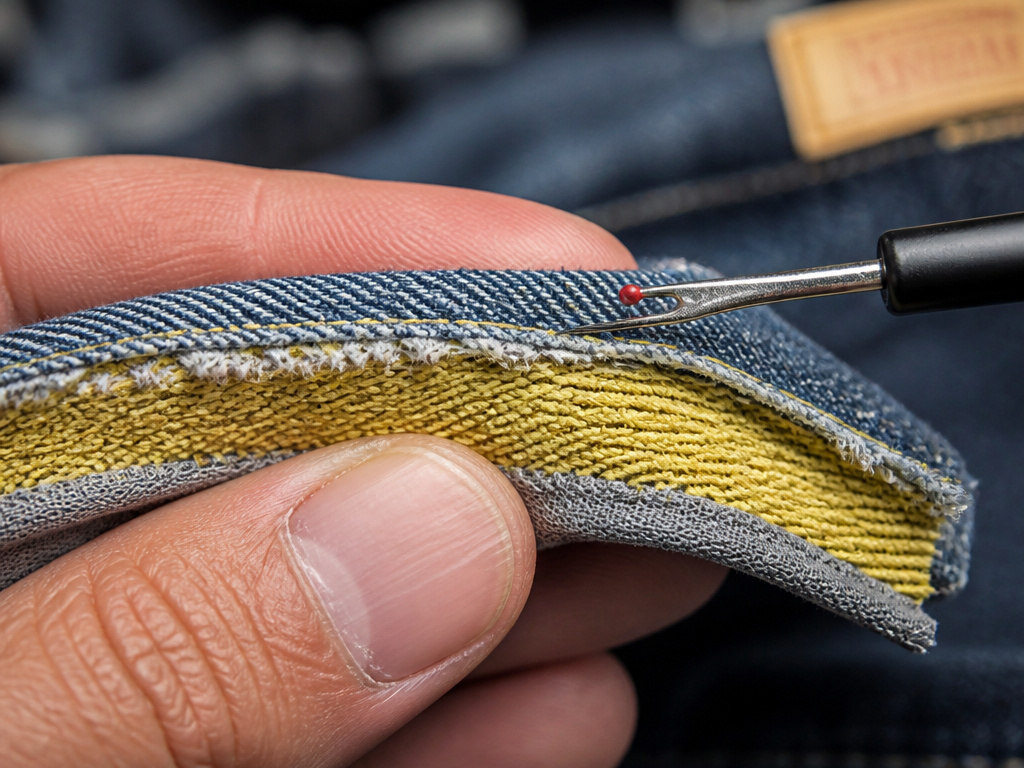
Forget the idea of a single miracle fabric. The most advanced work involves mixing fibers to find a balance of abrasion resistance, comfort, cost, and weight, as demonstrated by blends and double-layer cotton. That same 2024 study provides a clear example: while UHMWPE blends won on abrasion, double-layer 100% cotton with increased mass showed excellent results with abrasion resistance, puncture resistance, impact strength, and energy absorption.
Common mistake: Choosing a single-layer “abrasion-resistant” jean over a dual-layer construction. The single layer might be a heavier denim, but two lighter, specialized layers working together almost always outperform it in a slide.
This is where you see proprietary fabrics like cotton and aramid blends or specific engineered constructions. They engineer the yarn mix, the weave, and the laminate layers to hit specific CE performance classes while maintaining breathability and stretch.
The denim study on DocsLib shows this engineering in action. Researchers developed fabrics using cotton/Cordura® and Kevlar®/polyester yarns in double-layer and backed constructions. The result? These samples showed impact abrasion resistance times over 4 seconds, meeting the EN 13595-2:2002 Level 1 requirement for high-impact zones.
Here’s what that blend-and-layer approach looks like in a typical pair of high-end riding jeans:
- Outer Layer: A durable, casual-looking fabric like cotton denim or canvas.
- Middle Layer: A woven or knit panel of blended fibers (e.g., Cotton/UHMWPE, Kevlar/polyester) sewn or laminated into the knee, hip, and seat areas.
- Inner Layer: A comfortable liner, sometimes with a moisture-wicking treatment.
This modular method allows for gear that looks casual but includes a CE-certified Level 1 or Level 2 protective layer in crucial areas. The downside is care, these multi-layer garments often have specific washing instructions to prevent delamination.
CE Ratings Decoded: What AAA, AA, A, and B Actually Mean
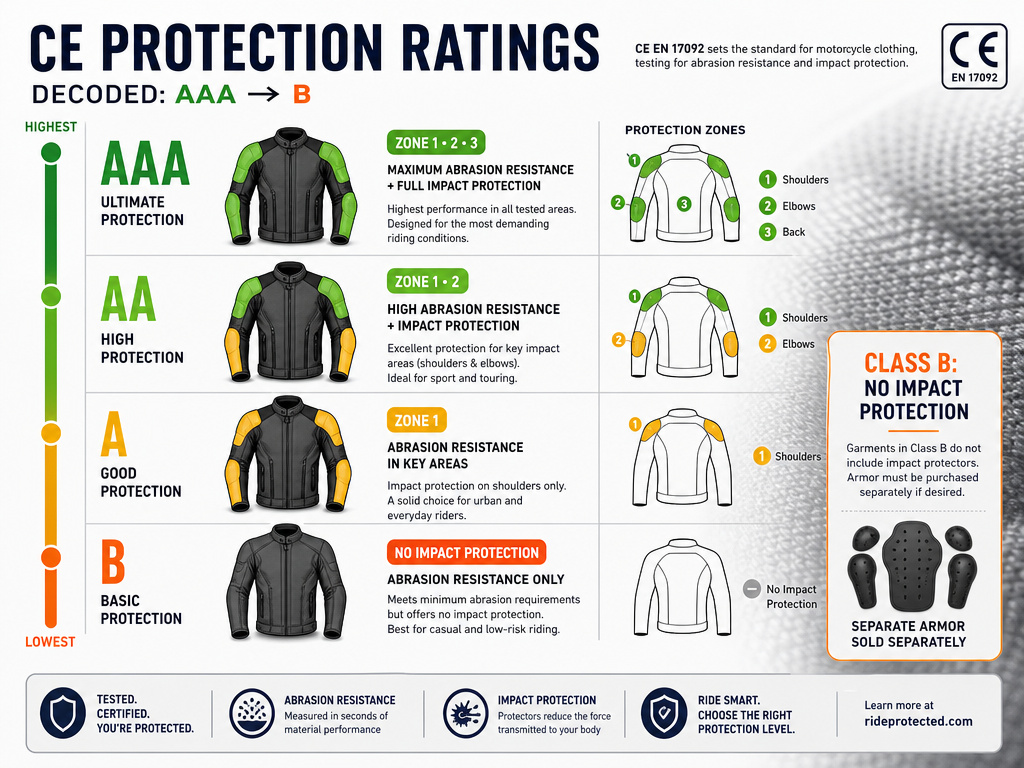
The CE label on a garment is your starting point, not your finish line. EN 17092:2020 is the current European standard, and it sorts jackets and pants into classes based on the protection they offer.
- Class AAA: Highest protection. They use materials and construction that meet higher requirements than Class AA and A.
- Class AA: Garments offer protection using materials and construction that meet higher requirements than Class A and lower than Class AAA.
- Class A: Garments offer a minimum necessary degree of protection from impact and abrasion.
- Class B: Light-duty abrasion protection. Crucially, Class B garments do not offer impact protection. The standard recommends wearing them with separate, certified EN 1621-1 shoulder, elbow, or knee protectors.
- Class C: Impact protector ensembles only (like armor shirts or shorts). They provide no standalone abrasion protection.
These classes are tested against risk zones on the garment:
- Zone 1: High risk of damage (impact, abrasion). Shoulders, elbows, knees, hips, seat.
- Zone 2: Moderate risk (abrasion, tearing). Areas surrounding Zone 1.
- Zone 3: Low risk (abrasion, tearing). Forearms, shins, upper back.
The label should list the class. If it just says “CE Certified,” dig for the specific class. A Class B mesh jacket is fine if you install armor. Without armor, it’s a fancy windbreaker.
The Testing Maze: Darmstadt vs. Cambridge
You can’t talk standards without talking tests, and here’s where it gets messy. There are two main impact abrasion tests, and they don’t speak the same language.
The Darmstadt test (mandated by EN 17092:2020) is one impact abrasion test method.
The Cambridge test (used in the older EN 13595-2:2002 and by the Australian MotoCAP program) is another impact abrasion test method.
Where this goes sideways: Comparing a garment rated using the Cambridge test to one rated using the Darmstadt test. The Guide for Manufacturers explicitly states these methods “are not comparable.”
This is critical for understanding global ratings. A MotoCAP 5-star rating uses the Cambridge test. A European CE Class AA rating uses the Darmstadt test. They are both valid, but they are different exams. When you look at an abrasion test report, note which machine was used. It’s the only way to make sense of the numbers.
Care and Maintenance: Don’t Wash the Protection Out
The best fabric blend is useless if you ruin it in the laundry. Technical motorcycle fabrics have enemies: heat, harsh detergents, and improper drying.
- Leather: Needs conditioning to prevent drying and cracking. Use products designed for motorcycle leather, which often contain abrasion-resistant additives. Never store leather wet.
- Kevlar & Aramid Blends: These fibers are sensitive to UV degradation and chlorine bleach. Wash gently and air dry out of direct sunlight. Don’t use bleach.
- General Rule: Always zip up all closures, fasten Velcro, and remove armor and liners before washing. Check the tag. If it says “dry clean only,” believe it, the adhesive for laminated layers can dissolve in solvent.
Abrasion resistance isn’t just a material property; it’s a condition. A faded, stiff, poorly maintained jacket has lost a significant part of its designed performance.
Frequently Asked Questions
What fabric has the best abrasion resistance?
In standardized testing of common blends, UHMWPE (Dyneema) has shown the highest abrasion resistance. Cattle leather is also highly abrasion resistant. For textiles, layered constructions using Cordura, Kevlar, or Dyneema in high-denier weaves or blends achieve the highest CE ratings (AAA, AA).
Is Cordura better than Kevlar?
They have different jobs. Cordura (nylon) is better for overall abrasion and tear resistance as a shell fabric. Kevlar (aramid) is better for cut resistance and heat tolerance. They are often used together in a single garment. Cordura on the outside for abrasion, Kevlar panels underneath or in blends for cut protection.
What is the 12 second rule on a motorcycle?
This is a misinterpretation of an old MotoCAP testing benchmark from the Cambridge test. It suggested 12 seconds of abrasion resistance was the target for high-protection gear in that old benchmark. The current EN 17092 standard uses the Darmstadt test and different pass/fail cycles for each class (AAA, AA, A, B). Don’t chase a “12-second” garment; choose a garment with a certified CE class rating appropriate for your riding.
Can denim jeans be abrasion resistant?
Regular denim jeans offer almost no abrasion resistance. Motorcycle-specific jeans use layered constructions with fabrics like Cotton/Cordura® or Kevlar®/polyester in impact zones. A 2018 technical document showed such designs could achieve over 4 seconds in the Cambridge impact abrasion test, meeting EN 13595-2:2002 Level 1 requirements. Look for jeans with CE certification (Class A or AA) for verified protection.
Before You Go
The one spec you can take to the bank is the CE class label. AAA, AA, A, or B. It’s a pass/fail grade on a specific standardized test.
If you ride in variable conditions and want one answer: a CE Class AA textile jacket with a removable liner. It balances high abrasion protection from modern layered fabrics with the versatility to handle rain and temperature swings. The class tells you it passed a known test. The construction, such as the use of layered fabrics or specific fiber blends, is also important.
Leather can provide high abrasion resistance, but only if it’s 1.5mm thick full-grain cattle hide. Thinner leather, or leather from any other animal, is a compromise you can see and feel. Don’t make that compromise with your skin.
