
Casual Motorcycle Gear vs Technical Riding Gear
This post contains affiliate links. As an Amazon Associate, we earn from qualifying purchases.
Casual motorcycle gear prioritizes everyday style and comfort with basic certified protection (often Class A), while technical riding gear is engineered for maximum abrasion and impact resistance (Class AA/AAA) with advanced materials and features for specific, demanding riding conditions. The choice depends on your riding style: urban commutes versus long-distance touring or aggressive sport riding.
That’s the short version. The long one involves three things: a certification label, the fabric on the tag, and where you actually point the front wheel.
Ignore any of those and you buy the wrong kit. When you compare a casual motorcycle gear vs technical riding gear scenario, a jacket perfect for a cafe run chokes you on a six-hour highway stint. Summer mesh gloves that breathe beautifully also let the road greet your knuckles. This is about what stays between your skin and the asphalt when physics takes over.
What follows breaks down the specs most riders gloss over: the EN 17092 class system, the real difference between polycotton and Cordura, and where that AAA-rated textile still falls short compared to leather. By the end, you’ll know which label to look for in the casual motorcycle gear vs technical riding gear debate and why your next ride decides your next purchase.
Key Takeaways
- The EN 17092 certification label (A, AA, or AAA) is the single most important spec, indicating abrasion resistance; casual gear is typically Class A, technical gear is AA or AAA.
- Casual gear uses materials like polycotton and stretch denim for comfort; technical gear relies on abrasion-resistant fabrics like Cordura, Kevlar, and GORE-TEX laminates.
- Match the gear to the ride: Class A is for low-speed urban trips; Class AA/AAA is mandatory for highway speeds, touring, or adventure riding.
- Fit is essential; armor that shifts in a crash is useless, so always check gear in a riding posture, not just standing in a store.
- You cannot layer your way to a higher certification; wearing a casual jacket over a base layer doesn’t upgrade its abrasion resistance, only its warmth.
The EN 17092 Class System Explained
Ever wondered what those A, AA, and AAA labels on a jacket tag actually mean? They’re not marketing grades. They’re your first clue to how long the fabric might hold together in a slide.
The EN 17092 standard is a European regulation that tests motorcycle garment abrasion resistance, seam strength, and tear resistance. Class A is the baseline pass. Class AA offers higher performance, and Class AAA is the top tier for abrasion protection in a textile or leather garment.
This label is your objective starting point. The Alpinestars Acteon trousers are CE certified to Class A under EN 17092. The review notes this is “the minimum level” and “relatively modest.” That’s fine for its job, city commuting. Conversely, the Touratech Compañero Ultimate suit is CE Class AAA (EN 17092-2:2020), a rating Touratech markets for “long-distance trips and high-speed falls on the road.”
The gap between A and AAA isn’t incremental; it’s the core difference in the casual motorcycle gear vs technical riding gear spectrum, between a garment designed for lower-risk scenarios and one built to handle more severe slides. Checking the class is the fastest way to filter out fashion from function.
Material and Construction: Denim vs. Cordura vs. Leather
The certification tells you the result. The materials tell you how it got there. Your gear is only as good as the stuff it’s made from.
Casual gear leans on everyday fabrics upgraded just enough to pass a test. The Dainese KEVINS jacket uses Replay Hyperflex abrasion-resistant denim with soft cowhide sleeves. The Alpinestars Acteon trousers are a polycotton blend with stretch panels. They feel like regular clothes because they largely are, with strategic reinforcements. They’re built for comfort and short trips, which the Acteon review confirms: “clearly aimed at city riders and commuters who want something lightweight, breathable and easy to live with.”
Technical gear starts with purpose-built textiles. The Mosko Moto Boundary IR Jacket uses a 3-layer eVent™ Expedition fabric with a 500D Stretch Cordura™ nylon face and SuperFabric® ceramic-plated panels in high-wear zones. The SPIDI J-Tracker Tech jeans use a Cordura®/Cotton blend and are Class AA certified. These aren’t casual fabrics with added tech; they are tech from the ground up.
Then there’s leather. Here’s where sources disagree. A review of the AAA-rated Pando Moto Commando jacket states that EN17092 sets a minimum requirement and decent leather can outperform it, while a manufacturer source states motorcycle safety clothing is engineered for protection without a direct comparison to leather’s superior potential.
Some sources consider leather to have a high inherent abrasion resistance. Some reviews argue that for maximum abrasion protection above all else, leather is superior.
| Material Type | Common Use | Protection Level | Best For |
|---|---|---|---|
| Polycotton / Stretch Denim | Casual Jackets & Jeans | Class A (Minimum) | Urban commuting, short errands |
| Cordura®/Nylon Blends | Technical Textiles | Class AA/AAA | Touring, adventure riding |
| Full-Grain Leather | Race & Sport Gear | High abrasion resistance (sources disagree on comparison to AAA textiles) | Sport riding, track days, where maximum abrasion protection is prioritized |
| GORE-TEX / eVent Laminates | Weatherproof Technical Gear | Varies (often AA/AAA) | All-weather, long-distance touring |
Where this goes sideways: Assuming a “motorcycle” label means the fabric is special. Plenty of fashion jackets use standard cotton or polyester with zero abrasion resistance. The certification and the material list are what you verify.
Protection: Armor Types and Coverage
The shell keeps the road off you. The armor keeps the impact from breaking you. And not all armor is the same, or in the right place.
There are two main types. Soft protectors are flexible, lightweight, and often integrated into casual or summer gear for comfort. Rigid, or composite, protectors have a hard plastic outer shell over foam and are typical in technical jackets and leathers. The level matters too: CE Level 1 is standard, Level 2 offers higher impact absorption.
Casual gear often includes basic, removable Level 1 armor. The Dainese KEVINS jacket has removable Dainese Pro-Shape Level 1 protectors for shoulders and elbows. The Alpinestars Acteon includes Nucleon Flex Plus knee protectors certified to Level 1.
Technical gear typically steps up to Level 2 coverage in more areas. The Pando Moto Commando jacket uses D3O Level 2 protectors at shoulders and elbows. The Touratech Compañero Ultimate goes further, including SAS-TEC Level 2 protectors for shoulders, elbows, chest, back, hips, and knees.
The difference is the coverage. A technical suit protects your entire kinetic chain: shoulders, elbows, back, hips, knees. Casual gear often stops at shoulders, elbows, and maybe knees. Your spine and hips are left to chance.
Common mistake: Buying a jacket with flimsy, non-certified foam pads that float in oversized pockets. In a crash, that armor slides to your bicep or side, leaving your elbow joint unprotected. Look for certified armor (EN 1621-1) that fits snugly in a well-designed pocket.
Fit is the final, critical layer. My rule: always check gear in a riding posture. A jacket that feels great standing up can pull tight across the shoulders when you reach for the handlebars, pulling elbow armor out of position. That’s a fit failure, and it turns any level of protection into a false promise.
Appropriate Use Cases: Commuting vs. Touring vs. Adventure

A jacket is right or wrong for the ride you’re about to do. The manufacturer’s own positioning tells you exactly who they built it for.
Urban Commuting & Short Trips: This is casual gear’s home turf. The use case is low-speed, short duration, often in warmer weather with a focus on blending in off the bike. The Alpinestars Acteon trousers are described as ideal for “sunny urban rides.” The SPIDI Motojoy jacket is meant to “adapt easily across seasons, from mild spring rides to cooler autumn conditions.” If your ride is under an hour, under 50 mph, and ends at a coffee shop, Class A casual gear is the appropriate tool.
Touring & Sport Riding: This demands technical gear. The stakes are higher speeds, longer exposure, and variable weather. The Touratech Compañero Ultimate is presented as gear for “long-distance trips and high-speed falls on the road.” The Mosko Moto Boundary IR Jacket is described as a “premiere adventure touring jacket designed for offroad performance.” These garments assume you’ll be in the saddle for hours, facing rain, cold, and the real possibility of a higher-energy get-off. The AAA or AA rating isn’t overkill here; it’s the requirement.
The Layering Middle Ground: Some products try to bridge the gap. The Pando Moto Commando is a AAA-rated protective base layer “you can wear on its own… Or as part of a layered approach.” This is a versatile concept, wear it under a casual hoodie for street cred and hidden protection, or under a waterproof shell for touring. However, remember the shell’s abrasion rating doesn’t change. A casual denim jacket over the Commando doesn’t make the outer layer AAA-rated.
Worth knowing before you start: Dainese notes that “a jacket that is perfect for summer won’t work in winter, and vice versa. Even the most versatile three-layer/four-season jackets struggle above 86°F.” The idea of one jacket for every ride is a compromise. For year-round riders, owning two jackets, one ventilated, one insulated, is often the only comfortable solution.
How to Choose: A Decision Framework
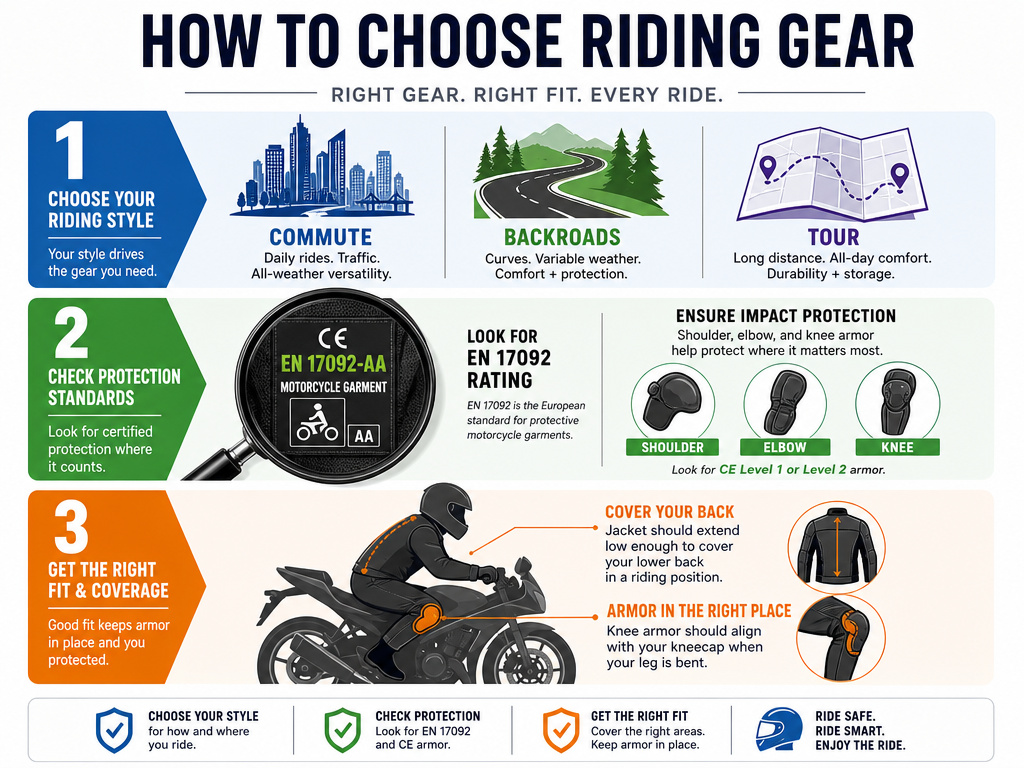
With all the specs and scenarios, how do you actually pick? Don’t start with a brand or a style. Start with this three-step filter.
1. Diagnose Your Primary Ride.
Be brutally honest about 80% of your riding. Is it a 20-minute commute through town? Weekend backroad blasts? Multi-day cross-country tours? Your primary use case locks in the necessary protection class and feature set. A commuter can prioritize casual riding jeans; a tourer needs textile pants with full armor.
2. Verify the Certification and Armor.
Before you fall in love with the look, find the label. Look for EN 17092 and the class (A, AA, AAA). Then, check for CE-certified armor (EN 1621-1) in shoulders, elbows, and knees. For technical gear, look for back protector compatibility (at least) and preferably hip armor. If this information isn’t readily available from the manufacturer, treat it as a major red flag.
3. Fit for the Riding Posture.
This is the hands-on test. If buying online, consult size charts meticulously, focusing on chest, sleeve, and inseam. When trying on, assume the riding position: squat down to simulate a sport tuck, reach forward as if to grip bars. The jacket shoulders shouldn’t bind, the back shouldn’t ride up excessively, and all armor should stay firmly over your joints. The same goes for pants, knee armor should center on your kneecap when seated.
This framework cuts through the noise. It pushes you to buy for the ride you do, not the rider you imagine yourself to be. A perfect-fitting, Class A casual jacket is a smarter buy for a commuter than a poorly fitted, discount AAA jacket they’ll never wear because it’s too stiff for the office.
Maintenance and Care Differences
How you clean and store your gear directly impacts its safety and lifespan. The materials dictate the rules.
Technical Textiles (Cordura, Nylon Blends): These are often machine-washable, but always check the tag. Use a gentle cycle with tech-specific detergents (like Nikwax Tech Wash) that clean without compromising water-repellent coatings. Avoid fabric softeners. Hang to dry; never tumble dry on high heat as it can degrade laminates and melt adhesives.
Leather: Requires dedicated leather cleaners and conditioners. Water can stain and dry it out. Never put leather in a washing machine. After getting wet, dry it at room temperature, away from direct heat sources. Conditioning a few times a year keeps it supple and prevents cracking, which compromises abrasion resistance.
Kevlar & Hybrid Fabrics (like in protective jeans): Often require cold, gentle washes. Hot water can break down the aramid (Kevlar) fibers over time. Turn them inside out to protect the outer finish and any sewn-in armor pockets.
The core principle: gear is maintenance. A leather jacket left wet in a bag will grow mold and stiffen. A textile jacket washed with heavy detergent will lose its water resistance. That degradation isn’t just cosmetic, it directly affects the material’s performance in a slide. Caring for gear isn’t about keeping it pretty; it’s about keeping it reliable.
ATGATT and short-trip compromises
The ATGATT philosophy insists on full protective gear for every ride, no matter the distance. For short trips, riders often compromise by choosing gear that balances protection with convenience. Casual gear like polycotton trousers with stretch panels or jackets with soft-feel stretch fabric can offer a degree of certified protection while feeling more like everyday wear. These garments may carry a Class A or AA rating under EN 17092 and include CE Level 1 protectors. However, this level of gear is designed for urban commutes and sunny rides, not high-speed impacts. The compromise lies in accepting a lower protection class and softer armor for the sake of comfort on brief errands, knowing that a top-tier AAA-rated suit with Level 2 armor is the safer choice for any unexpected event.
Personal evolution from casual to technical gear
Many riders start with casual gear, drawn to items that look like regular clothing but include basic protections like removable Level 1 shoulder and elbow pads. The evolution often begins with a realization that comfort on a short ride doesn’t equate to safety on a longer one or at higher speeds. This leads to seeking out technical features: garments with higher CE armor levels, like Level 2 protectors rated for a wider temperature range, and tougher fabrics like Cordura blends or materials with ceramic-plated reinforcement panels. The shift is toward gear explicitly designed for riding posture, with pre-curved sleeves, stretch panels, and robust weather membranes. The destination is often a dedicated touring or adventure jacket built for long-distance trips, where every component from the AAA-rated shell to the full armor system is chosen for its protective performance over its casual appearance.
Frequently Asked Questions
Can I make casual gear safer by adding my own armor?
You can improve impact protection, but you cannot upgrade abrasion resistance. Adding CE Level 2 armor to a casual jacket’s pockets improves impact protection. However, the jacket’s outer shell is still only certified to its original class (e.g., Class A). The fabric won’t magically become more abrasion-resistant. For slide protection, the shell’s certification is the final word.
Is AAA-rated textile as good as leather?
According to a professional review of AAA-rated gear, no. The review states that EN 17092 sets a minimum requirement, and “decent leather can way outperform the abrasion resistance required.” High-end technical textiles offer excellent, certified protection suitable for most road riding, but premium leather still has a higher inherent abrasion resistance ceiling. The trade-off is that leather lacks the inherent waterproofing and ventilation of modern technical textiles.
What’s the most important piece of gear to not cheap out on?
Gloves. Your instinct in a fall is to put your hands down. After that, a helmet that fits perfectly. Then, a jacket and pants that match your typical riding risk. Ankle protection is also critical, motorcycle boots are designed to resist crushing and abrasion in a way regular boots simply are not.
Do I need different gear for summer and winter?
Yes, if you ride in both extremes. As noted by Dainese, even versatile jackets struggle above 86°F. A mesh or perforated jacket for summer and an insulated, waterproof jacket for winter can keep you more comfortable in extreme temperatures than a single four-season jacket.
Are armored hoodies a good compromise?
Armored hoodies are a specific category of casual gear. They offer more style than a technical jacket and more protection than a regular hoodie. They are ideal for urban riders who want low-profile protection. However, they are usually Class A, and their soft shell offers less abrasion resistance than a heavy textile or leather jacket. They are designed for low-speed, urban environments.
The Bottom Line
The choice between casual and technical gear boils down to a single question: what are you asking the garment to do?
If the answer is “get me to work and the cafe without looking like a power ranger,” then modern casual gear with CE certification is a legitimate, safe choice. Look for the EN 17092 Class A label and verified armor. Brands are making protective jeans and jackets that don’t scream “motorcycle.”
If the answer is “keep me intact on a six-hour highway slog in variable weather,” you need technical gear. Your checklist starts at EN 17092 Class AA or AAA, includes Level 2 armor at major joints, and names fabrics like Cordura and GORE-TEX.
One rule most guides skip: your gear is a system. Wearing AAA-rated riding jackets with street sneakers is like bolting race tires to a car with worn-out brakes. The weak point fails first. Build your kit in order of what hits the ground: gloves, boots, helmet, then jacket and pants. Fit every piece in a riding stance. That’s how you turn a collection of products into actual protection.
