
How Long Do Motorcycle Brake Pads Last?
This post contains affiliate links. As an Amazon Associate, we earn from qualifying purchases.
Motorcycle brake pads last until the friction material wears down to 1 mm, and that point arrives at wildly different mileages. Honda’s CRF450R manual says to replace both pads once either reaches 1 mm. Owner reports run from rear pads every 2,000 miles on some BMW GS bikes to 108,000 miles on one Gold Wing trike.
That 1 mm line shows up in the UK MOT manual too, where a pad worn below 1.0mm counts as a Dangerous defect. Thickness still misses one way pads fail. In 2020, Triumph, Ducati and Brembo pads were recalled because the friction material could corrode and peel off the backing plate with plenty of pad left.
The rest covers real owner mileage, why linked brakes chew through rear pads, how sintered and organic compounds trade pad life for disc life, and the check that catches both wear and corrosion.
Key Takeaways
- Measure, don’t count miles. Honda replaces both pads at 1 mm if either one gets there, front or rear.
- On linked-brake bikes, check inner and outer pads separately. One can hit bare metal while its partner looks fine.
- A thick pad can still fail. The 2020 recalls covered pads that could detach from the backing plate.
- Sintered pads wear discs faster, according to a RevZilla presenter, and Malossi warns against running them on cast iron discs.
- A bike that sits all winter can seize its pads and bind the brake, so spin the wheels before the first ride.
How Long Do Motorcycle Brake Pads Last on Real Bikes?
108,000 miles on one set of rear pads. That’s what the owner of a 2005 Gold Wing MotorTrike reported on the TrikeTalk forum, while his fronts lasted 20,000 to 25,000 miles a set.
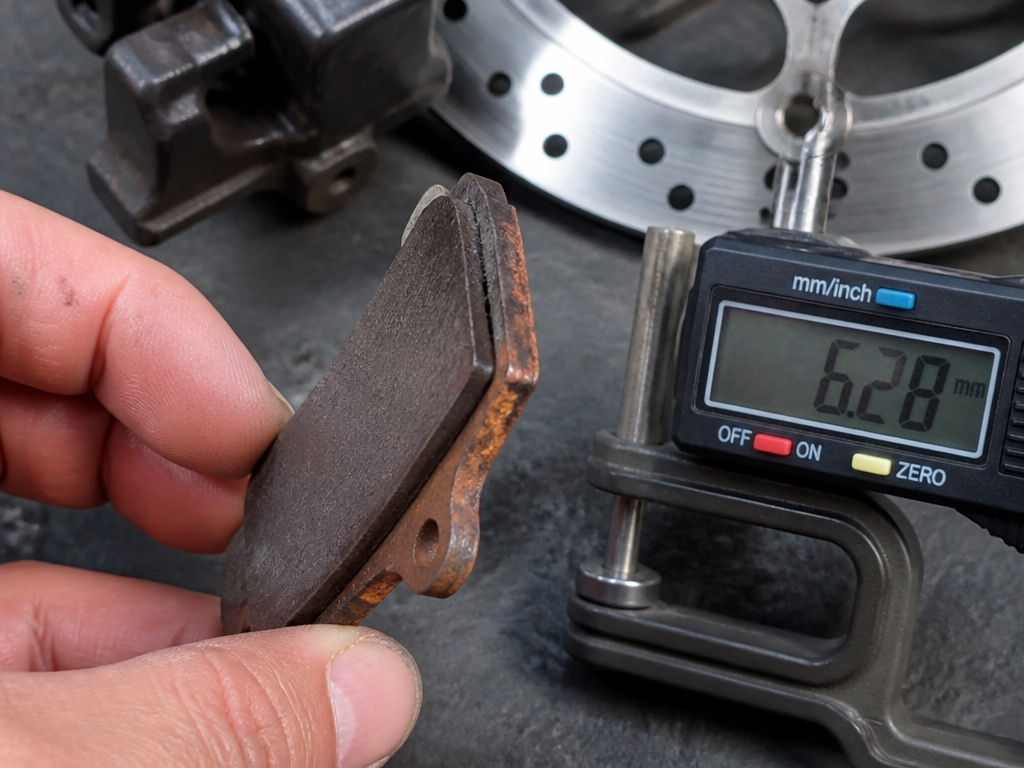
Motorcycle brake pad life is measured in remaining friction material. Honda’s CRF450R owner’s manual calls for replacing both pads in a caliper once either is worn anywhere to 1 mm (0.04 in). The UK MOT inspection manual classes a pad or lining worn below 1.0mm as a Dangerous defect, and oil or grease on pads as a Major defect.
Thickness is the real clock, which is why the how long do motorcycle brake pads last question gets mileage quotes that fall apart. The owner reports swing wildly, even on the same platform.
Here’s a sample from two owner forums: TrikeTalk for Gold Wing trikes and UKGSER for BMW GS models. Read it as a spread of real outcomes. Nobody logged these under test conditions.
| Bike (owner report) | Pad position | Reported life |
|---|---|---|
| 2005 Gold Wing MotorTrike | Rear | 108,000 mi, still original |
| 2005 Gold Wing MotorTrike | Front | 20,000-25,000 mi per set |
| 2008 GL1800 trike | Front, OEM Honda | One pad at 1 mm by 13,600 mi |
| BMW GS LC (three owners) | Rear | Changed at 6,000, 7,700 and 12,775 mi |
| BMW GSA LC (one owner) | Rear | 11,000, then 6,000, then about 500 mi |
That last row is real. One rider got three very different results from three sets on the same bike, which tells you the bike was doing something new pads couldn’t fix.
The 2008 trike deserves a second look too. Its owner measured new OEM Honda front pads at 4 mm total, with 3 mm above the wear indicator. That’s not much material to start with.
I’ll be straight about the gaps. I couldn’t find owner numbers for sportbikes, cruisers or scooters that I’d stand behind. One model’s mileage says little about yours anyway.
The manuals point the same way. Honda’s CRF450R owner’s manual says to inspect the pads at every regular maintenance interval. The Yamaha MT-07 schedule, as summarized by maintenanceschedule.com, gives no mileage for pad replacement at all.
A motorcycle service schedule tells you when to look. The pad tells you when to buy.
Why Do Rear Pads Die First on Linked-Brake Bikes?
A BMW GS owner takes his bike in for its 12k service and hears the rear pads need replacing soon. They’d already been swapped at 6k, and he says he barely uses the rear brake. His mechanic told him some bikes need rear pads every 2,000 miles.
Two explanations came out of that UKGSER thread. They don’t agree, and the fix is different for each.
On a conventional bike, the front and rear brakes sit on separate controls, so you choose how hard each pad works. Linked systems take part of that choice away from you.
The Dealer’s Answer: The Lever Works the Rear First
Another GS owner’s dealer said the hand lever applies the rear brake fractionally before the fronts, for stability. Do lots of light braking and the rear pads do far more of the work.
One rider backed this up with his bike’s NAV 5 data. It showed the rear brake had been actuated nearly twice as often as the front.
The mechanism is simple. Every gentle squeeze puts the rear pads on the disc first, even when the front alone would have done the job. Thousands of tiny stops add up.
The Owner’s Answer: Stiff Pistons and Road Salt
A GSA LC owner in the same thread had a different problem. His rear sets lasted 11,000 miles, then 6,000, then about 500. On that last set, the wear was uneven between the pads.
He stripped the caliper and found the pistons a little stiff. He blamed road salt, grime, and too little grease on the pins.
A sticky piston or a dry slider pin holds one pad against the disc after you let go. That pad wears with every mile, and its partner hardly touches the disc.
I side with the owner here, at least as the first thing to rule out. Grease is cheap. A dealer’s theory won’t free a dragging piston.
Gold Wing trikes add a twist. One TrikeTalk poster says the left front caliper is linked to the rear brake on most trike brands. An owner who replaced the fronts at about 52,000 miles found the linked-side front pads worn very thin, with about a third left on the other side.
Easy to miss: Checking only one front caliper on a linked trike. One trike owner found his left outer front pad down to bare metal at 20,000 miles, while the rears still looked brand new.
Wet Grit, Salt and Winter Storage: What Eats Pads Fastest

Dirty water is hard on pads.
Honda says it plainly in the CRF450R manual. Pad wear depends on how hard the bike is used and on track conditions, and pads wear faster on wet, dirty tracks.
Wet grit sticks to the disc and gets trapped between disc and pad. Every time you brake, it works like sandpaper on both surfaces.
Your hands and feet matter as much as the weather. A foot resting on the rear pedal keeps that pad rubbing for miles. Easing off the throttle early lets engine braking slow the bike before the pads have to work. Good braking technique saves pads as a side effect.
Storage is the one that catches riders off guard. A UKGSER poster was told after winter that his rear pads were down to the metal. He measured them: new pads came in at 3.66 mm, and the old ones still had 3.12 mm.
They were scrap anyway. The pads had seized over winter, and he’d ridden about 10 miles with the rear brake binding.
A binding brake gives itself away if you check. Spin the wheel by hand on the stand and it stops after a short turn instead of coasting. After a ride, the disc is hot enough to make you snatch your fingers back.
Where this goes sideways: Riding off on the first spring day without spinning the wheels by hand. A seized pad drags from the first mile, and that GS owner had to bin pads with most of their material left after about 10 miles of binding.
I’d run this short list every spring, no exceptions:
- Spin both wheels by hand and listen for scraping.
- Pump the lever and pedal a few times before moving.
- Check the date on your brake fluid. The MT-07 schedule calls for fresh brake fluid every 2 years and new brake hoses every 4 years, regardless of mileage, because fluid soaks up moisture as it ages.
- Look at the slider pins for dry, rusty spots.
Sintered vs Organic: The Pad Life Trade-Off Sources Disagree On
Every pad on the shelf promises long life. The sources behind those promises point in different directions.
Malossi’s retailer copy for its MHR Team II sintered pads claims shorter braking distances and extended life. The same page adds a note: Malossi doesn’t recommend sintered pads with cast iron brake discs.
A RevZilla Shop Manual presenter calls sintered pads the stock choice on most modern bikes, and durable. He also says they’re the priciest of the common types, wear the disc faster, and run noisier and dustier. Organic pads, in his view, wear quickly but are easy on rotors.
| Compound | Pad life | Disc wear | Who says so |
|---|---|---|---|
| Sintered | Extended life | Avoid on cast iron discs | Malossi (MHR Team II) |
| Sintered | Durable | Wears disc faster; noisier, dustier | RevZilla presenter |
| Organic | Wears quickly | Easy on rotors | RevZilla presenter |
Sintered pads are metal particles fused into a hard block. That hard face bites well and handles heat, and it also scrubs more metal off the disc on each stop. A softer organic pad gives way first, so the pad wears instead of the disc.
Dust is the part you see.
Which Compound Wins Where
Sintered vs organic for a modern road bike: stay with sintered if that’s what came stock, because the brakes were built around it. Malossi advises against sintered pads with cast iron discs, so check your disc material before fitting them. The difference between sintered and organic pads also shows up in lever feel and fade.
If you ride a Yamaha MT-07 and want more life than stock, the common swap is EBC’s double-hardened set. That’s two packs of EBC FA252HH for the twin front discs and one FA174HH for the rear (see it on Amazon), per maintenanceschedule.com. The 2021 bike’s bigger 298 mm discs, up from 282 mm, still take the same pads.
For other bikes, a fitment list of the best motorcycle brake pads beats guessing from a compound name on a box. Scooter riders will find the Malossi MHR Team II listed for the Yamaha Aerox, Gilera Runner and Aprilia scooters (check availability).
Whatever you fit, check rotor wear every time the pads come out. A hard pad on a worn disc is how a pad job turns into a disc job.
I’d stay with the compound the bike came with unless I had a specific reason to switch. Changing compounds trades one wear problem for another, and a disc is a much bigger bill than a set of pads.
The 2020 Recalls: Pads That Failed With Plenty of Material Left
NHTSA recall 20V236000 covered an estimated 3,709 Triumph motorcycles. Their front pads could corrode until the friction material separated from the backing plate. That lengthens stopping distance and raises the risk of a crash.
Three recalls from that period share the same failure:
- Triumph 20V236000 (Triumph number SRAN 579): certain 2018-2020 Street Triple RS and Tiger 1200 models, plus 2019-2020 Speed Triple models. Issued April 28, 2020, with free front pad replacement starting June 26, 2020.
- Ducati 20V-232: 97 units of the 2017 1299 Superleggera. Free front pads at the dealer.
- Brembo 21E-005: Tungaloy pads, model BRM10B, part number 07988236/07B80923, reported January 25, 2021, covering 28,300 units.
The NHTSA Brembo equipment recall notice says Brembo worked with the motorcycle makers, who filed their own recalls in May 2020. Their dealers replace the Tungaloy pads with improved pads, free of charge.
A law-firm blog citing the NHTSA notice says Triumph had received 13 reports of pad detachment, with no injuries. That’s a secondary source, so treat the count with care.
I think of a pad like a glued joint in woodworking. A joint can have plenty of timber left and still fall apart once the glue line lets go. Corrosion attacks the bond between friction block and backing plate, and a thickness gauge never sees it.
Thickness can’t catch this.
Measure the pads for wear. Run your VIN for recalls. Neither check covers the other.
If you own one of the Triumph or Ducati models above, run your VIN at NHTSA or ask a dealer whether the work was done. The Triumph and Ducati remedies were free front pad replacement.
1 mm, 1.6 mm or 2 mm: Where Is the Replace-Now Line?
Which number should you work to? Three sources give three answers.
| Source | Limit | What it means |
|---|---|---|
| UK MOT manual (DVSA) | Below 1.0 mm | Dangerous defect |
| Honda CRF450R manual | 1 mm (0.04 in) anywhere | Replace both pads in that caliper |
| Mechanic’s video (anecdotal) | 1-2 mm | Cites EBC 2 mm, Alberta 1.6 mm |
The UK MOT inspection manual for motorcycles also lists a missing or wrongly fitted pad as Dangerous. The video presenter cites 1 mm for the KTM 1290 Super Duke, Yamaha R1 and Kawasaki ZX-6R. I couldn’t verify those against the manuals, so treat them as his reading.
Here is the practical answer. The legal and Honda floor is 1 mm, and I treat it as a floor. On a road bike I’d swap at 2 mm for margin, because Honda’s word “anywhere” means the thinnest spot on the worst pad.
How to Check Pad Thickness at the Caliper
Before you start: Discs and calipers stay hot after a ride, so let them cool before you reach in with bare fingers. Brake fluid strips paint, so keep a rag under the reservoir and wipe any spill at once. A bike on its side stand can tip while you crouch at the caliper, so use a center stand or paddock stand.
- Get the bike upright on a stand. Skip it and you’re peering at the pads at an angle, which hides the wear groove.
- Look at the front pads through the wheel and the rear pads from the back of the caliper, as Honda describes. If the wear groove is gone, you’re at or near the limit.
- Check every pad, inner and outer, on both front calipers. Skip one side on a linked bike and you can miss a pad already on bare metal.
- Look for oil, grease or a shiny face. Oil on the pads is a Major MOT defect and they won’t grip.
- Check the hoses and fittings for leaks or cracks, and make sure the lever, pedal and their bolts are tight, per Honda’s list. A weeping fitting soaks the pads within days.
If any pad sits at the line, replace brake pads in pairs per caliper, as Honda specifies. Then bed in new pads with gradually harder stops before you need them in traffic. Ride it before you trust it.
Squeal, Grind or a Soft Lever: What Each Warning Means
Four signs cover most of it: a squeal, a grind, a gritty feel, and a lever that goes soft.
- Grinding is a dry, metal-on-metal rasp you feel through the lever. That’s the backing plate on the disc. Park the bike.
- A squeal from a pad with life left points to a glazed or dirty face. Glazed pads look shiny and glassy instead of matte grey.
- A gritty, gravelly feel means road grit is trapped between pad and disc, or the pad face is crumbling. Pull the pads and look.
- Soft lever? That’s air or old fluid in the lines. Pads rarely cause it.
Oil on the pads is its own failure. A leaking fork seal sits right above the front caliper, so oil runs down the fork leg and onto the disc and pads.
Don’t bother scrubbing a soaked pad with brake cleaner. The friction material is porous, and the oil is already inside it. Fix the seal, then fit new pads.
If your bike is heading for an MOT, the brakes also have to stop it hard enough. One control needs at least 30% efficiency and the other at least 25%. A wheel that locks on the rollers counts as meeting the 30% mark for that control.
Some linked systems only work above 10 km/h, so they can’t show up on a roller tester. If one fails the efficiency test, the tester has to switch to a decelerometer test. That’s normal, and worth knowing before you argue with the result.
Grinding is the one that ends the debate.
Frequently Asked Questions
When should I replace my motorcycle brake pads?
Replace them when either pad in a caliper reaches 1 mm anywhere. That’s Honda’s rule for the CRF450R, and below 1.0mm the UK MOT calls it a Dangerous defect. Some mechanics work to 2 mm for margin. Replace any pad soaked in oil, whatever its thickness.
What is the 70/30 brake rule for motorcycles?
It’s riding-school shorthand for the front brake doing most of the stopping, because weight shifts forward when you brake. No manufacturer or regulator in the sources here publishes that exact split. The UK MOT uses a different measure: one control must reach 30% efficiency and the other 25%.
How much does it cost to replace motorcycle brake pads?
Pads are among the cheaper brake parts, and a pad swap is a common first DIY job. Shop labor adds to the bill, and twin front discs need two sets, as on the Yamaha MT-07. The cost climbs fast if worn pads have scored the discs.
Do brake pads go bad if the bike just sits?
They don’t wear while parked, but they can seize. One GS owner’s barely worn rear pads bound for about 10 miles after winter and had to be replaced. The 2020 recalls also showed corrosion can attack the bond between friction material and backing plate.
Should I replace the rotors when I change pads?
Not automatically. Measure the discs at every pad change and replace them if they’re under the minimum thickness stamped on them or deeply scored. A RevZilla presenter says sintered pads wear discs faster, so check closely if you run them.
Before You Go
So, how long do motorcycle brake pads last? Until the thinnest spot on the worst pad reaches the replacement limit: 1 mm per Honda and the UK MOT, or 1-2 mm per one video presenter. Corrosion can also make a pad fail before that. On linked or salt-crusted bikes, that can come shockingly early: one GSA rear set lasted about 500 miles.
One thing to do this week: put the bike on a stand and look at every pad, inner and outer, front and rear. On linked brakes, start with the rear and the left front. If one pad is wearing much faster than its partner, clean and grease the caliper before fitting new pads, or you’ll be back within a few hundred miles.
This advice is thinner for sportbikes and scooters, where I couldn’t find owner data I’d trust. The measuring rule holds for every bike.
Bottom line: buy pads by the millimeter, and if you own one of the Triumph or Ducati models named in the 2020 recalls, check the VIN before anything else.
