
Are Steel Toe Boots Good for Motorcycle Riding?
This post contains affiliate links. As an Amazon Associate, we earn from qualifying purchases.
Steel toe boots are good for motorcycle riding only as a stopgap. They beat sneakers in a crash but trail certified motorcycle boots. In a TAC Victoria survey of injured riders, 55% in other boots had a lower-limb injury, versus 47% in riding boots and 63% in everyday shoes. The steel cap is rated for crush and dropped weights only.
That middle number is where work boots live. A second study, from Australian researchers, found a much wider gap between plain boots and shoes, and the two results don’t line up neatly. So the honest answer has two halves: work boots help, and the steel cap is the least useful thing about them on a bike.
What follows: what the steel cap is actually tested for, what two crash studies say about work boots, the three places they fall short on the bike, and a checklist for riders who have to wear them to the job site anyway.
Key Takeaways
- Work boots beat shoes: one study of 212 crashed riders found non-motorcycle boots carried under half the injury risk of shoes or joggers (RR 0.46).
- The steel cap passes two straight-down tests under ASTM F2413. Neither involves sliding, twisting, or side crush.
- The toe-amputation story failed testing. MythBusters found toes were safer with a steel cap than without, though nobody has crash-tested caps on a motorcycle.
- Riders who’ve switched say the bulky toe box dulls shifter feel, and deep lugs grip the road when you’d want them to slide.
- If you ride highways or anything past a short town commute, buy a certified motorcycle boot and leave the work boots at work.
The 75 Foot-Pound Test Your Steel Toe Passed (and the Ones It Skipped)
ASTM F2413 is the US standard behind the “safety toe” label stitched inside work boots. It cares about one thing: something heavy landing on your toes.
ASTM F2413-18 rates a safety toe on two vertical tests. The I/75 impact test drops a 50 lb weight from about 18 inches onto a clay form inside the cap. The C/75 test presses with a steady 2,500 lb. A toe passes when the clay compresses no further than 1/2 inch, or 15/32 inch in women’s sizes.
Those figures come from KEEN’s summary of the standard (KEEN sells safety boots, so read it as a maker’s explainer). KEEN also says its carbon, aluminum, steel and composite caps are all built to the same protection level. That matters later, when we get to composite caps.
I/75 and C/75: Straight Down Only
Look at the direction of force in both tests. Every load comes from above, square onto the toe box. A warehouse injury works that way: a pallet tips, a jack slips, a box of tile drops.
A motorcycle crash rarely does, which matters when you ask are steel toe boots good for motorcycle riding. Your foot gets dragged along the road, twisted against a peg, or pinned sideways under the bike. The cap was never asked to handle any of that, so the label tells you nothing about it.
What EN 13634 Measures Instead
Motorcycle boots sold with a CE mark are tested to EN 13634, the European standard for rider footwear. Its test list reads like a crash report. Here’s how the two standards line up side by side.
| Test | What it checks | Standard |
|---|---|---|
| I/75 impact | 50 lb dropped about 18 in onto the toe | ASTM F2413 |
| C/75 compression | Steady 2,500 lb pressed onto the toe | ASTM F2413 |
| Impact abrasion | Time until an abrasive belt wears a hole | EN 13634 |
| Impact cut | How far a dropped blade gets through | EN 13634 |
| Transverse rigidity | Side-to-side crush across the midfoot | EN 13634 |
| Height | Ankle-height or shin-height boot | EN 13634 |
There’s zero overlap. A work boot can ace both ASTM tests and never once get checked for what happens in a slide.
When a boot lands on my bench, the first thing I read is which of these two labels it carries. Judging a riding boot by its toe cap is like judging a cabinet by its hinges. The joints that take the real load sit somewhere else: the sole bond, the ankle, the seams.
Does a Steel Toe Cap Help or Hurt Your Foot in a Crash?
The toe-amputation story refuses to die. The claim: crush a steel cap hard enough and it curls inward like a cookie cutter, taking your toes with it. One rider made exactly this case on video, warning that a bent cap could trap the foot inside the boot.
The testing points the other way. On a falling load, the cap helps.
What the Drop Tests Actually Showed
MythBusters ran this myth in Episode 42. The cap didn’t curl. A blade attachment glanced off the steel and cut just past where the cap ended, and the myth was marked busted.
A cadaver study at Massachusetts General Hospital, reported by the workplace insurer MEMIC, dropped 150 lb from 3 ft onto five pairs each of safety-toed and regular boots. Feet in regular boots averaged 8.2 fractures per foot. Feet in safety shoes averaged 3.2, a 67% drop in severity.
The caps have a ceiling, though. MEMIC reports that a 400 lb drop from 6 ft in the MythBusters tests deformed the steel plate and caused significant foot fractures. No amputations. In an arbor press, a regular shoe’s toe box gave out at 1,200 lb while the safety shoe held to 6,000 lb.
Where the Cap Ends, Damage Starts
The part nobody mentions: The cap only covers your toes. In the MythBusters blade test, the blade glanced off the steel toe and cut just beyond the cap’s end.
So where do I land? The amputation fear is overblown, and the toe benefit on a bike is unproven. Here’s what the evidence can’t tell you yet:
- No study has crash-tested a steel cap on a motorcycle.
- The cadaver and MythBusters tests both used falling weights. That’s a workplace injury, and a sliding foot on asphalt behaves nothing like it.
- MEMIC itself notes there’s little published information on how much protection safety toes give, even on the job.
I’d stop worrying about steel cutting your toes off and start worrying about the sole and the ankle. The cap was built for a dropped pallet. The pavement doesn’t drop on you; it drags you.
Two Crash Studies, Two Very Different Gaps Between Boots and Shoes
0.46. That’s the relative risk the ANU motorcycle protective clothing study found for non-motorcycle boots against shoes or joggers. The study used a hospital-based sample of 212 crashed riders. In plain terms, riders in ordinary boots carried less than half the injury risk of riders in shoes.
That boot category covers everything that isn’t motorcycle-specific, work boots included. Big win, on paper.
Victoria’s transport insurer saw a much smaller gap. The TAC motorcyclist boot injury risk findings come from a sample of 763 injured riders. Lower-limb injury hit 63% of riders in everyday shoes, 55% in other boots, and 47% in riding boots.
| Source | Comparison | Result |
|---|---|---|
| de Rome et al. 2011 | Non-motorcycle boots vs shoes or joggers | RR 0.46 (95% CI 0.28-0.75) |
| de Rome et al. 2011 | Gear with fitted armour, feet and ankles | RR 0.54 (95% CI 0.35-0.83) |
| TAC Victoria 2016 | Lower-limb injury by footwear | Riding boots 47%, other boots 55%, shoes 63% |
| TAC Victoria 2016 | Open wounds, shoes vs boots | 47% vs 25% |
Why the gap between them? They measured different outcomes in different groups. De Rome adjusted injury risk in a smaller crash sample, while TAC counted any lower-limb injury across a bigger survey. I keep both numbers in my head and don’t average them.
They agree on the direction, at least. Boots beat shoes. Only TAC split riding boots from other boots, and riding boots came out ahead. TAC puts the reason simply: motorcycle boots are designed to stay on in a crash and protect from impacts and abrasion.
Why fuss over feet at all? The NHTSA lower extremity injuries report used National Trauma Data Bank records from 2003 to 2005. Riders with one isolated lower-extremity injury went home 81% of the time, and only 4% needed further rehab.
Stack a leg injury on top of other injuries, and rehab needs jump to 23%. That compares with 8% for riders who had no lower-extremity injury at all. Your feet are what get you walking again after a crash.
Sole, Ankle, Leather: Three Places a Work Boot Quits on the Bike
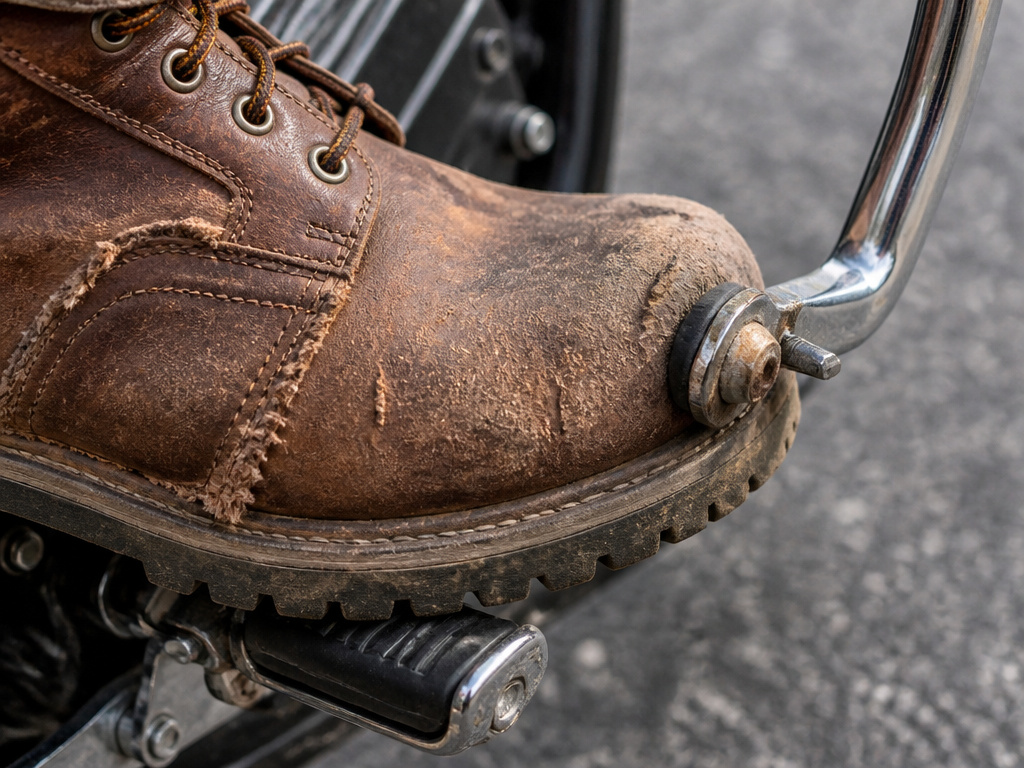
Three things go wrong, in the order you’ll notice them: the sole, then the ankle, then the leather. The full work boots vs motorcycle boots breakdown goes deeper. Here’s the short version from the saddle.
Lugged Soles Grip When You Want Them to Slide
Deep work-boot lugs are made to bite into mud and gravel. On a bike, that bite works against you. A new rider in one long owner thread disliked the bulky toe box of boots for shifter feel and chose armoured sport-bike boots instead.
The mechanism is simple. A sliding foot sheds energy along the ground. A gripping foot stops while your body keeps moving, so the force goes through the ankle as a twist.
You feel the bulk long before any crash. A thick lugged sole sits high on the peg, and a steel toe box presses a hard ridge across the top of your foot every time you lift the shift lever. That same rider disliked the bulky toe box of boots for shifter feel.
Ankle Height Without an Ankle Rating
A work boot covers the ankle. Nothing certifies what that leather does when your foot rolls. TAC’s guidance is blunt about it: ankle-covering boots such as work boots beat everyday shoes but fall short of protective boots.
Lab data on rider footwear is thin. The Iowa State motorcycle footwear drop study is one of the few research efforts aimed at it, but the full paper wasn’t open to me. I’m not quoting numbers I couldn’t read. For anyone riding daily, I’d steer you toward riding boots with ankle protection that were built and tested for it.
Leather That Was Never Meant to Meet Asphalt
ASTM F2413 doesn’t test abrasion at all. EN 13634 times how long a boot survives on an abrasive belt before it wears through. Leather that’s been dragged comes off looking sanded, with bald, fuzzy patches where the grain used to be and stitching rubbed down to loose thread.
Even purpose-built gear wears through. De Rome’s team found material damage failed 25.7% of motorcycle gloves, 29.7% of jackets and 28.1% of pants in the crashes they studied. If tested gear fails that often, I wouldn’t bet on a boot that never got tested.
| Feature | Steel toe work boot | Motorcycle boot (EN 13634) |
|---|---|---|
| Certified for | Toe impact and toe compression | Abrasion, cut, side crush, height |
| Sole | Deep lugs built to grip | Tested for sole delamination |
| Toe box | Bulky cap; owners report dull shifter feel | Sport styles add toe sliders (owner report) |
| Lower-limb injury (TAC) | 55% (other boots) | 47% (riding boots) |
The winner by use case: on the bike, the motorcycle boot takes every row in that table. On a job site with forklifts and dropped steel, the work boot wins easily.
The Half-Size-Up Rule That Wrecks Your Shifting
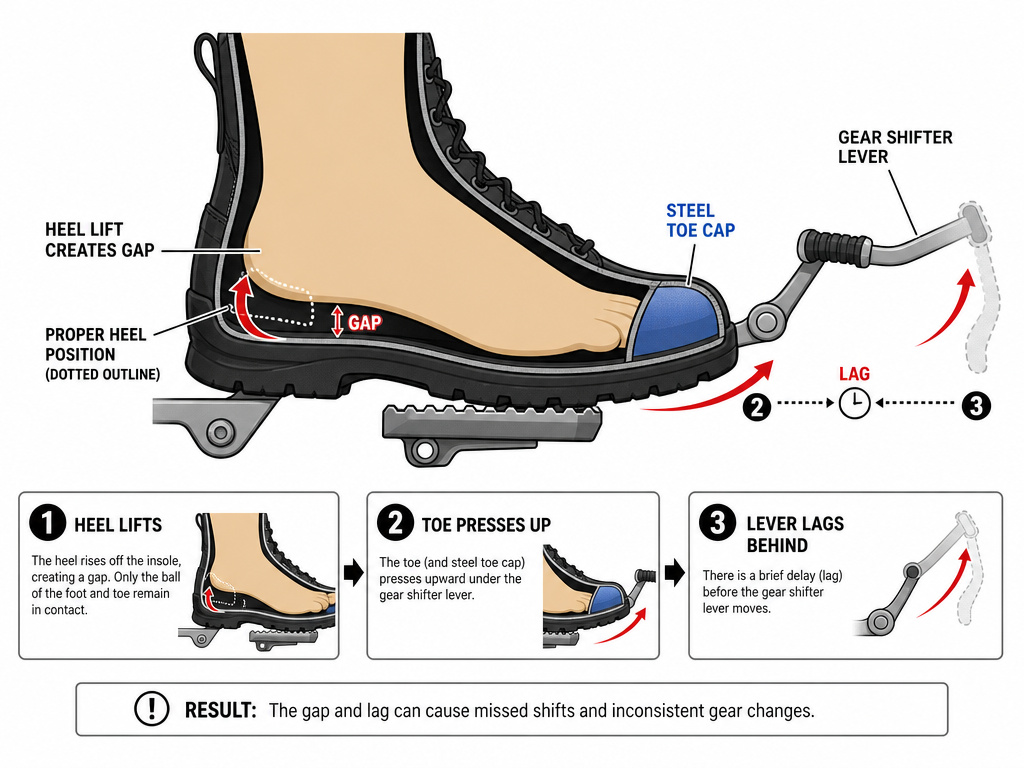
For years I followed the standard advice to buy boots a half size up for comfort. My feet are narrow. The extra room let my heel lift inside the boot, and shifting felt awkward and late every time I worked the lever.
A floating heel means your foot moves before the boot does. You lift, the boot lags, and the lever moves a beat after you meant it to. Add a stiff steel toe box on top of that slop, and you’ve built the exact shifter complaint owners raise about work boots.
Now I tell narrow-footed riders to buy their true size and fix the volume with the right socks. Does your heel lift when you go up on your toes in the store? Then it’ll lift on the shifter too.
Heel lift in the store is heel lift on the shifter. Fix the size first, then the socks.
Ride it before you trust it. A slow parking-lot loop with a dozen upshifts tells you more than any store mirror.
When Are Steel Toe Boots Good for Motorcycle Riding?
Short, slow rides to work, when the only other choice is sneakers. That’s the honest window.
Some riders swear by them. One rider who films his practice sessions says his steel toe work boots protected his foot and ankle when it got trapped under his bike during U-turn practice. His argument is that some protection beats none, and I agree with that part. Sneakers and so-called riding shoes don’t belong on a highway.
The other camp has a point too. One owner who rides regularly in steel-toe Red Wing Engineer 2268s says the caps aren’t a problem on the bike. He also says they add weight, cost comfort on a long walk, and give little of the protection you’d want in a crash. That poster adds that steel toes are banned on race tracks, which I can’t confirm for every track, so check your organizer’s gear rules.
Engineer-style leather biker boots like the 2268 look the part. The look and the certification are separate questions. If your employer allows it, keeping a pair of commuter boots at work and changing at the gate is the cleanest fix.
Before you start: Three hazards come with riding in work boots. A 13-case series of heel flap injuries from motorcycle spoke accidents named inadequate footwear as a contributing factor, so wear a closed heel and tuck lace ends inside the boot. A bulky toe box can miss the lever, so practice shifts in an empty lot before traffic. Deep lugs grip, so keep feet on the pegs in turns.
If the work boots are staying on, judge them before the first ride:
- Covers the ankle bone fully. Skip this and you’ve dropped out of TAC’s “other boots” group into the shoe group, the one with the highest injury rate.
- Laces you can tuck, or a pull-on design. Loose ends flap right next to the chain and rear wheel.
- A sole without deep, blocky lugs. Chunky tread grips when you put a foot down mid-skid and hangs up under the shift lever.
- A toe box that slides under the lever without wedging. Otherwise you’ll miss upshifts all week.
- True-size fit with no heel lift. Skip it and every shift lands late.
Skip this if: you ride the highway, do track days, or rack up long miles. TAC’s guidance is plain on this point: wear motorcycle-specific footwear, and save the work boots for town.
The Boots I’d Point You Toward (and the Pair I’d Retire)
A certified motorcycle boot is the default answer, and the shopping list is shorter than the marketing makes it look. What gets under my skin is boots sold with moody photos and the word “protective” while the CE label is missing or covers one part.
Start with dedicated motorcycle boots that carry the EN 13634 mark. The first digit of that marking gives height: 1 for ankle, 2 for shin. The types of motorcycle boots run from short ankle styles to tall touring boots, so pick the height that matches how fast you ride.
Here’s how I’d match it to your situation:
- New rider, mostly street: the Alpinestars SMX-1, the armoured sport-bike boot that a new rider in an owner thread chose after disliking the bulky toe box of boots (check availability before you buy).
- Job requires a safety toe: choose a boot with a safety toe rated to ASTM F2413. KEEN rates its four cap types to the same level, so pick on fit and toe-box shape. The standard holds women’s caps to their own 15/32 in limit, so a women’s-specific boot carries the full rating.
- Already own Red Wing Engineer 2268s: keep them for slow town runs.
- Highway or long days: a shin-height certified boot. Full stop.
Don’t bother swapping a steel cap for composite to make a work boot safer on the bike. KEEN rates all four cap types the same, and none of them was tested for a slide. I also came up empty looking for a boot certified to both EN 13634 and a work safety-toe standard. If your job demands both, ask the maker directly.
If you want one answer, here it is. Buy a CE-certified, over-the-ankle motorcycle boot, something in the class of the Alpinestars SMX-1, and wear the work boots only when you’re working.
Frequently Asked Questions
Can I use steel toe boots for a motorcycle?
Yes, and they’re better than shoes. TAC’s survey found 55% of riders in other boots had a lower-limb injury, against 63% in everyday shoes. Riding boots did better still at 47%.
Do steel toe boots cut off your toes in a crash?
That claim failed testing. MythBusters found the cap didn’t curl, and even a 400 lb drop from 6 ft caused fractures without amputation. No one has tested caps in a real motorcycle crash, so the riding question stays open.
Are composite toe boots better than steel toe for riding?
Not by any rating that exists. KEEN says its carbon, aluminum, steel and composite caps are made to the same protection level. None of them is tested for abrasion, twisting, or side crush, so choose on fit and toe-box bulk.
Can work boots be used as motorcycle boots?
For short, slow commutes, yes, if they cover the ankle, the laces are tucked, and the sole isn’t heavily lugged. TAC’s position is that work boots beat everyday shoes but fall short of protective boots. For highway riding, they’re the wrong tool.
What type of boots should you wear on a motorcycle?
Over-the-ankle boots certified to EN 13634, the European standard for rider footwear. TAC recommends motorcycle-specific footwear because it’s designed to stay on and resist impact and abrasion. Check the label for the CE mark and the height digit.
What are the best work boots for motorcycle riding?
Look for ankle height, a slim toe box that clears the shift lever, shallow tread, and a true-size fit with no heel lift. No work boot carries a riding certification. Treat even the best one as a stopgap.
Before You Go
Your first step this week: pull out your work boots and read the label inside the tongue. If it only lists ASTM F2413, you’re wearing a toe guard with no slide, cut, or ankle testing behind it.
Then set your own trigger. If you came here asking are steel toe boots good for motorcycle riding, the line I’d draw is simple: the moment your ride includes highway speed or runs past a short town commute, the work boots come off and certified riding boots go on.
One concession. If your job site won’t let you change footwear and the ride is ten slow blocks, steel toe work boots are a reasonable compromise. They beat sneakers by every number we have, and I’d rather see you in them than in canvas shoes.
Bottom line: buy certified motorcycle boots if you ride regularly or at speed, and keep steel toe work boots for the job and the short, slow trip there.
