
Hard vs Soft Motorcycle Saddlebags: Which Should You Buy?
This post contains affiliate links. As an Amazon Associate, we earn from qualifying purchases.
Hard luggage offers a lockable, rigid shell and stable capacity, while soft luggage provides lighter weight, impact-friendly flexibility, and quicker detachment. The choice isn’t about which is universally better, but which best fits your riding style, commuting and touring often favor hard cases, while adventure riding and quick daily use lean toward soft bags.
The core trade-off here is permanence versus portability, often framed as hard vs soft motorcycle saddlebags. One is a fixed extension of your bike; the other is a removable pack you can carry. That distinction drives everything from security to the way your bike handles on the highway.
What follows is a breakdown of the hard vs soft motorcycle saddlebags, built from manufacturer specs and long-term tester reports. We’ll look at the hard numbers on materials and capacities, examine where the experts genuinely disagree, and end with a clear framework for picking your side.
Key Takeaways
- Pick hard cases for multi-day touring where locked, weatherproof storage at overnight stops is essential.
- Choose soft bags for adventure riding or daily commuting where light weight, impact absorption, and taking your gear with you are priorities.
- Waterproofing claims for both types are often overstated; plan to use internal dry bags for critical items in heavy rain.
- Hard cases add predictable width and can stabilize some bikes at speed, while soft bags create aerodynamic drag that affects lighter motorcycles more.
- Your bike’s weight and the permanence of the mounting system are as important as the bag type itself.
Hard vs Soft Saddlebags: Direct Comparison Table
Start with the tangible differences. This table pulls specifications straight from manufacturer datasheets for a direct, feature-by-feature comparison.
| Feature | Hard Saddlebags | Soft Saddlebags |
|---|---|---|
| Primary Construction | ABS composite (Harley-Davidson), technopolymer (Givi), fiberglass-reinforced polyamide (SW-Motech) | 1200D-1680D Ballistic Polyester (Nelson-Rigg, Tour Master), Textiline fabric (SW-Motech) |
| Security | Integrated locks; physical barrier to casual theft. | Relies on straps/buckles; vulnerable to a blade. Quick removal is a “portable security” benefit. |
| Weather Protection | Gasketed seals aim for waterproofness; seals can degrade. | Coated fabrics claim waterproofing; seams and stitching are long-term leak points. |
| Weight (Example Model) | 6.6 lbs – 8.16 lbs per bag (SW-Motech Pro Blaze 30, Givi Trekker T46) | 1.6 lbs – 3.2 lbs per pair (Nelson-Rigg CL-950) |
| Capacity Stability | Fixed volume (e.g., 46L for Givi T46). Holds shape when packed. | Listed capacity (e.g., 25L per bag for Viking Lamellar) reduces on-bike due to clearance needs. |
| Crash/Impact Safety | Rigid shell can act as a lever against mounts; may transfer force to rider’s leg. | Compresses on impact; reduces risk of leg injury and mounting point damage. |
| Best For | Long-distance touring, secure overnight stops, riders wanting integrated lighting. | Adventure/off-road riding, sport-touring, daily commuting where gear is carried off-bike. |
A Givi Trekker Outback T46 case measures 24.4″ long, 15.7″ wide, and 16.1″ high, offering a rigid 46-liter capacity. Its 8.16-pound shell provides a fixed, lockable storage module distinct from the flexible, strapped nature of soft luggage.
The numbers in the hard vs soft motorcycle saddlebags comparison tell a clear story about mass and volume. A hard case is a piece of vehicle bodywork you put things inside. A soft bag is a reinforced duffel you strap to the side. That fundamental difference shapes every riding experience that follows.
Security: The Lock vs The Knife
The security conversation highlights a major source disagreement. It’s not a simple “hard is safer” rule.
Hard luggage manufacturers design security in. The Harley-Davidson Tour-Pak trunk and Givi cases use integrated locks that latch to the mounting rack. This presents a physical barrier. A tester would need tools and time to break in without leaving obvious damage. For leaving a bike parked at a motel overnight, that’s a tangible benefit.
Common mistake: Relying solely on a hard case’s lock for security. Low-quality latches can fail on rough roads, and the entire rack is still attached to the bike, a determined thief with tools can still take the whole unit.
Soft luggage security works differently. A blade can slice through any fabric panel in seconds. The security advantage RevZilla’s guide points out is portability. You unbuckle a Nelson-Rigg CL-950 or a Cortech Super 2.0 tail bag in moments and walk away with it. Your gear is never left unattended on the bike. For a commuter who parks in a public lot, carrying their bag to their desk is a more effective security system than any lock.
However, that only works if you always take the bags with you. If you ever leave them strapped on for a quick errand, they are vulnerable. There’s no perfect answer, just a clear trade-off: permanent, defendable storage versus removable, personal-custody storage.
Waterproofing: Gaskets vs Seams
Both sides claim 100% waterproofing. Both sides have a documented history of failing that claim under real-world conditions.
Hard cases use gaskets that press against the lid. When new and clean, they work. But gaskets compress over time. Road grit and UV exposure degrade them. Long-term reviews note leaks developing at the seal line after a season or two of use. The fix is often replacing the gasket, a maintenance item most buyers don’t anticipate.
Soft bags rely on coated fabrics like 1680 Denier Ballistic Polyester with a PVC or PU backing. The fabric itself might hold water out. The stitching, however, is a line of needle holes. Manufacturers tape seams on the inside, but in prolonged, driving rain, water can wick through. Long-term user reports confirm that in prolonged heavy rain, water can seep through the stitching of soft bags. The solution here is simpler: use internal dry bags for anything that must stay dry.
You should trust neither claim completely for your passport, laptop, or sleeping bag. Plan your packing around that reality.
Handling and Aerodynamics: Stability vs Drag
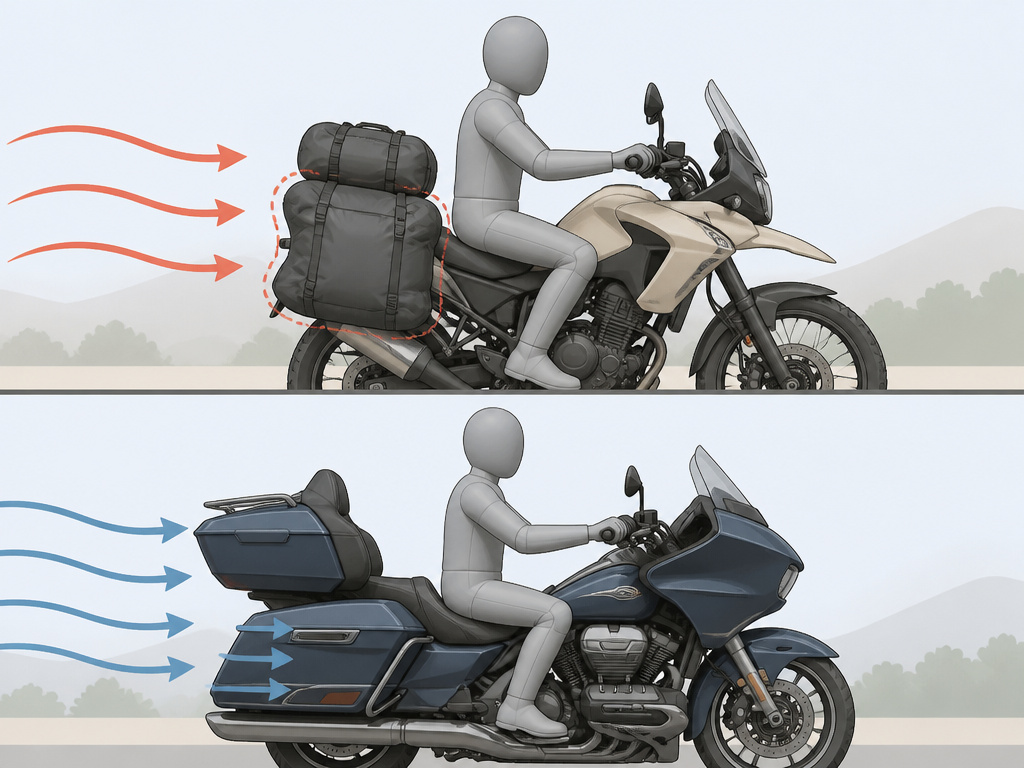
Here’s where expert opinions visibly split, and your motorcycle’s weight decides who’s right.
Motorcycle.com’s testing found that properly shaped hard bags can have a negligible or even positive effect on high-speed stability. They act like stabilizers, adding predictable width and damping certain oscillations. On a heavy touring bike, this can be a net benefit.
WebBikeWorld’s testing counters that any added side surface area, hard or soft, creates aerodynamic drag. That drag affects handling in crosswinds. The effect is more pronounced on lighter motorcycles. A set of bulky soft bags on a middleweight adventure bike will catch more wind and require more correction than sleek hard cases.
But soft bags have a handling advantage in a drop. The ADV Pulse testing is clear: they compress on impact. This reduces the risk of the bag acting as a lever against its mounts and snapping them. It also lowers the chance of the rigid structure injuring the rider’s leg. For off-road riding where drops are a question of “when” not “if,” this is a critical safety point.
Where this goes sideways: Mounting soft bags too far back. This shifts weight rearward, lightening the front end and making steering feel vague, especially at lower speeds in parking lots.
Your bike’s weight is the arbitrator. Heavy touring rig? Hard bags likely stabilize. Light or mid-weight adventure bike? Consider the aerodynamic and crash-safety points of soft luggage first.
Weight and Capacity: The Numbers on the Page vs The Bike
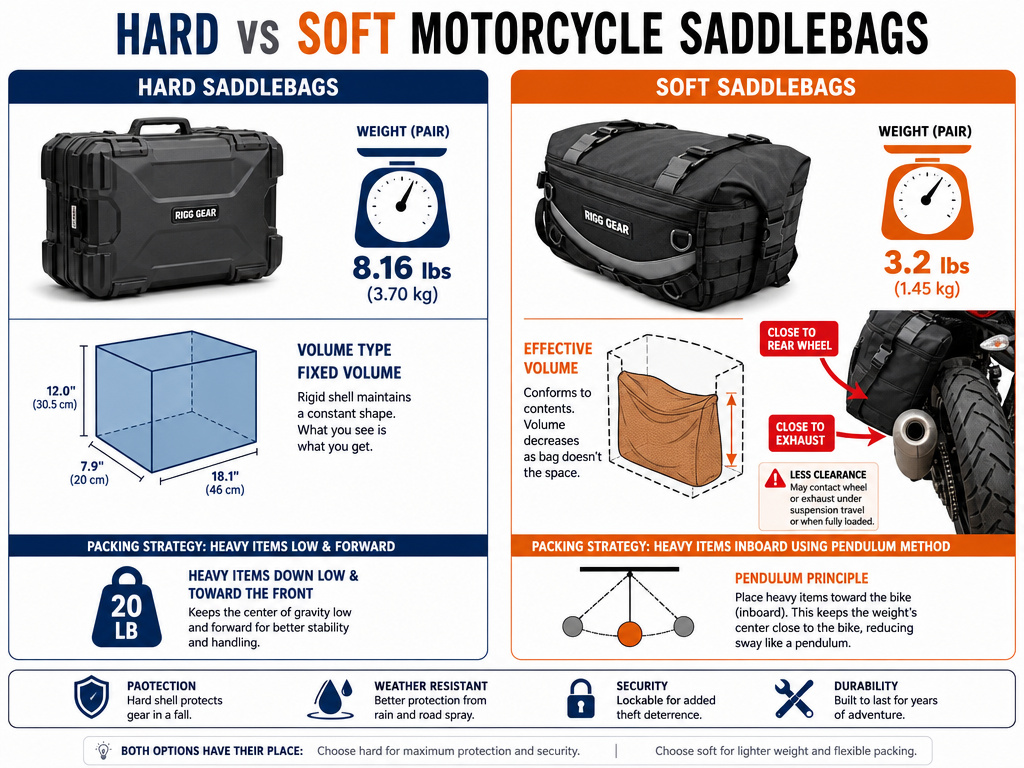
The spec sheet only tells half the story. The numbers matter, but how they translate to your motorcycle matters more.
The weight difference is stark. A pair of Nelson-Rigg CL-950 soft bags weighs 3.2 pounds. A single Givi Trekker T46 hard case weighs 8.16 pounds, and you need two. On a performance-oriented bike, that added weight can affect handling.
Capacity figures are similarly deceptive. A Viking Bags Lamellar soft bag is listed at 25 liters per bag. That’s its capacity when packed full and sitting on the floor. On the bike, you must clear the rear wheel, exhaust, and suspension. You often can’t pack it to its full dimensions, reducing effective capacity. A hard case, like the SW-Motech Pro Blaze 30, holds its shape and fixed volume regardless.
Packing strategy also differs. Hard cases allow dense, rigid items and better organization. Soft bags require careful weight distribution, heavy items low and centered, to avoid creating a pendulum effect that worsens handling. This is where our guide on motorcycle luggage weight limits becomes essential reading.
Durability and Long-Term Costs
Durability involves which parts wear out and how much it costs to fix them.
High-end soft bags made with materials like 1680 Denier Ballistic Polyester resist abrasion incredibly well. The consumable parts are the straps, buckles, and waterproof coatings. Replacing them is often cheap or even impossible, you buy a new bag.
Hard cases face different failures. The plastic shell might crack from a direct impact or stress fracture. More commonly, the latch mechanisms fail. A broken latch on a hard case can render it unusable until you get a replacement part from the manufacturer. Those parts aren’t always cheap or readily available. The long-term cost isn’t just the upfront price; it’s the cost and hassle of replacing proprietary components years down the line.
This material conversation extends to the choice between aluminum vs plastic motorcycle panniers for those committed to the hard-case route. Each has its own failure profile.
Making Your Choice: A Rider-Centric Framework
Forget the generic pros and cons list. Your decision should flow from three questions about how you actually ride.
First, what’s your typical trip? Multi-day touring with hotel stops points directly to hard cases. The security and organization for unpacking and repacking nightly are worth the weight. Day trips, commuting, or off-road adventures where you might drop the bike point to soft bags.
Second, how permanent do you want the setup? Hard cases typically require a dedicated, bolt-on rack. They become part of the bike. Soft bags often use strap-based systems, allowing removal in minutes without tools. If you only need luggage occasionally, soft bags avoid leaving an empty rack on your bike full-time.
Third, what’s your tolerance for maintenance? Soft bags need almost none, just keep them clean and dry. Hard cases have moving parts (latches, hinges) and seals that can require attention. If you hate fiddling with gear, factor that in.
For many riders, the answer is a hybrid: a top case for secured, easy-access items and soft saddlebags for flexible capacity.
How to Organize Gear in Hard vs Soft Saddlebags
Hard cases are rigid containers, functioning like lockable trunks. This structure makes it simple to arrange items neatly and access them without everything collapsing. Their solid walls protect contents from being crushed. Gear mixes together inside, and retrieving a small item from the bottom often means unpacking layers. For organization in soft luggage, you must rely on internal dry bags or other organizers to separate items.
Can Saddlebags Expand for Bulky Items?
Soft bags excel here. Their fabric construction allows them to bulge outward to accommodate odd-shaped or extra gear, though a bag’s effective capacity can be reduced by the need to clear the bike’s rear wheel and exhaust. You can also strap a jacket or other item on top. Hard bags have a fixed volume defined by their molded shape; you cannot pack beyond their sealed lid. What fits inside is limited by the rigid dimensions. The choice is between a flexible container that adapts to your load and a fixed box that requires your load to adapt to it.
Frequently Asked Questions
What are the disadvantages of hard side luggage?
The main disadvantages are added weight, higher cost, and increased width. They are also more likely to transfer impact forces to the motorcycle’s mounting points or the rider’s leg in a crash. Their fixed nature means you can’t easily remove them without tools, and their rigid shape offers no give if you overpack them.
Are soft motorcycle saddlebags safe?
For crash safety, soft bags can be safer for the rider in many off-road or low-speed drop scenarios. Because they compress on impact, they are less likely to act as a lever against the bike’s frame or cause injury to your legs. For security against theft, they are less safe if left unattended on the bike, but their quick-detach design allows you to take your belongings with you.
Which is more waterproof, hard or soft saddlebags?
Neither is perfectly waterproof in long-term, real-world use without maintenance. Hard cases rely on gaskets that can degrade; soft bags have stitched seams that can eventually leak. For critical items in either system, using internal dry bags is the only guaranteed solution. Manufacturer claims of “100% waterproof” should be viewed as marketing optimism, not a warranty.
Do saddlebags affect motorcycle handling?
Yes, significantly. They add weight and change the bike’s center of mass and aerodynamic profile. Hard bags can add stability on heavy bikes at highway speeds but increase width. Soft bags create more aerodynamic drag, which affects handling in crosswinds, especially on lighter motorcycles. Proper mounting and weight distribution are critical for both types, as covered in our guide to mounting saddlebags.
Before You Go
The debate centers on matching a tool to a job. Your weekend bombing run down forest roads has different needs than a cross-country motel hop.
If you’re still split, borrow or rent before you buy. Feel the weight difference on your bike. Practice packing and unpacking. See which system’s workflow fits your life. The best luggage is the kind you’ll use correctly every time, not the kind that sits in your garage because it’s a hassle.
For a direct look at specific models that excel in each category, our reviews of the best saddlebags and best hard cases break down the top performers. And remember, whether you choose sleek panniers or flexible straps, pack the heavy stuff low and centered. That single rule does more for your bike’s manners than any choice of material.
