
Aluminum vs Plastic Motorcycle Panniers: Key Differences
This post contains affiliate links. As an Amazon Associate, we earn from qualifying purchases.
Aluminum panniers and plastic motorcycle panniers split on one choice: dent or crack? Aluminum deforms on impact but rarely shatters; plastic flexes and bounces back until a sharp blow cracks it. The better buy comes down to your mix of off-road drops, highway miles, and how much weight you’re willing to hang off the side of your bike.
The question isn’t which material is stronger in a lab. It’s which one fails in a way you can live with, and which one carries your gear without changing how your motorcycle handles. The debate over aluminum vs plastic motorcycle panniers reflects this. Manufacturers build them for different riders, the tall, narrow aluminum box for the backcountry, the sleek plastic pod for the tarmac tourer.
What follows is a walk through the specs that matter in the aluminum vs plastic motorcycle panniers debate: thickness, weight, waterproofing claims, and what happens when they hit the ground. You’ll get a side-by-side breakdown of brands like Touratech, SW-MOTECH, and Givi, and a clear verdict on which rider profile wins with which material.
Key Takeaways
- Aluminum dents and plastic cracks. A drop that permanently deforms an aluminum pannier might only scratch a polymer one, but a sharp rock can split a plastic seam where aluminum would just bend.
- Weight dictates handling. A pair of loaded aluminum panniers can add significant weight to your bike’s high center of gravity before you pack them, affecting low-speed balance more than lighter plastic cases.
- Waterproofing is a construction game, not a material guarantee. Some plastic cases may have IP67 ratings, while premium aluminum ones rely on features like robot-welded seams and replaceable seals.
- Mounting is half the battle. A well-engineered rack system for either material costs as much as the cases and is essential for security and vibration control.
- For most riders doing mixed commuting and weekend tours, modern plastic cases are the default pick. For dedicated off-road adventurers expecting crashes, the repairability of aluminum wins.
Aluminum vs Plastic: The Core Material Differences
Forget the marketing. The real difference sits in how each material absorbs energy and what it sounds like doing it.
Aluminum has a low elastic limit. In practice, that means it bends permanently under impact rather than snapping back. You drop the bike on a rock, the pannier gets a dent. The seal might be fine if the deformation is away from the lid, or it might leak forever if the lid flange twists. SW-MOTECH uses 1.5mm aluminum on its TRAX ADV cases, while Outback Motortek goes to 2mm thick aluminum; Touratech also uses 1.5mm aluminum. That extra half-millimeter isn’t for waterproofing; it’s for resisting trail rash.
Technical Snapshot: Aluminum panniers are typically constructed from 1.5mm to 2mm thick aluminum sheet, formed into a box and welded at the seams. Thickness correlates with dent resistance, not overall strength, which comes from the ribbed embossing and corner bracing. Sealing against water relies on a compressible gasket trapped between the lid flange and the main body.
Polymer cases, often high-density polyethylene (HDPE) or structural foam polypropylene, work differently. They flex on impact, absorbing the energy and often springing back. But they have a brittle failure mode. Hit a sharp enough corner hard enough, and the plastic can crack, often along a molded seam or at a stress point around a mounting hole. A cracked case is usually a totaled case, while a dented aluminum one can be hammered out.
The point is this. That dent-or-crack dynamic decides your long-term cost. Aluminum can be field-repaired with a rubber mallet and some ingenuity. Plastic requires replacement or specialized plastic welding.
The Weight Penalty That Changes Handling
Consider the numbers, because your bike feels every pound.
An empty SW-MOTECH TRAX ADV M (37L) aluminum case weighs 5.1 kg (about 11.2 lbs). Its larger L model is 5.4 kg. Now look at a typical mid-range plastic pannier in the same 35-40L range. Plastic panniers are often lighter than aluminum ones. That’s a 3-4 lb difference per side, empty.
Multiply that by two, add your mounting racks, and you’ve just strapped extra weight from the bare aluminum high up on your motorcycle before you pack a single sock. That weight sits at the widest point of the bike, raising its center of gravity. At parking lot speeds or in off-camber off-road situations, you’ll notice it. The bike wants to tip. Plastic cases lighten that load.
Where this goes sideways: Choosing aluminum for its ‘lightweight’ reputation without checking the scale. Some premium aluminum cases weigh less than cheap, thick plastic ones, but most don’t. Always compare the manufacturer’s listed weight, not the material name.
| Specification | Aluminum (e.g., SW-MOTECH TRAX) | Plastic (e.g., Givi Trekker) | Impact on Choice |
|---|---|---|---|
| Typical Empty Weight (per 40L case) | 11-13 lbs | 7-9 lbs | Plastic wins for low center of gravity and handling. |
| Failure Mode | Permanent dent, bent lid flange | Cracked shell, broken latch tabs | Aluminum is field-repairable; plastic often requires replacement. |
| Surface Finish | Powder coat or anodized; scratches show bare metal. | Molded-in color; scratches are less visible. | Plastic hides trail rash better. |
| UV Resistance | Excellent (anodizing/powder coat) | Varies; some polymers can become brittle with sun exposure. | Aluminum is more consistent long-term. |
Durability & Damage Resistance: Dent vs. Crack
This is the heart of the aluminum vs plastic motorcycle panniers debate. It’s not about which is tougher, but about how each one fails in the situations you’ll actually put them in.
For off-road riders, the calculus favors aluminum. When you drop your bike on a trail, and you will, the pannier is likely to hit a rock, a stump, or the ground itself. An aluminum case dents. You curse, you assess the seal, you might hammer it out at camp, and you ride on. The case is still structurally intact. A plastic case in the same scenario might scrape, gouge, or, if it hits a sharp edge just right, crack open. I’ve seen a cracked plastic pannier spill its contents across a forest service road. That’s a trip-ender.
For street-focused touring, the advantage can flip. Plastic absorbs vibration better and resists the minor abrasion of brushing against garage walls or other bikes in parking lots. A low-speed tip-over in a parking lot might scratch a plastic case but dent an aluminum one. The plastic’s flexibility can be a virtue.
Common mistake: Assuming all ‘plastic’ is the same. A cheap ABS case will crack like cheap pottery. A high-quality structural foam polypropylene case, like those from Caribou Cases, is designed to withstand significant impact and may even meet military-specification (Mil-Spec) drop tests. The material grade matters as much as the label.
Mounting hardware is a critical, often overlooked, part of this durability equation. Caribou Cases criticizes riveted construction, stating rivets can work loose, shear, and allow water ingress, preferring stainless fasteners with nylock nuts. Meanwhile, brands like SW-MOTECH promote their ‘punch rivet technology’ and Touratech touts ‘high quality rivets’ as part of a robust build. The polymer advocate prioritizes hardware that won’t fail under vibration; the aluminum OEMs are building a rigid, sealed unit. Your takeaway: inspect how the case attaches to its mounts. Loose hardware means a loose case, regardless of material.
Waterproofing & Weather Protection: Claims vs. Reality
No one wants a soggy sleeping bag. Here, plastic holds a theoretical edge, but aluminum fights back with craftsmanship.
Many premium plastic panniers boast official IP67 ingress protection ratings. That means they’ve been tested to withstand immersion in one meter of water for 30 minutes. It’s a verifiable, standardized claim. You can trust it.
Aluminum panniers almost never carry an official IP rating. Instead, they rely on construction quality. SW-MOTECH states every case gets a manual waterproof test before leaving the factory and uses robot-welded seams, punch rivet technology and replaceable seals. Touratech’s design uses silicone seals and a tongue-and-groave lid interface. The promise is total protection, but the proof is in the pudding, or in this case, the first downpour.
The weak point is often the seal itself, not the box. Over time, UV exposure and compression can cause rubber gaskets to degrade. The good news? On quality aluminum panniers like the TRAX series, those seals are replaceable. On a plastic case with a molded-in gasket channel, a failed seal might mean a new lid or a messy application of aftermarket sealant.
Worth knowing before you start: Unit Garage is explicitly honest about its Atlas aluminum panniers, stating they are ‘not IP67-rated’ and recommending internal dry bags. This clarity is refreshing. It tells you the case is for adventure, not submersion, and places the waterproofing burden on your packing strategy.
The bottom line: If you ride in monsoons and need a guarantee, a plastic case with a bona fide IP67 rating is your safest bet. If you value field-repairability and accept that true waterproofing comes from a dry bag inside the case, aluminum’s robust construction is perfectly adequate.
Cost, Aesthetics, and The Long Game

The price tag is just the entry fee. The real cost plays out over years of ownership.
Upfront, you’ll find both materials across a wide price spectrum. You can spend a fortune on carbon-fiber-reinforced plastic or handcrafted, titanium-latched aluminum. For comparable quality from reputable brands, aluminum often commands a premium over plastic. You’re paying for more labor-intensive welding and finishing.
Aesthetics are subjective but consequential. Aluminum panniers, especially bare or powder-coated ones, have a rugged, adventure-oriented aesthetic. Plastic panniers, particularly sleek, color-matched ones, can integrate more cleanly with sport-touring and standard motorcycles. Which look you prefer isn’t trivial, you have to see this thing on your bike every day.
Long-term ownership costs tilt the scale.
- Aluminum: Potential costs include repowder-coating after scrapes, replacing worn latches or seals, and straightening a badly dented lid. Parts are often available.
- Plastic: Costs involve replacing the entire case after a crack, buying new lid assemblies if latches are integrated, and watching for sun-induced brittleness over a decade.
One hidden “cost” is noise. An improperly mounted aluminum pannier can buzz or rattle on certain frequency vibrations. A well-secured plastic case, being less rigid, often dampens these vibrations, resulting in a quieter ride. You won’t know until you mount them and hit a specific RPM range on the highway.
Mounting, Security, and How It All Attaches
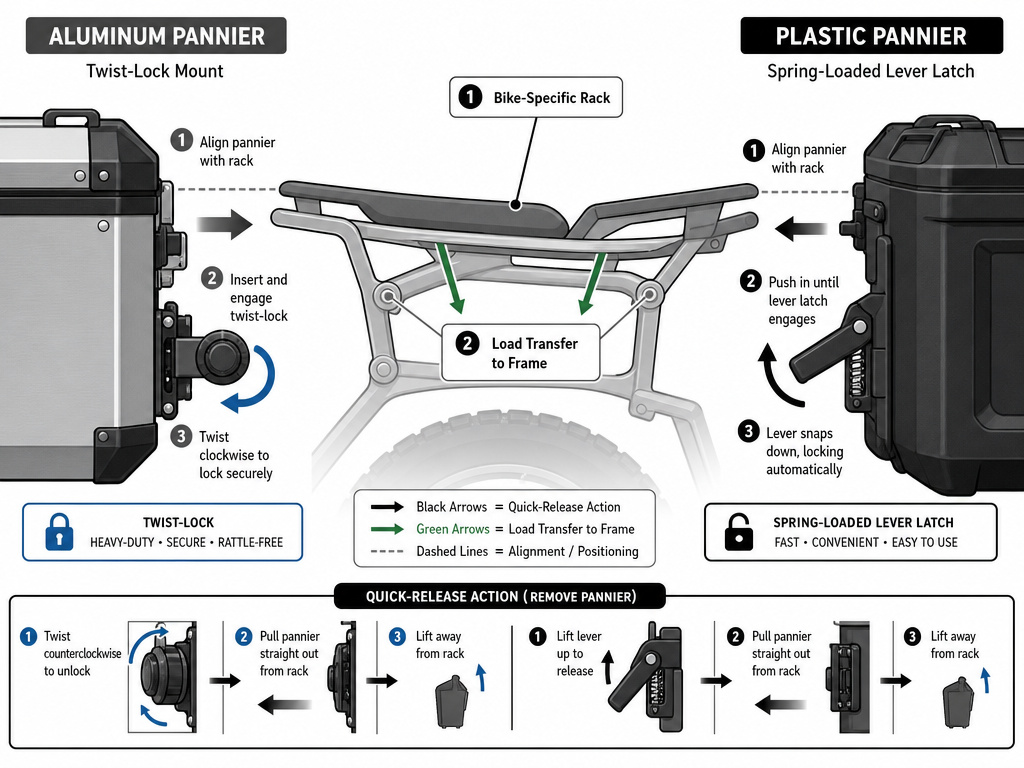
The best pannier in the world is a hazard if it’s poorly mounted. This is where the conversation moves from the case to the bike.
Both material types require dedicated, bike-specific racks. These racks are not interchangeable between aluminum and plastic systems, and they often cost as much as a single pannier. The rack’s job is to transfer the load and any impact forces directly to the motorcycle’s frame, not the subframe or plastic bodywork.
Security differs slightly. Most systems use a central locking mechanism that secures the pannier to the rack and locks the lid shut. Aluminum panniers, with their rigid construction, can sometimes accommodate more robust locking points. However, any thief with a cordless angle grinder can defeat either material in seconds. The real security is in deterrence and never leaving valuables in unattended cases.
Ease of removal is a daily-use feature. Quick-release systems are common on both. Plastic cases often use a spring-loaded lever; aluminum systems might use a twist-lock or a captured pin. Test this action. You want a system that’s secure enough to survive off-road pounding but simple enough to operate with cold, gloved hands.
Which Pannier Material Is Right For You? A Decision Guide
It’s time to move from specs to a verdict. Your primary riding style is the deciding vote.
Choose Plastic (Polymer) Panniers If:
- Your riding is 80% pavement, focusing on touring and commuting.
- You prioritize lower weight and a lower center of gravity for confident handling.
- You want a verifiable, high-level waterproof guarantee (IP67 rating).
- You prefer a sleek, integrated look that matches modern sport-touring bikes.
- Your budget is a primary concern, and you want good value.
Choose Aluminum Panniers If:
- You ride serious off-road trails where drops and impacts are expected.
- You value field-repairability, the ability to hammer out a dent and keep riding.
- You like the traditional, rugged adventure-bike aesthetic.
- You are okay with a slightly higher weight penalty and accept that true waterproofing may require internal dry bags.
- You’re investing in a long-term system and appreciate replaceable seals and hardware.
For the rider splitting time between backroads and light trails, the modern plastic case is hard to beat. The weight savings translate directly to a more manageable bike, and the waterproofing is bulletproof. But when your path consistently gets rocky and steep, the ding-and-continue spirit of aluminum is worth its weight.
Scratch visibility & maintenance
Aluminum panniers show scratches and scuffs readily, turning a shiny finish into a matte, brushed look over time. This is considered normal wear. Maintenance is straightforward: keeping latches clean and lubricated is recommended for smooth operation. The material itself does not rust, so cosmetic scratches are typically left alone as part of the pannier’s patina. For those who prefer a uniform appearance, some light sanding can blend in minor marks, but deep gouges from impacts will remain visible.
Aerodynamics & wind resistance
The shape and width of your panniers affect how your motorcycle handles the wind. Aluminum cases often come in specific dimensions, like a common height of 45cm and lengths around 46cm, but widths can vary significantly between models. A wider pannier will catch more air, which can create drag and potentially affect stability at higher speeds or in crosswinds. When mounting hard panniers, ensure the latches and the speed pin are locked while riding; Outback Motortek strongly recommends it for their aluminum panniers.
Contents getting dirty from aluminum rubbing off
Aluminum panniers can leave a fine, grayish dust on your gear, especially when new or if internal surfaces are unfinished. This residue comes from the bare metal rubbing against items during vibration. To prevent this, use internal liner bags or pack your items within separate stuff sacks. Over time, this rubbing may lessen as surfaces wear in, but it’s a practical consideration for keeping clothes and sleeping bags clean. The aluminum transfer is not harmful but can be a nuisance on light-colored fabrics.
Frequently Asked Questions
Do aluminum panniers rust?
Aluminum doesn’t rust like steel, but it can oxidize, forming a dull, greyish-white layer. High-quality panniers are anodized or powder-coated specifically to prevent this. Bare aluminum (like some Happy Trails offerings) will oxidize but remains structurally sound. You can polish it to restore shine.
Are plastic panniers really strong enough for off-road?
It depends on the plastic. Cheap ABS is not. Structural foam polypropylene, used by brands like Caribou Cases, is exceptionally tough and impact-resistant, often meeting Mil-Spec tests. For severe off-road, the repairability of aluminum still gives it an edge, but premium plastic is far more capable than many assume.
Which is louder, aluminum or plastic panniers?
Aluminum, being more rigid, can transmit more vibration and create a buzz or drumming sound at certain speeds if not perfectly mounted. Plastic tends to dampen vibrations. Proper mounting with anti-vibration pads is crucial for either type to minimize noise.
Can I mix and match? Aluminum on one side, plastic on the other?
Technically, yes, if you have separate racks for each system. Practically, it’s a bad idea. The weight imbalance will affect handling, and the asymmetrical look is, well, asymmetrical. Stick with a matched pair for balance and consistency.
The Bottom Line
Look at your rear tire. How much of its tread is left on the sides? If the edges are squared off from highway miles, buy plastic panniers. You’ll appreciate the waterproof guarantee and the bike will handle better with the lower weight.
If the tire’s sides are scalloped and chewed from leaning hard on dirt, buy aluminum. The next time you park on a sidehill and the bike tips over, you’ll be glad you can stand the pannier back up, assess the new character dent, and keep going without a parts order.
Most riders live in the middle. For them, the modern, high-grade plastic pannier is the default answer. It covers the most common use cases with fewer compromises. But know this: the right choice isn’t about the pannier surviving the journey. It’s about you finishing it.
