
Motorcycle Riding Modes Explained: What They Actually Do
This post contains affiliate links. As an Amazon Associate, we earn from qualifying purchases.
Motorcycle riding modes are factory-programmed bundles of electronic controls that adjust throttle response, traction control, ABS, and often suspension settings to match specific riding conditions. Common presets like RAIN, STREET/ROAD, and SPORT tweak these systems, a RAIN mode, for example, delivers milder power and maximum traction control intervention for slippery roads.
Think of that bundle as a single lever you pull to recalibrate the whole bike’s safety net. A RAIN mode isn’t just a slower throttle. It’s a coordinated shift in how much slip the traction control allows, how aggressively the anti-lock brakes intervene, and how much engine braking you feel when you close the throttle. This is a key part of motorcycle riding modes explained. The goal is to make the bike more forgiving so you can focus on the road.
The rest of this guide walks through exactly what those preset modes change, when to use them, and the one rule every manufacturer stresses about switching them, a core part of motorcycle riding modes explained. You’ll also see how brands like Ducati, Yamaha, and BMW implement them differently.
Key Takeaways
- Riding modes are preset bundles of electronic controls that adjust throttle, traction control (DTC), ABS, and often wheelie control and suspension with a single selection.
- The RAIN preset universally provides the mildest power delivery and the highest level of electronic intervention for safety on wet or poor surfaces.
- Manufacturers disagree on when it’s safe to change modes: Ducati recommends changing the mode when the motorcycle is stopped, but notes that if changed while riding, it should be done at low speed with great care; BMW’s system allows changes while riding if the throttle is closed and the brake isn’t applied.
- Never turn ABS completely OFF unless you are an expert riding off-road and understand the bike’s manual specifically permits it in a mode like ENDURO.
- The best way to learn is to start in the mildest preset (often RAIN or STREET) on a new bike to feel the safety net, then experiment in a safe, controlled environment.
What Is a Riding Mode? (The Bundle Defined)
A riding mode is a pre-configured package of electronic settings, the fundamental concept in any motorcycle riding modes explained guide. Yamaha calls them “combinations of various settings.” Ducati defines each mode as containing “the following parameters, set by Ducati or customised by the user.” This isn’t marketing. It’s the bike’s brain shifting multiple safety systems at once.
The core systems a mode bundles are:
- Throttle Response / Power Mode: How quickly the engine delivers power when you twist the grip. This is managed by a ride-by-wire system, not a cable.
- Traction Control (DTC): How much rear-wheel slip is allowed before the computer cuts power.
- ABS Calibration: How early and aggressively the anti-lock braking system intervenes to prevent wheel lock-up.
- Wheelie Control (DWC): How much front-wheel lift is permitted under acceleration.
- Engine Braking Control (EBC): How much the engine slows the bike when you close the throttle or downshift.
- Suspension Damping: On bikes with electronic suspension, the firmness or softness of the fork and shock.
A Riding Mode is a single user selection that simultaneously changes the calibration of the engine power delivery, traction control intervention, ABS behavior, and, if equipped, suspension damping and wheelie control. It is a unified electronic profile designed for a specific riding scenario.
When you select “RAIN” on a Yamaha with YRC, you’re not just getting a soft throttle. You’re getting the maximum support from the traction and ABS systems, tuned for low grip. When you select “SPORT” on a Ducati Panigale 959, you’re getting high power, less intrusive traction control, and the ride-by-wire system delivering that power instantly.
Common Mode Names and What They Change
Preset names vary by brand and model, but their intentions are consistent. You’ll never see a RAIN mode that gives full power and minimal traction control. The logic is baked in.
Here’s a breakdown of the most common presets and what they typically adjust, based on official manufacturer documentation.
| Preset Name | Primary Purpose | Typical Throttle/Power | Typical Safety System Level |
|---|---|---|---|
| RAIN / WET | Slippery conditions (wet roads, gravel, cold tires) | MILD / LOW power, soft delivery | MAXIMUM intervention for DTC, ABS, DWC. Engine braking may be reduced. |
| STREET / ROAD / TOURING | General road riding, commuting, mixed conditions | MODERATE / MEDIUM power, linear delivery | BALANCED intervention. ABS and traction control are active but less intrusive. |
| SPORT | Aggressive riding on dry, clean pavement | HIGH / INSTANT power, sharp response | MINIMAL intervention. Traction control allows more slip, ABS may allow rear wheel lift. |
| ENDURO / OFF-ROAD | Unpaved, loose surfaces | Controllable, often MEDIUM power with soft initial response | Rear ABS may be disengaged, traction control tuned for sliding, wheelie control permissive. |
RAIN / WET Mode
This is the safety-first setting. Yamaha states its RAIN mode provides “mild power output for rainy weather and other poor road conditions.” Ducati’s equivalent on a Panigale 959 is the WET preset. The throttle map is muted, so a big handful of grip won’t translate to a sudden surge that could break traction. The traction control system is at its most sensitive, ready to cut power at the slightest hint of wheel slip. ABS is also at its most supportive, intervening early to prevent lock-up. Some systems, like BMW’s ABS Pro on the S 1000 XR, offer “maximum support” in RAIN mode.
STREET / ROAD / TOURING Mode
This is the default for most riders on most days. Yamaha says its STREET mode “covers a wide range of road surfaces and ride environments, is well-suited to city riding.” Power delivery is more direct than RAIN but not as sharp as SPORT. The electronic aids are in a middle ground, there to save you if you make a mistake, but not so intrusive that they feel like they’re fighting you during spirited riding. It’s the balanced choice.
SPORT Mode
This mode unleashes the bike’s performance character. Yamaha says SPORT “provides high engine response and is well-suited to twisty roads and track riding.” The throttle connection feels immediate. The safety nets are pulled back: traction control allows more slip before intervening, and ABS settings might focus more on braking power than preventing wheel lift, as noted in the Ducati Multistrada 1260 S manual for its SPORT mode. The bike feels raw and responsive. You need to be smooth.
ENDURO / OFF-ROAD Mode
Specific to adventure bikes, this mode reconfigures the bike for loose surfaces. The most critical change is often to the ABS. The Ducati Multistrada 1260 S (MY19) manual specifies that “ABS OFF level can only be used when the ‘ENDURO’ Riding Mode is selected,” and only when the bike is at a standstill. This allows the rear wheel to lock and dig into dirt or gravel. Traction control is also recalibrated to allow controlled slides. Power delivery is usually tuned for controllability off the bottom, not peak horsepower.
Common mistake: Using SPORT mode in the rain because “it feels more responsive.” The sharper throttle and reduced safety nets on a slick surface drastically increase the chance of a high-side if the rear tire breaks traction and then suddenly regrips. The RAIN mode’s soft throttle and quick-intervention traction control exist to prevent that exact scenario.
How Do Riding Modes Actually Work? (The Systems Involved)
The magic, and complexity, of riding modes comes from how they orchestrate several independent electronic systems. You’re not adjusting one thing; you’re conducting an orchestra.
The Conductor: The IMU and ECU
An Inertial Measurement Unit (IMU) is the brain’s gyroscope and accelerometer. It constantly feeds data on lean angle, pitch, and roll to the Engine Control Unit (ECU). The ECU takes this data, along with your throttle input, wheel speed, and gear position, and executes the “score” defined by your selected riding mode.
The Orchestra Members:
- Ride-by-Wire Throttle: This is how the mode changes power delivery. When you select LOW power, the ECU simply interprets your physical throttle grip movement as a request for less engine output. A full twist in RAIN commands a reduced throttle opening compared to other modes.
- Traction Control (DTC): The mode sets the allowable slip threshold. Higher DTC levels on a Ducati (like level 8) provide more intervention, while lower levels (like level 2) allow more slip before intervening.
- ABS: The mode changes the calibration. RAIN mode might trigger ABS earlier and modulate brake pressure more gently to maintain stability. SPORT mode might allow more braking force and even some rear-wheel lift for aggressive stopping.
- Engine Braking Control (EBC): This is a subtle but important one, especially on sportbikes. Some riding modes may adjust engine braking control (EBC), which can affect how the bike decelerates when the throttle is closed. Less engine braking allows you to control deceleration more precisely with the brakes.
How to Change Riding Modes Safely

This is where manufacturer instructions diverge, and you must follow your bike’s specific manual. Rules vary by manufacturer: Ducati recommends changing the mode when stopped, while BMW allows changes while riding under specific conditions.
Ducati’s Stance: Preferably Stopped
The Ducati Multistrada 1260 S manual is explicit: “Ducati recommends changing the Riding mode when the motorcycle is stopped. If the riding mode is changed while riding, be very careful (it is recommended to change the Riding mode at a low speed).” The concern is that an immediate change in power delivery or ABS calibration mid-corner or under braking could surprise the rider.
BMW’s Procedure: Possible While Riding
The BMW S 1000 XR manual describes a different process. “The new riding mode is activated during operation under the following conditions: The throttle grip is in the neutral position. The brake lever is not being operated.” This suggests BMW’s system is designed for on-the-fly changes, but only when you’re not actively accelerating or braking.
The Universal Safety Principle
Regardless of your bike, the safest practice is to make mode changes when you are in a straight line, at a steady speed, and with no imminent need for aggressive inputs. Never fiddle with the mode switch while leaned over in a corner or as you’re approaching a stop.
Where this goes sideways: Changing to a more aggressive mode (like SPORT) in the middle of a hard acceleration. The sudden jump to a sharper throttle map can cause a jerk that unsettles the bike. Make the switch during a predictable, steady-state section of riding.
Custom and Track Modes
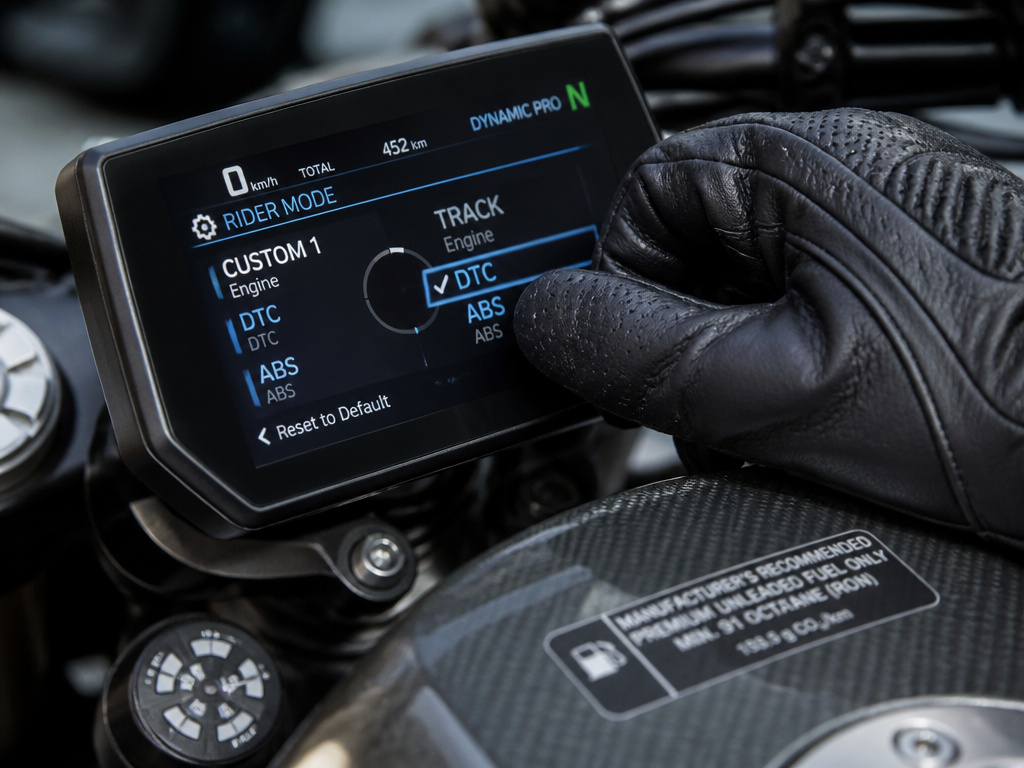
Beyond the presets, most systems offer customizable modes. Yamaha YRC includes CUSTOM 1/2 and TRACK 1-4 modes. Some Ducati systems offer customizable parameters, but the manufacturer warns that changes should only be made by experts in motorcycle set-up.
Important: The Ducati manual carries a strong warning here: “Changes should only be made to the parameters by people who are experts in motorcycle set-up; if the parameters are changed accidentally, use the ‘DEFAULT’ function to restore factory settings.”
Custom modes are powerful but are not for beginners. They let you create contradictions, like maximum power with maximum traction control, which might not be a safe or coherent setup. The factory presets are engineered by teams of test riders to be balanced packages. Sticking with them is wise for most riders.
How do major motorcycle brands implement riding modes?
Manufacturers tailor their preset riding modes to a bike’s intended use. Yamaha offers presets like SPORT, STREET, and RAIN, where SPORT provides high engine response for twisty roads, STREET suits city riding, and RAIN gives mild power output for poor conditions. Ducati’s approach varies by model: a Multistrada might have SPORT, TOURING, URBAN, and ENDURO, while a Panigale offers RACE, SPORT, and WET. BMW uses scenarios like RAIN and ROAD, with Pro modes for more aggressive riding. The specific modes and their names always depend on the vehicle model, reflecting its design purpose from touring to track use.
Frequently Asked Questions
What is the difference between a Riding Mode and a Power Mode?
Power Mode (or Engine Map) is just one component of a Riding Mode. It controls only the throttle response and power delivery. A Riding Mode is the full bundle that includes the Power Mode setting plus the chosen levels for traction control, ABS, wheelie control, and suspension.
Can I change riding modes while moving?
Check your owner’s manual. Ducati recommends against it; BMW allows it under specific, stable conditions. The conservative rule is to change modes only when stopped or moving at a slow, steady speed in a straight line.
Do I need to use different riding modes?
For daily riding, you might live in STREET/ROAD mode forever. But using RAIN in actual rain or on cold, slick roads is a genuine safety benefit. SPORT mode can make the bike more engaging on a fun road. Using the right tool for the job is the point.
Does Eco mode save fuel?
Yes, but primarily by changing the throttle map to discourage rapid acceleration. It doesn’t magically make the engine more efficient; it just makes it harder for you to use more fuel by softening the response to your right wrist.
Why does my bike only have one mode?
Many older or more basic motorcycles lack riding modes entirely. Many older or more basic motorcycles lack the electronic management systems required for riding modes. Riding modes are a feature of modern, electronically managed bikes.
The Bottom Line
Riding modes are a tool, not a gimmick. Their real value is in matching the bike’s enormous potential to the rider’s environment. A 150-horsepower sportbike in RAIN mode is far more manageable on a damp, twisty road than it is in SPORT.
The one action to take this week: Read your motorcycle’s owner’s manual section on riding modes. Find out how many you have, what they’re called, and the manufacturer’s specific instructions for changing them. Then, the next time you’re in an empty parking lot or starting a ride, cycle through them. Feel the difference in the first 10% of throttle travel. That firsthand knowledge is more valuable than any article.
Stick with the presets until you’re utterly bored with them. The engineers who set those defaults have forgotten more about your bike’s dynamics than most of us will ever know. Custom modes are for when the factory settings genuinely don’t fit your specific, repeated use case, like track days with different tire compounds. For the street, the presets are almost always the right answer.
