
Cruiser Motorcycle Pros and Cons: A Balanced Look
This post contains affiliate links. As an Amazon Associate, we earn from qualifying purchases.
Cruiser motorcycles deliver low-slung comfort and iconic style, but trade away cornering clearance and nimble handling. The pros, a relaxed riding position, easy low-speed control, and strong low-end torque, make them ideal for highway cruising and city riding. The cons, limited lean angle, substantial weight, and often higher long-term maintenance costs, mean they struggle on twisty roads and demand a bigger budget.
That low seat height and forward foot position create a specific physical experience. It’s not just about looking cool parked outside a diner. It’s about how your body fits the machine for the miles you actually ride, and where that fit starts to work against you. The trade-offs are mechanical, not just stylistic, which is central to any discussion of cruiser motorcycle pros and cons.
What follows is a breakdown of the cruiser motorcycle pros and cons, where they excel, where they fall short, and the specific numbers, from tire pressures to service intervals, that define real ownership. We’ll look at rider fit, compare them to standards and tourers, and lay out the maintenance realities most gloss over.
Key Takeaways
- Cruisers put your feet forward and your hands high, creating a laid-back riding posture that reduces back and wrist strain on long, straight roads.
- The low center of gravity and seat height make them confident at stops and in parking lots, a major plus for new or shorter riders.
- That same low stance limits lean angle dramatically; footpegs and exhausts scrape easily, making aggressive cornering a physical impossibility.
- Heavy, V-twin engines deliver effortless highway torque but often require shorter oil change intervals (e.g., every 2,000 km on a Keeway Cruiser 250) and chew through rear tires faster.
- For pure highway touring with luggage, a dedicated touring motorcycle is a more capable tool, while a standard motorcycle offers more versatility for mixed riding.
The Core Cruiser Compromise: Comfort vs. Cornering
You don’t feel the compromise until you try to turn. The riding position is the cruiser’s greatest gift and its fundamental limit. Your legs stretch out, your back stays upright or leans back slightly, and your hands reach up to wide bars. On the interstate, this posture is a revelation, wind supports your chest, and there’s zero pressure on your wrists. Highway pegs extend the comfort further. It’s a sofa on wheels, projecting calm and control.
The Suzuki Address 110 owner’s manual states that braking distances double on a rainy day. This physics applies to all bikes, but a cruiser’s longer wheelbase and weight distribution change how that extended stopping distance feels mid-panic.
Now take that same posture into a series of tight bends. Your body is pinned. You can’t shift your weight to the inside of the turn because your legs are already extended forward. To lean the bike over, you must counter-steer more aggressively. And just as you find a rhythm, you hear it: a metallic shriek from below as a footpeg or exhaust header grinds into the pavement. You’ve hit the hard, physical limit of lean angle. The bike isn’t going over any further. This is the ceiling.
Where this goes sideways: Assuming a cruiser can keep up with sportier bikes on a twisty road. The scrape is your warning. Push past it, and the bike will start to stand itself up, running wide toward the outside of the lane, or worse.
Low Seat Height & Center of Gravity: A Double-Edged Sword
That signature low seat is a huge confidence booster. Swinging a leg over a 27-inch seat is trivial compared to hoisting onto a 34-inch adventure bike saddle. At a stoplight, you can plant both feet flat on the ground. The weight sits low in the frame, between your knees, making the bike feel manageable and stable during slow-speed maneuvers like U-turns.
The catch is that low weight often comes from a long wheelbase and a heavy engine slung low in the frame. While it’s stable in a straight line, that mass resists quick directional changes. Flicking through a chicane or dodging a pothole requires more deliberate, heavier input at the handlebars. It’s a relaxed stability, not a flickable agility.
Performance & Practicality: What That V-Twin Actually Delivers
Cruiser performance is about torque, not top speed. A large-displacement V-twin engine delivers a fat wave of pulling power from just above idle. You roll on the throttle at 45 mph in top gear, and the bike surges forward without needing a downshift. This makes passing and highway merging effortless. It’s a lazy, muscular kind of power that perfectly suits the cruising ethos.
Top-end horsepower and acceleration, however, are usually modest. These engines aren’t built to spin to 10,000 rpm. The focus is on the low-end and mid-range, which is where you spend 95% of your street riding time anyway.
| Aspect | Cruiser Reality | Ideal For |
|---|---|---|
| Engine Character | High torque, low RPM | Highway passing, relaxed cruising |
| Acceleration | Strong from a stop, tapers at high speed | City traffic, casual riding |
| Fuel Efficiency | Moderate to poor (large displacement, aerodynamic drag) | Riders who prioritize feel over MPG |
| Real-World Speed | Ample for legal limits, runs out of breath near triple digits | Riders who rarely exceed 80 mph |
The Fuel & Maintenance Ledger
That satisfying rumble has a cost. Big pistons and lots of metal moving at low speeds generate heat and stress lubricants. Manufacturer schedules reflect this.
The Keeway Cruiser 250 service manual calls for an engine oil and filter replacement every 2,000 km (1,243 miles) using SAE 15W40 grade SF or higher oil. That’s a frequent interval compared to many modern parallel-twins. The Indian Motorcycle service bulletin I-24-02 for its Challenger models specifies a total oil capacity of approximately 5 qts (4.7L) for a change, but warns to add only 4 qts (3.8L) initially and check the level, a precise process to avoid overfilling.
These aren’t suggestions. Ignoring them leads to accelerated wear. The NHTSA linked braking service bulletin for Harley-Davidson models underscores how complex these systems are, requiring a dealer update with a specific 12V, 1.2A power supply connected. This isn’t a backyard job.
Ownership Costs & Maintenance Realities
Beyond oil changes, cruiser ownership asks for more from your wallet and your calendar. Tires are a prime example. The classic fat rear tire is a wear item. The combination of heavy weight and abundant torque can accelerate wear. You’ll be shopping for new cruiser tires sooner than a rider on a lighter bike.
This is where crash bars move from an accessory to a sensible investment, they protect expensive cylinder heads and covers.
Common mistake: Buying a used cruiser without a maintenance history. A neglected V-twin is a money pit. A stack of dealer receipts is worth more than a shiny paint job.
Consider warranty coverage as part of the cost equation. The Bajaj Avenger 220 DTS-i, for instance, carries a 2-year or 30,000 km warranty, whichever comes first. Knowing the limits of factory coverage helps you budget for what comes after.
Rider Fit, Ergonomics, and Who Actually Fits
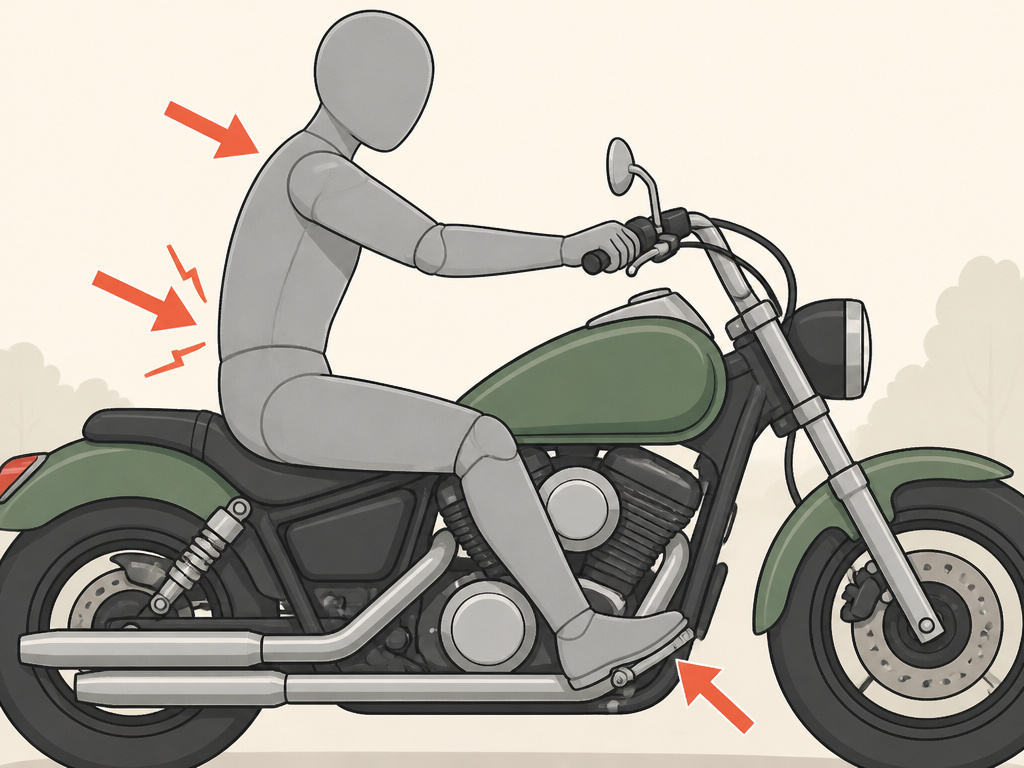
The cruiser posture is a specific geometry that can cause discomfort if your body doesn’t match the bike’s blueprint.
The fix isn’t always easy. Unlike standard motorcycles with neutral ergonomics, customizing a cruiser’s fit can require expensive aftermarket parts: extended forward controls, different handlebars, or a custom seat. A good cruiser seat is the first and best upgrade, but it solves only one part of the puzzle.
This is why the standard advice to “sit on a bunch of bikes” is critical when you compare a cruiser motorcycle pros and cons. You need to feel if your lower back tenses up after five minutes, or if your shoulders hunch. The right fit makes a hundred-mile day a breeze. The wrong fit makes fifty miles an ordeal.
Cruiser vs. Touring vs. Standard: Clearing the Confusion
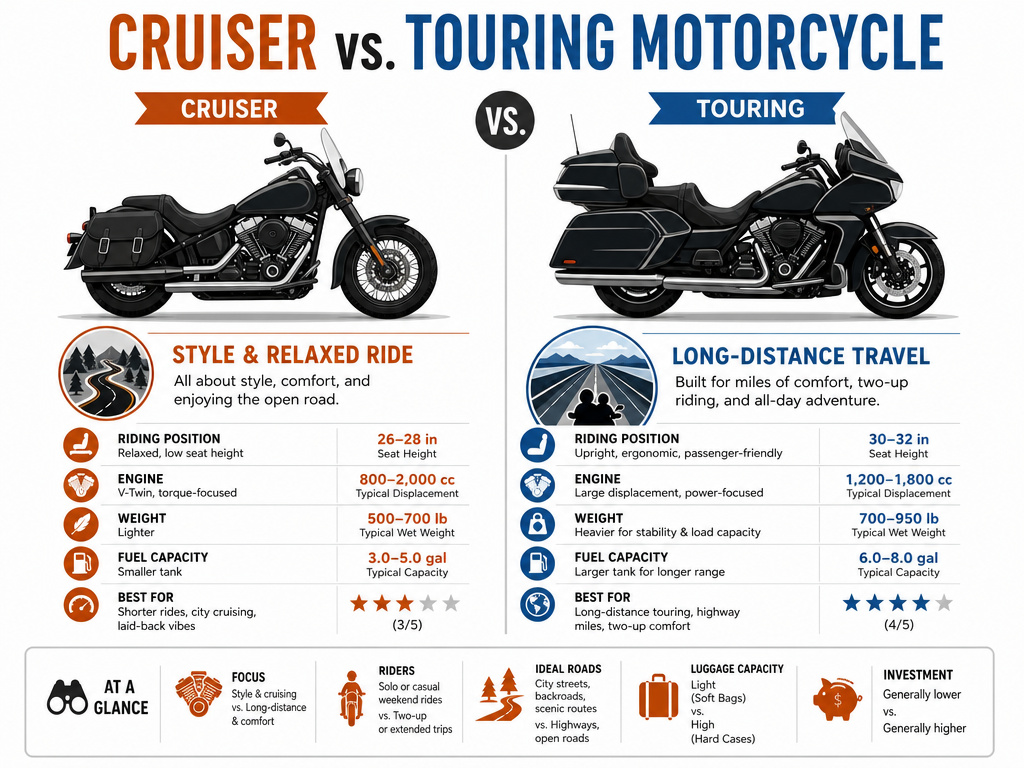
Shoppers often lump cruisers and baggers into the same category as full-dress touring bikes. They shouldn’t. A cruiser with a windshield and saddlebags is a dressed-up cruiser. A dedicated touring motorcycle is engineered from the ground up for distance, with a focus a cruiser lacks.
| Feature | Cruiser | Touring Motorcycle |
|---|---|---|
| Primary Mission | Style, relaxed cruising | Long-distance, two-up travel |
| Suspension Travel | Shorter, firmer | Longer, plush, often adjustable |
| Storage | Add-on bags (often cosmetic) | Integrated, lockable hard luggage |
| Wind Protection | Small windshield or none | Large, adjustable fairing and windscreen |
| Passenger Comfort | Often an afterthought | Large seat, integrated backrest, footboards |
The touring motorcycle pros and cons are about maximizing comfort and cargo over thousands of miles. A cruiser’s priorities are different.
Meanwhile, a standard motorcycle offers a neutral riding position, better ground clearance, and lighter weight. It’s the versatile middle ground. You give up the cruiser’s iconic look and low-speed stability for a bike that can comfortably tackle a wider variety of roads.
The Customization Culture (And Its Cost)
Customization is a huge part of the cruiser appeal. The aftermarket for parts is vast, from exhausts and air intakes to handlebars, sissy bars, and paint. You can make the bike your own, whether you’re building a minimalist bobber vs chopper or a gleaming showpiece.
This culture also sets a financial trap. It’s easy to spend thousands on cosmetic upgrades before addressing core needs like comfort or safety. My stance: before you buy a louder pipe, buy better gear. A set of protective cruiser boots and cruiser gloves will do more for your riding experience than anything bolted to the frame. A quality cruiser helmet that’s quiet at speed is a better investment than a chrome accent.
Safety & Reliability Considerations
A cruiser’s long wheelbase and weight contribute to stable, predictable braking. As noted in the Suzuki manual, wet weather drastically extends that distance. Anti-lock brakes (ABS) are a highly valuable, sometimes essential, feature on these heavy bikes.
Reliability is brand and maintenance-dependent. Even reputable brands have issues. The NHTSA motorcycle recall notice for 2024 Harley-Davidson Touring models details a regulator wire that could rub and short, causing a total loss of electrical power and propulsion. It’s a reminder that complex machines can fail, and staying on top of recalls is part of responsible ownership.
Simple owner neglect is a bigger threat. The Bajaj manual warns not to operate the starter for more than 5 seconds, waiting 15 seconds before recranking. The Suzuki manual explicitly says never to turn the ignition to ‘LOCK’ while moving. These are the small, ignored rules that lead to stranded bikes and dead batteries.
Frequently Asked Questions
Are cruiser motorcycles good for beginners?
They can be, with major caveats. The low seat height builds confidence, and the manageable low-end power is forgiving. However, their heavy weight can be intimidating at slow speeds or when maneuvering in a garage. A lightweight standard or dual-sport is often a more forgiving and versatile first bike that teaches better fundamentals.
What is the main disadvantage of a cruiser motorcycle?
The definitive disadvantage is limited cornering clearance. The low-slung design means hard parts like footpegs, exhaust pipes, and sometimes the frame itself will scrape the pavement during moderate cornering. This physically restricts how aggressively you can ride on twisty roads and can be unnerving for new riders.
Do cruisers get worse gas mileage?
Often, yes. Larger displacement engines (1800cc+, for example) and less aerodynamic designs (especially with a windshield) typically consume more fuel than smaller, faired motorcycles. Expect mileage to be moderate to poor for many big V-twins compared to smaller, more aerodynamic motorcycles.
Is a cruiser comfortable for long rides?
For straight-line highway miles, yes, the relaxed posture is excellent. For rides involving many curves or rough pavement, the limited suspension travel and fixed riding position can become fatiguing. Your comfort is also highly dependent on finding a bike that fits your specific body dimensions.
Can you tour on a cruiser motorcycle?
You can, and many riders do. Adding a windshield, saddlebags, and a more comfortable seat creates a capable tourer for solo or light two-up travel. However, for serious, repeated long-distance touring with a passenger and full luggage, a motorcycle designed from the start as a touring motorcycle will offer superior comfort, storage, and wind protection.
The Bottom Line
A cruiser motorcycle is a deliberate choice for a specific kind of riding. It trades cornering prowess and lightweight agility for unmistakable style, relaxed highway manners, and easy low-speed control. If your riding is mostly urban or interstate, and you value presence and comfort over carving canyons, a cruiser is a compelling fit.
Before you buy, be honest about your routes and your physique. Rent one for a day that includes both highway and backroad sections. Feel the scrape. Then, budget for the bike, its shorter service intervals, faster tire wear, and the gear, starting with a helmet and boots, that makes the ride enjoyable. The cruiser life is about enjoying the ride on its own terms, not about going fastest.
