
How to Adjust Motorcycle Idle Speed: The 12-Second Rule
This post contains affiliate links. As an Amazon Associate, we earn from qualifying purchases.
Adjusting motorcycle idle speed requires matching three things: your specific bike’s factory procedure, its operating temperature, and a verified tool like a tachometer. The common “turn the screw” advice misses that some manufacturers, like Buell, advise against owner adjustment, while systems like Kawasaki’s idle speed control valve do it automatically. A stable idle between 1050-1150 RPM (Buell) and 2000 RPM (Honda) is the goal, but only after confirming a real problem with the 12-second rule.
That gap between “my bike sounds off” and turning a screw is where most riders get it wrong. You need a diagnostic step first, or you’ll chase a symptom caused by a dirty air filter, bad throttle cables, or an automatic system that’s supposed to handle it. Knowing how to adjust motorcycle idle speed is only useful after this check.
What follows: the simple 12-second test to confirm you even need to adjust, a breakdown of four major brands’ official stances (from “don’t touch it” to “here’s the knob”), and the one prerequisite check that stops you from making things worse.
Key Takeaways
- Use the 12-second rule before adjusting: if the idle stabilizes within 12 seconds of a cold start, the speed is likely fine and you’re chasing another issue.
- Manufacturer guidance varies wildly: Buell explicitly says dealer pre-adjustment is optimal and owner adjustment “is not recommended,” while Honda provides a full owner-accessible procedure.
- Always verify engine temperature first. The Honda CRF250R manual requires the engine be at normal operating temperature for an accurate adjustment.
- For bikes with an idle speed control valve, like certain Kawasaki Ninja models, manual adjustment is “not necessary normally” – the system does it automatically to 1100 rpm.
- A 3/16″ allen wrench is the specified tool for adjusting idle on Buell XB models, accessed between the front cylinder head and air scoop on the left side.
The 12-Second Rule: Diagnose Before You Adjust
Ever tweak the idle screw only to have the problem come back a week later? That’s usually because the idle speed wasn’t the root cause. The 12-second rule is a field test that costs nothing and saves a misdiagnosis.
Here’s how it works. Start your bike from cold. Don’t touch the throttle. Just listen and watch the tach if you have one. Time how long it takes for the RPM to settle into a steady, unwavering hum. If it finds its happy place within 12 seconds, your base idle speed is probably set correctly. The rough running or stalling you noticed is likely due to something else, a gummed-up carburetor jet, a slightly sticky throttle cable, or an air filter that’s seen better days. If the RPM hunts up and down for 20, 30, or 45 seconds before settling, then you can start looking at the idle adjustment. This simple check for how to adjust motorcycle idle speed separates a setting problem from a system problem.
Common mistake: Adjusting the idle screw as a first response to rough running. By the time you’ve turned it three times, you’ve masked the real issue, a dirty air filter or a failing sensor, and now your baseline is off.
What Your Manufacturer Actually Says (It’s Not Universal)
This is where generic online guides fall apart. Manufacturers do not agree on whether you should even be doing this: Buell advises against owner adjustment, while Honda, Yamaha, and Kawasaki provide procedures or note it’s not normally necessary. Your first stop must be your owner’s or service manual, because the official stance dictates the correct path.
| Manufacturer | Recommended Action | Specified Idle Speed | Key Tool / Method |
|---|---|---|---|
| Buell (XB Models) | “Adjusting that setting is not recommended.” Dealer pre-sets to optimum. | 1050–1150 RPM | 3/16″ allen wrench on left-side cable |
| Honda (CRF250R) | Provides detailed owner procedure with warm-up and tachometer steps. | 2000 ± 100 RPM | Fast idle knob (in = adjustment screw) |
| Yamaha (YZF-R125) | Owner adjustment via pilot screw after checking air filter and compression. | Not specified in excerpt | Turn pilot screw direction ‘a’ or ‘b’ |
| Kawasaki (Ninja w/ DFI) | “It is not necessary to adjust the idle speed normally.” Automatic idle speed control valve. | 1100 ±50 RPM | System is automatic; inspect valve if out of spec |
The Buell position is the most conservative. Their service bulletins state plainly: “Your Buell dealer has pre-adjusted the idle speed to the optimum setting. Adjusting that setting is not recommended.” Honda, on the other hand, walks an owner through a full, multi-step process in the manual, treating it as part of routine maintenance.
A 3/16 in. Allen wrench may be used to turn the idle speed adjuster knob on Buell XB models. The adjuster is located on the left side of the vehicle between the front cylinder head and the air scoop assembly.
This isn’t a minor detail. If you own a Buell, the factory guidance is to leave it alone. If you own that Honda dirt bike, you’re expected to know how to use the fast idle knob. Starting with the manual tells you which camp you’re in.
The Non-Negotiable Prerequisites
You can’t adjust idle in a vacuum. It’s the last step in a chain, not the first. Three things must be true before your screwdriver touches anything.
First, the engine must be at normal operating temperature. The Honda manual is explicit: “The engine must be at normal operating temperature for accurate idle speed adjustment.” A cold engine runs on a different fuel map; adjusting based on a cold idle guarantees it will be wrong once the bike is warm. Their procedure says if the engine is cold, start it and let it warm up for three minutes, then shut it off before adjusting.
Second, baseline systems must be sound. The Yamaha YZF-R125 manual lists two prerequisites prior to adjustment: “the air filter element should be clean, and the engine should have adequate compression.” Similarly, performing a throttle body synchronization is a common prerequisite on multi-cylinder bikes. You’re setting the final resting point for a system that needs to be balanced first.
Third, rule out throttle cable interference. The Kawasaki manual has a specific warning: “If handlebar movement changes the idle speed, the throttle cables may be improperly adjusted or incorrectly routed, or damaged. Be sure to correct any of these conditions before riding.” This is a brilliant diagnostic. If turning the bars left or right makes the idle surge or drop, you have a mechanical cable problem. No amount of idle screw turning will fix that.
Locating the Adjustment Point
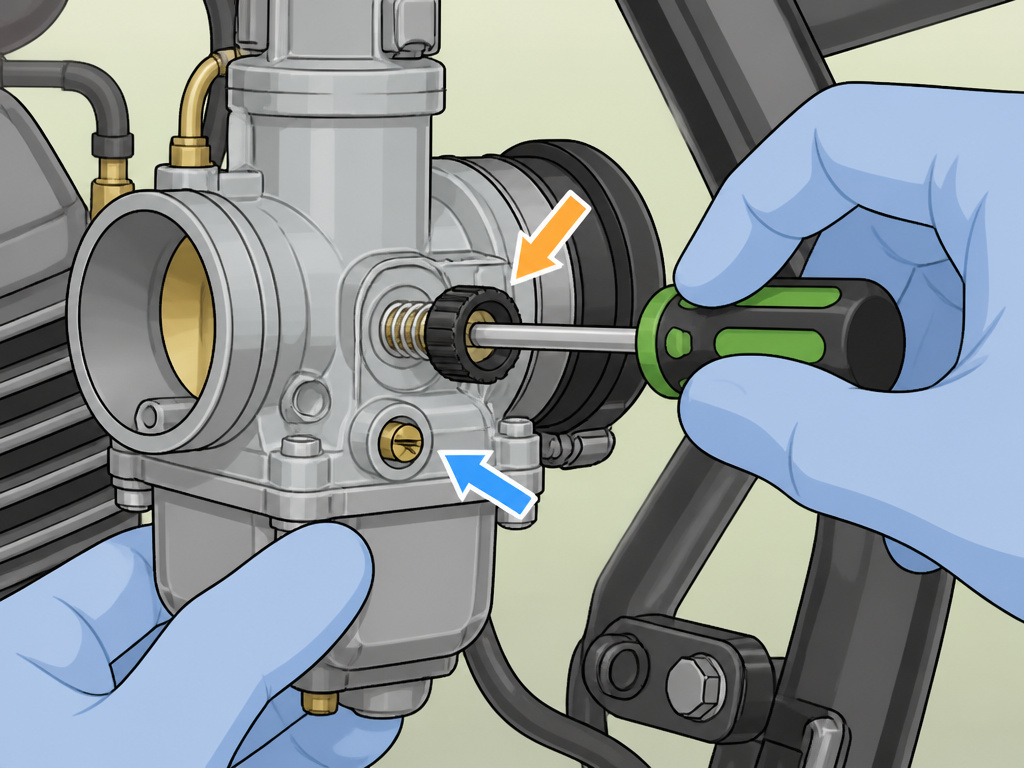
It’s rarely just “a screw on the carb.” Location and type vary dramatically by fuel system and brand.
For carbureted bikes, you’re looking for the idle speed screw, usually a large, spring-loaded screw with a knurled plastic tip that rests against the throttle linkage. It’s separate from the air/fuel mixture screw, which is typically smaller, made of brass, and recessed into the carb body. Turning the idle screw changes the throttle plate’s resting position.
For fuel-injected bikes, it can be a knob, a cable, or a sealed electronic unit. On the Buell XB models, it’s a cable with a knob, accessed with a 3/16″ allen wrench. On the Honda CRF250R, the fast idle knob itself becomes the adjuster when pushed in. Many modern fuel-injected bikes, however, have no user-accessible adjuster at all, idle is managed entirely by the ECU. Trying to adjust these requires a fuel controller or a dealer diagnostic tool.
The feel of a dedicated idle screw or knob is positive. A dedicated idle screw or knob will turn smoothly with distinct increments. If you’re forcing it or it feels gritty, you’re probably on the wrong component. That gritty feel is old carbon and varnish, a sign the whole intake likely needs a carburetor cleaning procedure before you touch the idle.
Step-by-Step Adjustment Procedure (When It’s Your Job)
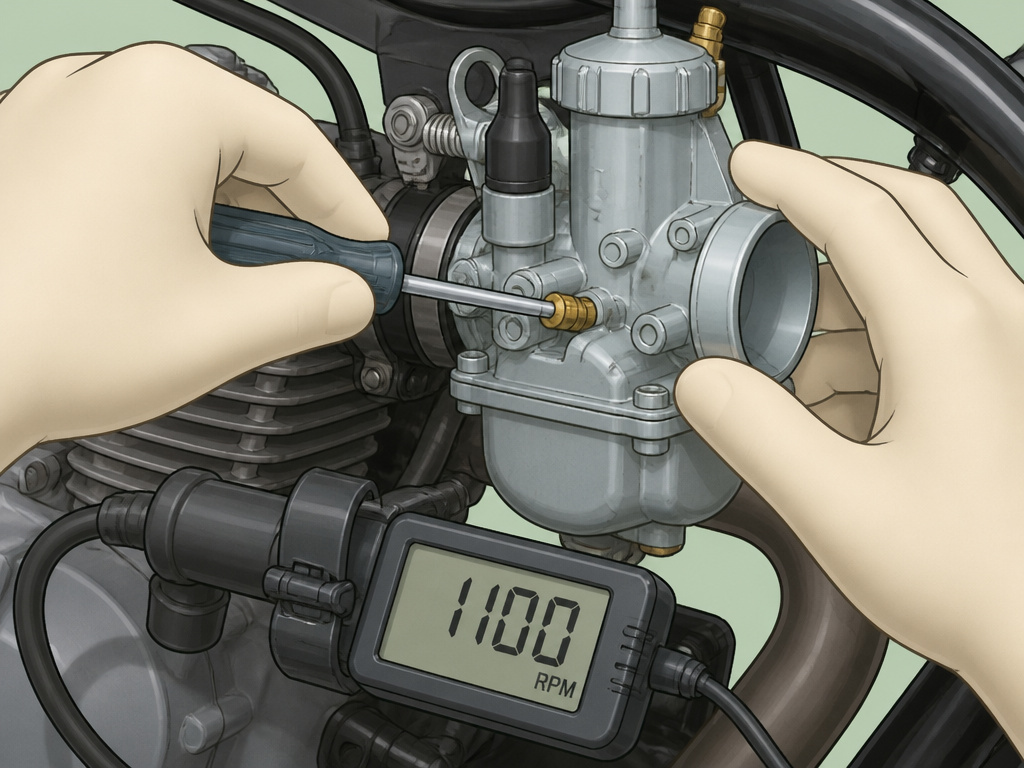
If your manual gives you the green light and the prerequisites are met, this is the sequence. It assumes you have a tachometer, a crucial tool. Guessing by ear is how you set a Harley to sound “choppy” and then wonder why it overheats in traffic.
- Warm the Engine Fully. Warm the engine fully. The Honda manual requires the engine be at normal operating temperature, and if cold, to warm it up for 3 minutes before shutting it off to adjust. This ensures the idle air control valve (if equipped) and ECU are in their normal operating mode.
- Connect a Tachometer. Clip the lead to the spark plug wire or connect to the diagnostic port, per your tach’s instructions. The Honda manual explicitly says, “Connect a tachometer to the engine.”
- Position the Bike. Place the motorcycle upright on a level stand. Both the Honda and Kawasaki procedures emphasize keeping the motorcycle vertical for an accurate reading.
- Shift to Neutral. Ensure the transmission is in neutral. The Honda procedure lists this as step 3: “Shift the transmission into neutral.”
- Locate and Turn the Adjuster. With the engine running, locate the correct adjuster. Refer to your manual for the direction. For the Buell, turning the knob in direction ‘1’ decreases speed, direction ‘2’ increases it. For the Honda CRF250R, turning the fast idle knob counterclockwise increases idle speed.
- Adjust to Spec. Make small adjustments (1/8 to 1/4 turn at a time), letting the engine settle for 10-15 seconds between each. Adjust to the specified range (e.g., 1050-1150 RPM for a Buell, 2000 ± 100 rpm for the Honda CRF250R).
- Test and Fine-Tune. Blip the throttle. The RPM should rise smoothly and return promptly to your set idle speed without dipping below or hanging above it. A hang or a dip indicates other issues, like a vacuum leak or sticky cable.
When Adjustment Does Nothing (Troubleshooting)
You’ve turned the screw through its entire range and the idle won’t change, or it changes erratically. This means the idle circuit is blocked or the system designed to manage it has failed.
On a carbureted bike, a completely unresponsive idle screw points to a clogged pilot jet or passage. The screw just moves a throttle stop; if the fuel isn’t flowing through the idle circuit, nothing happens. Time for a disassembly and cleaning. On a fuel-injected bike with an idle air control valve (IACV), a stuck or failed valve is the culprit. The Kawasaki manual directs: “If the idle speed is out of specified range, check the idle speed control valve.”
Another scenario: the idle changes, but it’s unstable no matter where you set it. This points to an air leak (check vacuum hoses and intake manifold seals) or a failing throttle position sensor (TPS). The idle screw sets a baseline, but the ECU or carburetor needs stable inputs to hold it.
How to Adjust Idle on Carburetor vs Fuel Injection
Modern fuel-injected motorcycles often manage idle speed automatically. Some models use an idle speed control valve that adjusts to a set value without manual input. On these bikes, a changing idle is often a symptom of another fault, not a simple adjustment issue. Carbureted bikes and some simpler fuel-injected models have a manual adjuster, typically a knob or screw. The core process for how to adjust motorcycle idle speed is similar: locate the adjuster, ensure the engine is fully warmed up, and turn it while monitoring a tachometer. However, the need for adjustment is far less common on modern fuel-injected systems.
Idle Speed Screw vs Air Fuel Mixture Screw
It’s easy to turn the wrong screw. The idle speed screw controls only how fast the engine runs when the throttle is closed. The air/fuel mixture screw changes the fuel ratio for the entire low-speed range and is often set at the factory. Adjusting the mixture screw to fix an idle problem can create poor running at other throttle positions. If your bike has both, identify the idle adjuster by its location; it’s often on the throttle body or carburetor linkage and is meant to be turned while the engine is running. If the idle changes when you move the handlebars, the issue is likely with the throttle cables, not either screw.
Which Way to Turn the Idle Screw for Higher RPM
The direction to turn the adjuster varies. The direction varies by model. For the Honda CRF250R, turning the fast idle knob counterclockwise increases idle speed. For Buell XB models, turning the knob in direction ‘2’ increases idle speed. Other models may label directions differently, where turning in one specific direction increases speed and the opposite direction decreases it. The rule is universal, however: make tiny adjustments. Turn the screw or knob a small amount, let the engine settle for a few seconds, and observe the change. Always start with a fully warmed engine, the transmission in neutral, and the motorcycle held upright for a consistent reading.
Frequently Asked Questions
What is the 12-second rule on a motorcycle?
The 12-second rule is a quick diagnostic to see if your idle speed is truly mis-set. Start the bike cold without touching the throttle. If the RPM settles into a steady idle within 12 seconds, the base idle setting is likely correct and you should look for other causes of rough running. If it takes longer than 12-15 seconds to stabilize, then adjusting the idle speed may be warranted.
What RPM should a motorcycle idle at?
There is no universal RPM. It varies by engine size, configuration, and manufacturer. For example, a Buell Ulysses XB12X idles at 1050-1150 RPM, while a Honda CRF250R dirt bike idles at 2000 ± 100 RPM.
How do I adjust the idling speed on a fuel-injected motorcycle?
The process varies. Some have a dedicated idle adjustment knob or screw (like older Buell models with a cable). Many modern bikes have an idle speed controlled automatically by the ECU via an idle air control valve; these often cannot be adjusted without a dealer tool or a aftermarket fuel management module. Always consult your service manual first to see if user adjustment is provided for.
Why does my motorcycle idle speed keep changing?
Fluctuating idle is rarely fixed by the idle screw. Common causes include a dirty or failing idle air control valve (on fuel-injected bikes), a vacuum leak in the intake system, a dirty carburetor pilot circuit, improperly adjusted throttle cables that bind when the bars are turned, or a faulty engine temperature sensor.
Before You Go
One threshold decides everything: if your bike has an automatic idle system, stop. For models like the Kawasaki Ninja with its idle speed control valve, the manual’s stance is clear, manual adjustment is not part of normal procedure. Turning a screw on that bike is at best useless, at worst disruptive.
If you have an older bike with a manual adjuster and it fails the 12-second test, then follow the chain: verify engine temperature, check for cable issues, ensure the air filter is clean. Then, and only then, use a tachometer to set it to the book value. This isn’t about finding a sweeter sound. It’s about setting the mechanical baseline the rest of the fuel and ignition systems rely on. Get that wrong, and you’re just adding a new problem on top of the old one.
