
How Does a Motorcycle Fuel Controller Work?
This post contains affiliate links. As an Amazon Associate, we earn from qualifying purchases.
A motorcycle fuel controller works by intercepting the signals between the stock ECU and the fuel injectors, then modifying the injector ‘on’ time (pulse width) to make the air-fuel mixture richer or leaner. This corrects the mixture after modifications like exhaust or air intake changes that the factory ECU can’t properly adapt to. To understand the process, one might ask: how does a motorcycle fuel controller work? Piggyback controllers do this from the outside, while ECU flashes rewrite the internal fuel map itself.
The gap between the stock map and your modified engine is where the answer to how does a motorcycle fuel controller work lives. The factory programming has a fixed idea of how much fuel to inject at every RPM and throttle position. Swap the airbox or pipe, and that map is wrong, the bike runs lean and hot, or rich and sluggish. A controller plugs that gap. What follows: three signals it reads, two ways it changes them, and the one tuning step most riders skip.
Key Takeaways
- A fuel controller intercepts and alters the ECU’s injector pulse width, the only reliable way to change fuel delivery on a modern motorcycle.
- It’s a necessity only after engine breathing mods (intake, exhaust, cam) that change air volume; adding one to a stock bike is often a waste of money.
- The core tuning process involves adjusting a fuel map, a 3D grid of throttle position vs. RPM, to add or subtract fuel percentage in specific cells.
- Closed-loop systems with O2 sensors will fight a piggyback controller at idle and cruise; know your bike’s system type before you buy.
- Custom dyno tuning beats a pre-loaded map for power and safety, but an off-the-shelf map from a known tuner is better than a blind guess.
The Stock ECU’s Job: Reading, Calculating, Commanding
Your motorcycle’s stock Engine Control Unit (ECU) is a computer with one job: deliver the right amount of fuel and spark at the right time. It doesn’t think. It runs a program. The Ducati workshop manual for the M1100 S describes a pre-programmed injection-ignition system using engine speed and throttle position as main parameters.
The ECU picks a spot on the fuel map by cross-referencing two or three key inputs. According to the Honda Programmable FI guide, the ECM looks at engine RPM, throttle position, and manifold pressure. The throttle position sensor (TPS) tells it how far the twistgrip is open. The manifold absolute pressure (MAP) sensor reads vacuum or boost in the intake tract. Engine speed comes from the crankshaft position sensor.
This selection process is the technical heart of fuel injection. The ECU uses RPM and throttle position (or manifold pressure) to select a base fuel value from a 3D map stored in its memory. That base value, expressed in milliseconds of injector opening time, is then modified in real-time by correction sensors for temperature and barometric pressure.
Those correction sensors are the intake air temperature (IAT) and engine coolant temperature (ECT) sensors. A cold engine needs a richer mixture to start and run smoothly, the Ducati manual notes that during cranking, the mixture is enriched based on engine temperature. Once the base milliseconds are looked up and adjusted, the ECU sends a precise electrical pulse to each injector. This is the injector pulse width.
The Role of Sensors and Pulse Width
Pulse width is everything. The fuel injector is a simple on/off solenoid valve, as described in the ATK Fuel Induction manual. It’s either fully closed or fully open. The amount of fuel squirted into the intake port depends on how many milliseconds the ECU commands it to stay open. That command is the pulse width.
The voltage that opens the injector is controlled by the ECU. The fuel pressure pushing against the injector nozzle is also regulated to a fixed value above manifold pressure. The Honda guide states a normal motorcycle idle vacuum pressure is about one inch of Hg., or 4.9 psi, and fuel pressure is typically 32-50 psi. The GL1800 uses 50 psi. This fixed differential means the only variable the ECU controls is time. More milliseconds equals more fuel.
But fuel pressure isn’t universal. Here’s where sources disagree. The SYM Fuel Injection System manual specifies its pressure-regulating valve keeps pressure around 2.5 bar (about 36 psi). The Honda guide states a typical range of 32-50 psi. The point is consistency: the ECU assumes pressure is constant for its calculations.
The factory ECU’s pulse width calculation aims for a stoichiometric air-fuel ratio. As noted on the CRF250F page, the chemically correct stoichiometric ratio for gasoline is 14.7:1. All the sensor inputs. RPM, throttle, manifold pressure, air temp, feed into one goal: hitting that 14.7:1 mix under most riding conditions for efficiency and emissions.
| Sensor | What It Measures | How the ECU Uses It |
|---|---|---|
| Throttle Position (TPS) | Twistgrip angle (0-100%) | Selects row on fuel map; senses acceleration rate. |
| Manifold Absolute Pressure (MAP) | Air pressure/vacuum in intake | Selects column on fuel map; calculates air density. |
| Crankshaft Position | Engine RPM & position | Main timing reference; selects fuel map column. |
| Intake Air Temp (IAT) | Temperature of incoming air | Adjusts pulse width for air density; adds/subtracts fuel %. |
| Engine Coolant Temp (ECT) | Engine operating temperature | Governs cold-start enrichment and warm-up fueling. |
| Oxygen (O2) Sensor | Oxygen content in exhaust | Provides feedback for closed-loop correction at idle/cruise. |
This table is the ECU’s recipe. A fuel controller changes the ingredients.
Where the Stock Map Falls Short (And a Controller Steps In)
The factory map is a compromise. It’s tuned for a specific bike configuration, meeting emissions standards, achieving decent fuel economy, and providing smooth throttle response, all on a showroom-stock motorcycle. It has no room for error.
Change the bike’s ability to breathe, and the map is instantly wrong. Install a less restrictive air filter and a free-flowing exhaust. More air can now enter the engine. The stock ECU sees the same throttle position and RPM, but the actual air mass flowing through is greater. It still injects the same old pulse width milliseconds, resulting in a lean mixture, not enough fuel for the air present.
Where this goes sideways: Running lean under load increases combustion temperatures. This can lead to pre-ignition (pinging), burnt valves, and in extreme cases, piston damage. The lean condition might not be noticeable during gentle riding but reveals itself as flat spots, hesitation, or overheating when you roll the throttle open.
The answer to how does a motorcycle fuel controller work is that it inserts itself into the signal path between the ECU and the injectors. It listens to the same key sensors, primarily TPS and RPM, and uses them to reference its own, separate fuel map. When it sees the ECU send a pulse, it either shortens or lengthens that pulse width by a percentage you define. Need 10% more fuel at 4000 RPM and 50% throttle? The controller adds it.
Piggyback vs. ECU Flash: Two Paths to the Same Goal
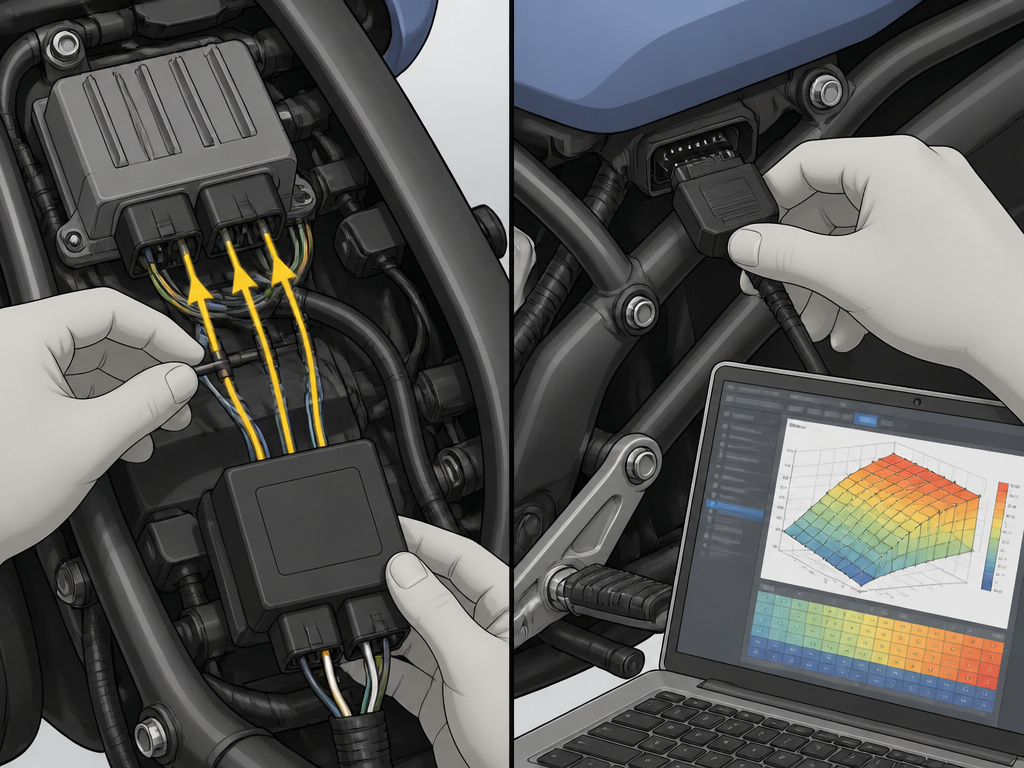
You have two main technical routes: a piggyback controller or an ECU flash/reflash. Both change the fueling, but their method and permanence differ.
Piggyback Controllers (like the EZECU City Fi, Power Commander, or Daytona Twin Tec units) are external hardware. They splice into the motorcycle’s wiring harness. The City Fi ECU manual explains it intercepts the fuel injection signal input from the factory ECU. It then outputs a modified pulse to the injectors. It’s a translator, changing the ECU’s command on the fly.
- Pros: Reversible. You can unplug it and sell it separately. Often user-tunable with PC software. Can be transferred to another bike of the same model.
- Cons: Adds wiring and complexity. Some closed-loop systems will try to compensate against its changes at steady throttle. Physical installation required.
ECU Flashing is a software modification. A specialist connects to the stock ECU’s diagnostic port and overwrites sections of the original fuel, ignition, and throttle maps with new values. This isn’t adding hardware; it’s changing the software the existing hardware runs.
- Pros: Clean, no added wiring. Can adjust all parameters, fueling, ignition timing, throttle response, rev limit, fan temperature, and more. It works properly with the bike’s native systems.
- Cons: Usually permanent (though often reversible for a fee). Requires a specialist with proper software/licensing. Tends to be a more expensive, one-time service.
| Method | How It Works | Best For | The Catch |
|---|---|---|---|
| Piggyback Controller | Intercepts & modifies ECU signal in real-time. | Riders who modify in stages, want resale flexibility, or have a bike with no flash support. | Can conflict with closed-loop feedback; adds physical wiring to manage. |
| ECU Flash/Reprogram | Rewrites the stock ECU’s internal fuel/ignition maps. | Riders wanting a comprehensive, clean tune that adjusts ignition and throttle maps alongside fuel. | Commits the ECU; requires a tuner with specific software; usually more costly upfront. |
The choice often comes down to your bike and your plans. For a simple slip-on and air filter change, a pre-mapped piggyback is fine. For a full system, big-bore kit, and cams, a custom dyno flash is the only right answer.
Fuel Controller Tuning: Maps, Modes, and Mistakes
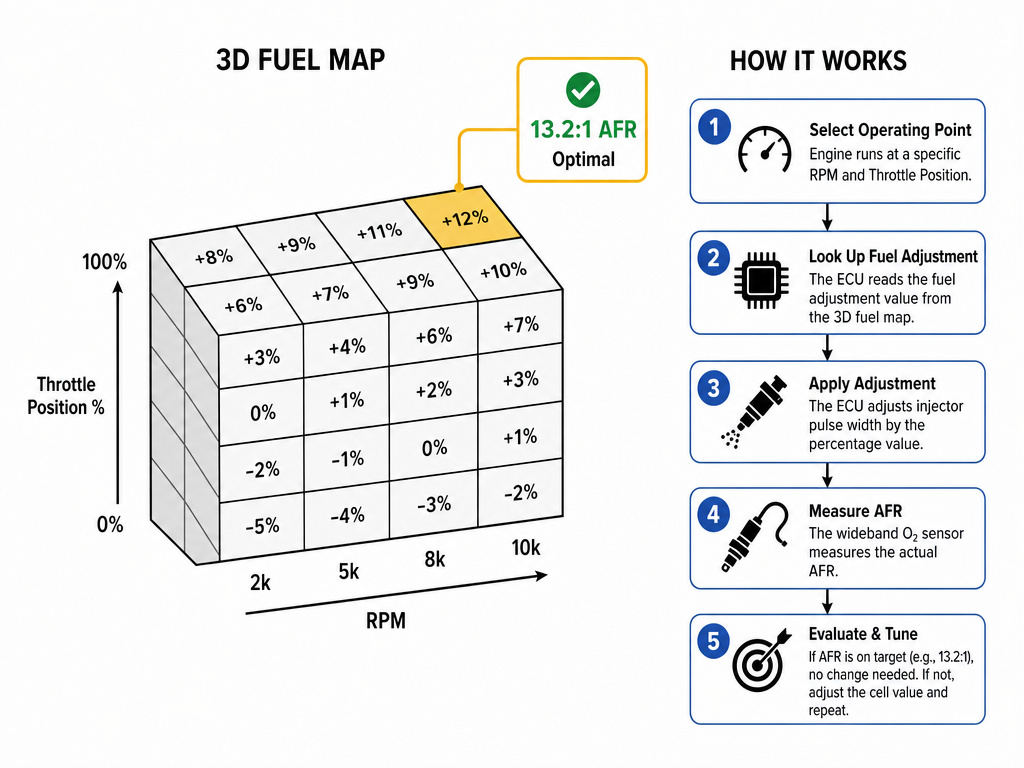
Tuning is where a box of electronics becomes useful. The controller’s brain is its fuel map, a 3D table with RPM across the bottom (X-axis) and throttle position up the side (Y-axis). Each cell in this grid holds a percentage value: +5%, -3%, +12%. This number is how much the controller alters the stock ECU’s pulse width at that exact RPM and throttle point.
Common mistake: Cranking every cell to +10% because “more fuel equals more power.” That just makes the bike run pig-rich, foul plugs, and lose power. Fuel needs to track air mass. You add fuel only where the modification has increased airflow.
There are two ways to populate this map:
- Pre-Loaded/Off-the-Shelf Maps: The manufacturer provides maps for common modifications (e.g., “Yamaha MT-07 with DNA air filter and Akrapovič slip-on”). You download it and upload it to the controller. This is plug-and-play, but it’s an approximation. It assumes your bike, fuel, and atmosphere match their test conditions.
- Custom Tuning: A tuner places your bike on a dynamometer and measures air-fuel ratio under load at hundreds of different RPM and throttle points. They then adjust each map cell individually until the AFR is optimal (usually around 13.2:1 for wide-open throttle performance). This is the gold standard. The Daytona Twin Tec manual notes their auto-tuning feature only saves adjustments after the engine reaches 95°C (200°F) and runs for at least 5 minutes, ensuring stable, hot-engine data.
The tuning interface matters. Systems like the City Fi ECU offer a fuel tuning map with 500 RPM through 15,000 RPM resolution and 10 programmable TPS levels (0%, 5%, 10%, up to 100%). You adjust values in this grid with software. Other systems, like the Daytona Twin Tec, use “Alpha-N” tuning, where the table represents percent injector pulse width before correction for BLM, front cylinder trim, barometric pressure, intake temperature, and cold start enrichment.
When You Don’t Need a Fuel Controller
A controller isn’t a magic power box. It’s a correction tool. If your motorcycle is completely stock, adding one is almost always a waste of money. The factory carefully calibrates that map for the stock parts. A controller can’t add power the bike can’t use.
Even with modifications, you might not need one. A simple slip-on muffler swap that doesn’t change the header pipe or mid-pipe often alters the sound more than the airflow. The stock ECU’s adaptive capabilities (via the O2 sensor in closed-loop systems) can often compensate enough. The bike might run leaner than stock.
The real line is crossed when you change the air intake or the full exhaust system (headers included). These mods significantly increase air volume, moving the bike outside the stock ECU’s correction window. That’s when a controller moves from optional to mandatory.
Installation and Wiring Reality
Installing a piggyback controller is a wiring job, not a bolt-on. Fair warning: you’ll be handling the bike’s main wiring harness. The general process:
- Locate the stock ECU (usually under the seat or behind a side panel).
- Identify the injector wires (color codes are in the controller’s instructions).
- Splice the controller’s harness into these wires, typically using supplied Posi-Tap or solder-seal connectors.
- Route the controller’s main unit and its wiring cleanly, avoiding heat sources and moving parts.
- Connect power, ground, and the TPS wire.
The Honda guide offers a critical safety tip relevant here: When testing PGM-FI fuel pumps, always disconnect the ECM connector to prevent possible damage to the ECM. The same principle applies, be methodical with electrical disconnects to avoid sending voltage where it shouldn’t go. It is a job that requires careful attention to wiring.
Why riders feel they need a fuel controller
On forums, riders often report their bike feels flat after installing a new exhaust or air filter. The stock ECU uses a fixed map based on key inputs such as engine speed and throttle position, and often manifold pressure. It cannot adapt to the increased airflow from modifications, so the mixture becomes lean, causing surging, popping on deceleration, or a loss of power. Others note poor cold starts or hesitation during throttle roll-on, symptoms of a map that’s no longer correct. A fuel controller gives them the ability to adjust the injector pulse width, directly altering the fuel mixture to match their new setup and restore smooth, predictable power.
Frequently Asked Questions
Can a fuel controller improve fuel economy?
It can, but usually doesn’t. Its primary job is to add fuel for performance, which reduces economy. However, if a modification made the bike run excessively rich, a tune can lean it back toward efficiency at cruise. Don’t buy one expecting better MPG.
Will a fuel controller work with my bike’s ride modes and traction control?
Piggyback controller only alters the fuel signal. It is typically transparent to the ECU’s logic for traction control, riding modes, and ride by wire. Those systems function as before. An ECU flash can actually modify those features directly.
How do I know if my bike has a closed-loop system?
Check for an oxygen (O2) sensor in the exhaust header, usually near the cylinder head. If it has one, it’s closed-loop at idle and steady-state cruise. Many modern bikes are. The CRF250F page confirms that bike’s system is open-loop (no O2 sensor).
Is it safe to run a pre-loaded map?
Generally, yes, if it’s from a tuner for your exact modifications. It’s safer than running untuned with those mods. However, it’s still a generic tune. For maximum performance and safety, especially with major engine work, custom dyno tuning is the only answer.
The Bottom Line
A fuel controller is a translator for a modified engine. It takes the stock ECU’s outdated commands and corrects them in real-time. If you’ve changed how your bike breathes, you’ve changed its language. You need the translator.
Skip it if your bike is stock or you’ve only changed the muffler tip. But if you’ve opened the airbox or swapped the full exhaust, it stops being an upgrade and starts being a necessary part of the modification. Start with a pre-loaded map from a known tuner, but understand its limits. The real gain comes from a custom tune, where someone matches fuel to air cell-by-cell. That’s when a modified bike finally runs right.
