
Braided Stainless Motorcycle Brake Lines Pros and Cons
This post contains affiliate links. As an Amazon Associate, we earn from qualifying purchases.
Braided stainless steel motorcycle brake lines improve lever feel by eliminating the expansion of rubber hoses under pressure, offering greater durability and a consistent bite. The trade-off is a stiffer, less forgiving system that requires precise installation, may not fully renew complex ABS setups, and introduces new abrasion risks if routed poorly.
The expansion control is the whole point. Rubber hoses swell slightly with each squeeze of the lever, absorbing a fraction of the hydraulic pressure meant for the caliper. That lost motion translates directly to lever travel and a vague, mushy feel, especially when the fluid gets hot. Understanding the braided stainless motorcycle brake lines pros and cons is key to evaluating this upgrade.
What follows is a breakdown of where that benefit is real, where marketing overpromises, and the specific pitfalls, like ABS integration and torque specs, that decide the braided stainless motorcycle brake lines pros and cons question.
Key Takeaways
- The primary benefit is eliminating hose expansion, which firms up lever feel and improves modulation, particularly under repeated hard braking.
- On bikes with complex ABS systems, a standard aftermarket kit often leaves critical hard lines in place, which can be a partial upgrade at best.
- Installation demands precision: Overtightening fittings or kinking the line during routing can cause immediate failure or slow leaks.
- Manufacturer recommendations like Kawasaki’s 4-year hose replacement are considered by some to be liability-driven; however, Kawasaki’s service manual recommends this interval, while many riders report real-world rubber hose lifespan often exceeds a decade with proper inspection.
- Quality matters: Stick with DOT/TUV-approved brands like Spiegler or HEL that use proper fittings and offer a verifiable warranty.
The Core Benefit: Eliminating Hose Expansion
Under hard braking, the pressure inside your brake line can spike to very high levels. A standard rubber hose will balloon minutely under that load. You don’t see it, but you feel it as extra lever travel before the pads bite.
Braided stainless steel lines use a woven metal sheath over an inner PTFE (Teflon) liner. The sheath acts as a reinforcing cage, preventing the liner from expanding under pressure. This delivers more of the hydraulic force from the master cylinder directly to the caliper piston by reducing hose expansion.
That’s the advertised “firmer lever” and “better feel.” It’s real. The difference isn’t subtle on a track bike or an older machine with tired, original lines. The lever comes back to the same spot every time, whether the brakes are cold or after three hard laps.
The catch, when you compare a braided stainless motorcycle brake lines pros and cons, is that your brain and hand are part of the system. Some riders, particularly on sport-touring bikes, find the sharper pressure rise from braided lines feels too abrupt. Japanese engineers have been quoted saying they sometimes use rubber hoses specifically to tune that initial bite to be more progressive. It’s not always about cost-cutting.
The Durability Debate: Lifetime vs. Liability
Open a service manual, and you’ll find a scheduled replacement interval for brake hoses. The 2019 Kawasaki Ninja 1000 manual, for instance, recommends replacement every 4 years. Aftermarket companies like Spiegler note a “generally unrecognized manufacturer’s recommendation” that all original rubber hydraulic hoses should be changed every four years.
The owner community sees it differently.
Some forum consensus holds that these intervals are liability-driven, while manufacturers like Kawasaki recommend a 4-year replacement interval. Riders often report OEM rubber hoses lasting many years beyond the manufacturer’s recommended interval with proper inspection. The rubber itself, protected from ozone and road grime, can last a long time. The failure point is rarely the hose body, it’s the fittings or the internal lining, which can degrade from contaminated brake fluid.
| Perspective | Recommended Interval | Primary Reason |
|---|---|---|
| OEM (e.g., Kawasaki) | 4 years | Proactive safety, liability mitigation |
| Aftermarket (e.g., Spiegler) | 4 years (for OEM rubber) | Marketing to encourage upgrade |
| Owner Experience | 10+ years (with inspection) | Real-world observation of hose longevity |
Braided lines sidestep this debate with a different value proposition: inspectability and external toughness. You can see the stainless sheath. It won’t dry-rot or crack from UV exposure. A set from Spiegler comes with a lifetime warranty against defects. The trade-off is that you can’t inspect the inner PTFE liner for degradation. It fails from the inside out, usually at a fitting.
The Installation Reality: It’s Not a Bolt-On
This is where good intentions meet stripped threads and spilled DOT 4 fluid. Swapping lines isn’t just unscrewing old hoses and screwing in new ones.
Before you start: DOT 4 brake fluid damages paint and plastics on contact. It can have serious health effects on contact with skin and eyes, requiring proper protection. Cover your tank, fenders, and frame. Wear gloves. Have a supply of fresh, sealed DOT 4 brake fluid and a set of line wrenches ready.
The physical job has two hard parts: routing and torque.
Routing is critical. Braided lines are less flexible than rubber. They don’t forgive a tight bend or a pinch against a frame member. A kink can crack the inner liner, leading to a slow leak or a sudden blow-out. You must ensure full steering lock-to-lock clearance and clearance for fork compression.
Torque is critical. This isn’t a case of “tighten until it feels good.” Under-torqued fittings weep fluid; over-torqued fittings strip aluminum caliper or master cylinder threads, which is a catastrophic repair.
Harley-Davidson’s service documentation provides a clear example of the specificity required:
- ABS brake line tube nut fittings: 14.5–19.3 N·m (10.7–14.4 ft-lbs)
- Caliper banjo bolt: 19–24.4 N·m (14–18 ft-lbs)
- Upper to lower line swivel nut: 5.1–7.3 N·m (45–65 in-lbs)
Use a torque wrench. Harley-Davidson warns that improperly serviced brakes can cause death or serious injury. After everything is tight, you must thoroughly bleed the brakes to remove air, which is its own specialized task, especially on ABS models.
The ABS Complication: Partial Upgrades and Hidden Lines

This is the biggest caveat, and one generic articles miss. On a modern motorcycle with ABS, the brake line system isn’t just a hose from the master cylinder to the caliper.
The system includes integrated hard lines, often rigid steel pipes connected to rubber hoses with sharp 90-degree bends, that run to and from the ABS pump module. These are often permanently assembled or incredibly difficult to access.
A standard “ABS-compatible” braided line kit, like a 5-line HEL kit for a Kawasaki Z1000SX, typically replaces only the flexible rubber sections you can easily see. The complex hard lines to the pump remain original.
Where this goes sideways: Replacing only the flexible lines on a complex ABS system leaves the oldest, most stressed hard lines in place. Forum experts argue this can be a “complete waste of money” if your goal is a total hydraulic system renewal. You get a firmer lever feel from the new lines, but the overall system integrity is still limited by the original hard piping.
For a full renewal, you often need a custom kit or must source OEM hard lines, which escalates the job from an afternoon in the garage to a major disassembly requiring special tools. The NHTSA technical service bulletin for brakes for certain Indian models underscores the complexity of factory ABS systems, detailing specific inspection procedures dealers must follow.
Potential Downsides and Failure Modes
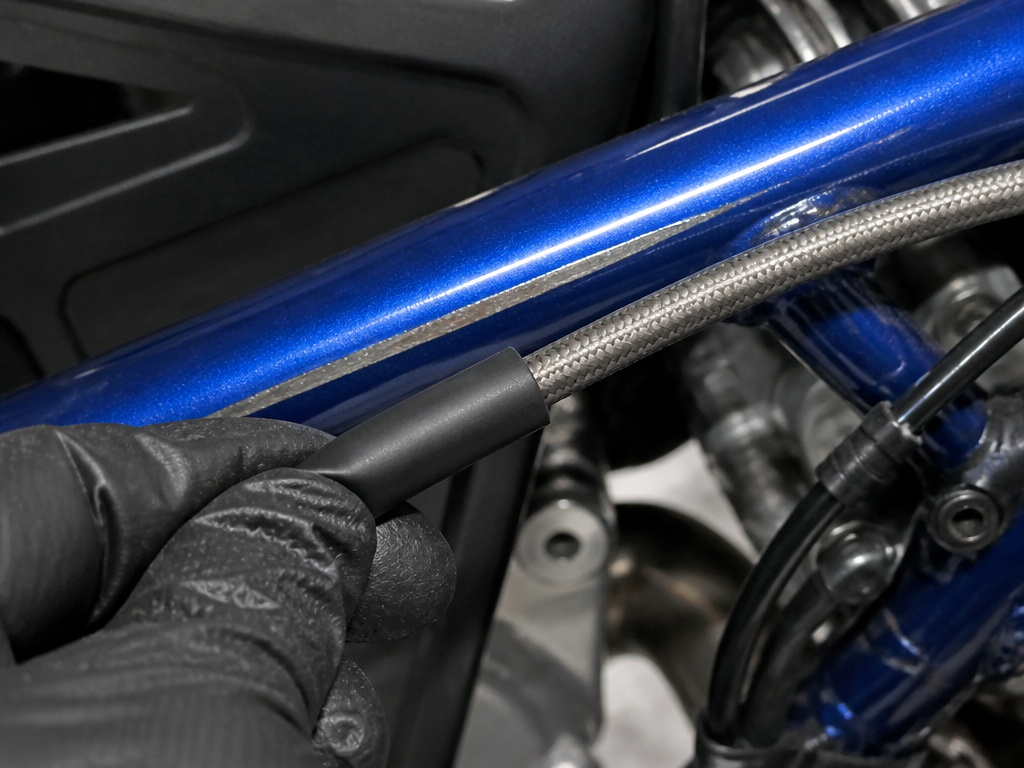
Braided lines aren’t a panacea. They introduce new risks that rubber hoses don’t have.
- Abrasion as a Saw: The braided stainless sheath is incredibly abrasive. If it vibrates against a painted frame tube, a wire loom, or even another brake line, it will cut through the other material over time. Proper routing with protective sleeves or cushioned clamps is mandatory.
- Fitting Fatigue: The line itself is tough, but it’s only as strong as its ends. Failures in braided lines often occur at the crimped fittings, not in the middle of the line. This is why the quality of the crimp and the fitting material is paramount.
- Corrosion (The Hidden Kind): The stainless braid can trap contaminants, potentially leading to corrosion. This doesn’t affect function immediately but can make the line inflexible and prone to cracking at stress points. A coated line can help prevent this.
- No Warning Before Failure: A rotting rubber hose gives visual cues, cracks, bulges, discoloration. A braided line with a failing inner liner gives none until it leaks or bursts.
These risks are why a federal motorcycle brake system recall, like the one issued for 2024 Suzuki Hayabusas for under-torqued flare nuts, highlights that installation integrity is everything, regardless of line type.
When Is the Upgrade Worth It? A Decision Matrix
Not every bike needs braided lines. Use this table to match your use case to the potential benefit.
| Your Riding Scenario | Likely Benefit | Recommended Action |
|---|---|---|
| Track/Performance Riding | High. Consistent lever feel under extreme heat and pressure is critical. | Install a quality, full-coverage kit. Prioritize lever feel over cost. |
| Older Bike (>10 years) | Medium-High. Aging rubber is the primary performance limit. Fresh fluid, new brake pads, and braided lines transform braking. | Inspect OEM hoses first. If they’re original, a full line swap is a great system refresh. |
| Modern Bike with ABS | Low-Medium. Benefit is limited to lever feel; system integrity depends on untouched hard lines. | Consider if lever feel is your only gripe. For a true system renewal, research custom kits or prepare for a complex job. |
| Adventure/Off-Road Bike | High (for abrasion). The durability against brush, rocks, and debris is a tangible safety benefit. | Choose a coated kit from a reputable brand. Ensure routing is protected from snags. |
For most street riders complaining of a spongy brake lever, the first and cheapest fix is always a thorough brake fluid flush with high-quality DOT 4. Old, moisture-contaminated fluid is the culprit far more often than hose expansion.
Frequently Asked Questions
Do braided brake lines actually improve stopping power?
Not directly. They don’t increase the clamping force of your calipers. What they do is improve efficiency and consistency by removing the variable of hose expansion. This gives you more precise control over the power that’s already there, which can help you brake more effectively, especially at the limit.
What is the best brand of braided brake line?
Stick with established, certified brands. Spiegler and HEL are benchmarks, offering DOT/TUV approval, quality crimps, and good customer support. DAYTONA lines are manufactured by NICHIRIN, a major OEM supplier, indicating solid quality. Avoid no-name eBay kits with questionable fittings and no certification.
Can I install braided lines myself?
Yes, if you are mechanically competent, have a service manual, a torque wrench, and the patience for meticulous bleeding. The job is more about care and procedure than strength. If you have an ABS-equipped bike, research your specific model’s layout thoroughly first, it may be more complex than you think.
How long do braided stainless steel brake lines last?
Quality set should last the life of the motorcycle. The warranty is often “lifetime.” However, you should still inspect them annually for abrasion, damage at the fittings, or any signs of leakage. The internal liner can degrade from contaminated fluid, so regular brake fluid changes (every 2 years) are still essential.
Are braided lines worth it on a new bike?
The upgrade becomes more worthwhile as the bike ages or if you are pushing its limits on track.
The Bottom Line
Braided lines offer a real, tangible improvement in brake feel for riders who can perceive and use that feedback. They are a durable, long-life component when installed correctly.
But they are not a magic bolt-on. The 4-year replacement rule for rubber is conservative, but it exists because hidden internal degradation is real. Before you spend $300 on lines, spend $20 on fluid and an afternoon bleeding your brakes using a proper brake bleeding procedure. If the lever is still soft, then diagnose further.
For modern ABS bikes, temper your expectations. You might be buying a partial solution. And no matter what, if you do the install, torque the fittings. That single step separates a safe, lasting upgrade from a roadside failure. The official DOT brake component recall notices exist because professionals sometimes get it wrong.
