
Motorcycle Oil vs Car Oil: Key Differences and Warnings
This post contains affiliate links. As an Amazon Associate, we earn from qualifying purchases.
Motorcycle oil and car oil are not interchangeable. The difference comes down to three engineered specifications: JASO MA/MA2 certification for wet clutch compatibility, higher shear stability for gear protection in a shared sump, and controlled friction modifiers. Using modern car oil in a motorcycle with a wet clutch risks clutch slippage and accelerated wear, a failure mode documented by sources like TERZO Lubricants, though some general automotive blogs consider it sub-optimal but not immediately catastrophic.
That JASO MA2 certification is a measurable friction standard, a dynamic friction index (DFI) of at least 1.45, designed so your clutch plates grip instead of glide. This is a key difference in motorcycle oil vs car oil. Car oils, especially API SP or ILSAC GF-6 grades, are formulated with opposite goals: they add friction modifiers to improve fuel economy, which directly undermines a wet clutch’s operation.
What follows is a breakdown of the engineering specs that separate the two oils, the documented failure modes from using the wrong one, and a clear guide for reading your manual, the bottle label, and making the safe choice. We’ll also cover the one scenario where a car oil might get you home without immediate damage.
Key Takeaways
- A JASO MA or MA2 certification is critical for wet-clutch motorcycles; the strict friction indexes (e.g., MA2 DFI ≥ 1.45) prevent clutch slippage that car oils can cause.
- Motorcycle oil must survive extreme shear forces from lubricating gears in a shared sump; Valvoline tests show their 4-Stroke Motorcycle Oil SAE 10W-40 provides 40% better transmission protection vs. A typical API SL quality engine oil.
- API “Resource Conserving” or ILSAC GF-6 labels on car oil mean friction modifiers are present; using these oils risks clutch failure and is not a “one-time” fix.
- For emergency use only, a high-temperature viscosity match (like a 10W-40 car oil) is less risky than a low-viscosity fuel-economy grade, but change it immediately.
- Older motorcycle manuals specifying API SG, SH, or SJ need a modern JASO MA oil, as newer API SN/SP oils have reduced anti-wear additives (zinc/phosphorous) that can harm flat-tappet engines.
The Shared Sump: Why One Oil Does Three Jobs
A car engine and its transmission are separate, sealed units with their own dedicated lubricants. A motorcycle’s reality is different. Most bikes use a shared sump system: one oil reservoir lubricates the high-revving engine, the metal-on-metal gear teeth of the transmission, and the friction plates of the wet clutch.
This multi-tasking demand is why motorcycle oil formulations prioritize shear stability and clutch-compatible friction over passenger-car priorities like fuel economy and extended drain intervals. An oil that thins excessively under gear shear, a common issue with low-viscosity car oils, leaves critical components under-protected.
This isn’t theoretical. Lubricant manufacturer TERZO cites real-world data from delivery riders and dual-sport communities where improper oil leads to “notchy” shifting and premature shear-down.
The consequence of getting it wrong: If the oil shears down too much, viscosity drops. You lose protective film strength at the cam and bearing surfaces. The clutch plates, meanwhile, might start to glaze or slip if the oil’s friction profile is off. You’ll feel it as a loss of power delivery or a clutch that engages inconsistently.
The Wet Clutch: Where Friction is a Feature, Not a Bug
Your motorcycle’s wet clutch is a pack of alternating steel and friction plates, bathed in oil. The oil’s job is to lubricate the plates as they slide during engagement, but it must also allow them to grip firmly when fully engaged. This requires a very specific, carefully balanced friction coefficient.
When you compare a motorcycle oil vs car oil, remember car engine oil is designed to minimize friction everywhere to save fuel. To do this, refiners add friction modifier additives. In a motorcycle’s wet clutch, these additives act like a permanent lubricant between the plates. The clutch can’t fully lock up, leading to slippage, burning, and eventual failure.
The Japanese Automotive Standards Organization (JASO) created the MA and MA2 specifications to define oils that work in this environment. The difference is in the numbers:
| JASO Specification | Dynamic Friction Index (DFI) | Static Friction Index (SFI) | Best For |
|---|---|---|---|
| JASO MA | ≥ 1.05 | ≥ 0.85 | Basic wet clutch compatibility, general riding. |
| JASO MA2 | ≥ 1.45 | ≥ 1.15 | High-performance engines (≥400cc), heavy loads, aggressive riding. |
JASO MA2 oils are better suited for motorcycles with high-performance engines or that frequently operate under heavy loads. Using an oil without this certification, like any modern API SP or ILSAC GF-6 car oil, gambles with your clutch’s grip. Forum reports often describe the failure as gradual: a slight slip under hard acceleration that worsens over time until the clutch is toast.
The Additive Battle: Zinc, Phosphorous, and Wear
Beyond friction modifiers, the anti-wear additive packages in a motorcycle oil vs car oil differ significantly. This matters most for owners of older motorcycles.
Modern car oils (API SN, SP) are formulated to protect catalytic converters. A key rule limits phosphorous content to a maximum of 0.12% in “Resource Conserving” oils, as phosphorous can poison the catalyst. Zinc dialkyldithiophosphate (ZDDP), a superb anti-wear agent, contains phosphorous, so its levels have been reduced over successive API standards.
| API Service Category | Approx. Zinc (ppm) | Max Cam Wear (microns) | Note |
|---|---|---|---|
| API SG (Obsolete) | ~1600 | Not Specified | High ZDDP for older, high-wear engines. |
| API SJ | ~1200 | 180 | Common spec in older motorcycle manuals. |
| API SM | ~800 | 90 | Reduced ZDDP for catalyst protection. |
| API SN/SP (Current) | ~800 or lower | Strict limits | Optimized for modern car emissions systems. |
Where this goes sideways: Owners of classic bikes or models with flat-tappet engines (like some Moto Guzzi models) following an old manual that says “API SG” might use a modern API SP oil. The reduced anti-wear additives can lead to premature cam and tappet wear, a documented issue in enthusiast forums. A proper JASO MA-rated oil often maintains more robust anti-wear protection suitable for these engines, even if the bottle also shows a newer API SN rating.
Decoding the Bottle: A 30-Second Label Check
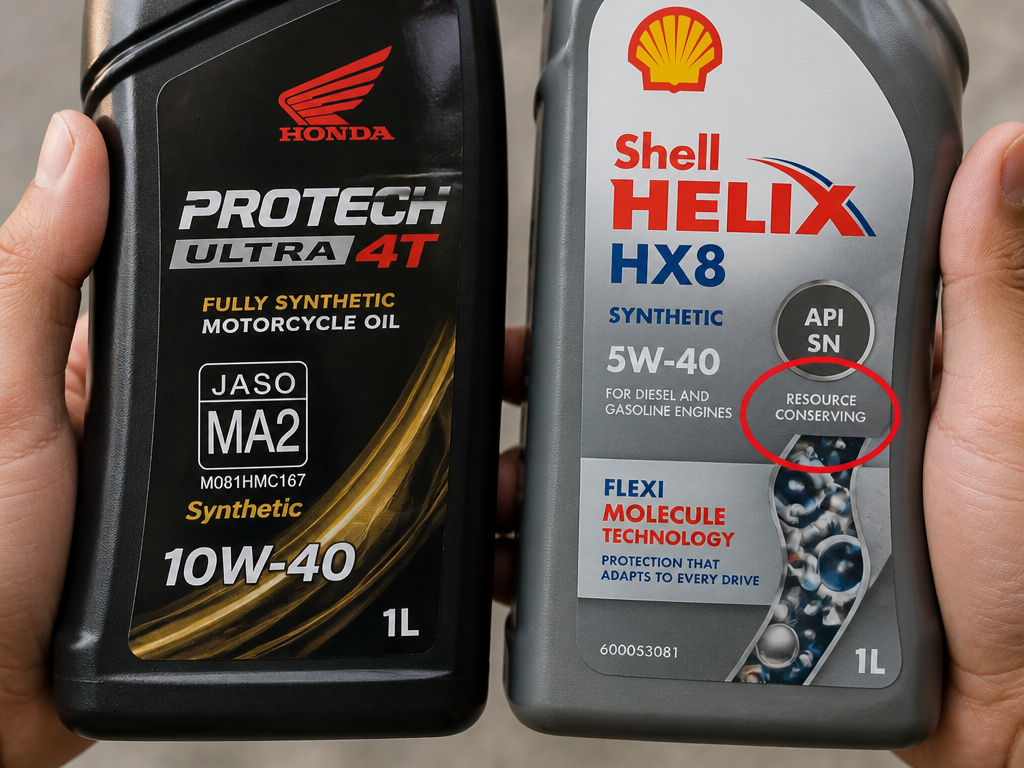
You don’t need a chemistry degree. When you’re holding a bottle, look for three things in this order.
- The JASO Logo: This is your primary target. Look for “JASO MA” or “JASO MA2” clearly on the front or back label. If it’s not there, put it back.
- The Viscosity Grade: Match this to your manual. 10W-40 is a common grade, and TERZO Lubricants recommends it as ideal when daily temperatures are 25°C–40°C, for liquid-cooled engines that rev above 9,000 rpm. 20W-50 is for hotter climates. The “W” stands for winter, indicating cold-flow performance.
- The API “Donut”: Look for the API service category, such as API SL, SN, or SP. Many motorcycle oils will still list API SL alongside JASO MA2 because that is an older category often cited as required by motorcycle manufacturers. An API SN or SP rating is fine if and only if the JASO MA/MA2 certification is also present.
What to actively avoid on a car oil bottle: The words “Energy Conserving” or “Resource Conserving” in the lower half of the API donut. Also avoid any viscosity grade trending toward modern car specs like 0W-20 or 5W-30 with an ILSAC GF-6 stamp. These are packed with the friction modifiers that spell trouble.
Can You Use Car Oil in a Motorcycle? The Tiered Reality
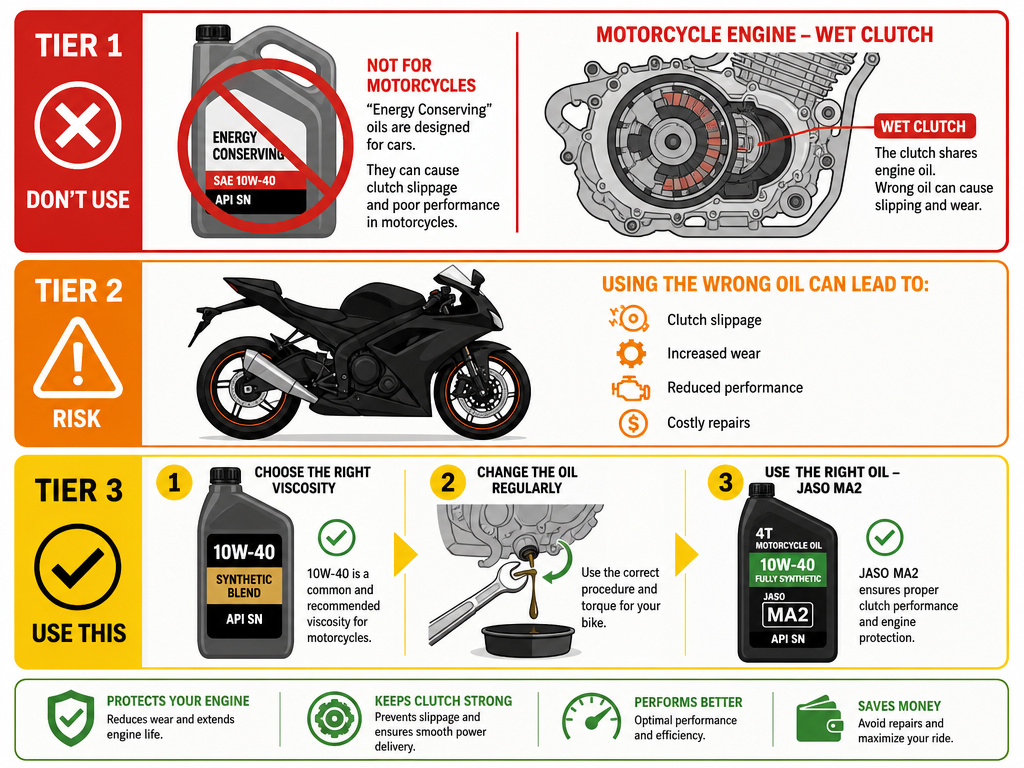
The internet is full of anecdotes saying “I’ve done it for years.” Here’s the risk-tiered breakdown, grounded in the engineering conflict.
- Never Use: Any car oil labeled Energy/Resource Conserving (API SN/SP, ILSAC GF-6) in any motorcycle with a wet clutch and shared sump. The risk of clutch slippage is high, and the oil lacks the shear stability for the transmission.
- High Risk, Not Recommended: Using any car oil in a high-performance, high-clutch-demand bike (sportbikes, heavily loaded tourers). The stress will expose the oil’s weaknesses quickly.
- Emergency Use Only (Get-Home Fix): If you’re stranded and only a car oil is available, this is the least-bad choice hierarchy:
- A car oil that matches your bike’s exact viscosity grade (e.g., 10W-40).
- Change it out for the correct JASO MA/MA2 oil immediately after getting home. Change it out for the correct JASO MA/MA2 oil immediately after getting home.
- Expect slightly rougher shifting and monitor clutch feel closely.
Can you use motorcycle oil in a car? Technically, yes, a JASO MA oil won’t hurt a car engine. But it’s expensive and sub-optimal. Car engines are designed for lower-friction, fuel-economy oils. You’d be paying a premium for no benefit and possibly slightly reduced fuel economy.
Choosing the Right Motorcycle Oil: A Straightforward Guide
Forget the boutique racing oils. For 95% of riders, the choice is simple.
- Read Your Manual First. It dictates the required viscosity and often an API service category (e.g., API SL). Consider this the minimum.
- Buy a Oil That Says JASO MA or MA2. This satisfies the wet-clutch requirement the API spec ignores. For modern bikes, JASO MA2 is the safe, high-performance default.
- Pick a Reputable Brand and the Correct Viscosity. You don’t need to overthink this. A Valvoline 4-Stroke Motorcycle Oil 10W-40 (conventional or synthetic) that meets JASO MA2 and API SL will protect a vast range of bikes from Hondas to Harleys.
- Change It On Time. This matters more than chasing the “best” oil. Follow your manual’s recommended service schedule.
For a task as critical as lubrication, that’s not a place to cut corners.
Frequently Asked Questions
Is motorcycle 10W40 the same as car 10W40?
No. While the viscosity rating (10W-40) is the same, meaning they flow similarly at hot and cold temperatures, the additive packages are completely different. The motorcycle oil will have JASO MA/MA2 certification and be formulated for higher shear stability and wet-clutch compatibility. The car oil will be formulated for fuel economy and catalytic converter protection, often with friction modifiers.
What happens if I put car oil in my motorcycle?
In a motorcycle with a wet clutch and shared sump, you risk two main problems: clutch slippage and insufficient gear protection. The friction modifiers in car oil can prevent the clutch plates from gripping fully, leading to slip, heat, and burnout. The oil may also shear down too quickly from the gearbox, reducing its ability to protect engine bearings and camshafts. Symptoms can include clutch slippage and insufficient gear protection, potentially leading to mechanical failure.
Can I use synthetic car oil in my motorcycle?
It’s not recommended. The primary issue is the additive package, not the base oil (synthetic vs. Conventional). A full-synthetic car oil still contains the friction modifiers and lower anti-wear additives that make it unsuitable for a motorcycle’s wet clutch and shared-sump system. Always look for a synthetic oil that also carries the JASO MA/MA2 specification.
My old manual only says “API SG.” What oil should I use?
Use a modern JASO MA-rated oil in the correct viscosity (likely 10W-40 or 20W-50). The JASO MA standard ensures clutch safety, and quality JASO MA oils typically maintain a more robust anti-wear additive level (like zinc) that is appropriate for older engine designs, even if the bottle also shows a newer API SN or SP rating. This is safer than hunting for an obsolete API SG car oil.
How often should I change my motorcycle oil?
Consult your owner’s manual for specific recommendations on how often you should change your motorcycle oil. However, consider the “severe service” schedule, more frequent changes (e.g., every 2,000-3,000 miles), if you frequently ride in stop-and-go traffic, in very dusty conditions, make lots of short trips where the oil doesn’t fully heat up, or ride the bike hard. Fresh, clean oil is the cheapest insurance you can buy.
Before You Go
Specification matching matters, not brand loyalty or synthetic versus conventional oil. Your bike’s wet clutch and gearbox need an oil with a certified friction profile and shear strength that car oils are not designed to provide.
If your manual lists an old API grade like SJ or SL, that’s the engine protection baseline. The JASO MA/MA2 stamp is the clutch and transmission guarantee. Prioritize the JASO rating every time. Spending an extra few dollars on the right quart is cheaper than a clutch replacement or a top-end rebuild. Buy the spec, change it on schedule, and ride with the confidence that your lubrication isn’t the weakest link.
