
Does Motorcycle Helmet Weight Matter? The Fatigue Factor
This post contains affiliate links. As an Amazon Associate, we earn from qualifying purchases.
Motorcycle helmet weight matters for rider fatigue and comfort, but it is not a safety performance metric under U.S. Law. The federal FMVSS No. 218 standard sets requirements for energy absorption, penetration resistance, and strap strength but specifies no weight limit. A lighter helmet reduces neck strain on long rides and can improve focus, but never at the expense of proper fit and a certified shell.
The standard’s silence on weight is a design choice, not an oversight. This allows manufacturers to use different materials, such as carbon fiber, fiberglass, or polycarbonate, to achieve the same crash-performance standard. Your job is to pick the lightest helmet that still fits perfectly and carries a real DOT or ECE certification label. A key question is: does motorcycle helmet weight matter?
What follows is a breakdown of where weight actually changes your ride: the physics of neck load, the material trade-offs, and how to test a helmet’s balance in the store. We’ll also cover the one time a helmet’s weight can signal a safety problem, and it’s not what you think.
Key Takeaways
- The FMVSS No. 218 safety standard includes zero weight requirements, focusing solely on impact performance and strap integrity.
- Neck fatigue is cumulative; extra helmet weight increases the load on your neck muscles, especially during long rides.
- Always choose certification over claimed lightness; a genuine DOT or ECE label is essential, while a ‘lightweight’ novelty helmet is dangerously ineffective.
- Carbon fiber shells offer the best strength-to-weight ratio but at a significant cost premium over polycarbonate or fiberglass.
- Perfect fit is heavier than any spec; a lighter helmet that wobbles on your head is more dangerous and fatiguing than a slightly heavier, snug one.
The 35% vs 51% Head Injury Gap
Head injury data makes the stakes brutally clear. According to NHTSA’s Fatality Analysis Reporting System (FARS) data from 2000 to 2002, an average of 35 percent of helmeted riders who died suffered a head injury. For non-helmeted riders, that figure jumped to 51 percent.
FMVSS No. 218 specifies performance requirements for energy attenuation, penetration resistance, and retention system (chin strap) structural integrity. It does not set a weight limit or requirement.
That 16-percentage-point gap is what a certified helmet buys you. The standard doesn’t care how the manufacturer achieves those performance goals, whether the shell is heavy polycarbonate or featherlight carbon fiber. The testing lab measures how well the helmet manages crash energy, not what the scale says.
This is why you must ignore any helmet that doesn’t have a legitimate certification label sewn into its liner. The Federal Register notes that “novelty helmets not certified to FMVSS No. 218 have been shown in testing to fail all or almost all of the safety performance requirements.” Some even carry counterfeit DOT stickers. A fake lightweight helmet is the worst of all worlds: it fails at its only job.
The bottom line: Certification is the floor. Weight discussions start only after you’ve verified the helmet meets DOT or ECE standards. That certification is your guarantee it passed the crash tests that actually save lives.
Where Lighter Helmets Win: The Physics of Fatigue
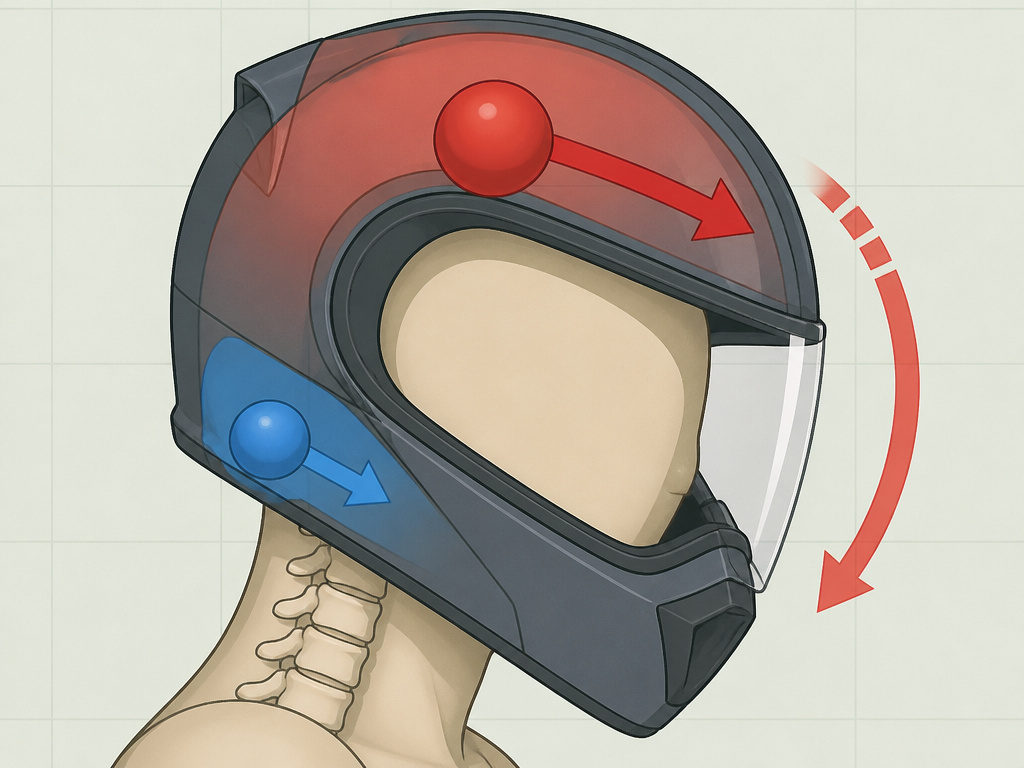
The does motorcycle helmet weight matter question is key because your neck isn’t a static post. It’s a complex stack of muscles and vertebrae fighting gravity and g-forces all day. Every extra ounce on your head is an ounce your neck must stabilize, especially when you turn your head to check a blind spot or fight buffeting wind.
Consider moment of inertia. This isn’t just weight; it’s weight distribution. A helmet with its mass concentrated high and forward (like some older, rounder designs) feels heavier when you turn your head than a helmet with weight kept low and close to your head’s center. You feel this as sluggishness or drag when you need to make a quick lifesaver glance.
| Riding Scenario | How Weight & Balance Affect You | The “Too Heavy” Tell |
|---|---|---|
| Long Highway Miles | Constant muscle engagement fights helmet mass. | A dull ache at the base of your skull within an hour. |
| City Riding | Frequent head-turning highlights poor balance. | Feeling like you’re “dragging” your head through turns. |
| High-Speed Wind | Poor aerodynamics amplify perceived weight (lift). | The helmet tries to lift, pulling up on your neck. |
| Off-Road / Adventure | Sudden jolts and impacts multiply neck strain. | Head feels like a bobblehead after rough terrain. |
The manual for the Schuberth C5 Carbon states its full carbon shell offers “unparalleled shock absorption strength and lighter weight.” That’s the ideal: a material that meets the strength requirement of the standard while shaving off every possible gram. But that carbon premium is real. For most riders, the jump from a polycarbonate to a carbon fiber helmet is a jump from the $200–$400 range to the $700–$1,000+ range.
What most people get wrong: They look at the scale weight on a spec sheet. The number on the box, say, 3.5 lbs (1588g), is almost meaningless without trying the helmet on. You need to feel how that mass is distributed on your head. A well-balanced 3.7 lb helmet can feel lighter than a poorly balanced 3.3 lb one.
The Carbon vs Polycarbonate vs Fiberglass Trade-Off
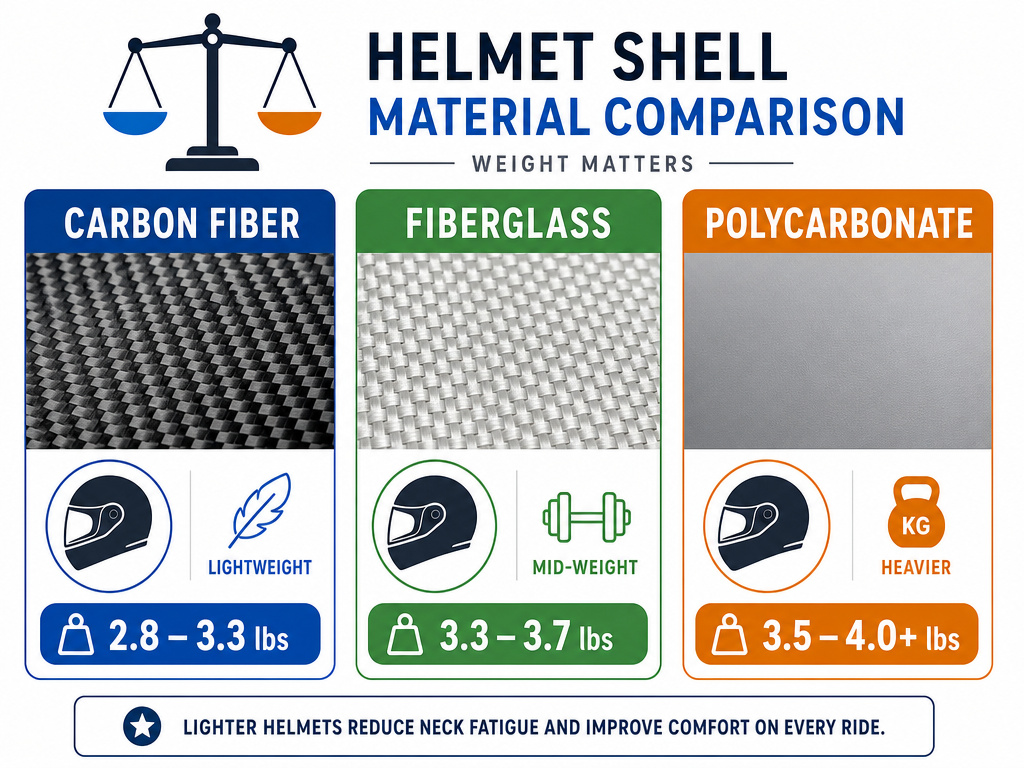
When you compare a does motorcycle helmet weight matter analysis, shell material is the single biggest determinant of a helmet’s weight, cost, and character. Each has a different recipe for meeting the FMVSS No. 218 energy-absorption mandate.
Carbon Fiber is the premium choice. Layers of carbon cloth are set in resin and cured under high pressure and heat in an autoclave. The result is an incredibly strong, stiff, and light shell. As the Schuberth C5 Carbon manual notes, this process yields “unparalleled shock absorption strength and lighter weight.” The trade-off is cost and potential brittleness in a very sharp, focused impact.
Fiberglass (or composite) is the traditional performance material. Layers of fiberglass cloth are laminated with resin. It’s heavier than carbon but often has more “give,” which some engineers argue is better for managing a wider range of impact energies. It’s the common choice in mid-to-high-priced helmets.
Polycarbonate is an injection-molded thermoplastic. Molten plastic is injected into a mold, making it the cheapest and fastest to produce. It’s also the heaviest of the three for a given level of strength. To meet the standard, polycarbonate shells often need to be thicker, adding weight. Don’t mistake this for weakness, a DOT-certified polycarbonate helmet passes the same tests as a carbon one. It just gets there a different way.
Where this goes sideways: Choosing a shell material based on marketing hype instead of your actual riding. A commuter in a polycarbonate helmet is better protected than a tourer who skipped a helmet upgrade to afford carbon.
Here’s a direct comparison of how these materials play out:
| Shell Material | Typical Weight Range (Full-Face) | Primary Advantage | Biggest Compromise |
|---|---|---|---|
| Carbon Fiber | 2.8 – 3.3 lbs (1270–1500g) | Best strength-to-weight ratio | High cost; can be noisy if not well-designed |
| Fiberglass/Composite | 3.3 – 3.7 lbs (1500–1680g) | Excellent balance of cost, weight, and performance | Heavier than carbon; complex shapes add cost |
| Polycarbonate | 3.5 – 4.0+ lbs (1590–1815g) | Most affordable; very durable shell | Heaviest option; can feel “dense” on long rides |
Your neck and your wallet have a conversation here. If you ride infrequently or on short trips, a well-fitted polycarbonate helmet is a rational, safe choice. If you log touring miles or have a sensitive neck, the investment in a carbon fiber or composite shell starts to make physical sense. The goal is to minimize fatigue, which is a legitimate safety factor, a tired rider is a less alert rider.
How to Test Weight and Fit Before You Buy
You can’t trust a spec sheet. You have to wear the helmet. Here’s a three-step store test that bypasses marketing and goes straight to what your body will feel.
1. The Five-Minute Wear Test. Put the helmet on, fasten the chin strap snugly (as mandated by every manual, like Schuberth’s), and just wear it. Don’t look in the mirror. Don’t walk around. Sit down and stare at a wall for five full minutes. What you’re feeling is the static weight and any immediate pressure points. A helmet that fits snugly all around your head will almost disappear. A bad one will announce itself with a hot spot on your forehead or a nagging sense of being pulled forward or backward.
2. The Head-Turn Balance Check. With the helmet still on and strapped, slowly turn your head left and right as if checking blind spots. Then look up and down. Does the helmet want to continue moving after your head stops? That’s poor balance. Does it feel like you’re moving a well-balanced mass, or dragging an anchor? This test reveals moment of inertia, the real-world effect of weight distribution.
3. The “Push” Test for Fit. This isn’t about weight, but a loose helmet ruins everything. Grip the helmet with your hands on either side and try to rotate it left and right on your head. Your skin should move with the helmet. If the helmet slides over your scalp, it’s too big. A helmet that doesn’t fit snugly, as the Schuberth C3 Pro manual warns, “could come off in an accident.” It will also wobble, magnifying every ounce of weight into a pound of distraction.
Common mistake: Prioritizing size for comfort over security. A helmet should be snug to the point of slight initial discomfort; the liner will break in. A size too large will never tighten up.
If you have a pre-existing neck condition or weaker strength, this test is critical. You might find that a modular helmet, despite its hinge adding a bit of weight, is the winner because you can put it on without straining to pull it over your head. The convenience benefit can outweigh the weight penalty. Our guide breaking down modular helmet pros and cons covers this exact trade-off.
When Weight Hints at a Safety Problem
Ordinarily, weight and safety are independent variables. But there is one scenario where an unusually light weight should set off alarm bells: the novelty helmet.
These are the brain buckets, the half-shells, the plastic replicas that look sort of like a helmet. They are dangerously light because they lack the crucial energy-absorbing EPS liner and a robust shell. The Federal Register documentation on the FMVSS No. 218 standard explicitly calls them out: they “have been shown in testing to fail all or almost all of the safety performance requirements.”
Their light weight is a symptom of missing safety components. It’s the wrong kind of light.
There’s also a more subtle, rare failure. In 2018, Dainese issued a recall for the AGV Carbon Modular helmet (model AGV 580). The official NHTSA helmet recall report details the cause: a cyanoacrylate glue used on screws could contact the polycarbonate chin base, causing a chemical reaction and premature deterioration. This wasn’t a weight issue, but it’s a critical reminder that a helmet is a complex system of materials. The wrong chemical interaction in manufacturing, something no weight spec will ever reveal, can compromise the structure. The remedy was to use an epoxy glue that wouldn’t cause the reaction.
The lesson? Trust certifications from known manufacturers, not anonymous online vendors. A legitimate company like Schuberth, AGV, or 130R submits its helmets for testing and stands behind them. They develop helmets to meet the standard first; you can explore recommended lightweight helmet options from various brands.
Accessories and the “Real World” Weight You Carry
The weight on the spec sheet is a lie. It doesn’t include the stuff you add.
Think about your typical setup: accessories like a Bluetooth communication system or an action camera add weight and can affect the helmet’s balance. A tinted or photochromic visor is often heavier than the clear one it came with. A thicker, winter liner adds mass. Suddenly, your 3.3 lb carbon helmet is a 4 lb touring rig.
This matters for balance. A chin-mounted camera dramatically changes the front-heaviness of a helmet. You must re-evaluate the feel. This is why the store test is so important, try to simulate your final setup. If you always use a comms unit, ask if the store has a demo model with one attached.
The same goes for neck strain management. Adding weight high on the helmet increases the force acting against your neck muscles. If you’re already prone to fatigue, strategies like a helmet with better aerodynamics (to reduce lift) or simple posture exercises become part of the solution, not an afterthought. Our resource covering ways to reduce helmet neck strain details these tactics.
Does helmet weight affect safety and crash protection?
The federal safety standard for motorcycle helmets, FMVSS No. 218, sets performance requirements for energy absorption, penetration resistance, and chin strap strength. It does not set a weight limit. A helmet’s safety in a crash is defined by its ability to meet these standards, not its mass. While no helmet can protect against all foreseeable impacts, using a certified helmet is critical. Data shows that from 2000 to 2002, an average of 35 percent of helmeted riders who died suffered a head injury, compared to 51 percent for non-helmeted riders. The primary safety focus should be on certification, proper fit, and secure fastening of the chin strap.
Can a heavy helmet affect my focus and reaction time?
A helmet’s weight can influence rider comfort and fatigue, which in turn may affect alertness over long rides. The federal safety standard does not address weight, focusing instead on structural performance. To maintain focus, ensure your helmet fits snugly all around your head without creating pressure points. A secure fit prevents the helmet from shifting and causing distractions. Proper care, like avoiding exposure to excessive heat and chemicals, helps preserve the helmet’s integrity and comfort. A well-fitted, certified helmet that feels balanced and comfortable is less likely to become a source of distraction, allowing you to stay focused on the road.
How does aerodynamics change the feel of a helmet’s weight?
At speed, a helmet’s aerodynamic profile can significantly alter how its weight is perceived. A well-designed shell can reduce wind buffeting and lift, making the helmet feel more stable and lighter on your head. This stability reduces neck strain and fatigue compared to a helmet that catches the wind. While safety standards do not regulate aerodynamics, a stable helmet allows for better control and less physical effort to keep your head steady. When choosing a helmet, consider how it feels at riding speeds, not just when stationary. A stable, aerodynamic design can make a heavier helmet feel more manageable and a lighter one feel even more effortless.
Frequently Asked Questions
What is the ideal weight for a motorcycle helmet?
There is no single ideal weight. Helmet weights vary by shell material and design, with carbon fiber typically being the lightest and polycarbonate often the heaviest for a given level of protection. “Ideal” is determined by your neck strength, riding style, and budget, the best helmet is the lightest one that fits you perfectly and is properly certified.
What is the 2 2 2 rule for bike helmets?
The “2 2 2 rule” is a fit checklist: 1) No more than 2 fingers should fit between your eyebrow and the helmet brow pad, 2) The cheek pads should be so tight that you can barely fit 2 fingers between your cheeks and the pads, and 3) When you grab the helmet, you should not be able to roll it off your head with the strap fastened. It emphasizes that a secure, snug fit is critical for safety.
Is it better to have a tight or loose helmet?
It is unequivocally better to have a tight helmet. A loose helmet can rotate or come off in a crash, offering zero protection. As manufacturer manuals state, it must fit “snugly all around your head.” Initial tightness, especially in the cheeks, will lessen as the liner breaks in over time. A helmet that feels “comfortably loose” in the store is already too big.
Does a heavier helmet mean it’s safer?
No. Safety is determined by compliance with standards like FMVSS No. 218 or ECE 22.06, not by weight. A heavier helmet could use a thicker, cheaper shell material to pass the tests, but it doesn’t mean it protects better than a lighter, well-engineered one. In fact, excessive weight can contribute to rider fatigue, which may impair reaction time.
How does helmet type affect weight?
Helmet type directly affects weight. A full-face helmet is typically the heaviest because it has the most material. A modular (flip-up) helmet is often 100-300 grams heavier than a comparable full-face due to the hinge mechanism. An open-face or half helmet is the lightest but offers drastically less protection. You can explore the specific advantages, including weight trade-offs, in our dedicated guide on full face helmet pros and cons.
The Bottom Line
Helmet weight is a comfort and performance variable, not a safety one. The federal FMVSS No. 218 final rule is silent on the scale for a reason.
Your decision tree is simple. First, find helmets that fit your head shape perfectly, this is more important than any material or weight spec. Second, verify the certification label is genuine and sewn in. Third, and only then, use weight as a tiebreaker between otherwise equal options.
For the commuter or weekend rider, a well-fitted polycarbonate helmet is a smart, safe buy. For the tourer or anyone sensitive to neck strain, investing in a carbon fiber or advanced composite shell is a legitimate upgrade. The money buys you reduced fatigue, which over a 500-mile day is a tangible safety feature.
Finally, remember that a helmet is a wear item with a lifespan. Sun, sweat, and temperature cycles degrade the resins and foams inside. When it’s time to replace, take the store test again. Your needs may have changed, and you can review the available shell material options.
