
How to Choose Earplugs for Motorcycle Riding: Step-by-Step
This post contains affiliate links. As an Amazon Associate, we earn from qualifying purchases.
You choose motorcycle earplugs by matching three things: the type of earplug, its Noise Reduction Rating (SNR/NRR), and your specific riding style. For most street riders, reusable filtered earplugs with an SNR between 20-26dB offer the best balance of hearing protection and situational awareness.
The numbers in that choice are not optional. Wind noise at highway speeds hits 106 decibels, a level that can cause permanent hearing damage in under four minutes. A quiet helmet only gets you so far, which is why knowing how to choose earplugs for motorcycle riding is critical.
What follows breaks down the science of wind noise, the real-world performance of foam, filtered, and custom earplugs, and how to read a spec sheet so you know what you’re actually buying when you tackle the how to choose earplugs for motorcycle riding question.
Key Takeaways
- At 70 mph, wind noise hits 106 decibels – a level the British Tinnitus Association says is safe for just three minutes and 45 seconds.
- Filtered, reusable earplugs (like EARPEACE Moto or MotoSafe Pro) are the default pick for most riders; they cut damaging high-frequency wind noise while letting you hear traffic and intercoms.
- The UK’s Health and Safety Executive warns against earplugs that reduce sound below 70dB because you risk losing awareness of horns and sirens.
- Foam earplugs degrade quickly; a user report notes noticeable loss of seal and effectiveness after about 10 uses (roughly a week of commuting).
- Your ear shape changes; even custom molded earplugs have a lifespan of about four to five years before they need to be remade.
How Loud Does It Get? The Numbers That Matter
A University of Southampton study working with police riders mapped it out. According to a University of Southampton (ISVR Consulting) study, wind noise exposure at 40 mph is around 85dB, while other sources suggest it can be around 90 dB at 40–50 mph. Push to 70 mph, and it hits 106dB. The University of Southampton (ISVR Consulting) study found wind noise reaches 115dB at 125mph. That changes fast.
The University of Southampton (ISVR Consulting) study found wind noise exposure for riders is around 85dB at 40mph, 106dB at 70mph, and reaches 115dB at 125mph. This data provides the concrete baseline for why earplug selection is a safety calculation, not a comfort preference.
At 94dB, safe exposure time drops to around 1 hour. At the 106dB typical of highway riding, the maximum safe exposure is just three minutes and 45 seconds. That’s not a typo. The damage is cumulative and permanent.
This is why the “I’ll just tough it out” approach fails. Your brain might get used to the roar, but the tiny hair cells in your inner ear do not. They flatten and die. They don’t grow back.
The Three Main Earplug Types
You have three paths: disposable foam, reusable filtered, and custom molded. Each has a different job, a different cost curve, and a different group of riders who swear by them.
Disposable Foam Earplugs: The High-Protection Workhorse
These are the orange or yellow cylinders you see on job sites. Brands like the 3M E-A-R Soft FX (SNR 39dB) or Moldex Pura-Fit 6800 (NRR 32) offer high single-number noise reduction. They work by physically blocking your ear canal, muffling all frequencies fairly evenly.
The protection is real, but the trade-off is situational awareness. Everything gets quieter, engine note, traffic, your own intercom. That’s why the UK’s Health and Safety Executive advises against protection that reduces levels below 70dB. A 39dB plug could theoretically bring 106dB wind noise down to 67dB, which might block crucial sounds.
There’s another catch. A user on webBikeWorld reported that after about 10 uses, a week of commuting, foam plugs lose their spring. The seal degrades, insertion gets harder, and effectiveness drops. Treating them as truly disposable is the only way to guarantee their rated protection.
Reusable Filtered Earplugs: The Balanced Default
This is where most riders should start. Plugs like EARPEACE Moto or MotoSafe Pro use acoustic filters. The silicone body seals your ear, but the filter inside is designed to attenuate harmful high-frequency wind noise more than mid-range sounds like speech, engines, and sirens.
| Feature | Foam (Disposable) | Filtered (Reusable) | Custom Molded |
|---|---|---|---|
| Best For | Maximum dB reduction | Situational awareness & intercom use | All-day comfort & perfect seal |
| Noise Reduction | Broad-spectrum muffling | Targeted frequency filtering | Balanced, flat attenuation |
| Typical Cost | Very low per pair | Moderate upfront | High upfront |
| Lifespan | Single use to ~10 uses | Several months to years | 4-5 years |
| Main Drawback | Poor sound clarity, degrades quickly | Requires cleaning, filters can clog | High cost, requires professional fitting |
Where this goes sideways: Choosing foam plugs for their high SNR without considering frequency. You get silence, but lose the ability to hear your intercom or a car horn in dense traffic. That’s a different kind of risk.
Filtered plugs come with different filter strengths. EARPEACE offers Clear (17dB SNR), Red (20dB SNR), and Black (26dB SNR) filters. For example, EARPEACE Moto earplugs should be wiped off with a damp cloth each time you wear them, and can be washed in warm soapy water if particularly dirty, but the attenuation filter must be removed before submerging and only reinserted after the earplug has dried completely.
Custom Molded Earplugs: The Long-Term Investment
Companies like Auritech and Ultimate Ear make earplugs cast from an impression of your ear canal. The fit is perfect, which means consistent protection and often superior comfort for all-day touring. Custom earplug makers like Auritech and Ultimate Ear have SNR ratings ranging from 22 to 31.
The cost is the barrier. Ultimate Ear plain models start around £65, filtered models at £85 plus a fitting fee. Auritech filtered models are around £119. Your ear shape isn’t static, though. Custom earplug lifespan is probably about four to five years due to changes in ear shape over time.
They are particularly good for riders with unusual ear shapes or those who use low-power intercom systems, as the precise seal and filtered acoustics make speech clearer.
The SNR Rating Is Just the Start
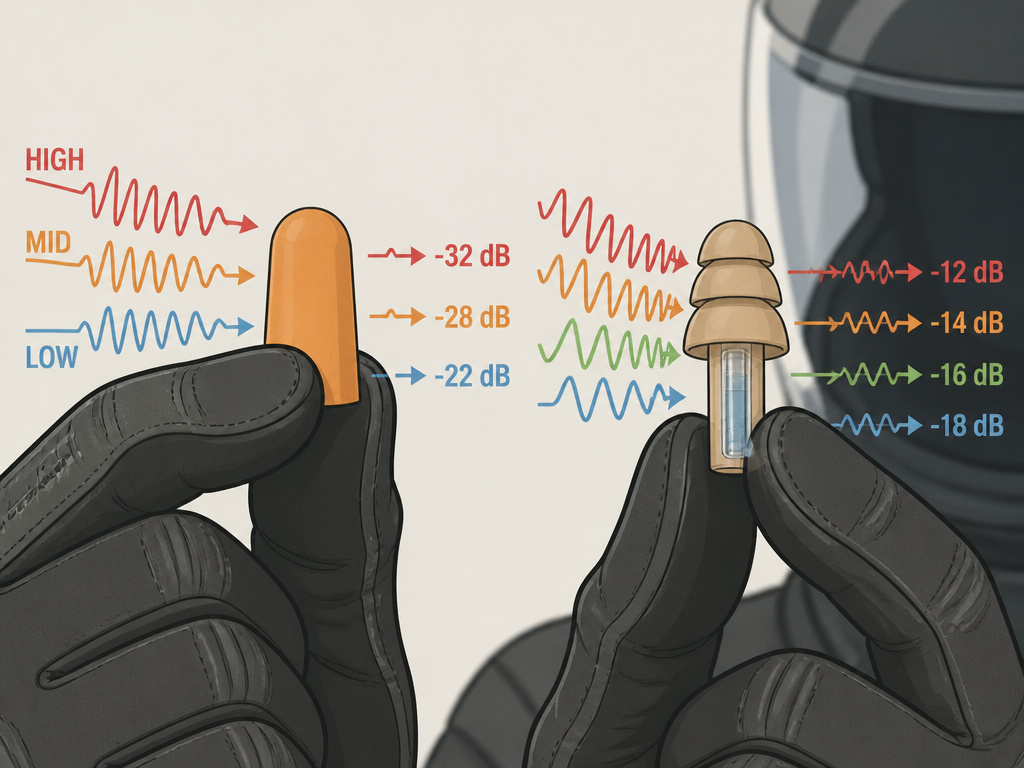
The Single Number Rating (SNR) or Noise Reduction Rating (NRR) tells you how many decibels the plug can reduce noise under perfect lab conditions. It’s a useful starting point, but it hides the most important part: which frequencies get cut.
This is the core of the debate between disposable and filtered plug advocates. On the topic of primary noise reduction target, sources disagree. For example, a webBikeWorld review prioritizes the highest overall Noise Reduction Rating (NRR/SNR) from disposable earplugs as the key safety metric, while other sources emphasize that filtered earplugs reduce higher frequencies more, preserving useful mid-range sounds for awareness.
The University of Southampton’s data gives us the math. If highway wind noise is 106dB, a 26dB filtered plug brings it down to 80dB. A 39dB foam plug brings it down to 67dB. That’s below the 70dB threshold where the HSE says awareness becomes difficult.
I’ve used high-SNR foam plugs. The silence is profound. But I also found myself turning my head constantly to check blind spots because I couldn’t hear the traffic around me. On a bike, that’s a problem.
The better metric for the how to choose earplugs for motorcycle riding process is the frequency attenuation chart, which shows how much noise is cut at different pitches. A motorcycle earplug with a clarity filter will show a steep drop in the high frequencies (where wind whistle lives) and a gentler slope in the mids (where speech and engine sounds sit). This is the “clarity” filter brands talk about.
How to Match Earplugs to Your Ride
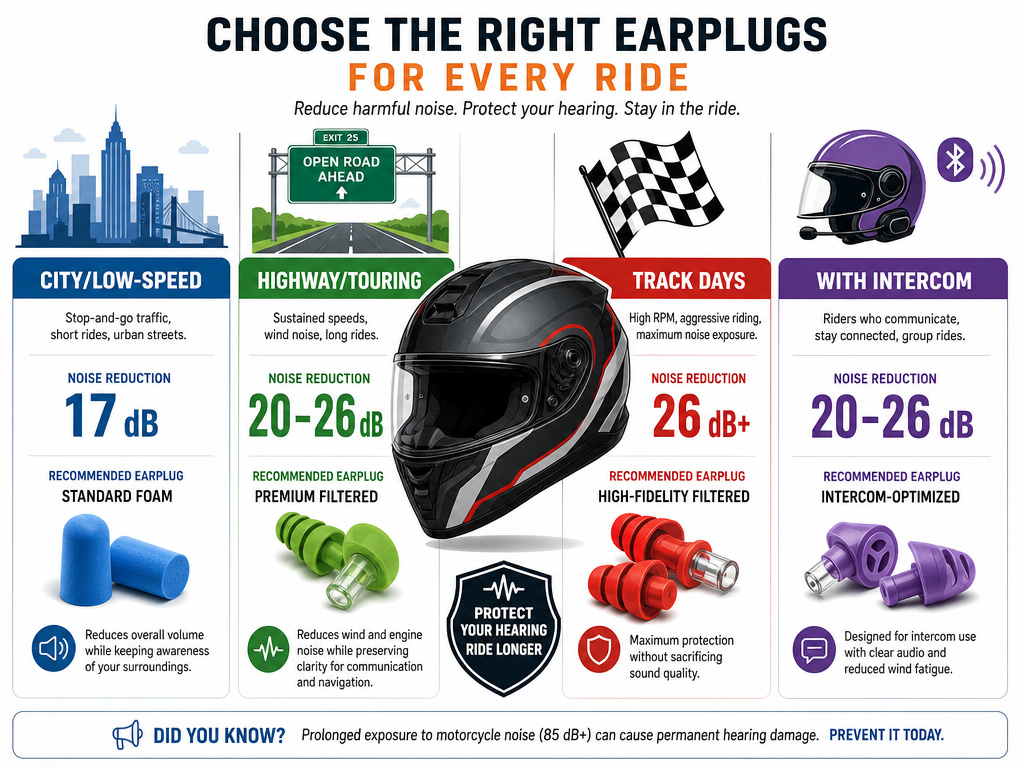
Your commute, your bike, and your helmet change the equation. A naked bike rider needs more protection than someone behind a giant touring fairing.
- City & Low-Speed Commuting (Under 50 mph): Noise is lower but constant. A lower-attenuation filtered plug (like a 17dB filter) is ideal. It takes the edge off without isolating you from city traffic sounds.
- Highway & Touring (50+ mph): This is the primary use case. Aim for a filtered plug with 20-26dB attenuation. This is the zone where you protect against the 106dB+ threat while preserving intercom and traffic awareness. This is where most reusable earplug options earn their keep.
- Track Days & High-Performance Riding: Wind noise and engine scream are extreme. Here, maximum attenuation is the priority. High-SNR foam plugs or the strongest filtered filters (26dB+) are appropriate. Situational awareness comes from your mirrors and track marshals, not ambient sound.
- Riding with an Intercom: Filtered or custom filtered plugs are almost mandatory. They cut the wind roar that would otherwise force you to crank the volume to dangerous levels, preserving audio clarity at a safe volume.
Before you spend a lot, consider a test pack. A company called Earplugs by Post (Lucy Dell Earplugs) sells a £10 Test Pack for a selection of 20 different pairs. The company offers earplugs with SNR values varying from 22dB to 39dB. It’s the cheapest way to find what actually fits your ears, which is the single most important factor no rating can predict.
The Practicalities: Fit, Care, and Law
A perfect SNR rating means nothing if the plug doesn’t seal. Roll foam plugs thin, pull your ear up and back to straighten the canal, and insert deeply. You should hear the outside world get muffled; your own voice will sound louder and fuller in your head.
Maintenance prevents infections and preserves performance. For reusable silicone plugs like EARPEACE, wipe with a damp cloth after each use. For a deep clean, remove the filter and wash the body in warm, soapy water. Reinsert the filter only after the plug is completely dry.
On the topic of reusing disposable foam earplugs, sources disagree. A user report advises against reusing them, citing noticeable degradation after about 10 uses (one week of commuting), while another user reports finding that disposable earplugs can be washed and reused.
Finally, know the law. It’s rare, but some places regulate earplugs. In Ohio, wearing foam earplugs while riding is prohibited. California allows them if you can still hear a siren or horn. Maryland only permits custom-made earplugs.
Are earplugs legal for motorcycle riders?
Laws on wearing earplugs while riding vary by location. In Ohio, wearing foam earplugs is prohibited. California allows earplugs as long as you can still hear sirens or horns from other vehicles. Maryland only permits the use of custom-made earplugs. Because regulations differ, you must check your local laws. The key legal principle is maintaining your ability to hear essential warning sounds, like emergency vehicle sirens and other traffic noises, for safety on the road.
Frequently Asked Questions
What type of earplugs are best for motorcycle riding?
For most riders, reusable filtered earplugs with an SNR between 20dB and 26dB are the best choice. They provide strong protection against damaging wind noise while preserving the mid-range frequencies needed to hear traffic, your engine, and helmet intercoms. They strike the right balance that foam vs reusable earplugs debates often miss.
Can earplugs be too quiet for motorcycle riding?
Yes. The UK Health and Safety Executive advises against ear protection that reduces sound levels below 70dB, as it can impair your ability to hear communication and warning signals like sirens or horns. A plug with a very high SNR (e.g., 39dB) could reduce highway noise to this unsafe level of quiet.
How often should I replace my motorcycle earplugs?
It depends on the type. Disposable foam plugs should be replaced daily or after a few uses, they degrade quickly. Reusable silicone plugs can last for months or even years with proper care (regular cleaning and filter checks). Even custom molded earplugs have a lifespan of about four to five years before changes in your ear canal affect the fit.
Are custom earplugs worth the money?
They are if you ride frequently, tour long distances, or struggle with the fit of universal plugs. The perfect seal offers consistent protection and often superior comfort. For the occasional weekend rider, a high-quality reusable pair from our list of best ear plugs is a more cost-effective starting point.
Do I still need earplugs if my helmet is quiet?
Yes. Even the quietest helmets, like premium Schuberth or Shoei models, cannot fully block wind noise at speed, especially the turbulent wake created by your bike’s windscreen. Earplugs are necessary to reduce helmet wind noise down to a safe, non-damaging level.
Before You Go
The goal isn’t silence. It’s safety. Your aim is to reduce the 106dB roar to between 80 and 85dB, a level safe for long rides that still allows you to ride effectively. That’s the threshold.
If you take one action after reading this, make it this: don’t ride on the highway again without something in your ears. Start with a basic pair of filtered reusable plugs. Pay attention to how they feel and what you can still hear. Your future self, the one who doesn’t have tinnitus and can still follow a conversation in a noisy bar, will thank you. Protecting your hearing is as fundamental as wearing a helmet. The only difference is you can’t see the damage until it’s too late.
