
What Is a Scrambler Motorcycle: Purpose, Features, and Fit
This post contains affiliate links. As an Amazon Associate, we earn from qualifying purchases.
A scrambler motorcycle is a retro-styled, versatile machine designed for both paved roads and light off-road trails. Its defining features include a high-mounted exhaust, wire-spoke wheels, and knobby tires, all rooted in 1950s British “scrambles” racing. Modern examples like the Royal Enfield Scram 411 and Ducati Scrambler blend this classic look with street-friendly ergonomics and enough suspension travel for gravel paths.
That 200mm of ground clearance on the Scram 411 isn’t just a spec-sheet number. It’s the difference between hopping a curb to a shortcut and hearing your exhaust can grind on a driveway apron. A common question for riders exploring this style is what is a scrambler motorcycle, a category built for such urban escapes. Factory manuals disagree on how far you can push that capability: Royal Enfield warns against heavy off-road use for the Scram 411, while Triumph explicitly includes moderate off-road use for the Scrambler 1200.
What follows is a breakdown of what makes a scrambler, where the lines blur with adventure bikes and cafe racers, and an answer to what is a scrambler motorcycle’s value proposition as a jack-of-all-trades.
Key Takeaways
- The scrambler’s high-mounted exhaust and knobby tires are functional legacies from 1950s off-road racing, not just cosmetic choices.
- Factory definitions of “off-road use” vary dramatically; the Royal Enfield Scram 411 manual warns against heavy use, while Triumph’s explicitly includes dirt roads.
- For new riders, a scrambler’s upright seating and moderate power are often a better first-bike fit than a sportbike or heavy cruiser.
- Maintenance intervals like the Scram 411’s 5,000 km oil change assume normal use; dusty or wet conditions require service to be done earlier.
- Compared to a dedicated dual-sport, a scrambler trades some off-road durability for better road manners and classic style.
What Defines a Scrambler Motorcycle?
Look past the Instagram filters and the distressed leather jackets. A real scrambler is a parts list that solves a specific problem: getting home after the pavement ends. The high exhaust pipe keeps it from getting crushed on rocks or in a drop. The knobby tires find grip in loose dirt. The wire-spoke wheels flex and absorb impacts that would crack a cast alloy rim.
The Royal Enfield Scram 411 has a 200 mm ground clearance, 190 mm of front suspension travel, and 180 mm of rear wheel travel. These specs, from the official owner’s manual, create the physical space needed for the bike to handle uneven terrain without scraping critical components.
That functional DNA comes directly from post-war Britain. Kids would take their road-going Triumphs and BSAs, bolt on whatever they could find to help them survive dirt-track “scrambles,” and race. They weren’t building dirt bikes from scratch; they were adapting what they had. The modern scrambler is the same idea: a standard motorcycle, slightly modified to handle more than just tarmac.
The look is now a global style, but the mechanical intent separates it from a flat tracker or a cafe racer. A flat tracker is built for left-turn-only dirt ovals, with minimal suspension and a slammed seat. A cafe racer is streamlined for speed on smooth roads. A scrambler sits in the middle, with ergonomics that let you see over traffic and suspension that doesn’t punish you for a pothole.
Scrambler vs. Adventure Bike vs. Dual-Sport: Where the Lines Blur
This is where most buyers get confused. All three types can handle dirt, but their engineering priorities are different.
A modern adventure bike is a touring rig first. It’s built for two people and their luggage to cross continents, with sophisticated electronics, massive wind protection, and often a 1000cc engine. It’s capable off-road in the right hands, but it’s heavy. Dropping a 600-pound BMW R 1250 GS in a creek bed is a very bad day.
A dual-sport is a dirt bike with lights. It’s tall, light, and powered by a single-cylinder engine built for abuse. It’s capable on the highway, but often prioritizes lightweight and off-road performance over long-distance comfort. It’s a tool, not a lifestyle statement.
The scrambler splits the difference. It’s heavier and more road-focused than a dual-sport but lighter and simpler than an adventure bike. Its limitation is often intention, not hardware. Take the Royal Enfield Scram 411 and the Triumph Scrambler 1200. Both have “scrambler” in the name, but their manuals give opposite guidance.
| Bike Model | Manufacturer’s Intended Use (Per Manual) | Key Limiting Factor |
|---|---|---|
| Royal Enfield Scram 411 | “Designed for on-road use, may be used occasionally on dirt trail.” Warns against heavy off-road use. | Street-focused chassis, lower-spec suspension components. |
| Triumph Scrambler 1200 | “Designed for on road and moderate off-road use,” explicitly including unpaved, dirt, or gravel roads. | Weight (over 500 lbs), expensive bodywork vulnerable to drops. |
The Triumph’s definition is more permissive, but its price tag and complexity make you think twice about actually dropping it. The Royal Enfield is more cautious in print, but its lower cost makes a tip-over less of a financial crisis. This contradiction is central to the what is a scrambler motorcycle tension: it’s marketed for adventure, but often built with a street rider’s budget and priorities.
Are Scrambler Motorcycles Good for Beginners?
Scramblers are a strong option for new riders. For a new rider, a scrambler checks a lot of boxes that sportbikes and cruisers miss. The seating position is natural and upright, giving you a clear view of traffic and making it easy to put a foot down. The power delivery is usually linear and manageable—The power delivery is usually linear and manageable, not extreme. The aesthetic is forgiving; a few scratches on a scrambler add “character,” while on a showroom-fresh sportbike they’re a tragedy.
I’ve watched new riders struggle with the top-heavy weight of a cruiser at low speed or the aggressive crouch of a sportbike in city traffic. The scrambler’s neutral geometry usually avoids both traps. The supermoto is the only other style that comes close for beginner-friendly fun, but its taller seat height and ultra-aggressive tires can intimidate someone just learning clutch control.
Common mistake: Choosing a bike based on its seat height in a showroom. A scrambler might feel manageable on flat concrete, but its weight distribution matters more when you’re stopping on a gravelly incline.
There are caveats. Some scramblers, especially the larger 800cc+ models, can be quite powerful and torque-heavy, which isn’t ideal for day one. Start by looking at the smaller displacements: the Honda CL500, the Royal Enfield Scram 411, or the Triumph Scrambler 400. Their lower power and lighter weight build confidence faster. The goal is to learn riding skills, not bike-taming skills.
The Scrambler Ownership Experience: Maintenance and Mods
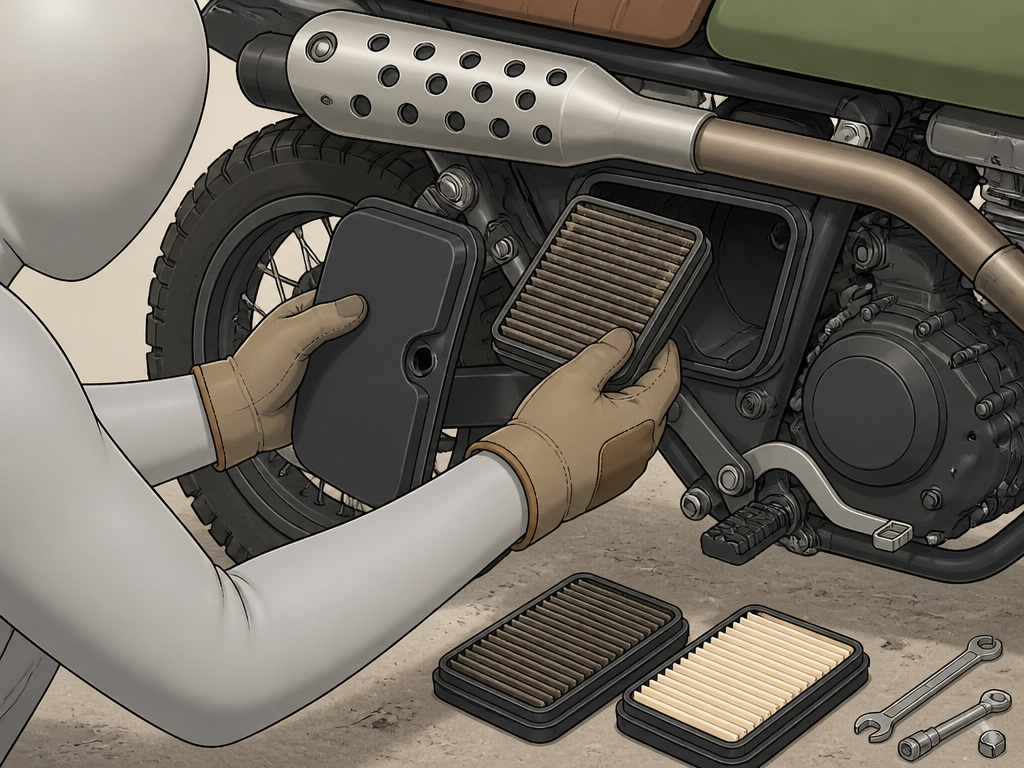
Expect a mix of standard motorcycle upkeep and a few off-road-aware checks. The basics are no different from any other bike: chain tension, tire pressure, brake pads. But the “occasional dirt trail” use case adds items to your list.
Dust is the enemy. If you ride on dry trails, your air filter needs attention long before the manual says. Royal Enfield’s manual for the Scram 411 states service “will need to be done earlier” if used in very dusty environments. That means inspecting the filter every few hundred dusty miles, not every few thousand. A clogged filter starves the engine and kills performance.
Follow the book for fluids, but understand what “normal use” means. The Scram 411’s schedule calls for the first engine oil and filter change at 500 km, then engine oil every 5,000 km and a new oil filter every 10,000 km. If your idea of a weekend is exploring backcountry fire roads, those intervals will need to be done earlier. Dirt and water contamination break down oil faster.
Here’s a snapshot of critical, model-specific maintenance from the OEM manuals:
| Component | Royal Enfield Scram 411 Interval | Notes & Consequences |
|---|---|---|
| Engine Oil | First 500 km, then every 5,000 km | Using the wrong grade or skipping changes accelerates engine wear. |
| Engine Oil Filter | First 500 km, then every 10,000 km | A clogged filter bypasses, sending unfiltered metal particles through the engine. |
| Spark Plug | Replace every 15,000 km | The Bosch UR5CC plug must be gapped to 0.7-0.8 mm. A worn plug causes hard starts and poor fuel economy. |
| Air Filter | Clean/Replace more frequently in dusty conditions | A dirty filter suffocates the engine, causing it to run rich and lose power. |
Modifications are a huge part of the culture. The first thing many owners add is a skid plate. It’s cheap insurance for the engine cases if you do venture over rocky ground. Next is often better suspension – the stock setup is usually tuned for comfort on pavement, not control on washboard gravel. Finally, people swap the tires. The stock knobbies are often a 50/50 road-dirt compromise. If you really want to go off-road, a more aggressive tread pattern is the single best upgrade.
Just remember what Triumph’s manual says: the only approved parts are those with official Triumph approval, and we recommend a dealer install them. That’s the manufacturer covering itself. In the real world, trusted aftermarket brands exist for a reason. Choose components that match your actual use, not just the look.
Frequently Asked Questions
What is the purpose of a scrambler bike?
Its purpose is versatility. A scrambler is designed to be a competent daily rider on city streets and highways while retaining the ability to confidently handle gravel roads, packed dirt trails, and the occasional unplanned detour. It’s not for motocross tracks or deep mud, but for the rider whose journey might include a bit of both worlds.
Why are they called scramblers?
The name comes from 1950s and 60s British motorcycle racing events called “scrambles.” These were off-road races on rough, natural terrain tracks. Riders would “scramble” over the obstacles. Young riders would modify their street-legal bikes to compete, creating the original scrambler style, which manufacturers later began producing as factory models.
What are the top scrambler motorcycles?
Popular modern models span a wide range of price and performance. Key examples include the Royal Enfield Scram 411 (affordable, single-cylinder), the Ducati Scrambler (middleweight, V-twin, style-focused), the Triumph Scrambler 1200 (premium, high-performance), and the Honda CL500 (reliable, beginner-friendly). The “best” depends entirely on your budget and how much off-road performance you genuinely need.
Is a scrambler a good first motorcycle?
Often, yes. Their upright riding position, manageable power outputs (particularly in the 400-500cc range), and forgiving nature make them excellent choices for learning. They are generally lighter and easier to handle at low speeds than cruisers and less intimidating than sportbikes. Always take a motorcycle safety course and choose a model that fits your physical size and comfort level.
The Bottom Line
A scrambler motorcycle is a practical choice disguised as a nostalgic one. It works because its defining features—the high pipe, the tires, the stance—originally solved real problems. Today, they offer a rider the legitimate freedom to turn down a questionable road without needing a dedicated dirt bike.
Before you buy one, be brutally honest about your “off-road” ambitions. If it’s graded gravel and the occasional field, almost any scrambler will do. If it’s rocky hill climbs, you’re looking at the wrong category. Check the owner’s manual for the specific model’s warnings—the Royal Enfield and Triumph disagreement proves there’s no single rule.
Fit beats price tag. Sit on a few. Feel the weight. Then go learn the basic motorcycle parts and maintenance tasks. That knowledge, more than any accessory, is what makes a scrambler truly capable.
