
Types of Motorcycle Luggage: How to Choose for Your Bike
This post contains affiliate links. As an Amazon Associate, we earn from qualifying purchases.
Motorcycle luggage falls into five main types: saddlebags/panniers (hard or soft), tail bags, top cases, tank bags, and backpacks. The best type for you depends on your motorcycle’s style, cruisers often use tail bags and pillion bags, adventure bikes use hard panniers, and sportbikes rely on tank and tail bags, and the specific weight and speed limits set by the bike and luggage manufacturers.
That last part, the manufacturer’s limits, is where most riders get tripped up. It’s not just about the bag’s capacity; it’s about your bike’s frame, the mounting points, and how that extra weight changes the way the motorcycle leans, stops, and handles wind. This is a key consideration when comparing types of motorcycle luggage.
What follows is a breakdown of every luggage category, the real-world specs you need from the manufacturer’s manuals when comparing types of motorcycle luggage, and the handling trade-offs nobody mentions until you’re loaded down on a mountain pass.
Key Takeaways
- Saddlebags and panniers are for volume, but check your bike’s specific load limit, the Suzuki V-Strom 650’s plastic cases max out at 5kg (11 lbs) each, while the Yamaha Super Ténéré 1200 allows 10kg (22 lbs) per side.
- A top case is the most disruptive to handling. It acts like a sail and raises the bike’s center of gravity. The Suzuki 35L plastic top case has a maximum load of just 3 kg (6.6 lbs).
- Hard luggage protects your gear and often locks, but it’s heavier, more expensive, and can trap a leg in a tip-over. Soft luggage is lighter, cheaper, and collapsible, but offers no impact protection.
- Your bike’s Gross Vehicle Weight Rating (GVWR) is the final law. The combined weight of you, a passenger, all gear, and the luggage itself must stay under this number, found on the frame’s information plate.
- Manufacturers set maximum speeds for loaded luggage. Exceeding them, like riding a loaded Yamaha Super Ténéré above 120 km/h (74 mph), can cause unstable handling, especially in crosswinds or during emergency maneuvers.
The Luggage Landscape: From Saddlebags to Tool Rolls
You need a place to put your stuff. The motorcycle industry has answered with a dozen solutions, each with a specific job within the main types of motorcycle luggage. Forget the marketing fluff, here’s what each type actually does, and where it typically lives on a bike.
Saddlebags & Panniers: Your Main Storage
These are the boxes or bags hung on either side of the rear wheel. “Saddlebag” often refers to the soft, traditional style, while “pannier” is the term for rigid, lockable cases. They’re the workhorses for touring and commuting, offering the most organized space.
They come in two flavors, and the choice here is your first big decision.
Common mistake: Buying hard panniers for a bike you also want to lane-split with daily. The extra width is permanent and turns a 30-inch handlebar into a 40-inch liability in traffic.
Hard vs. Soft Luggage: The Core Trade-Off
This decision involves protection, convenience, and how you ride.
| Aspect | Hard Luggage (Panniers/Top Cases) | Soft Luggage (Saddlebags/Tail Bags) |
|---|---|---|
| Protection | Excellent. Waterproof, lockable, crush-proof. | Good against weather (if waterproof), poor against impacts. |
| Security | High. Integrated locks deter casual theft. | Low. A knife defeats any strap. |
| Weight & Cost | Heavy and expensive. Adds weight before you pack anything. | Light and relatively inexpensive. |
| Convenience | Can be bulky to store off the bike. | Collapses when empty; easy to store. |
| Best For | Long tours, commuting with valuables, adventure riding on rough roads. | Weekend trips, riders who lane-split, budget-conscious buyers. |
Hard cases from brands like Givi or OEM options from Suzuki and Yamaha are built for abuse. The trade-off is real: hard cases add significant weight before you pack anything. That weight is high and wide, which you’ll feel when pushing the bike around a garage or leaning into a corner.
Soft luggage, like kits from Kriega or Giant Loop, is minimalist. It straps on and conforms to your load. The risk is that a simple drop can crush whatever’s inside, and a determined thief needs only seconds. For most weekend riders, the simplicity and lower cost of a soft bag system wins.
Tank Bags: Your Command Center
A tank bag sits on your fuel tank, putting essentials right in front of you. They attach via magnets, straps, or a ring system that bolts around the fuel cap.
Where this goes sideways: Using a magnetic tank bag on a bike with a plastic or carbon-fiber tank cover. There’s no magnetic pull, so the bag relies entirely on the secondary straps, which can slip. I’ve seen a bag slide into the front wheel after a hard stop, a rider’s nightmare.
The best use for a tank bag is items you need while moving: phone, wallet, sunglasses, a energy bar. Keep it small. A giant tank bag blocks your view of the instrument cluster and makes it harder to move around on the bike. For a deep dive on the two main mounting types, our comparison of magnetic vs strap tank bags breaks down the pros and cons of each.
Tail Bags & Seat Bags: Simple Added Capacity
A tail bag straps directly to the passenger seat (pillion) or a rear luggage rack. It’s the easiest way to add storage without permanent mounts. Styles range from small, sporty pods to large, expandable duffels.
Their weakness is the same as their strength: straps. An improperly secured tail bag can shift, and loose strap ends can flap or even catch in the rear wheel. The Saddlemen manual is blunt: “Cut off or secure any excess mounting strap material so it will not interfere with the motorcycle’s controls, suspension, wheels or other components.”
Harley-Davidson sets a universal limit of 25 lbs (11.4 kg) for any bag mounted to the passenger pillion, while Saddlemen rates its specific bag models for 15 lbs (AP1500) and 20 lbs (AP2350).
Top Boxes: The Convenient Compromise
A top case, or trunk, mounts on a rear rack above the tail. It’s incredibly convenient for quick access and often integrates a backrest pad. It’s also the worst type of luggage for motorcycle handling.
The problem is physics. A top case places weight high and far back, raising the center of gravity and creating a pendulum effect. In crosswinds, it acts like a sail. Manufacturers know this, which is why their limits are so strict. Suzuki’s 35L plastic top case has a maximum load of 3 kg (6.6 lbs) and a top speed of 130 km/h. It’s basically for a helmet and gloves.
A loaded top case changes the bike’s steering geometry. At low speed, the front end can feel light and vague. In a high-speed swerve, the rear wants to swing out behind you. It’s a subtle effect, but it’s real.
For a full evaluation of the best options on the market, check out our guide to best top cases.
Backpacks: A Last Resort
A motorcycle-specific backpack is better than a standard one, it’s designed to sit lower on your back, often has chest and waist straps, and may include a hydration bladder. But it’s still weight on your body.
Fatigue is the main issue. After an hour, that weight strains your shoulders and back, restricting movement and increasing fatigue. In a crash, anything on your body becomes a potential injury risk. Use a backpack for light, critical items you need off the bike, not as your primary luggage solution.
The Critical Math: Weight and Speed Limits
This mandatory section of the manual is the part most riders skim. These numbers aren’t suggestions; they’re the result of engineering tests for stability and component stress. Ignoring them voids warranties and courts disaster.
Decoding the Manufacturer’s Spec Sheet
Every reputable luggage maker or motorcycle company provides limits. You must find them. Here is a snapshot of how much they vary:
| Motorcycle / Luggage | Maximum Load Per Bag/Case | Maximum Speed When Loaded | Source |
|---|---|---|---|
| Harley-Davidson (Pillion-mounted bag) | 25 lbs (11.4 kg) total | Not specified (follow GVWR) | H-D Service Doc 1915091253031641486 |
| Saddlemen AP1500 Pillion Bag | 15 lbs | Not specified | Saddlemen IS-11400270 |
| Suzuki V-Strom 650 Plastic Side Cases | 5 kg (11 lbs) each | Less than 130 km/h (80 mph) | Suzuki Global Accessories Catalog |
| Suzuki V-Strom 650 Plastic Top Case (35L) | 3 kg (6.6 lbs) | 130 km/h (80 mph) | Suzuki Global Accessories Catalog |
| Yamaha Super Ténéré 1200 Side Cases | 10 kg (22 lbs) each | 120 km/h (74 mph) | Yamaha 2BS-F84B9-V0_1 Manual |
| Yamaha Ténéré 700 Side Cases | 5 kg (11 lbs) each | 130 km/h (80 mph) | Yamaha 2BS-F84B9-V0_1 Manual |
Notice the dramatic differences. The Yamaha Super Ténéré can carry twice the load per side as the Suzuki V-Strom, but at a lower top speed. This results from the bike’s weight, frame strength, and suspension setup.
Gross Vehicle Weight Rating (GVWR): The Final Word
The luggage limit is only one piece of the puzzle. The ultimate cap is your motorcycle’s Gross Vehicle Weight Rating. This is the absolute maximum weight the fully loaded bike can safely be, including itself, all fluids, you, a passenger, and every piece of cargo.
You’ll find the GVWR (and the Gross Axle Weight Rating, or GAWR) on a metal plate or sticker on the bike’s frame, usually near the steering head or on the swingarm. The Harley-Davidson manual warns: “Exceeding these weight ratings can lead to component failure and adversely affect stability, handling and performance.”
Do the math: (Bike weight) + (Rider weight) + (Passenger weight) + (Luggage weight) + (Accessory weight) must be ≤ GVWR. This is why loading a small bike like a Suzuki V-Strom 650 for a two-up tour is a tight squeeze, you can hit the GVWR long before the panniers are full.
For a dedicated explanation of how these limits work together, our guide to luggage weight limits walks through the calculations.
Mounting and Security: Making It Stay Put
A bag is only as good as its attachment to the bike. A shifting load is dangerous.
Mounting Systems Demystified
- Straps & Buckles: The simplest method. Nylon straps with quick-release buckles secure the bag to fixed points like passenger pegs, subframes, or luggage racks. The risk: UV degradation and wear can weaken straps over time. Inspect them before every long ride.
- Bolt-On Racks & Frames: These are permanent metal frames that bolt to the bike’s subframe. Hard cases then lock onto these frames. This is the most secure method for hard luggage. The catch: Installation can be complex and may require drilling.
- Magnetic Mounts: Used for tank bags. Powerful magnets hold the bag to a metal tank. The rule: The tank must be steel. Test the hold by trying to slide the bag sideways with significant force before riding.
Easy to miss: When routing straps, avoid all moving parts (wheels, suspension) and hot parts (exhaust). Harley’s manual explicitly warns to verify straps “do not obstruct reflectors, turn signals or tail lamp” and to prevent “strap contact with the rear wheel.”
Security: Keeping Your Gear
Hard luggage with integrated locks is the best deterrent. For soft luggage, use a separate cable lock threaded through the bag’s straps and around the bike’s frame. It won’t stop a thief with tools, but it will stop a casual grab-and-run.
In high-theft areas, the best practice is to take the luggage with you. Most soft luggage is designed for quick detachment, and many hard cases have quick-release mechanisms.
Choosing for Your Bike Style
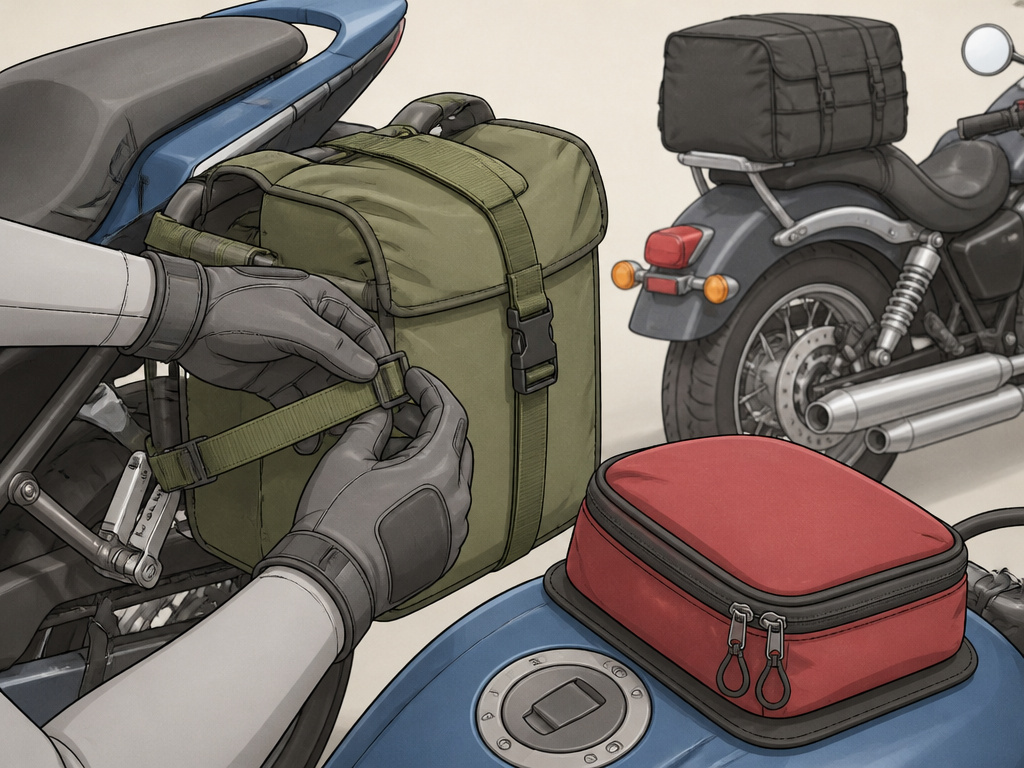
Your motorcycle’s design dictates what luggage works. A sportbike lacks the mounting points for large panniers, while a cruiser’s low rear fender rules out a giant tail bag.
Adventure & Touring Bikes
These are built for luggage. They have robust subframes and are designed to carry weight. Hard panniers and a top case are the standard, but many riders prefer soft luggage for its lighter weight and lower cost when dropped. The key is balancing the load side-to-side. Our review of best panniers covers options for both hard and soft styles.
Cruisers
Cruisers often use tail bags, swingarm bags, and specially designed “sissy bar” bags that strap to the passenger backrest. Hard luggage is less common but available. The low seat height means a top-heavy load is especially destabilizing. Stick to the manufacturer’s pillion weight limit (that universal 25 lbs for Harley).
Sportbikes & Naked Bikes
With minimal bodywork and a focus on lean angle, luggage options are limited. Tank bags and tail bags are the primary solutions. Some models accept under-seat bags or small, sport-specific soft panniers that tuck in close. A magnetic or strap-mounted tank bag is often the most practical choice here.
Packing Strategy: Low, Tight, and Balanced

How you pack is as important as what you buy.
- Pack Heavy Items Low: Place dense objects (tools, spare parts) at the bottom of saddlebags or in a low tail bag. This keeps the center of gravity down.
- Balance Side-to-Side: Weigh your bags. A significant weight imbalance between left and right panniers will cause a constant steering pull.
- Secure Everything Inside: Loose items in a bag will shift, changing the bike’s balance. Use packing cubes or clothes to fill voids and prevent movement.
- Do a Test Ride: Load the bike as you would for a trip. Ride at low speed in a parking lot, practicing slow turns and stops. Then ride on a safe road up to highway speed. Feel for wobbles, instability, or unusual handling. Adjust the load if anything feels off.
Crash Bar Bags
Crash bar bags mount directly to the protective frame around your engine, keeping weight low and centered. This placement can improve handling compared to top-heavy luggage. They are typically soft, durable pouches designed to hold smaller, frequently needed items or tools. Secure installation is critical; the bag must be fastened tightly to the frame so it cannot shift or contact any moving parts like the forks or wheel. Always inspect the mounting before a ride and ensure all straps are trimmed or secured to avoid interference with controls or suspension.
Handlebar / Windshield Bags
Handlebar or windshield bags provide quick access to essentials like a phone, wallet, or map right in front of the rider. They attach to the handlebars or the base of the windscreen via straps or buckles. A secure fit is paramount to prevent the bag from sliding into the controls or blocking your view of the instruments. When mounting, verify that no straps obstruct the turn signals, headlight, or your ability to steer freely. These bags are best for lighter items to avoid affecting steering responsiveness.
Roll Bags / Dry Bags
Roll bags, often called dry bags, are versatile, waterproof containers secured with a roll-top closure. They can be strapped to a luggage rack, passenger pillion, or even used as duffels. Their key advantage is keeping gear dry and compressing down as contents shrink. When strapping one down, ensure it is mounted securely so it will not shift. Verify all straps are clear of the rear wheel, suspension, and lights. For models with a pull handle, retract it fully before riding. Always stay within your motorcycle’s total load capacity.
Frequently Asked Questions
What is the 12 second rule on a motorcycle?
The “12-second rule” is a following-distance guideline for riders. You should scan the road ahead and identify potential hazards at least 12 seconds before you reach them. This gives you ample time to react to stopped traffic, debris, or animals. It has nothing to do with luggage, but it’s a critical safety practice for all riding, especially when a loaded bike has longer stopping distances.
Are hard or soft saddlebags better for a beginner?
For a beginner, soft saddlebags are usually the better first purchase. They are less expensive, so you can learn what you need without a big investment. They are also lighter and easier to install, and they won’t cause as much damage to the bike (or your leg) in a likely tip-over. Once you’ve toured a bit and know your needs, you can invest in a hard luggage system if it makes sense. Our comparison of hard vs soft saddlebags details the long-term considerations.
How much weight can my motorcycle luggage rack hold?
There is no universal answer. You must check your motorcycle’s owner’s manual or the rack manufacturer’s specifications. For example, a Harley-Davidson Tour-Pak luggage rack has a maximum capacity of 10 lbs (4.5 kg), and the combined load of the rack and the Tour-Pak itself must not exceed 25 lbs (11.3 kg). Always err on the side of the lower limit if you find conflicting information.
Can I use any tail bag on my motorcycle?
You can use any tail bag that securely straps to your bike, but compatibility is key. Ensure the straps are long enough to reach solid mounting points (not just around plastic bodywork). Check that the bag does not interfere with the brake light, turn signals, or your ability to get on and off the bike. For a curated list of designs that work across many bikes, see our guide to best tail bags.
The Bottom Line
Luggage turns your motorcycle into a practical tool. The right choice isn’t about the most capacity; it’s about matching the system to your bike’s design and respecting the hard numbers in the manual.
Start with a soft tail bag or tank bag. They’re affordable and teach you about load management. Before any major trip, look up your bike’s GVWR and your luggage’s specific weight and speed limits, these are the rules of physics. Pack heavy items low, balance your load, and always do a handling check before you hit the open road. The goal is to bring your gear, not let it bring you down.
