
Roll Off vs Tear Off Motocross Goggles: Which Is Better?
This post contains affiliate links. As an Amazon Associate, we earn from qualifying purchases.
The core difference between roll-off and tear-off motocross goggles is capacity versus clarity. Roll-offs use a continuous film system, with a standard roll providing a varying number of advances (sources cite 25 to at least 30), making them better for long, muddy rides. Tear-offs are thin sheets stacked on the lens, with sources reporting installable layers ranging from 5-7 single sheets to multiple stacks of seven, offering a full, unobstructed field of vision for short, dry races. For most riders, the choice comes down to your typical terrain: mud demands a roll-off; dry hardpack favors a tear-off.
That 25-advance figure for a roll-off roll is cited by industry sources like Risk Racing, and it’s a critical number for planning a muddy day. A stack of seven tear-offs, on the other hand, is a fixed limit that can be exhausted quickly if the roost is heavy. The real decision isn’t about preference, it’s about matching a finite resource to the mud you’ll actually face, which is the core of the roll off vs tear off motocross goggles debate.
What follows is a breakdown of the specs that matter: film width, optical clarity, installation hassle, and the one mechanical failure nobody mentions until a grain of sand jams the whole system.
Key Takeaways
- Roll-offs are often recommended for mud, tear-offs for dust. A roll-off’s capacity can outlast a tear-off stack in sustained wet conditions, per sources like Risk Racing, though some recommend sealed tear-off systems for mud.
- Field of vision is a key point of debate. The ADAC MX Masters notes roll-offs can limit peripheral vision to a single strip, while tear-offs give a full lens; however, other sources argue modern wide-film roll-offs and sealed tear-off systems have improved the field of vision.
- Film width dictates modern performance. New systems like the Acerbis Vortex 50mm Roll-Off compete with tear-off visibility, while older 36mm designs (Chequered Flag) feel restrictive.
- Sand poses a significant risk to roll-off mechanisms. Fine grit can jam the film advance, a documented failure mode from the ADAC, leading many to recommend tear-offs for sandy tracks, though proper maintenance can mitigate the risk.
- Hybrid goggles exist for a reason. Models like the Acerbis Vortex with integrated tear-off pins let you use both systems, a concept backed by US Patent 6725467.
How a Roll-Off System Actually Works (And Where It Jams)
You have two canisters, one on each side of the goggle lens, holding a roll of clear film. Pull a cord, and a fresh section of film winds across the viewing area, taking the dirty film with it. It’s simple in theory. The catch is in the pull.
A standard roll-off roll holds up to 25 advances, which should be enough for a moto, or a light day in the trails. If you are racing motocross and it is very muddy you will want to use these 25 pulls sparingly. . Risk Racing
That “up to 25” figure is your budget. Each pull requires you to take a hand off the bar, find a straight, and yank the cord twice. In a downpour, you’ll burn through that budget fast. The mechanism itself has two documented weak points. First, moisture can make the film stick to the lens, preventing advance, a warning straight from the ADAC MX Masters. Second, and more critically, sand.
Where this goes sideways: Riding a sandy track with roll-offs. Fine grains get into the canister gears and between the film and lens, locking the system solid. You’re left with a permanently dirty strip and no way to clear it.
The physical sensation when this happens is a gritty resistance on the pull cord, followed by a soft snap as the film tears instead of advancing. It’s a race-ending failure that’s entirely predictable if you know the terrain.
The Simplicity and Limits of a Tear-Off Stack
Tear-offs are brutally simple: thin plastic sheets hooked onto posts on the goggle lens. When one gets dirty, you grab the tab and rip it off. The entire field of vision stays clear because the film covers the whole lens, not just a strip. Most riders install a stack before a race.
The question is, how many can you stack? Sources disagree on the exact number, but they cluster around a practical limit.
| Source | Reported Tear-Off Layers | Context |
|---|---|---|
| ADAC MX Masters | 6 to 7 strips | Inserted before each race |
| MX-Gear.com | Up to 5-7 is possible | General installation guide |
| Alpinestars | 4 stacks of 7 (28 total) | Pack configuration for laminated tear-offs |
| Motocross Action Magazine | 3 stacks of 7 (21 total) | Using Tear-Off Gaskets (TOGS) |
The takeaway isn’t the exact number, it’s that you have a hard cap, usually between 7 and 28 pulls depending on your gear and patience. After that, you’re done. The other limit is optical. As you add layers, clarity drops.
Common mistake: Assuming more layers are always better. The Risk Racing blog states that as a tear-off stack gets thicker, vision quality goes down dramatically. Laminated stacks from brands like Alpinestars mitigate this, but physics always wins in the end.
Installing a stack takes focus. You must avoid fingerprints on the film and ensure each layer is seated flat. A single air bubble or wrinkle distorts your view for the entire moto. It’s a five-minute job that feels like ten when you’re trying to do it at the truck before practice.
The 50mm vs. 36mm Film Width Difference
This is the spec that changes the old argument. Early roll-off systems used narrow film, creating a letterbox effect that severely hampered peripheral vision. Modern designs have widened significantly.
- Acerbis Vortex Roll-Off Goggle: Features an oversized 50 mm Roll-Off system.
- Chequered Flag Hybrid XL Roll Off Goggle: Uses a 36mm film roll off system.
- Alpinestars SUPERTECH Roll-Off Goggles: Provides over 160mm of width between Roll-Off cartridges (the effective viewing width).
A 14mm difference in film width might not sound like much, but on the goggle it’s the difference between tunnel vision and an acceptable view. The Acerbis 50mm system is explicitly engineered for “elite riders facing the harshest mud and rain conditions,” and that width is a big part of why. The Risk Racing blog confirms this shift, noting that new 50mm wide film makes roll-offs much more competitive with tear-offs on field of vision.
The injection-molded Roll-Off lens ensures nearly zero visual distortion. All Roll-Off lenses have built-in silicone ‘Glide Lines’ to keep the film from binding or sticking to the lens. . Alpinestars SUPERTECH product specifications
The “Glide Lines” are a small but critical feature. They create a tiny air gap between the film and the lens, preventing the moisture-induced sticking the ADAC warned about. When you’re comparing goggles, film width and this anti-binding feature are the two specs that separate a functional tool from a frustrating one.
Field of Vision: The Real Trade-Off
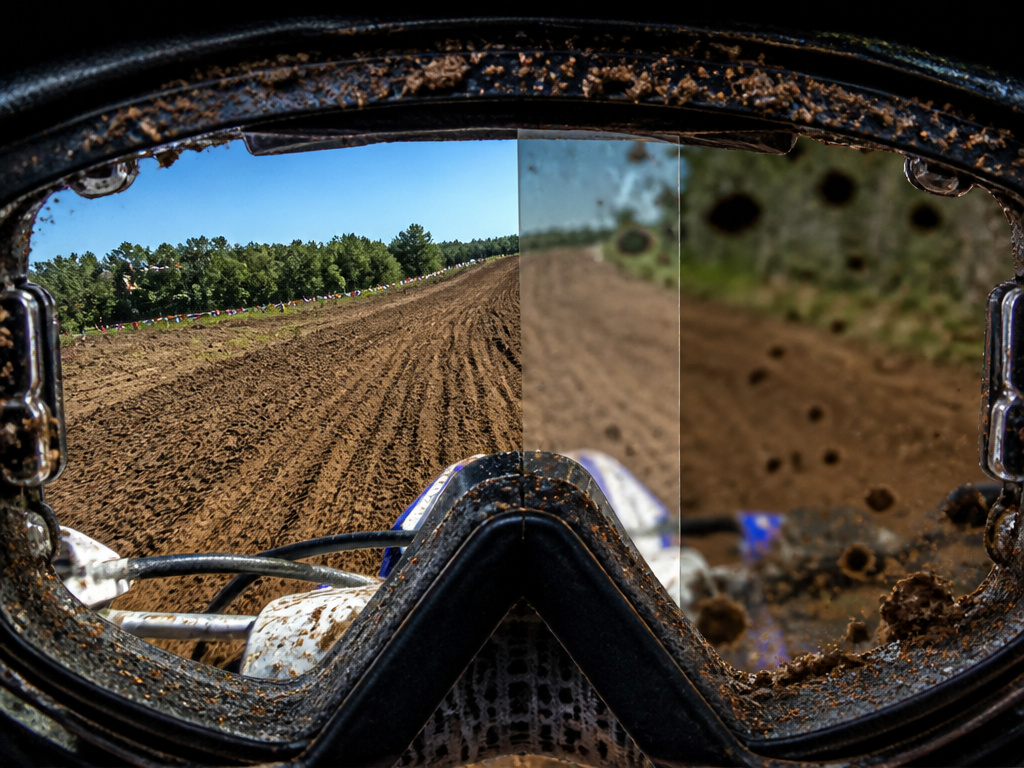
This is the heart of the roll off vs tear off motocross goggles debate. One system offers unlimited sightlines but limited clears. The other offers limited sightlines but more clears. Which matters more depends entirely on where you’re looking.
Tear-off advocates, including the technical experts at the ADAC MX Masters, are blunt: “Tear-off goggles are more popular with riders, because the entire field of vision is kept free, while the rider with roll-off goggles has only a single clean strip to look through and peripheral vision remains limited.”
Roll-off advocates counter that modern 50mm film minimizes this loss, and the capacity is worth the trade in sustained mud. Interestingly, a third option has emerged to try to bridge this gap: the perimeter seal.
Motocross Action Magazine tested Tear-Off Gaskets (TOGS), which are adhesive seals that go under tear-off stacks. Their finding was telling: “Normally, riders use roll-offs in the rain or mud, but the Tear-Off Gaskets are better because they have a wider field of vision, are easier to pull and ensure no water gets behind.”
So the hierarchy for vision in mud, according to this test, becomes: 1) Sealed Tear-Offs, 2) Wide-Film Roll-Offs, 3) Standard Roll-Offs. It’s a nuanced stance that most basic comparisons miss.
Mud, Rain, and Sand: Picking the Right Tool for the Terrain
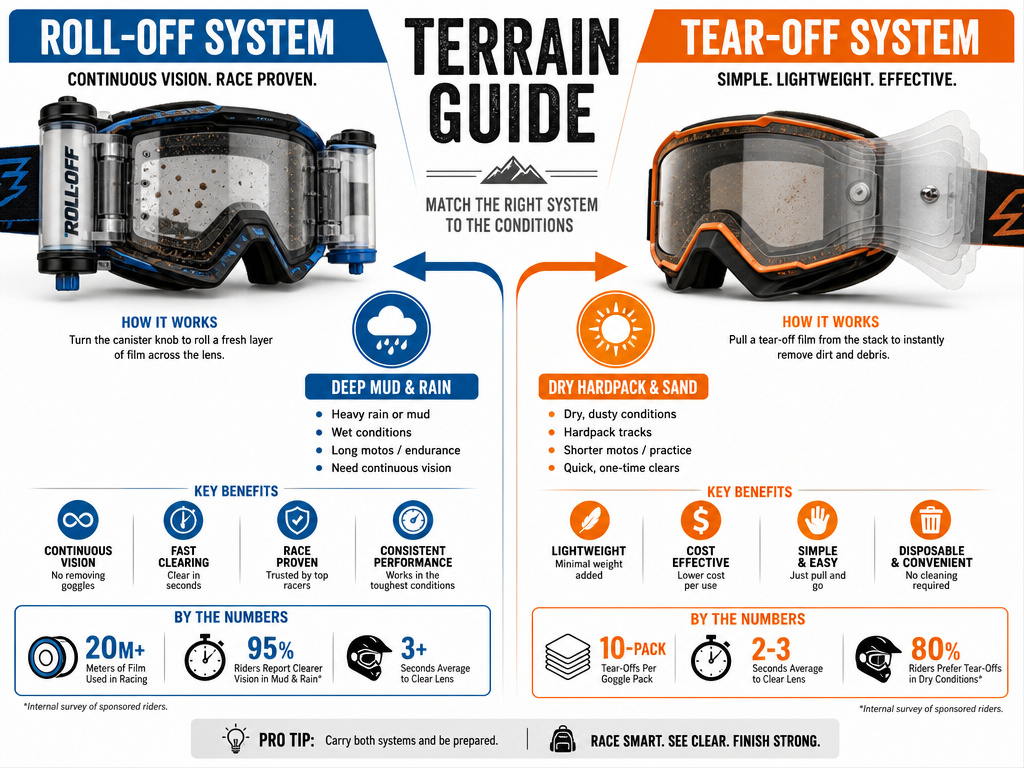
Match the system to the dirt when choosing between roll-off and tear-off motocross goggles. This isn’t about opinion; it’s about the documented performance and failure modes from the sources.
- Deep Mud & Rain: This is roll-off territory. The Acerbis Vortex is literally marketed for the “harshest mud and rain.” A single roll giving 25 advances is simply more capacity than any practical tear-off stack. The US Patent for hybrid systems argues the roll-off provides a “more unlimited supply of material” for the latter stages of an event after tear-offs are spent.
- Dry Hardpack & Supercross: This is where tear-offs excel. You need a full field of vision to hit precise lines and see competitors in your periphery. A stack of 7-10 layers is typically enough for a short, dry moto. The YJ-Optical blog summary is correct: tear-offs suit “dry tracks, short races, and riders who want a simple setup.”
- Sandy Whoops & Deserts: Use tear-offs. The ADAC warning is absolute: “Roll-off goggles are not much use on a sandy track because the fine grains of sand soon get everywhere and can even interfere with the roll-offs’ mechanism.” Sand acts like grinding paste in the delicate film advance mechanism.
- Enduro & Trail Riding: This is a toss-up. For long, wet rides, a roll-off’s capacity wins. But if you’re facing variable conditions and don’t want to risk a mechanical jam, a robust set of goggles designed for dirt biking and set up for tear-offs is the more reliable, lower-maintenance choice.
Worth knowing before you start: Your goggle frame decides your options. Goggles made for roll-offs have integrated canisters; goggles for tear-offs have posts. Trying to force the wrong system onto a frame is a recipe for failure.
Installation, Cost, and the Wireless Future
The convenience gap is narrowing, but it still exists. Installing a roll-off system is a one-time-per-event task that can be finicky, threading the film, setting tension. Installing tear-offs is a before-every-session task that requires clean hands and patience.
Cost is more complex than just the sticker price. You must factor in consumables. * Roll-Offs: You buy the goggle system (e.g., Alpinestars SUPERTECH) and then replacement film rolls. * Tear-Offs: You buy the tear-off system (standard or laminated) and then packs of sheets. Motocross Action Magazine provided specific pack prices for various tear-off types.
The most interesting innovation is the wireless roll-off. Wireless roll-off systems exist that put a button on the handlebar to motor-advance the film. Your hands never leave the bars. It addresses the core safety complaint about both systems: taking a hand off to clear your vision at race pace. This is the future for serious mud racers, turning a manual chore into an instinctive button press.
Can You Have Both? The Hybrid Goggle Reality
The patent document and current products say yes. The goal is to use tear-offs for the initial, heavy roost and then rely on the roll-off film for the long haul.
The Acerbis Vortex is a prime example, featuring a “hybrid system with integrated tear-off pins.” The Chequered Flag Hybrid XL kit includes both roll films and tear-off sheets. This approach is smart, but it requires a compatible goggle frame and adds complexity. It’s the choice for the rider who refuses to compromise and is willing to manage two systems.
For most, picking one dedicated system based on their primary terrain is simpler. But knowing hybrids exist is key, it means you don’t have to fully commit to one camp if your riding style is truly mixed.
Which is better for the environment: roll off or tear off goggles?
Tear-offs create immediate waste. A single pack can contain many individual sheets, and these used plastic films are often discarded on the track or trail. In areas with environmental rules, disposable tear-offs may be restricted. Roll-off systems generate far less physical litter per use. A single roll provides many pulls, and the used film is contained on the take-up spool instead of being thrown away. For riders conscious of their impact or riding in sensitive areas, a roll-off system is the cleaner choice, as it minimizes the plastic waste left behind during a ride.
Frequently Asked Questions
Are roll-off goggles worth it?
If you regularly ride in wet, muddy conditions, absolutely. The capacity of a 25-advance roll is worth the investment over constantly buying and installing tear-off stacks. For dry or sandy conditions, they are harder to justify.
How many tear-offs can you put on motocross goggles?
Most riders install between 6 and 7 single layers for a race, as noted by the ADAC MX Masters. Using laminated stacks (like Alpinestars Supertech Laminated Tear-Offs), you can install multiple stacks of seven, potentially reaching 21-28 layers, though optical clarity decreases with each added stack.
What is better for a muddy motocross race?
Roll-offs are the consensus choice for sustained mud. The Risk Racing blog states directly: “When it’s raining, or the mud is flying more than usual, Roll-offs might be your best bet.” Their higher capacity prevents you from running out of clear vision mid-moto.
Do all goggles work with both systems?
No. Goggles are designed for one or the other, or as a hybrid. Roll-off goggles have side canisters; tear-off goggles have posts on the lens or frame. Check the product specifications before you buy to ensure compatibility with your chosen tear-off system, which may depend on the goggle type.
Before You Go
Stop thinking about this as a brand loyalty test. It’s a terrain-matching exercise. If your local track is a hardpack blue groove, buy a pair of motocross goggles built for tear-offs and don’t look back. If your world is Pacific Northwest slop, get a 50mm roll-off system like the Acerbis Vortex.
The one rule that overrides everything: practice the installation at home. Whether it’s threading a roll-off film or stacking tear-offs without fingerprints, doing it calmly in your garage beats fumbling at the starting line. Your vision is the one thing you can’t fix with a throttle.
