
Motocross Goggles vs Enduro Goggles: Which Should You Buy?
This post contains affiliate links. As an Amazon Associate, we earn from qualifying purchases.
Motocross goggles are built for high-speed impact protection and a tight seal against roost, while enduro goggles prioritize anti-fog ventilation and a wider field of view for low-speed, technical terrain. The Leatt Velocity 6.5 Enduro lens is tested to Military Ballistic Impact Standard MIL-DTL-43511D, but its design focuses on fog management for hard enduro. For pure motocross, a single-pane lens with a robust tear-off system handles track debris better.
That ballistic standard on an enduro goggle is the first clue this isn’t about protection levels. Both types protect your eyes. The real split comes from what happens when you stop moving at race pace and start wrestling a bike up a muddy hill, which is the core of motocross goggles vs enduro goggles.
What follows: three specs that actually matter, the one feature professional testers say is overrated, and concrete picks for each riding style. You don’t have to guess.
Key Takeaways
- Enduro goggles use a dual-pane lens for anti-fog (Fox Vue Enduro, 100% ARmatic), while motocross models often use a single-pane lens optimized for tear-offs and impact.
- Ventilation versus sealing is the main trade-off. Enduro designs have more airflow to manage sweat; motocross designs seal tighter to block dirt roost from other riders.
- Professional testers question the utility of articulated outriggers for lens changes, finding simpler frames like the Scott Fury more practical despite manufacturer marketing.
- Clean and dry your goggles at the start of the day to maintain the anti-fog coating’s effectiveness, a simple step that makes a bigger difference than most fancy features.
- You can use one type for the other sport in a pinch, but you’ll trade performance: motocross goggles fog quickly in enduro, and enduro goggles let in too much roost on a busy track.
The Core Difference: Ventilation and Sealing
Head to any motocross starting gate and listen. You’ll hear the high-pitched whine of two-strokes and the deep thump of four-strokes. What you won’t hear is anyone complaining about fog. At speed, airflow solves that problem. The real enemy is the shower of dirt and rocks—”roost”—kicked up by the rider in front of you. A motocross goggle seals against your face and helmet with dense foam to keep that debris out.
Switch to a hard enduro trail. The pace drops to a crawl. You’re generating body heat, sweating, and the bike’s radiator is pumping out warmth. Airflow is minimal. Here, fog isn’t an annoyance; it’s a safety hazard that blinds you on a steep, rocky climb. An enduro goggle trades some of that sealing for controlled ventilation. The Fox Vue Enduro Goggles use closed-cell foam in their vent ports specifically to manage weather while still allowing air movement to fight fog.
A motocross goggle prioritizes a sealed barrier against external debris. An enduro goggle prioritizes a managed airflow channel to evacuate internal moisture and heat. The foam density, vent placement, and even the frame’s lower edge are designed for these opposing goals.
The Leatt Velocity 6.5 Enduro Goggles have a self-draining lower edge, a small but telling detail. It’s for shedding mud and water when you’re picking your bike up out of a creek, not for deflecting high-speed roost.
Why This Trade-Off Exists
The physics are straightforward. Fog forms when warm, moist air from your breath and skin hits a cooler lens surface. On a fast MX track, the lens is cooled by constant high-speed air, and your helmet’s ventilation is wide open. The air inside the goggle exchanges quickly enough to prevent a humidity build-up. In slow, technical enduro, there’s no cooling wind. Without dedicated vents to allow that humid air to escape, it condenses on the lens. You can’t just add more vents to an MX goggle, because each one is a potential entry point for the fine dust and silt that hangs in the air on a dry track.
| Priority | Motocross Goggle | Enduro Goggle |
|---|---|---|
| Primary Threat | Roost, debris from other riders | Fog from rider sweat/breath |
| Lens Design | Often single-pane for clarity with tear-offs | Typically dual-pane for anti-fog (Fox, Leatt, 100%) |
| Ventilation Strategy | Minimal, sealed ports | Active, managed airflow (e.g., closed-cell foam vents) |
| Foam & Seal | Denser, tighter seal against face | Softer, sometimes channeled to direct sweat |
| Best For | High-speed laps, sandy/dusty conditions | Low-speed technical terrain, wet/humid conditions |
Lens Systems and Visibility
Lens technology is where the spec sheets diverge completely. For motocross, the lens is a consumable shield. The focus is on impact resistance, optical clarity at speed, and compatibility with tear-off or roll-off systems to maintain visibility through a muddy moto. You’ll change the lens when it’s too scratched, not when it fogs.
Enduro lenses are built as a climate-control system. The dual-pane lens is essential. Brands like Fox, Leatt, and 100% explicitly market this feature for their enduro models. The Fox Main Enduro Goggles, Fox Airspace Enduro Goggles, and 100% ARmatic Enduro Moto Goggle all specify a dual-pane construction. Here’s how it works: two lenses are bonded with a small air gap between them. This gap insulates the inner lens from the temperature shock of outside cold air, drastically slowing fog formation. It’s the same principle as double-paned windows.
To maintain the best possible anti-fog-ability, ensure your goggles are clean and dry at the start of the riding day. Dirt and oils on the lens degrade the coating’s performance before the first hill climb.
Field of view is another battleground. The Leatt Velocity 6.5 Enduro boasts a 170° WideVision lens. The goal is peripheral vision for picking lines through trees and over obstacles when you’re barely moving. A motocross goggle’s viewport might be slightly smaller or differently curved, optimized for the forward-focused vision of attacking a track, where your main concern is the next jump face or berm, not a root hiding at your 10 o’clock.
Tear-offs and roll-offs are a motocross staple. The APEXX LGND Moto & Enduro Bundle includes a pack of 10 tear-offs because on a muddy track, you’ll go through them. In enduro, while options like the Leatt Velocity 6.5 are roll-off and tear-off ready, many riders forego them. The slower pace and frequent stops allow you to wipe the lens with a glove, and tear-offs can become a snag hazard in tight trees.
Frame Design, Fit, and the Outrigger Debate

Put on a motocross goggle and it should feel like a single, solid unit with your helmet. The strap is wide with aggressive silicone backing to lock it to your helmet’s crown. The frame is designed to tuck into the eye port of a dedicated motocross helmet, which has a specific cut-out for this purpose.
Enduro goggles sometimes face a compatibility puzzle. Riders may use a cross-over helmet or an adventure helmet with a different eye port shape. This is where articulated outriggers enter the story. Manufacturers like Scott, Fox, and 100% position these hinged side arms as a key feature for improved helmet integration and a secure fit. They allow the strap to sit cleanly over a wider range of helmet shapes.
But here’s where a source conflict gives you a real insight. While Scott markets outriggers as an integration feature, the Enduro21 professional testers found them “a bit annoying sometimes, particularly taking the lens out which is slower we find.” They concluded the model without them (the Scott Fury) “makes more economic sense.” The 100% ARmatic Enduro uses integrated outriggers in its one-piece frame, and the Fox Airspace Enduro uses an outrigger system for a secure fit. The takeaway? Outriggers might help with fit on some helmets, but they can complicate the simple task of changing a lens mid-ride. Your helmet choice matters here.
For lens changes, brands push their quick-release systems. The 100% ARmatic boasts a “quick-release lens-changing system,” and the APEXX LGND uses a magnetic lens system praised for easy swaps. The professional test of the Scott Prospect with outriggers, however, noted the process was slower than on simpler frames. Manufacturers like 100% and APEXX Series market their quick-release and magnetic systems as fast and easy, while Enduro21 professional testers found lens removal with outriggers on models like the Scott Prospect to be slower.
How to Modify Fit for Better Sealing or Ventilation
Sometimes the stock setup isn’t perfect. A goggle that’s too tight will cause pressure headaches on a long enduro; one that’s too loose will let in dust on a motocross track.
- For a better seal (MX): Ensure the foam is intact and pliable. Dried-out, compressed foam won’t seal. Some brands offer different thickness foam kits. The strap should be tight enough to pull the goggle firmly into the helmet’s eye port, not just against your face.
- For more ventilation (Enduro): Make sure no part of your helmet liner or your sweat-wicking layer is blocking the goggle’s upper vents. On very humid days, some riders will carefully trim a tiny bit of foam from the nose bridge area to increase airflow, but this is a permanent mod that compromises sealing.
Impact Protection and Safety Standards
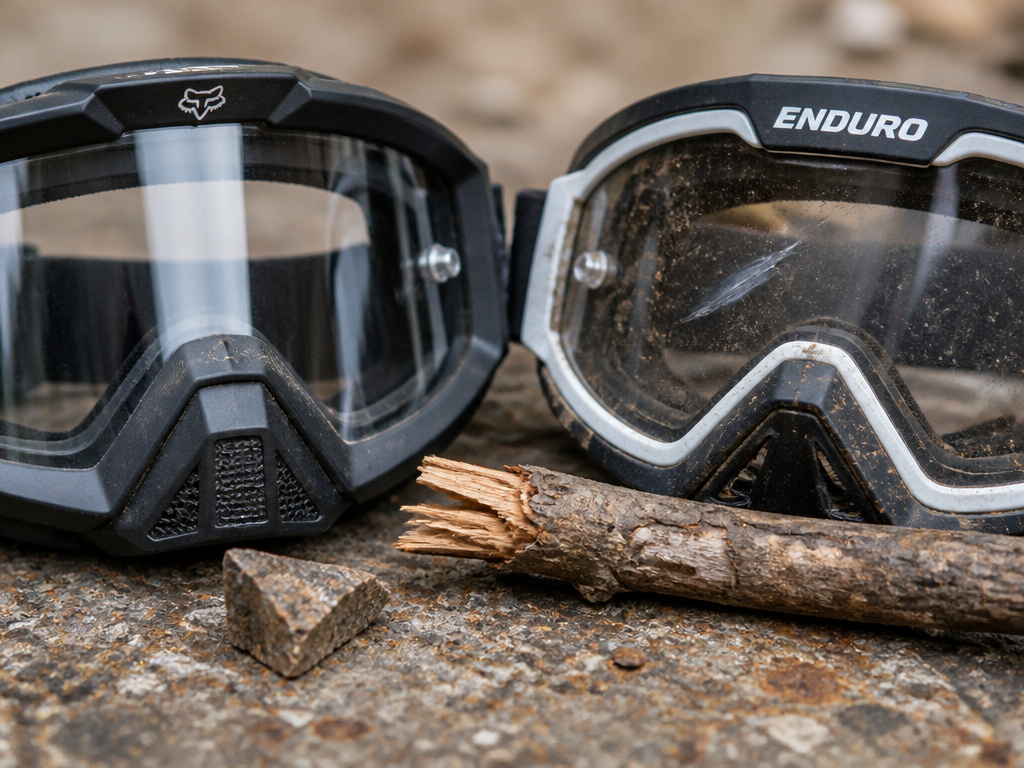
This is the one area where both types are—or should be—on equal footing. Your eyes don’t care what discipline you’re riding. The baseline standards are ANSI Z87.1 (U.S. Impact standard) and EN 1938:2010 (European personal protective equipment standard). Any reputable goggle will meet one or both.
The standout spec comes from the Leatt Velocity 6.5 Enduro. Its lens is tested to Military Ballistic Impact Standard MIL-DTL-43511D. That’s a serious claim. It tells you the lens material itself is incredibly tough, which is crucial for enduro where tree branches and rocks come at you at unpredictable angles and lower speeds. A motocross goggle lens is also built to take a direct hit from a rock, but the certification language is often the commercial ANSI/EN standard.
The frame’s job is to hold that lens in place and distribute impact force. Whether it has outriggers or not, a well-made frame from Fox, Leatt, or 100% will be designed to crumple or flex in a way that doesn’t drive the lens into your face. This is why fit is a safety feature. A goggle that shifts around during a crash offers less predictable protection.
Specific Model Recommendations
You need names, not just categories. Here are concrete picks that embody the differences we’ve laid out.
For Enduro / Technical Trail Riding:
- Leatt Velocity 6.5 Enduro: This is the benchmark for hard enduro. The 170° WideVision, permanent anti-fog double lens, self-draining lower edge, and that MIL-STD lens certification are all purpose-built for extreme conditions. It’s OTG compatible and includes a tear-off pack.
- Fox Vue Enduro Goggles: The trail-focused choice. The dual-paned, anti-fog lens and closed-cell foam in the vent ports are explicit design answers to cold, wet rides where fog is the enemy.
- Value Pick: Fox Main Enduro Goggles: Fox calls these the “best value on the market.” They feature the Variable Lens System (VLS™) and a dual-pane lens to prevent fogging, coming with a microfiber bag. They give you the core enduro tech at a lower price.
For Motocross / High-Speed Off-Road:
- Oakley Airbrake MX (from testing context): Professional testers highlighted its high-impact resistance and performance at speed. The lens protection from roost and branches was a noted advantage on MX tracks. Oakley recommends fitting a lens protector film to keep the lens surface nice.
- 100% ARmatic Enduro Moto Goggle: While branded “Enduro,” its 3DPlane Molded Lens technology and Ultra HD® clarity, paired with a quick-release system, make it a fantastic high-performance option for faster trail riding or motocross where optical quality is paramount.
- Kit Pick: APEXX LGND Moto & Enduro Bundle: This bundle makes sense for the rider who does both. You get the magnetic lens system goggles, a choice of an anti-fog Smoke or Revo Red lens, a bonus clear lens, tear-offs, and lens protectors. It’s a complete kit for varied conditions.
Can you use one for the other? Yes, with compromises. I’ve used a vented enduro goggle on a dry, dusty MX track day. The increased airflow meant more dust inside the goggle by the second moto. Conversely, a sealed motocross goggle in a humid enduro will fog the moment you stop moving. You can make it work, but it’s not ideal.
Maintenance and Care Differences
How you clean your goggles depends on what you’ve been doing. This is a practical gap most guides skip.
After a motocross day, you’re dealing with external grime: dried mud, dust, and maybe rubber from track debris. Spray the lens gently with water or a dedicated lens cleaner to loosen the dirt, then wipe with a microfiber cloth from the goggle bag (like the one included with the Fox Main Enduro). Don’t use your shirt or a paper towel—they scratch. The goal is to preserve the lens coating for optical clarity.
After an enduro, the enemy is inside: sweat, skin oils, and humidity. The anti-fog coating on the inner lens is delicate. Use a lens-specific cleaner and a soft cloth. The professional advice from the Oakley Airbrake test is golden: make sure the goggles are clean and dry at the start of the riding day. Storing them damp in a gear bag overnight allows grime to set onto the coating.
For muddy enduro races, if your goggle has a roll-off system, service it. Old film can jam. If you use tear-offs like those in the APEXX bundle, check that the posts are clean so the next tear-off pulls smoothly.
How do motocross and enduro goggles compare for weight and comfort on long rides?
Comfort over hours comes from a secure fit and breathable materials. Enduro goggles often feature designs like a one-piece frame with integrated outriggers or a silicone-gripped strap to improve helmet integration and prevent shifting during technical riding. The face foam is a critical component; some models like the Leatt Velocity 6.5 Enduro and Fox Main Enduro use a removable triple-layer foam for a plush seal that can be cleaned or replaced. For ventilation, the Fox Vue Enduro Goggles use closed-cell foam in their vent ports to manage airflow. A lighter goggle reduces pressure points, but the overall system’s stability and ability to manage sweat and heat contribute more to long-ride comfort than weight alone.
Are more expensive motocross or enduro goggles worth the money?
Value depends on the features you need for your riding. High-end enduro goggles often include a permanent anti-fog double lens, a wide field of view lens, and systems for quick lens changes or compatibility with roll-off and tear-off films. Some bundles add significant value by including multiple lenses, a clear lens protector kit, and a pack of tear-offs. Consider if features like a self-draining lower edge for mud or over-the-glasses compatibility are essential for you. A simpler, well-ventilated goggle that stays clean and dry may offer excellent performance for many riders without the cost of complex lens systems or articulated frames. The right goggle is the one that reliably manages fog and debris for your specific discipline.
Frequently Asked Questions
What are the best goggles for enduro riding?
For hard enduro, the Leatt Velocity 6.5 Enduro is the top pick due to its military-standard lens, wide field of view, and dedicated anti-fog ventilation. For all-day trail riding, the Fox Vue Enduro offers excellent fog management. For a rider who wants dual-pane protection, the Fox Main Enduro is a choice.
Can I use motocross goggles for enduro?
You can, but you’ll likely struggle with fog during slow, technical sections or in humid weather. Motocross goggles are sealed to keep debris out, which also traps your body heat and moisture. If you try it, be prepared to lift the goggle away from your face frequently to clear the lens.
What is a dual-pane lens?
Dual-pane lens consists of two separate lenses bonded together with a small air gap between them. This air gap acts as an insulator, reducing the temperature difference between the warm air inside the goggle and the cooler outer lens surface. This is the primary technology used in enduro goggles from Fox, Leatt, and 100% to combat fogging.
Are outriggers necessary on goggles?
Manufacturers say they improve helmet integration and fit. Independent professional testers have found they can make lens changes slower and aren’t essential for performance. They are not necessary, but they might improve comfort with certain helmet models. Try goggles with and without them if possible.
How do I stop my goggles from fogging?
First, use a goggle designed for the task—a dual-pane enduro model. Second, keep the lens clean and free of oils. Third, ensure the goggle’s vents are not blocked by your helmet or clothing. Fourth, start your ride with a clean, dry lens. No goggle is fog-proof in all conditions, but these steps maximize performance.
Before You Go
The choice in the motocross goggles vs enduro goggles debate isn’t about quality or safety. It’s about matching the tool to the job’s specific environmental problem. If your riding is fast, open, and dusty, prioritize sealing and a lens system for mud. If your riding is slow, technical, and humid, prioritize ventilation and a dual-pane anti-fog lens.
My bottom-line recommendation? If you only ride one discipline, buy for it. The Fox Main Enduro for trail riders and a robust Oakley or 100% model for motocross racers will serve you better than a compromise. If you split your time, the kit approach like the APEXX LGND Bundle is a smart way to have the right lens for the day. Fit them to your helmet before you buy, if you can. The best technology is useless if the goggle doesn’t sit right on your face.
