
Parallel Twin vs V Twin Motorcycle Engine: How to Choose
This post contains affiliate links. As an Amazon Associate, we earn from qualifying purchases.
A parallel twin engine has its two cylinders side-by-side, sharing a single engine case, while a V-twin engine has its two cylinders arranged in a V-shape at a specific angle. For most riders, a parallel twin offers smoother operation, lower cost, and easier maintenance, making it the better buy for sport, standard, and adventure bikes. A V-twin delivers stronger low-end torque, a distinctive exhaust note, and a narrower profile, making it the definitive choice for cruisers and certain high-performance sport bikes.
That 90-degree V-angle you see in Ducati’s L-twins or Moto Guzzi’s transverse layout isn’t just for looks. It’s an engineering solution to an inherent vibration problem. So is the 270-degree crankshaft you’ll find in modern parallel twins like the Honda Africa Twin. The debate of parallel twin vs v twin motorcycle engine often centers on these different solutions to balance and character. Both designs are chasing the same goal: a balanced, tractable engine that fits the bike’s mission.
What follows is a breakdown of how each engine type works, where it shines, and where it can bite you. We’ll use official specs for bikes like the Kawasaki Ninja 650 and Harley-Davidson Milwaukee-Eight 114, pull in real recall data, and explain why the old rules about “twins lack character” or “V-twins are always torquey” don’t hold up anymore. By the end, you’ll know which layout belongs under your tank.
Key Takeaways
- Match the engine to the bike’s job. A parallel twin’s compact size suits agile sport bikes, while a V-twin’s torque and packaging define the cruiser silhouette.
- Crankshaft angle decides vibration. A 270° parallel twin mimics a V-twin’s feel, a 180° twin is smoother, and a 90° V-twin has near-perfect primary balance.
- Official recall data shows failures are assembly or part-specific, not inherent to the engine architecture (e.g., Harley clutch plates, Indian sprocket nuts).
- Parallel twins dominate the 500-800cc class for cost and packaging, but modern 270° cranks blur the performance line with V-twins.
- Motorcycle Consumer News states a longitudinal V-twin creates significant gyroscopic forces which can slow steering but increase high-speed stability, while Tony Foale contends that the effect of crankshaft gyroscopic torque on handling is often overstated compared to overall engine mass placement and wheel geometry.
Parallel Twin vs V-Twin: The Quick-Reference Table
This isn’t about which is objectively better. It’s about which tool fits the job. Here’s how the core differences stack up.
| Aspect | Parallel Twin | V-Twin |
|---|---|---|
| Typical Displacement | 300cc – 900cc | 600cc – 1,900cc+ |
| Power Delivery | Broad, linear powerband; peakier in sport configs | Strong low-to-mid-range torque; can be peaky (Ducati) or lazy (Harley) |
| Primary Vibration | Low with 180° crank; higher with 360° crank; managed with balancers | Inherently imbalanced at 45°/60°; nearly balanced at 90° |
| Packaging Width | Wider, but shorter front-to-back | Narrower, but longer front-to-back |
| Manufacturing Cost | Lower (shared crankcase, often simpler valve train) | Higher (split crankcase, often more complex assembly) |
| Exhaust Note | Even, sewing-machine-like pulse; can be tuned for character | Distinctive, off-beat “potato-potato” lope |
| Best For | Sport bikes, standards, adventure bikes, cost-focused platforms | Cruisers, touring bikes, performance sport bikes (90° L-twin), niche ADV bikes |
The Parallel Twin: Precision Over Personality
Look at the engine bay of a modern middleweight. Chances are you’re looking at a parallel twin. Its two cylinders sit side-by-side, sharing a single block and a common crankshaft. This layout is the default for a reason.
Technical Snapshot: The parallel twin’s compact front-to-back length allows designers to position the engine centrally for optimal mass concentration, improving chassis geometry. Its 180° crankshaft configuration (pistons moving opposite each other) provides inherent primary balance, reducing the need for heavy balancer shafts and allowing for a lighter, more responsive engine. This is the configuration used in the Kawasaki Ninja 650’s 649cc engine.
How a Parallel Twin Actually Works
The magic, and the compromise, is in the crankshaft. The crankpin is the part of the crankshaft the connecting rods attach to. In a parallel twin, you have choices:
- 180° Crank: One piston goes up while the other goes down. This cancels out primary vertical forces (the up-and-down shake), making it inherently smoother. It’s the choice for refined, higher-revving performance.
- 270° Crank: The pistons fire unevenly, 270 degrees apart, then 450 degrees apart. This mimics the power pulse and traction feel of a 90° V-twin. It introduces a purposeful vibration and character that adventure bike riders and some sport standard riders prefer.
- 360° Crank: Both pistons rise and fall together. This creates significant primary imbalance but delivers a unique power pulse. It’s uncommon now, mostly found in older British twins.
The Kawasaki Ninja 650 uses a 649cc parallel twin engine. The engine produces linear power, and the bike feels smooth and tractable because those primary forces are canceling each other out. It’s competent, but some riders call the character sterile.
Where this goes sideways: Assuming all parallel twins are smooth. A 360° crank parallel twin (like in some classic Triumphs) vibrates intensely, and even a 180° crank will have secondary imbalance (a high-frequency buzz) that becomes noticeable at specific RPMs, usually right in the highway cruising range.
Strengths, Weaknesses, and Who It’s For
Strengths:
- Cost-Effective: One cylinder head, one set of camshafts (usually), and a shared crankcase make it cheaper to manufacture. This savings is often passed on.
- Packaging Efficiency: Its short length is a gift to frame designers. It allows for a steep steering head angle and a tight wheelbase, which translates to quick, agile handling.
- Ease of Maintenance: With everything in a line, valve checks and basic service are generally more straightforward than on a V-twin with its tucked-away rear cylinder.
- Smoothness (in 180° form): The balanced primary forces mean less vibration reaches the rider, reducing fatigue on long rides.
Weaknesses:
- Can Lack Character: The even firing order can sound and feel bland compared to the thump of a V-twin or the wail of an inline-four.
- Width: It’s the widest twin configuration, which can limit how narrow a motorcycle’s frame can be at the rider’s knees.
- Heat Management: The rear cylinder can run hotter than the front, as it’s tucked behind the first and gets less direct cooling airflow.
Best For:
- New Riders: Bikes like the Honda CBR500R (471cc parallel twin) are popular choices for new riders.
- Sport & Standard Motorcycles: Where agile handling and peak power are priorities.
- Adventure Bikes: Modern 270° crank parallel twins, like in the Yamaha Ténéré 700, provide the tractable low-end grunt and character needed for off-road riding.
The parallel twin is the rational choice. It’s an engine configuration that gets the job done with minimal fuss and maximum efficiency.
The V-Twin: Torque and Tradition
The V-twin is an icon. From a Harley’s lazy, ground-shaking idle to a Ducati’s frantic, high-RPM shriek, its character is unmistakable. The two cylinders are set at an angle to each other, sharing a common crankshaft.
The part nobody mentions: That V-angle isn’t arbitrary. Yamaha Motor Corporation advocates for a 90° V-angle as inherently achieving primary balance without complex counterbalancers, while Kevin Cameron argues that a 90° angle is not a requirement for good balance, and secondary imbalances can be managed through crankshaft counterweights and balancing shafts. A 45° or 60° angle, like on a Harley or an Indian, is inherently imbalanced. That imbalance is the source of the famous “shake,” which manufacturers manage, but never fully eliminate, with heavy counterweights and rubber mounting.
How a V-Twin Actually Works
The V-angle dictates everything: balance, packaging, and sound.
- 90° V-Twin (Ducati, Moto Guzzi): The pistons are 90 degrees apart on the crank. When one piston is at top-dead center, the other is halfway through its stroke. This spacing cancels primary shaking forces. This is why a Ducati Monster, despite being a V-twin, can feel incredibly smooth.
- 45°–60° V-Twin (Harley-Davidson, Indian): The narrower angle means both pistons are closer to being in phase. This creates a strong, pleasing rocking couple (the classic Harley shake) but requires significant counterbalancing. The long stroke amplifies this low-RPM torque and vibration.
Consider the Harley-Davidson Milwaukee-Eight 114. Its 45° V-angle and massive 114mm stroke produce that iconic 119 ft-lb of torque at a lazy 3,000 RPM. The engine isn’t just a power source; it’s a stressed member of the chassis and a core part of the bike’s aesthetic. The Ducati Multistrada V2‘s 90° 937cc engine, with its 13.3:1 compression ratio, is a different beast entirely, high-strung and peaky, making power high in the rev range.
Common mistake: Thinking all V-twins are low-revving torque monsters. Compare the Harley’s power curve to the Ducati’s. The Ducati’s engine, while still a V-twin, is built like a sportbike engine and needs to be revved hard to access its performance. They share a layout but have completely different missions.
Strengths, Weaknesses, and Who It’s For
Strengths:
- Torque-Rich Power Delivery: The long strokes and efficient intake pulses of a V-twin generate immense low-end and mid-range grunt. You ride a big V-twin with your right wrist, not the gearbox.
- Narrow Packaging: Despite their large displacement, V-twins are narrow where it counts, between the rider’s legs. This allows for low seat heights and a distinct cruiser posture.
- Distinctive Character: The sound, the feel, the look, it’s all unmistakable. This emotional connection is a legitimate buying reason.
- Longitudinal Layout Benefits: In bikes like the Moto Guzzi V85 TT, the longitudinal crankshaft (running front-to-back) creates a gyroscopic effect that adds high-speed stability, a prized trait for touring.
Weaknesses:
- Cost and Complexity: Two separate cylinder heads, more complex casting, and often an additional oiling system for the rear cylinder add cost.
- Heat on the Rear Cylinder: Especially in air-cooled or air/oil-cooled designs, the rear cylinder can run notoriously hot, cooking the rider’s right thigh in traffic.
- Vibration: Even in a 90° design, secondary vibrations exist. In a narrow-angle twin, the vibration is a defining, and for some, fatiguing, characteristic.
- Weight: They are often heavier than an equivalent-displacement parallel twin, with the mass higher up.
Best For:
- Cruiser & Touring Riders: The torque and aesthetic are inseparable from the genre.
- Performance Sport Riders: A 90° L-twin, like in a Ducati Panigale, offers a unique combination of compactness and high-revving power.
- Riders Who Prioritize Character: If the feel and sound of the bike are as important as its spec sheet, a V-twin is calling your name.
Crankshafts, Cooling, and Real-World Compromises
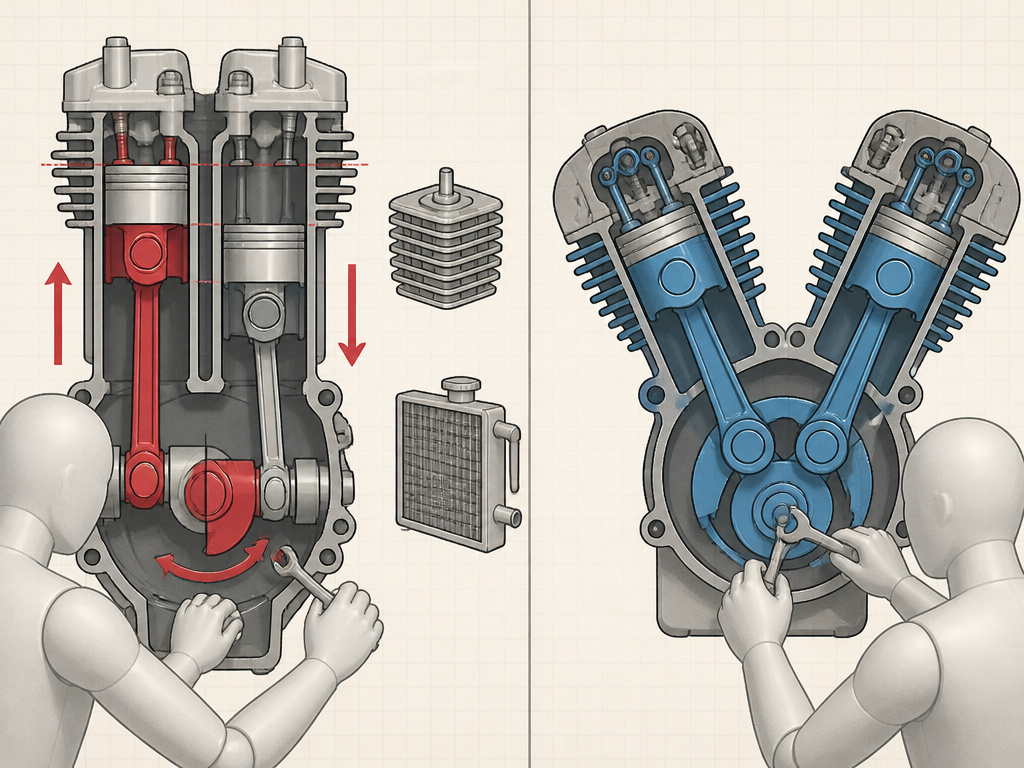
The basic parallel vs. V-twin divide is just the start. The real differences, the ones you feel in the saddle, come from the details: crankshaft timing, cooling methods, and how the engine talks to the chassis.
The 270° Crank: Blurring the Lines
Modern parallel twins don’t have to play by the old rules. The 270° crankshaft is a significant innovation.
- What it does: It makes the parallel twin fire unevenly, like a 90° V-twin. This gives it a lumpier, more tractable power delivery favored for off-road and general street riding.
- Why it matters: It steals the V-twin’s main performance advantage, instant, controllable torque, while keeping the parallel twin’s packaging and cost benefits. The Yamaha CP2 engine (MT-07, Ténéré 700) is the poster child for this.
- The trade-off: It introduces more vibration than a 180° crank. You’re buying character, not ultimate smoothness.
This innovation makes the old parallel twin vs v twin motorcycle engine debate somewhat obsolete. When you can have a twin-cylinder engine with V-twin-like torque in a cheaper, lighter package, the choice gets harder.
Air vs. Liquid Cooling: More Than Just Temperature
Cooling isn’t an afterthought; it’s integral to the engine’s design and feel.
| Cooling Type | Typical Use | Pros | Cons |
|---|---|---|---|
| Air-Cooled | Traditional cruisers (Harley Big Twin), classic standards | Simpler, lighter, fewer parts to fail, classic look | Heat soak in traffic, less stable temperature affects tuning, limited performance ceiling |
| Liquid-Cooled | Modern performance engines across all types (Ninja 650, Ducati V2) | Precise temperature control, allows higher compression and power, consistent performance | Heavier, more complex, requires radiator and plumbing |
| Air/Oil-Cooled (Harley M8) | Modern cruisers attempting a classic look with better heat management | Looks traditional, runs cooler than pure air-cooling | More complex than air-cooling, less efficient than full liquid-cooling |
A liquid-cooled engine like the Ducati’s can run a 13.3:1 compression ratio safely. This is a fundamental difference in engine cooling philosophy.
Vibration and Balance: The Engineering Trade-Off
All twins vibrate. The question is how much, and at what RPM.
- Parallel Twin (180°): Minimal primary vibration, noticeable secondary vibration (a buzz) at high RPM.
- Parallel Twin (270°): Purposeful, low-frequency pulse akin to a V-twin.
- V-Twin (90°): Minimal primary vibration, well-managed secondary vibration.
- V-Twin (45°-60°): Significant low-RPM rocking vibration, often marketed as “character.”
You can’t engineer the feel out without losing the soul. That’s the trade.
Reliability, Recalls, and Real Ownership
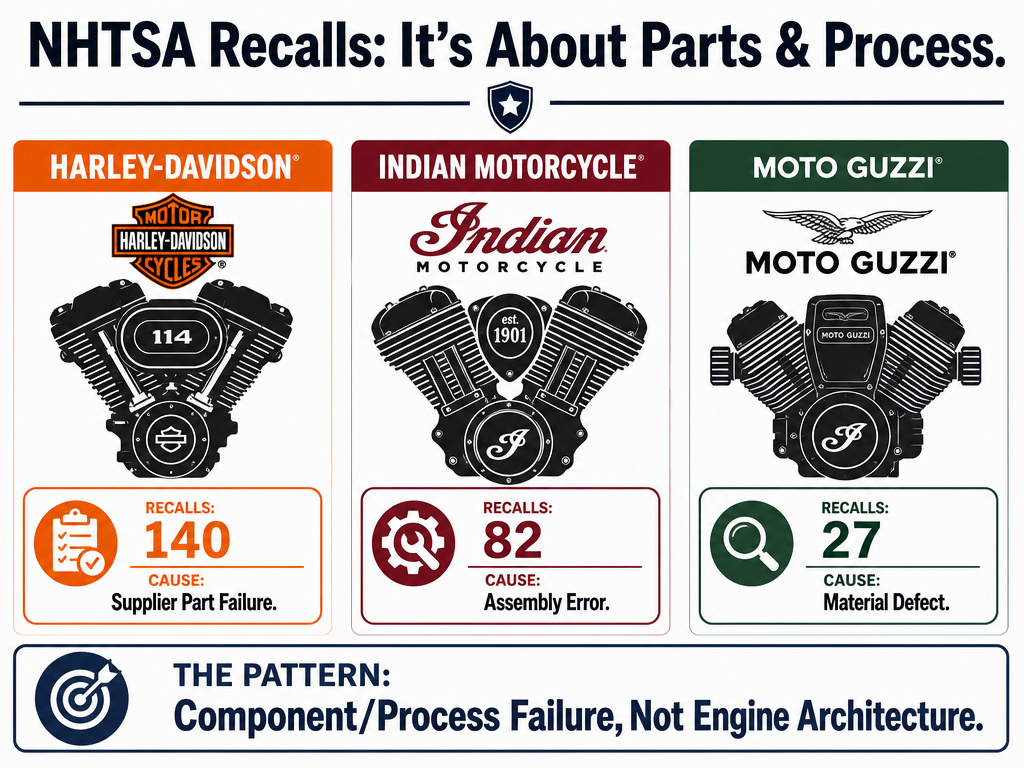
Forget the myths about one layout being inherently more reliable. Problems arise from specific design choices and manufacturing, not the basic blueprint.
Let’s look at the data from the National Highway Traffic Safety Administration (NHTSA):
- Harley-Davidson Recall 22V-085: Affected certain 2022 Touring bikes with Milwaukee-Eight 114/117 engines. The issue? Improperly heat-treated clutch plates that could fracture. This is a supplier part failure, not an engine design flaw.
- Indian Motorcycle Recall 21V-593: Affected certain 2022 Chief models. The problem was an improperly torqued transmission sprocket nut that could loosen. This is an assembly error.
- Moto Guzzi Recall 19V-883: Affected certain V7 III models. A fuel pump flange could crack. This is a material defect.
The pattern is clear. These are failures of a specific component or assembly process, not the V-twin architecture itself. A parallel twin from any brand is just as susceptible to a bad batch of parts or a line worker missing a torque step.
Long-term, simplicity often wins. Fewer parts can mean fewer things to go wrong, but it also means older technology and lower performance. There’s no free lunch.
Which Motorcycle Engine Is Right For You?
Stop looking at engine types and start looking at bike types. The engine is a component chosen to fulfill a mission.
Choose a Parallel Twin if:
- You’re a new rider looking at a Honda CBR500R, Kawasaki Ninja 650, or Yamaha MT-07.
- Your priority is agile handling, low cost of ownership, and smooth operation on highways.
- You like the idea of modern tech (ride modes, traction control) on a budget.
- The default pick: For most riders entering the middleweight category, a modern parallel twin, especially with a 270° crank, is the rational, capable choice. It does everything well.
Choose a V-Twin if:
- You are buying a cruiser for the sound, the feel, and the tradition. The engine is the point.
- You want a Ducati sportbike or sport-tourer for its specific, high-strung character and top-end power.
- You value low-end torque that allows you to cruise in high gear without constant downshifts.
- You’re an adventure rider considering a Moto Guzzi for its unique longitudinal stability.
The middle ground is disappearing. With 270° parallel twins offering V-twin character, and liquid-cooled V-twins achieving parallel-twin smoothness, the lines are blurring. Your test ride should focus on the complete package: throttle response, heat management, vibration at your cruising speed, and how the power vs torque delivery in a parallel twin vs v twin motorcycle engine matches your riding style.
Frequently Asked Questions
Is a parallel twin better than a V-twin?
“Better” is the wrong word. A parallel twin is typically more cost-effective, smoother, and better-suited to agile sport and standard motorcycles. A V-twin delivers stronger low-end torque, a narrower profile, and iconic character, making it ideal for cruisers and certain performance bikes. One isn’t superior; they are tools for different jobs.
What is the disadvantage of a parallel twin engine?
Its main traditional disadvantages are a potentially bland exhaust note and character compared to a V-twin, and a wider physical width that can affect chassis design. However, modern 270° crankshafts have largely addressed the character issue, giving parallel twins a lumpier, more engaging feel.
Do V-twins last longer?
There’s no evidence that the V-twin layout itself is more durable. Longevity depends entirely on the specific engine’s design, build quality, and maintenance. Simple, under-stressed air-cooled V-twins (like older Harleys) can run for immense mileage with basic care, but so can many modern, well-built parallel twins. Reliability is a function of engineering and execution, not cylinder arrangement.
Why are parallel twins so popular?
They strike an optimal balance of cost, packaging, and performance for the high-volume 300-900cc motorcycle market. They are cheaper to manufacture than V-twins or inline-fours, their compact size allows for excellent chassis geometry, and modern engineering (like 270° cranks) allows them to mimic the desirable traits of other layouts. This makes them the default rational choice for manufacturers and riders alike.
Is the Ninja 650 a parallel twin?
Yes. The Kawasaki Ninja 650 uses a 649cc, liquid-cooled, fuel-injected parallel twin engine with a 180° crankshaft. This configuration prioritizes smooth, linear power delivery and relatively low vibration, fitting its role as an accessible, all-around sport bike.
The Bottom Line
Here’s the one spec sheet you need: your own riding. Forget the hype about “soul” or “balance.” A parallel twin will likely cost you less, handle more sharply, and be easier to live with. A V-twin will speak to you in a deeper voice, push you back in the seat with its torque, and make you part of a tradition.
But the rule that changes the choice is the 270° crank. It means you can now get 90% of a V-twin’s feel in a parallel twin’s package. So unless you are unequivocally buying a cruiser or a Ducati, start your search with modern parallel twins like the Yamaha CP2 or Honda 500cc family. Test ride them back-to-back with a 90° V-twin like a Ducati Monster or a Suzuki SV650. Your right wrist and your bank account will have a very short conversation, and you’ll know.
