
Air Cooled vs Liquid Cooled Motorcycle Engine: Which Wins?
This post contains affiliate links. As an Amazon Associate, we earn from qualifying purchases.
In the air cooled vs liquid cooled motorcycle engine debate, a liquid-cooled engine maintains a precise, stable temperature for high performance and modern emissions compliance, while an air-cooled engine uses simple metal fins for cooling, excelling in simplicity and low-cost reliability. For most riders buying a new bike today, liquid cooling is the standard. This technology allows manufacturers to build the powerful, clean-running engines required by global standards. Air cooling survives in specific niches: cost-sensitive markets, retro-styled cruisers, and bikes where absolute mechanical simplicity is the priority.
That 12% figure changes everything. An air-cooled engine sheds only about 12% of its total heat through those iconic cooling fins, the rest exits via the exhaust or radiates from other surfaces. That’s the core engineering constraint. It means the engine’s temperature isn’t really controlled; it’s merely managed, and it fluctuates wildly with your riding speed and the weather outside. Liquid cooling, by contrast, creates a sealed, regulated thermal environment. The difference isn’t just about peak horsepower. It’s about whether your bike runs consistently the same way on a cold morning as it does in afternoon gridlock, and whether it can pass a modern emissions test without cheating.
What follows: the exact numbers on heat and fragility, where each system fails in real traffic, and the clear winners for cruisers, sport bikes, and daily commuters. By the end, you’ll know which cooling system fits your actual ride, not just the brochure fantasy.
Key Takeaways
- Liquid cooling is required for modern emissions standards like Euro 5+ and EPA Tier 4, making it the default for new, globally-sold performance bikes.
- Air-cooled engines shed only about 12% of heat through their fins; they rely on large oil capacities and proper tuning to avoid overheating in traffic.
- Motorcycle radiator tubes are made from 0.1mm to 0.3mm sheet metal, making them vulnerable to road debris, a radiator guard is a smart first purchase.
- For high-RPM, high-compression engines, liquid cooling isn’t an upgrade, it’s a necessity to prevent damage from thermal expansion.
- Choose air-cooling for simplicity and cost; choose liquid-cooling for consistent performance, lower emissions, and long-distance comfort.
How Does Each System Actually Work?
Forget the brochures. One moves air, the other moves liquid. The real difference is in how much control the engineer has over the engine’s core temperature.
An air-cooled engine is an exercise in direct heat radiation. Cylinders and heads are cast with external fins to increase surface area. As you ride, air flows over these fins, carrying heat away. There’s no thermostat, no pump, no secondary fluid. The system is completely passive and at the mercy of your speed and the ambient air. If you’re not moving, neither is the cooling. That’s why manuals for air-cooled bikes tell you to shut it off in a long traffic jam on a hot day, the metal soaks heat faster than stagnant air can remove it.
Liquid cooling is a closed-loop, active system. Coolant circulates through channels cast into the engine block and cylinder head, absorbing heat. A pump sends this hot coolant to a radiator at the front of the bike, where airflow through thin metal fins cools it before it returns to the engine. A thermostat regulates the flow, keeping the engine within a narrow, ideal temperature range regardless of outside conditions. It’s a buffered system: the coolant is the middleman, allowing heat to be moved from where it’s generated to where it can best be dissipated.
In an air-cooled engine, only about 12% of the heat flows out through the metal fins, with about 44% exiting via the exhaust. This low fin efficiency is the fundamental limit of air-cooling, forcing designers to use larger components and richer fuel mixtures to tolerate wider temperature swings. (Source: Wikipedia citing engineering data)
The choice between these systems dictates everything else about the engine: the materials used, the tolerances it can hold, the fuel mixture it runs, and ultimately, the power it can reliably make.
Which Engine Runs Hotter and Why?
The air-cooled engine runs hotter, full stop. But “hotter” isn’t the right word. It runs less consistently.
Air-cooled engine temperature is a slave to its environment. At a steady 60 mph on a cool day, it might be perfectly happy.
Where this goes sideways: In V-Twin air-cooled engines, the rear cylinder gets significantly less airflow than the front. It can run significantly hotter, leading to uneven wear and the need for different tuning for each cylinder in high-performance applications.
This inconsistency is the enemy of precision. To avoid pre-ignition (knock) when the engine is at its hottest, designers often command a richer air-fuel mixture across the entire rev range. That’s why sources note air-cooled engines run richer, making them less efficient and more polluting. It’s a protective compromise.
Liquid-cooled engines live in a tightly controlled climate. The thermostat keeps them at a stable, optimal temperature from the moment they warm up. This stability allows engineers to use higher compression ratios, like the 13.0:1 found in the Harley-Davidson Revolution Max 1250 or the Kawasaki Ninja ZX-10R, and tune the fuel injection for perfect combustion at that exact temperature. The result is more power from less fuel and far fewer harmful emissions.
The bottom line: An air-cooled engine’s temperature swings with the weather. A liquid-cooled engine’s temperature is set by the engineer. That control is why liquid cooling won.
The Real-World Ride: Heat, Noise, and Feel
This is where the spec sheet ends and your senses take over. The cooling system changes how the bike interacts with you.
Heat Management: On an air-cooled bike, you feel the engine’s heat. It radiates from the cylinders back toward your legs. On a cruiser, it’s often part of the experience. On a sport-style bike stuck in traffic, it can be punishing. Liquid-cooled bikes move the main heat exchange point to the radiator, usually mounted ahead of your legs. The heat gets dumped into the airstream before it reaches you. For the rider, this is a clear comfort win, especially on long, slow rides.
Sound: Liquid-cooled engines are quieter. The water jackets surrounding the combustion chambers act as sound dampeners, muffling mechanical noise. An air-cooled engine broadcasts every clatter and pop directly through its metal skin. Some riders love this raw, mechanical soundtrack. Others appreciate the quieter, more refined hum of a liquid-cooled bike, especially at highway speeds.
The Sensory Experience: There’s a tactile difference in the throttle response too. A properly sorted liquid-cooled engine feels seamless and linear, thanks to that stable temperature. An air-cooled engine’s power delivery can feel slightly different on a cold morning versus a hot afternoon, as the fuel mixture and ignition timing struggle to cope with the metal’s actual temperature. You don’t see it on a dyno chart, but you feel it in your wrist.
I switched from a Japanese liquid-cooled bike to an air-cooled Harley-Davidson in my student days, riding into downtown Toronto. The bike just got far too hot for me in that concrete grid. I switched back. Your experience may differ, but for dense urban riding, that’s the trade-off you’re signing up for.
Maintenance, Reliability, and What Breaks

Here’s where owners’ opinions diverge sharply from marketing slides. The “simple” air-cooled engine versus the “complex” liquid-cooled one isn’t a clean fight.
Air-Cooled: Simpler, But Demanding
The part count is lower. No radiator, hoses, water pump, or thermostat. The mantra is less to fail. But that simplicity shifts the maintenance burden onto other components. They rely heavily on a proper tune and fresh oil, which itself acts as a critical coolant. Many air-cooled bikes have a larger oil capacity for this reason. Let the oil degrade or the carburetion fall out of spec, and overheating follows quickly. The reliability is in your hands.
Liquid-Cooled: More Parts, But More Protection
Yes, you have a cooling system to maintain. Coolant needs to be changed every two to five years. Hoses and clamps should be inspected. There are more potential leak points. However, this complexity protects the engine’s core. By maintaining a steady temperature, thermal stress and wear on valves, pistons, and cylinder walls are drastically reduced. As one source notes, this can actually lead to longer service intervals for major internal components like valve adjustments.
The fragility is real, but specific. Motorcycle radiator tubes are made from 0.1mm to 0.3mm sheet, and the fins are made from 0.1mm thick material. A single kicked-up stone can bend a fin; a more serious impact can puncture a tube. This isn’t hypothetical, it’s a documented weak point. Using a radiator guard is as basic as putting on a helmet.
| Aspect | Air-Cooled Engine | Liquid-Cooled Engine |
|---|---|---|
| Typical Maintenance | Frequent oil changes, carburetor/EFI tuning | Coolant changes (2-5 years), hose/radiator inspection |
| Common Failure Point | Overheating from poor tune/oil, exhaust valve wear | Radiator damage, hose leaks, water pump failure |
| Long-Term Wear | Higher thermal cycling can lead to bore distortion | Stable temps promote even cylinder wear |
| Owner Intervention | High – requires diligent fluid and tune upkeep | Moderate – periodic system checks, but less daily fuss |
The recall reality: Complexity can introduce new failure modes. In 2024, the NHTSA issued recall 24V-099 for certain Kawasaki Ninja ZX-10R models due to a defective engine coolant temperature sensor that could crack and leak coolant, a problem impossible on an air-cooled design. It affected 342 units. It’s a reminder that every system has its own failure signature.
For a step-by-step guide, see our article on how to change motorcycle coolant.
Performance and Emissions: The Regulatory Hammer
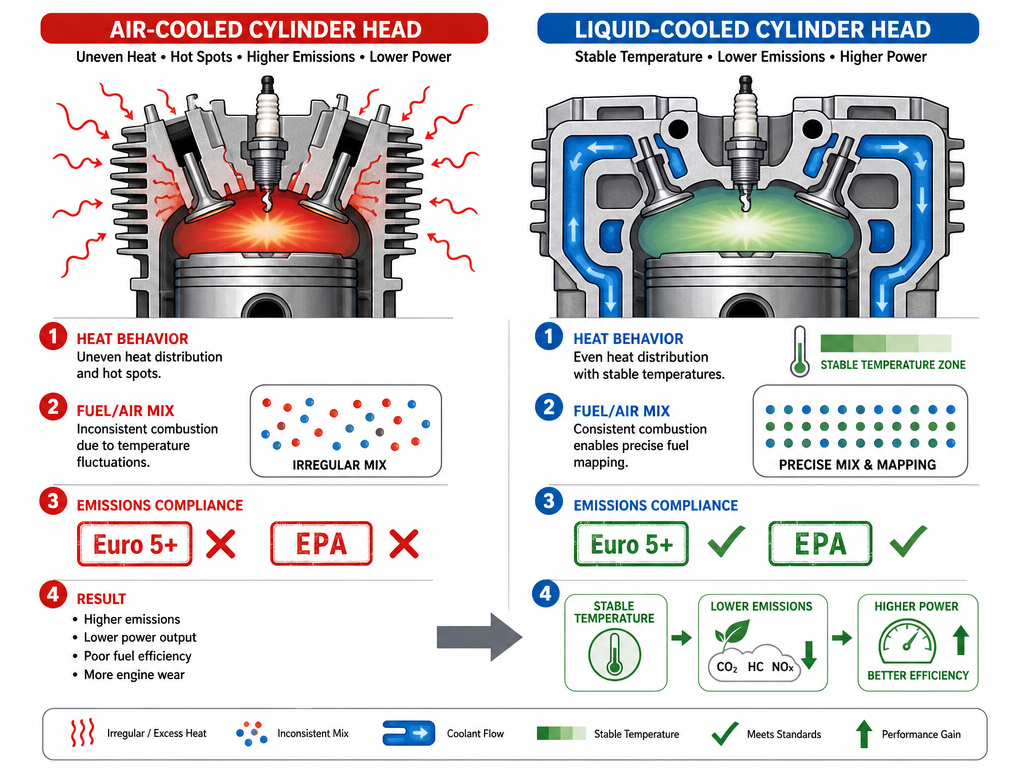
This isn’t about preference anymore. It’s about law.
Liquid cooling provides superior thermal stability, allowing precise fuel mapping and consistent emissions. This is why industry guides flatly state liquid cooling is required for compliance with Euro 5+, EPA, and BS6 emissions standards. An air-cooled engine, with its temperature swings and need for richer mixtures, simply cannot hit these stringent targets without heroic, and expensive, engineering workarounds.
When you compare an air cooled vs liquid cooled motorcycle engine, the performance link is direct. Stable temperatures allow for tighter build tolerances. Engineers can assemble engines with finer clearances because they know thermal expansion will be predictable and uniform. This reduces friction, increases mechanical efficiency, and, with higher, stable compression ratios, allows engines to rev higher and produce more power reliably.
Think of the Kawasaki Ninja ZX-10R’s 998cc inline-four screaming to its redline, or the Harley-Davidson Pan America’s 1250cc V-Twin making adventure-touring power. These are liquid-cooled achievements. An air-cooled engine like the one in the Bajaj Avenger Street 150, producing 14.54 PS at 9000 rpm, represents the practical limit of the technology for affordable mass production.
The part nobody mentions: The widespread adoption of liquid cooling in the 1980s wasn’t primarily for horsepower. It was a response to EPA pressure to reduce exhaust emissions. Stable temperature meant stable combustion, which meant cleaner exhaust. The performance benefits were a massive, welcome side effect.
Cost and Weight: The Trade-Off Tables
Manufacturers don’t choose cooling systems on a whim. The decision is a brutal calculation of cost, weight, and target market.
An air-cooled engine has the lowest unit cost and simplest assembly line requirements. There’s no radiator, plumbing, or pump to source and install. This makes it ideal for cost-sensitive regions like Southeast Asia, South America, and Africa, and for product lines focused on simplicity, reliability, and retro designs. It’s an excellent cost-performance ratio.
Liquid cooling introduces a significantly higher Bill of Materials (BOM) cost due to pumps, hoses, radiators, and thermostats. However, it enables a premium product that can be sold globally. The weight story is nuanced: the liquid system adds pounds from coolant and metal, but it can allow the use of lighter, higher-performance internal components. Sources disagree on the weight penalty: Jiangsu Jinsheng states liquid cooling adds weight from coolant and radiators, while YouMotorcycle argues modern liquid-cooled bikes can be lighter overall than air-cooled equivalents due to different component choices.
| Factor | Air-Cooled Advantage | Liquid-Cooled Advantage |
|---|---|---|
| Initial Cost | Lower purchase price, cheaper to manufacture | Higher purchase price, enables global compliance |
| Long-Term Cost | Lower parts cost, but potentially higher engine wear | Higher parts cost, but potentially longer engine life |
| Weight | Lighter system (no fluids, rad) | Heavier system, but may enable lighter internals |
| Market Fit | Cost-sensitive, low-tech service regions, retro styling | Global premium markets, high-performance segments |
The choice between different engine types often starts with the air cooled vs liquid cooled motorcycle engine business calculus, which then defines the bike’s character.
Which One Should You Choose?
Skip the dogma. Your riding life answers this.
Choose an air-cooled motorcycle if:
- You prioritize mechanical simplicity and want to do most maintenance yourself.
- You ride mostly in open, moving traffic, not daily urban gridlock.
- You love the classic, finned look and the raw mechanical sound.
- Your budget is tight, and you’re looking at smaller displacements (think single-cylinder or parallel-twin bikes like the Royal Enfield Classic 350).
- You live in a region where access to specialized mechanics or motorcycle coolant is limited.
Choose a liquid-cooled motorcycle if:
- You ride in variable conditions, especially stop-and-go traffic.
- You want consistent performance, better fuel economy, and lower emissions.
- You’re buying a modern sport bike, adventure tourer, or high-performance cruiser (e.g., Kawasaki Ninja series, BMW GS series, Harley-Davidson Pan America).
- You prefer a quieter, more refined riding experience.
- You plan on keeping the bike for the long haul and value reduced internal wear.
For the vast majority of riders buying a new bike today, the answer is liquid-cooled. It’s the technology that delivers what we now expect: seamless power, reliability, and cleanliness. Air cooling is a conscious choice for a specific, often nostalgic, experience. There’s no “better,” only “better for you.”
How Cooling Affects Engine Build and Fins
The chosen cooling method dictates fundamental engine architecture. An air-cooled design must cast large, deep fins onto its cylinders and heads to maximize surface area, as only a small fraction of engine heat actually escapes through this metal. This reliance on finning and air flow leads to larger temperature swings. To accommodate this expansion and contraction, engineers must design with looser internal tolerances. A liquid-cooled engine, by contrast, maintains a controlled thermal environment. This stability allows for much tighter build tolerances from the start. These tighter clearances are better for long-term durability and enable higher, more consistent performance, as the engine isn’t constantly expanding and contracting with heat cycles.
Frequently Asked Questions
Are Harleys still air-cooled?
Harley-Davidson’s core cruiser lineup, like the Softail and Touring models, still uses air-cooled (or air/oil-cooled) V-Twin engines. This is a central part of their traditional identity. However, for performance and global compliance, they have fully embraced liquid cooling. The Revolution Max 1250 engine in the Pan America and Sportster S models is a high-compression, liquid-cooled V-Twin, and the upcoming LiveWire electric models obviously use no engine cooling at all. Harley is now a two-technology company.
Do air-cooled motorcycles overheat easily?
They overheat in specific, predictable conditions. If stuck idling or moving very slowly in hot weather with no airflow over the fins, heat will build faster than it can dissipate. This is why manuals advise shutting them off in long, hot traffic jams. With proper maintenance (fresh oil, correct tune) and moving air, they are perfectly reliable. It’s a manageable trait, not a fundamental flaw.
What are the downsides of air-cooled engines?
The primary downsides are thermal inconsistency, which limits performance potential and makes meeting modern emissions standards difficult; greater noise; and heat directed toward the rider in traffic. They also often require more frequent oil changes and careful tuning to maintain that reliability.
Can you add a coolant system to an air-cooled engine?
Technically, you could engineer a liquid-cooling retrofit, but it would be a complex, custom, and expensive project involving machining new cylinder heads with water jackets, adding a radiator, pump, and plumbing. It’s almost never practical or cost-effective. Riders who need more cooling from an air-cooled bike typically add an auxiliary oil cooler, which helps but doesn’t offer the precise temperature control of a full liquid system.
Is liquid cooling more expensive to repair?
It can be. A punctured radiator or failed water pump is a more costly repair than anything on an air-cooled cooling system (which essentially has no dedicated cooling parts). However, proponents argue that by preventing overheating, liquid cooling avoids the much more expensive repairs of seized pistons or warped cylinder heads. Over the total lifespan of a well-maintained bike, the cost difference may balance out.
What about oil-cooled engines?
Oil-cooling is a middle ground. It uses the engine’s oil as a coolant, circulating it through a small external radiator. It’s more effective than pure air-cooling and adds less complexity than a full liquid system. However, oil is a less efficient heat-transfer medium than dedicated coolant, and the system still lacks the precise thermostat control of liquid cooling. It’s often found on “air/oil-cooled” bikes like some older BMWs and Suzukis.
The Bottom Line
Here is what actually held up. The Wikipedia entry on air-cooled engines gives you the theory, but the road gives you the truth. Liquid cooling won the engineering war for a reason: control. It allows builders to make more power, cleaner, more reliably, and in a package that’s easier to live with day-to-day.
Air cooling’s remaining virtue is authenticity. It’s a direct, visceral, and simple mechanical experience. Choose it because you want that experience, knowing its limits, like shutting it off in a summer traffic jam.
For everyone else, for the commuter, the sport rider, the adventurer, the answer is clear. Ride the technology that matches the times. That means liquid cooling. It’s not a debate about nostalgia; it’s a decision about how you want your bike to behave every time you twist the throttle. Fit beats price tag, and performance beats pedigree. Choose the engine that fits your actual ride.
