
Motorcycle Tire Warmers Pros and Cons: Is It Worth It?
This post contains affiliate links. As an Amazon Associate, we earn from qualifying purchases.
Motorcycle tire warmers are electric blankets that pre-heat your tires to a target temperature, offering immediate grip and stable pressures from your first lap. The main pros are safety from cold crashes, accurate hot-pressure setting, and preserved tire life. The main cons are high cost, the need for a generator and stands, and the risk of overheating and damaging tires if used incorrectly.
That target temperature is the first place manufacturers disagree. One brand aims for 90°C, another says 80-85°C is ideal, and a tire company representative warns that road tires should never see more than 60°C. Your choice isn’t just about grip, it’s about matching a specific heater to your specific tire compound, which is a key part of the motorcycle tire warmers pros and cons discussion.
What follows is a breakdown of the real performance trade-offs, grounded in manufacturer manuals and pro advice, which is essential for the motorcycle tire warmers pros and cons discussion. This section details the four concrete benefits, the three biggest practical hurdles, and the exact specs, watts, degrees, and minutes that decide whether a set of warmers is a smart buy or garage jewelry for your level of riding.
Key Takeaways
- Use warmers to set accurate hot pressures before you ride; tires gain about 20% pressure on track, so setting cold is a guess.
- Match the warmer’s temperature to your tire: slicks need 80-90°C, but modern street/track DOT tires can be damaged above 60°C.
- Budget for the whole system: warmers need a sufficiently powerful generator, front and rear stands, and adequate pre-heat time.
- Overheating hardens rubber. Never leave warmers on for more than 3 hours, and for rain tires, limit heating to 15 minutes on a low setting.
- For novice and intermediate track day riders on DOT tires, coaching is a better investment; warmers become critical when you switch to race slicks.
How Much Power Do Motorcycle Tire Warmers Use?
The power draw varies significantly between brands: the BMW M Tyre Heater pulls 550 watts, Woodcraft warmers draw about 1000 Watts, DMP Slingshot draws ~450W front/~550W rear, and an Open Source Racing community guide notes they typically pull ~1500 watts.
The BMW M Tyre Heater pulls a maximum of 550 watts. The DMP Slingshot set draws about 450W for the front and 550W for the rear. Woodcraft states their warmers draw about 1000 Watts. An experienced community guide notes tire warmers typically pull around 1500 watts.
Common mistake: Using a small, 1000-watt generator. Voltage drop from an underpowered source means the warmers never reach their target temperature, leaving you with a false sense of security.
These numbers aren’t marketing. They dictate your generator size. You need overhead. If your warmers draw 1500 watts at peak, a generator with sufficient overhead is necessary.
| Brand/Model | Power Draw (Watts) | Minimum Generator Size |
|---|---|---|
| BMW M Tyre Heater | 550 | (consult manufacturer) |
| DMP Slingshot (Front/Rear) | ~450 / ~550 | (consult manufacturer) |
| Woodcraft Tire Warmers | ~1000 | (consult manufacturer) |
| Typical Set (Community Estimate) | ~1500 | (consult manufacturer) |
According to the KLS Tyre Warmers manual, the rim itself will be warmed up after that time to a ‘handwarm’ temperature of about 35-40°C.
That last point is a critical sensory check. After 30-40 minutes, the metal wheel rim should feel warm to the touch. This is why simply plugging them in isn’t enough; you need to verify the heat has soaked through.
The 4 Core Benefits (and What They Actually Mean)
The advantages sound great on a product page. This translates them into what happens on the asphalt.
1. Immediate Grip and Confidence. This is the big one. That feeling is real, but it’s tied directly to tire type. A street tire won’t give you the same level of stick.
2. Accurate Hot-Pressure Setting. This is the most underrated technical benefit. According to a Chickenhawk Racing forum post, tires can increase in pressure about 20% on the track (e.g., from 30 to 36 psi). According to a Chickenhawk Racing forum post, without tire warmers, 6-8 laps might be needed to get a tire to its proper ‘hot pressure’. With warmers, you set your track day tire pressure while the bike is on the stand. You bleed the tires down to your target hot pressure 10 minutes before your session. When you hit the track, the pressure change is minimal, and your handling is consistent from lap one.
3. Preventing Cold Tearing. This is a specific tire-killer. The surface rubber literally tears away from the cooler layer beneath, leaving a grained, shredded appearance. Pre-heating the entire carcass with warmers eliminates this stress.
4. Reducing Overall Heat Cycles. Every time a tire heats up and cools down completely, it undergoes a heat cycle. By putting warmers back on between sessions, you keep the tire in its optimal temperature range, slowing this aging process. It makes your expensive performance motorcycle tires last longer.
The 3 Biggest Drawbacks (Cost, Complexity, and Risk)
The downsides aren’t just about money. They’re about transforming a simple track day into a logistics operation.
1. The Total System Cost. The warmers themselves are just the entry fee. The Kawasaki Tire Warmer Set NMX lists for £770.99. You also need a generator, front and rear stands, extension cords, and a power strip.
2. The Paddock Logistics. You need space in a crowded paddock. Your pre-track routine grows by the required heating time. It adds cognitive load that can distract from riding.
3. The Risk of Damaging Your Tires. This is the silent con. High heating temperatures to the tyres for a long period of heating time can harden the rubber and decrease the grip. Using the wrong temperature setting is easy. The Bridgestone Senior Product Manager was clear: “You shouldn’t bake road tyres to 80 degrees like you do slicks.” For road or hybrid tires, he recommends “around 50-60 degrees.” Exceed that, and you can permanently harden the compound, losing grip you paid to gain. Woodcraft warns that in rain conditions, you should not leave warmers on for more than 15 minutes.
Where this goes sideways: Running warmers on a street tire at a slick’s temperature.
Slicks vs. DOT Tires: When Warmers Are Mandatory

Your tire type dictates the need. This isn’t a subtle difference.
Race Slicks: Essential. Most slicks are designed to operate between 80°C and 90°C. They offer minimal grip when cold and can be dangerously slick for the first several laps. If you are running slicks, warmers are a required safety item, not a performance accessory. The manufacturer manuals from BMW (90°C target) and KLS (85-90°C “hi” setting) are written for this use.
DOT Race / Track Day Tires (e.g., Pirelli SC, Dunlop Q5): Here’s the gray area. These tires work in a wider temperature range and heat up quicker. You can use them without warmers, and many fast intermediate riders do. However, using warmers on a low setting (55-70°C) provides a safety margin on cold mornings and helps with pressure setting. The key is using the correct, lower temperature.
Street / Sport-Touring Tires: Generally not recommended. These tires are designed to work from cold and can be damaged by sustained high heat. As the Bridgestone expert noted, if you must use warmers, keep them under 60°C. For most riders on street tires, the complexity and risk far outweigh the tiny benefit.
| Tire Type | Warmer Needed? | Ideal Warmer Temp | Key Risk |
|---|---|---|---|
| Race Slick | Mandatory | 80-90°C (176-194°F) | Cold crash, cold tearing |
| DOT Race / Track Day | Recommended (Low Setting) | 55-70°C (131-158°F) | Overheating & greasing |
| Street / Sport-Touring | Not Recommended | Max 60°C (140°F) if used | Rubber hardening, no benefit |
How to Use Tire Warmers Correctly (The 7-Step Safe Procedure)
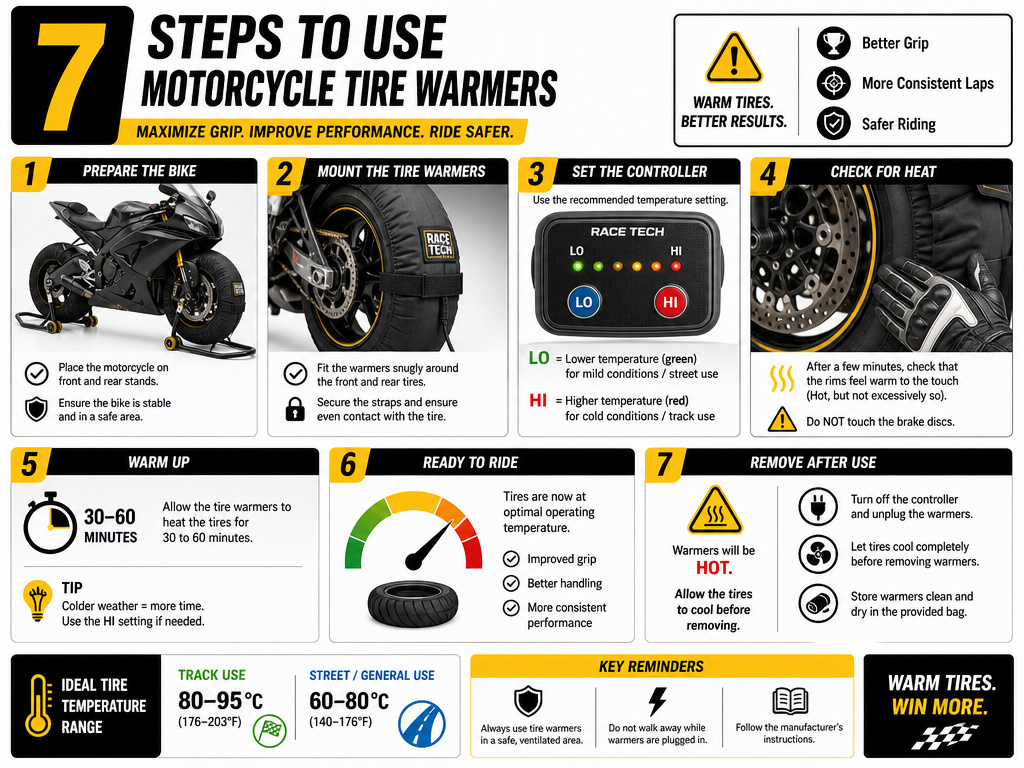
Mistakes here waste time or cook tires. Follow the sequence.
- Suspend the Bike. Always use front and rear stands. The Woodcraft manual is explicit: “Allowing the warmers to touch the ground with the weight of the motorcycle on them can damage the heating elements and potentially cause a fire.”
- Fit Snugly, Not Tight. Wrap the warmer around the tire, securing the Velcro over the rim. It should be snug to avoid bunching, which creates hot spots. The BMW manual says to plug in only after the warmer is “wrapped snugly against the rubber.”
- Plug In and Set Temperature. Now connect to your power source. Select your temperature. Know your model: a KLS pro-X has “lo” (55-60°C) and “hi” (85-90°C). Woodcraft has “Warm” (~57°C) and “Hot” (~79°C).
- Heat Soak for 45-60 Minutes. This is critical. Brands disagree on time: BMW says 30-40 minutes, Woodcraft recommends 40-60 minutes. Trust the rim test: when the metal rim is warm to the touch (35-40°C), the heat has penetrated.
- Set Hot Pressures. After full heat soak, check and adjust pressures to your target hot pressure. This is your most important tuning step.
- Unplug, Then Remove. Right before your session, unplug the warmers first. Then remove them from the tire. Never pull them off by the cord. DMP Slingshot warns specifically: “DO NOT PULL THE POWER CORD!”
- Re-Apply Between Sessions. Come in, check hot pressures immediately, then put the warmers back on (on a lower setting if there’s a long wait) to maintain temperature and reduce heat cycles.
Before you start: The heating element reaches over 175°F. Never touch it while on. Always unplug before removing. Never leave warmers unattended while plugged in. Keep them completely dry.
What Temperature Is Too Hot for Tires?
More heat isn’t always better. There’s a cliff.
For slicks, the upper limit is defined by the tire compound and track surface. Once the surface gets above 130°C (266°F), the rubber can start to get greasy and tear. You’ll see this as a shiny, melted appearance on the tire’s surface after a session.
For DOT and street tires, the limit is much lower. Once these tires get above the 130-degree range they start to get very ‘greasy’. Remember, 130°F is only about 54°C, well below a slick’s operating range. This is why the Bridgestone rep’s 50-60°C warning is so important. Your warmers’ “Hot” setting could be 79°C (175°F), which is a recipe for instantly ruining a street tire’s grip.
The safest approach is to consult your tire manufacturer’s recommendation. When in doubt, start low. You can always add a lap to warm up, but you can’t undo a hardened, greasy tire.
Deciding If You Need Them: A Track Day Rider’s Checklist
Forget the marketing. Answer these questions.
- What tires do you run? If the answer is slicks, you need warmers. If it’s DOT race tires, consider them. If it’s street tires, skip them.
- What’s your pace? The Open Source Racing community guide suggests warmers when you are “at a high intermediate pace or just starting to get into the fast group.” If you’re still learning lines and braking points, your money is better spent on a tire balancer and coaching.
- How many events do you do? The system cost is high. If you do 6+ track days a year, the investment in consistency and tire life pays off. For 1-2 days, it’s hard to justify.
- Can you manage the logistics? Do you have a vehicle that can haul a generator? Do you mind the extra setup time? If adding 45 minutes of faffing ruins your day, they’re not for you.
Honestly, for most people doing occasional track days on modern DOT tires, the answer is no. The performance gain is marginal compared to the cost and hassle. The real benefit, and where warmers become essential, is when you stop treating track days as fun outings and start treating them as testing sessions for competitive racing.
Frequently Asked Questions
Are motorcycle tyre warmers worth it?
They are worth it if you run race slicks or are a competitive racer where every second counts. For intermediate track day riders on DOT tires, they offer a confidence and consistency boost but are a significant investment in money and paddock logistics. For novices or street tire users, that money is almost always better spent on other gear or track time.
How much power do motorcycle tire warmers use?
Power consumption varies by brand. A single warmer can draw from 450 watts (DMP Slingshot front) to 1000 watts (Woodcraft). A full set typically draws between 1000 and 1500 watts. You will need a generator rated for at least 2000 watts to run a pair reliably without voltage drop.
What are the best motorcycle tire warmers?
“Best” depends on need and budget. For precise digital control, brands like KLS pro-X offer dual-temperature settings. For durability, Woodcraft and DMP are well-regarded. The Kawasaki Tire Warmer Set NMX uses Nomex for heat resistance. The best advice is to match the warmer’s temperature range to your specific tire type, buying a high-temp slick warmer for DOT tires is a common and expensive mistake.
What temperature is too hot for tires?
For race slicks, surface temperatures above 130°C (266°F) can cause greasing. For street and track-day DOT tires, temperatures above 60°C (140°F) can start to harden the rubber and degrade grip. Always use the lowest effective temperature setting on your warmers, and consult your tire manufacturer’s specific recommendations.
Can you use tire warmers on the street?
No. Manufacturer instructions, like those from Woodcraft, explicitly state: “These tire warmers are intended for racetrack use only.” Street tires are not designed for sustained high heat, and riding with race-hot tires on public roads is extremely dangerous due to their different handling characteristics and quick cool-down.
The Bottom Line
Tire warmers are a tool for a specific job: getting race slicks to operating temperature before a session. If that’s not your job, they’re an expensive, complicated accessory.
The one rule that cuts through the noise: never let a street or hybrid DOT tire see more than 60°C on a warmer. Exceed that, and you’re baking the grip out of it. The manuals for slicks talk about 90°C targets; the advice for road tires talks about damage. Those two worlds should not meet.
If you’re on the fence, rent a set before you buy. Many track day organizations or tire vendors offer rentals. Feel the difference for yourself, and tally the total hassle. That real-world test, not a product page, will tell you if the pros outweigh the cons in your paddock.
