
Motorcycle Airbag Jacket vs Airbag Vest: How to Choose
This post contains affiliate links. As an Amazon Associate, we earn from qualifying purchases.
A motorcycle airbag jacket is a complete outer garment with the airbag system built in, while an airbag vest is a standalone protective layer worn under or over your existing jacket. For most riders, a vest offers more versatility and is the better choice, but a jacket wins if you want an all-in-one solution and don’t plan to switch gear often.
The difference here is more than just form factor, it’s a trade-off between convenience and adaptability. A jacket requires you to use one piece of gear for protection and weather; a vest allows you to add protection to any jacket you already own. This is the core choice in the motorcycle airbag jacket vs airbag vest debate.
What follows is a breakdown of how each system works, the real-world numbers on protection and fit, and the hidden costs that decide which one you’ll actually wear for the long haul.
Key Takeaways
- The EN 1621-4 safety standard is essential; it certifies the airbag’s impact absorption, not just its inflation. Look for Level 2 certification for chest and back.
- For under-jacket wear, your outer jacket must have extra space, but the required amount varies by model: the Dainese Smart Jacket requires ≥5 cm of space inside the outer garment, while the Alpinestars Tech-Air 3 V2 System needs ≥4 cm extra circumference.
- Electronic systems require charging and have finite battery life; for example, the Dainese Smart Air offers 12 hours, while the Alpinestars Tech-Air 3 V2 Leather System offers up to 40 hours of active ride time.
- Post-activation service costs and procedures vary wildly. Some vests allow owner-replaceable gas generators; others require a mandatory, costly factory return.
- Avoid cheap, uncertified airbags sold on marketplaces like Amazon or Temu. These are often slow-inflating flotation devices that offer no real crash protection.
The Core Design: Jacket or Vest?
An airbag jacket is a full riding jacket, leather, textile, or mesh, with the airbag bladder, sensors, and inflator sewn directly into its structure. You buy it as one complete garment. An airbag vest is just the protective system: a sleeveless layer containing the airbag and its electronics, designed to be worn with your own jacket either over or under it.
This fundamental split at the heart of the motorcycle airbag jacket vs airbag vest debate creates two different ownership experiences. The jacket is simpler on ride day, one garment to put on. The vest is a separate piece of kit you add to your existing wardrobe. That separation is the vest’s biggest advantage and its main point of friction.
How They Work: Deployment Systems Compared
The protective technology inside jackets and vests is largely identical. The real division is in the trigger: electronic (autonomous) or mechanical (tethered). This choice affects where and how you can ride more than the jacket/vest form factor does.
Electronic systems, like those in the Dainese Smart Jacket or Alpinestars Tech-Air 3 V2, use inertial sensors and algorithms to detect a crash. They inflate in milliseconds without any connection to the motorcycle. The Alpinestars Tech-Air 3 V2 Leather System claims an inflation time of 50 milliseconds. These systems are packed with sensors; Alpinestars says its algorithm was developed from “millions of kilometers of riding data and thousands of crashes.”
Mechanical systems, like the SPIDI Air DPS Vest, use a physical tether (a lanyard) clipped to your bike. A sudden separation from the bike yanks a trigger, inflating the airbag. They have no batteries to charge and no sensor logic to potentially fail.
| Deployment Type | Best For | Key Limitation |
|---|---|---|
| Electronic / Autonomous | Riders who switch bikes, tour, or ride off-road where a tether is impractical. | Requires regular charging and has a finite battery life (e.g., 12 hours for Dainese Smart Air, up to 40 hours for Alpinestars). |
| Mechanical / Tethered | Commuters and dedicated sport riders on a single bike who want zero maintenance beyond a tether check. | Must be physically connected to the motorcycle at the start of every ride. |
The debate isn’t about which is safer when they work, but about which one you’ll reliably use. Forgetting to charge an electronic vest is as common as forgetting to clip in a tether.
Protection Levels and Safety Standards
All legitimate systems are certified to EN 1621-4, the European standard for motorcycle airbag garments. This is the single most important spec. It tests the inflated airbag’s ability to absorb impact force, measured in kilonewtons (kN).
Within EN1621-4, Level 2 is the higher standard. For chest protection, Level 2 requires the airbag to transmit ≤2.5 kN of force during a test impact. The Dainese Smart Jacket’s chest airbag recorded a mean result of 2.11 kN in testing. Back protection has a different threshold, with Level 2 for back requiring ≤4.5 kN.
Where this goes sideways: Assuming any airbag is better than none. Cheap, uncertified vests from online marketplaces often inflate too slowly, failing to protect during the critical first milliseconds of impact. They are dangerous imitations.
It’s crucial to note that protection isn’t just about the airbag. Some vests, like the Helite Turtle 2, incorporate a permanent SAS-Tec Level 2 back protector into their construction. Dainese, however, states its Smart Air provides protection “through the use of air alone,” arguing this allows for a lighter, less restrictive garment. This is a philosophical split, integrated hard armor versus pure air cushioning, not a clear right or wrong answer.
Fit, Layering, and Real-World Comfort
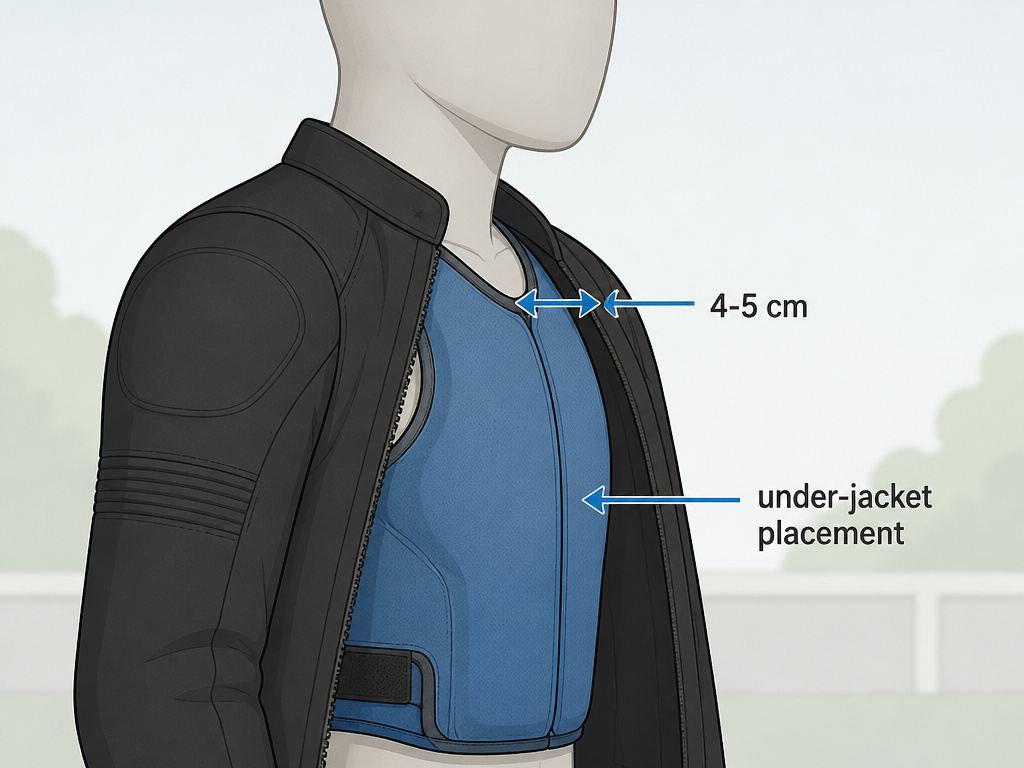
Comfort decides whether you wear the gear. An airbag you leave at home is useless.
Under vs. Over: Most vests and all standalone airbag jackets are designed to be worn under a riding jacket for optimal protection and aerodynamics. This is where the space requirement is critical. Your primary riding jacket must be sized up to accommodate the airbag’s bulk, both for daily comfort and for the 4-5 cm of inflation space. Wearing a vest over a jacket is possible (and recommended for some, like the Alpinestars Tech-Air 3 for V-twin riders), but it exposes the airbag’s outer shell to abrasion in a slide.
Seasonality: A mesh airbag jacket, like the Dainese Smart Jacket, is a dedicated summer piece. A standalone vest is more versatile; you can wear the same protective vest under a mesh jacket in July and a waterproof touring jacket in October. You’re buying one protection system for multiple jackets.
The Sensory Reality: A well-fitted vest disappears after the first hour. You notice the slight extra warmth and the soft crinkle of the bladder when you move. A poorly fitted one feels like a stiff life preserver, pushing your jacket up at the shoulders and binding across the back every time you reach for the bars. That discomfort is your cue to check the fit guide again.
Intended Use: Where Can You Actually Ride This?

Manufacturers define strict boundaries. Ignoring them can void your warranty and, more importantly, might affect the system’s ability to deploy correctly.
| Product | Manufacturer’s Intended Use | Where It’s Not Recommended |
|---|---|---|
| Dainese Smart Jacket | Paved road use only. | Off-road routes with jumps, “serious strain,” or track use. |
| Dainese Smart Air | Urban, highway, hill/mountain, and off-road trails. Unpaved and paved roads. | Track riding and “extreme off-road riding.” |
| Alpinestars Tech-Air 3 V2 | Very light off-road (unpaved roads ≥4m wide, gradients ≤ ±30%, no deep ruts). | Proper off-road, motocross, or track use. |
| SPIDI Air DPS Vest | FIM Cross-Country Rally homologated. Built for adventure and off-road. | N/A (designed for harsh conditions). |
These limits often relate to the algorithm’s programming. A system designed for street crashes might misinterpret a hard off-road landing as a non-threatening event, delaying deployment. The SPIDI Air DPS, with its FIM rally homologation, is built for those violent, multi-axis impacts.
Common mistake: Using a road-focused airbag on track days. Manufacturer Dainese explicitly states the Smart Jacket is ‘not intended for track use,’ though a professional reviewer noted an average rider reported ‘no problems using this on track.’ This represents a disagreement between the manufacturer’s limitation and some user experience.
Maintenance and Long-Term Costs
The purchase price is just the entry fee. The real cost is in the upkeep, service, and what happens after a deployment.
Routine Maintenance:
- Cleaning: You can’t just toss these in a washing machine. The Dainese Smart Jacket must be cleaned with a damp cloth and conditioner-free soapy water; its electronics cannot be submerged. The Alpinestars Tech-Air 3 V2 Leather System is not washable, only wipe with a damp cloth.
- Service Intervals: The Dainese Smart Jacket requires a free service every three years to check inflators, wiring, and software. Alpinestars states the gas inflator must be changed approximately every four years, a consumable cost.
The Big One: Post-Deployment Reset. This is the critical difference between systems.
- Dainese Smart Air: The airbag can be reused for a maximum of three activations. After each, the owner can replace the gas generator. After the third, the entire garment must be sent to a service center to replace the airbag and reset the control unit.
- Alpinestars Tech-Air 3 V2: The airbag bladder is certified for up to six inflations. After that, a user-replaceable bladder/inflator kit is available, suggesting an owner can reset the system without a mandatory factory return.
For the Dainese Smart Jacket, a full deployment reset involving a new bladder and two gas canisters costs £239.95 if not covered under warranty. You must budget for this possibility.
Making the Choice: Vest or Jacket?
Your riding style dictates the answer. We can ignore the exaggerated claims.
Choose an Airbag Vest if:
- You already own a jacket you love and want to add protection to it.
- You ride in multiple seasons and want to use one airbag with different outer layers.
- You value the potential for easier, user-serviceable post-deployment resets.
- You’re still dialing in your perfect gear setup and want flexibility.
Choose an Airbag Jacket if:
- You prefer a single, all-in-one garment with no extra layers to manage.
- You are buying a new jacket anyway and want the most integrated, sleek look.
- Your riding is predominantly one season (e.g., a dedicated summer mesh jacket).
- You don’t mind the prospect of sending the entire garment to the factory for service.
For the majority of riders, especially those who commute, tour, or own more than one jacket, the versatility of a vest like the Alpinestars Tech-Air 3 V2 or the Dainese Smart Air is the more practical, long-term choice. The integrated jacket is a fantastic solution for a specific, narrow use case.
Price and value comparison
When comparing the cost in the motorcycle airbag jacket vs airbag vest decision, consider the total ownership picture. An airbag jacket is a single purchase that includes the outer shell and the protective system. A vest requires you to also own a compatible jacket, which you may already have. Beyond the initial price, factor in long-term service costs. Some systems require free periodic check-ups, while others have user-replaceable components after a deployment. The cost to reset the system after an accident varies, with some allowing owner replacement of parts like the gas generator or bladder, and others needing a factory service. Cheaper options found on general marketplaces are often not certified protective gear and should be avoided.
Specific brand/model examples and reviews
Examining specific models highlights key differences. The Dainese Smart Jacket is a polyester mesh jacket with an integrated airbag certified to EN1621-4, offering Level 2 chest and Level 1 back protection. It is intended for road use only. In contrast, the Dainese Smart Air vest is promoted as a very light system suitable for a broader range of riding, including unpaved roads, but not extreme off-road or track use. The Alpinestars Tech-Air 3 V2 system is another electronic vest, certified to EN1621-4 Level 2, and can be worn over or under a jacket. It offers a long battery life and its algorithm is developed from extensive riding data. The SPIDI Air DPS Vest uses a tethered mechanical activation system.
Frequently Asked Questions
Are motorcycle airbag vests worth it?
Yes, if you value your spine and ribs. A high-quality vest meeting the EN1621-4 standard provides significantly higher impact absorption than standard foam armor, as certified by the Level 2 thresholds. It is a highly effective form of upper-body protection that meets the rigorous EN1621-4 standard. The cost is significant, but it’s a one-time investment in technology that actively works to prevent life-altering injuries.
What is the difference between an airbag jacket and vest?
An airbag jacket is a complete riding jacket with the system built in. An airbag vest is a standalone protective layer you wear with your own jacket. The jacket offers convenience; the vest offers flexibility. The protective airbag technology and safety standards inside them are otherwise identical.
Do motorcycle racers wear airbag suits?
Yes, professional racers in MotoGP and other series wear integrated airbag suits, which are the pinnacle of this technology. These are specialized, single-use systems designed for extreme speeds and specific crash types. The road-going systems from brands like Dainese and Alpinestars are direct descendants of this racing tech, but are built for reusability and a wider range of crash scenarios.
Can you wear an airbag vest over any jacket?
You can, but you shouldn’t without checking compatibility. The vest needs to fit snugly over the jacket without being overly tight. More importantly, wearing it outside exposes the vest’s outer shell to abrasion in a crash. Most manufacturers design vests to be worn under a jacket for optimal safety and protection of the airbag components. Always consult the vest’s manual for layering guidance.
How long does an airbag stay inflated after deployment?
The airbag provides a protective cushion for a short period after inflation. According to Dainese, their D-air® system airbags begin to lose pressure between 30 seconds (for racing airbags) and 60 seconds (for street airbags). This is by design, to allow the rider to breathe and move after the initial impact, while still cushioning secondary impacts.
The Bottom Line
Here is the honest take. An airbag vest is a tool, and a jacket is an outfit. Buy the tool if you want to upgrade the protection of the gear you already own and ride in. Buy the outfit if you’re starting from scratch and want the simplest possible daily routine.
The essential requirement is the EN 1621-4 certification. Everything else, electronic vs. Tethered, vest vs. Jacket, Dainese vs. Alpinestars, is a matter of fitting that certified protection into your actual riding life. Ignore the marketing claims about connectivity and app features. Focus on the service manual, the gas inflator expiration date, and the real centimeters of space in your current jacket. That’s what determines whether this investment saves your skin or just collects dust in the closet.
