
Inline Four Motorcycle Engine Pros and Cons: How to Choose
This post contains affiliate links. As an Amazon Associate, we earn from qualifying purchases.
Inline-four motorcycle engines deliver smooth, high-revving power with a distinct top-end rush, but they trade low-end torque for width, weight, and often higher maintenance costs compared to twin-cylinder engines. For street riding, their linear power and refinement are major advantages, but their size can compromise cornering clearance and their complexity shows up in service intervals.
That width and those service intervals are the practical trade-offs. The smoothness comes from perfect primary balance, the pistons move in opposing pairs, canceling out vibrations. But that balanced motion also dictates the engine’s physical shape, which decides what kind of motorcycle it can fit into and how it feels when you lean it over.
What follows is a breakdown of the inline four motorcycle engine pros and cons, where that smooth power comes from, what you give up to get it, and which riders should, or definitely should not, consider one. This section explains the engineering, the real ownership costs from service manuals, and gives clear recommendations.
Key Takeaways
- Inline-fours are inherently balanced and silky-smooth at high RPM, but they are physically wide and can limit cornering clearance on sport bikes.
- Power delivery is linear and top-end focused; you must rev them to access peak torque, unlike twins which deliver punch lower down.
- Maintenance like valve clearance checks are less frequent than some twins (e.g., every 15,200 miles on a Kawasaki ZX-4R), but the job is more complex and costly when required.
- Crossplane crankshaft designs (Yamaha R1) radically alter the power character, adding low-end grunt and a unique pulse, but they are the exception, not the rule.
- For most street riders, an inline-four’s real-world fuel efficiency is often worse than a twin of similar power due to the need to rev higher in daily use.
The Core Advantages of an Inline-Four
Smoothness isn’t just a nice bonus, it’s baked into the design. Two pistons rise while the other two fall, creating perfect primary balance. This cancels the big, shaking forces that single and twin-cylinder engines have to manage with counterbalancers. The result is an engine that stays glassy even as the tachometer needle sweeps past 10,000 RPM.
That mechanical refinement allows engineers to push for extreme revs. High RPM is how you make big horsepower from a small displacement. The Kawasaki Ninja ZX-4RR‘s 399cc engine spins to a high RPM to make its power, a feat impossible with a lower-revving twin. The power delivery feels linear and predictable. As you twist the throttle, acceleration builds progressively rather than hitting with a sudden, wheelie-prone shove. This makes high performance more accessible and less intimidating on the street.
A conventional inline-four engine uses a 180-degree crankshaft, where pistons 1 and 4 move together in opposition to pistons 2 and 3. This configuration provides perfect primary balance, eliminating the need for a balancing shaft and allowing the engine to rev smoothly to extremely high rotational speeds, often exceeding 14,000 RPM in modern sport bikes.
The sound is part of the appeal. A well-tuned inline-four under load produces a seamless, high-pitched wail that has defined sport bike racing for decades. It’s a rewarding soundtrack for enthusiastic riding. For commuting, that smoothness translates to less buzz in the handlebars and footpegs over long distances, reducing fatigue.
| Advantage | How It Works | Real-World Benefit |
|---|---|---|
| Silky Smoothness | Perfect primary balance from opposing piston pairs. | Reduced rider fatigue, ability to rev extremely high. |
| Linear Power Delivery | Power builds with RPM in a predictable curve. | Easier to manage high horsepower, less prone to sudden wheelies. |
| High Specific Output | Small displacement can make big power via high revs. | Lightweight, compact engines with top-tier performance. |
| Distinctive Sound | Even firing order creates a seamless howl. | Rewarding, race-bred auditory feedback. |
The Inline-Four’s Weaknesses
The quest for balance creates a wide engine. Four cylinders in a row, plus their associated camshafts and valve gear, demand space. This transverse mounting pushes the engine sides out, often into the space your knees want to occupy and, more critically, into the path of the pavement when cornering.
Where this goes sideways: Riders used to narrow twins often scrape the inline-four’s valve cover or exhaust header long before they reach the edge of the tire. On a tight canyon road, that hard, metallic scritch sound means you’re done leaning for that corner.
Low-end torque is the traditional sacrifice. All that smooth, high-RPM power comes at the expense of grunt down low. In city traffic, you might find yourself downshifting two gears to access meaningful acceleration, while a twin would pull cleanly from higher gear. This can make an inline-four feel lethargic in daily riding if you’re not willing to keep it on the boil.
Ownership costs bite in two ways. First, the parts count is higher: 16 valves, four spark plugs, more camshafts. When a major service like a valve clearance check arrives, the labor time, and therefore the bill, is higher. Second, their complexity and performance focus can lead to specific, expensive failure modes. Ducati issued a recall for Multistrada V4 engines (NHTSA campaign SRV-RCL-21-002) requiring a complete engine replacement, an 18-hour job, due to potential valve guide wear. Suzuki recalled certain models for tappet and camshaft inspections after finding excessive wear that could cause stalling.
Crossplane vs. Conventional: The R1’s Secret
Not all inline-fours are the same. Yamaha’s crossplane crankshaft, debuted in the 2009 YZF-R1, changes the game. Instead of pairing pistons 180 degrees apart, they fire at irregular 90-degree intervals. This unbalances the engine (requiring a balance shaft) but mimics the firing order of a V8.
The difference is tangible. A crossplane engine delivers its torque in a fatter, lumpier mid-range, with a characteristic braaap exhaust note instead of a smooth wail. It feels more like a big twin, with better drive out of corners. The trade-off is added complexity and cost. The 2009 R1’s service manual specifies a compression test at 350 r/min, with a standard pressure of 1480 kPa, while the 2020 R1 manual specifies the test be performed at 210 r/min.
This design addresses the classic inline-four’s lack of low-end punch. It’s a brilliant engineering solution, but it remains rare because it’s more expensive to manufacture and doesn’t pursue the ultimate peak horsepower that a conventional inline-four can achieve.
Inline-Four vs. Twin vs. Triple: Which Engine Is For You?
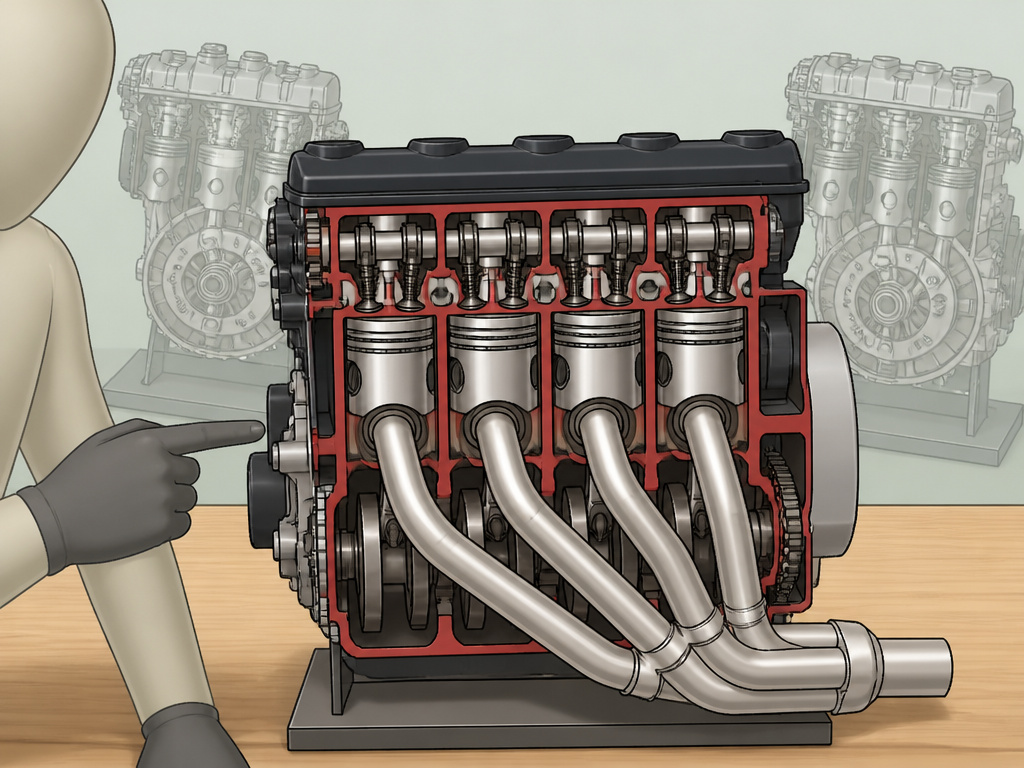
When you compare an inline four motorcycle engine pros and cons, this is the choice that matters. You’re not just picking an engine; you’re picking a riding experience.
- Inline-Four: Choose this for smooth, top-end power on open roads or track days. It rewards an aggressive, high-RPM riding style. Best for: Sport bike enthusiasts, experienced riders who love to rev.
- Parallel-Twin: This is the versatile all-rounder. Modern 270-degree cranks give them V-twin-like character with good low-end torque and a narrow package. Best for: Streetfighters, middleweight nakeds, adventure bikes, and new riders. They are the pragmatic choice for most.
- V-Twin: Character is king here. Strong low-end and mid-range punch, a deep throb, and a typically narrow engine. Best for: Cruisers, classic muscle bikes, and riders who prioritize instant throttle response over peak horsepower.
- Inline-Triple: The fascinating middle ground. It has the smoothness of a four and the low-end torque of a twin, with a distinctive off-beat growl. Best for: Riders who want a unique, exciting character without the width of a four.
| Engine Type | Best For | Power Delivery | Typical Compromise |
|---|---|---|---|
| Inline-Four | High-RPM performance, smoothness | Linear, top-end focused | Width, low-end torque, cost |
| Parallel-Twin | Versatility, real-world street riding | Strong mid-range, tractable | Can lack top-end excitement |
| V-Twin | Low-end torque, auditory character | Immediate punch, visceral | Often heavier, vibey at high RPM |
| Inline-Triple | Unique character, broad powerband | Strong mid-range, rev-happy | Less common, can be pricey |
A key part of the inline four motorcycle engine pros and cons is that the width of a transverse inline-four directly affects handling. In a sport bike, the engine is the main structural member (the “stressed member”). Its width sets the frame’s width, which determines how far you can lean before hard parts touch down. A longitudinal inline-four, like in old BMW K-series bikes, avoids this but introduces driveline complexity. For most modern sport bikes, the transverse layout is a necessary evil for packaging, but it’s a real constraint.
Real Ownership: Maintenance, Cost, and Longevity
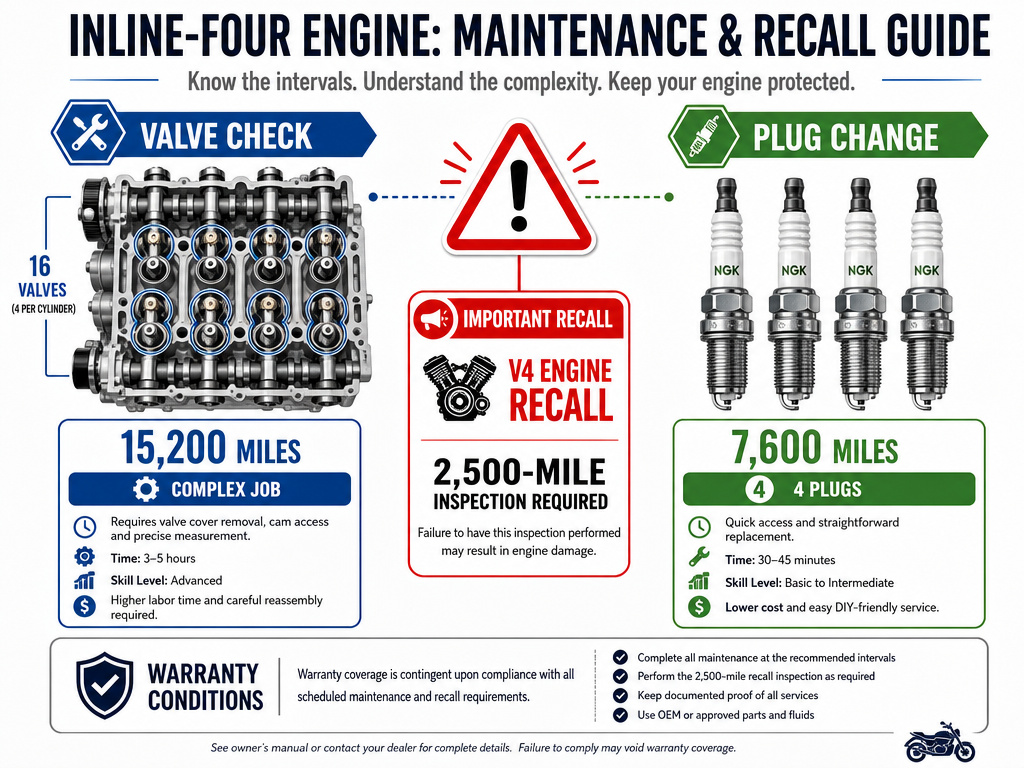
Forget generalizations. Here are the real numbers from service manuals. Valve clearance checks are the big-ticket service. A Kawasaki Ninja ZX-4R/RR calls for this check every 15,200 miles (24,000 km). That’s less frequent than some high-performance twins. However, accessing and adjusting 16 shim-under-bucket valves is a more involved, time-consuming job than adjusting 8 screw-and-locknut valves on many twins. The labor cost reflects that.
Spark plug changes are another multi-plug expense. The ZX-4R uses four NGK LMAR9G plugs, replaced every 7,600 miles (12,000 km). The 2009 Yamaha R1 schedule called for plug replacement every 8,000 miles (13,000 km).
Reliability is generally excellent, but complexity creates unique failure points. The sources show recalls aren’t abstract: the Ducati Multistrada V4 engine replacement recall and the Suzuki tappet/camshaft wear recall (with a 2,500-mile inspection threshold) are concrete examples. These issues are not common, but they illustrate that when a highly-strung inline-four has a problem, it can be major.
The part nobody mentions: Following the factory maintenance schedule isn’t just advice, it’s often a condition of keeping your warranty valid. U.S. Federal law prohibits the removal or rendering inoperative of emission control devices, with civil penalties up to $10,000 per violation. The Ducati warranty is forfeited if the bike is repaired or overhauled by an unauthorized workshop, or if non-original parts are used.
Who Should Buy an Inline-Four Motorcycle?
This isn’t about engine types. It’s about matching the machine to the mission.
- The Sport Rider / Track Enthusiast: This is the inline-four’s home turf. You want the high-RPM rush, the precise feedback, and the peak power for straights. The width is a trade-off you accept for the performance. A Yamaha R1 (crossplane) or a Kawasaki ZX-10R is your tool.
- The Commuter / Urban Rider: Think twice. An inline-four’s powerband is mismatched with stop-and-go traffic. The width makes filtering harder. A parallel twin or a single-cylinder engine is almost always a smarter, more engaging choice for the city.
- The Touring Rider: It depends. A sport-touring bike like a Kawasaki Ninja 1000SX offers sublime smoothness for eating highway miles. But for heavy, loaded touring with a passenger, the broad torque of a large parallel twin or a boxer engine might be less busy and more relaxing.
- The New Rider: Almost never. The lack of low-speed manners and the potential for high speed can be overwhelming. Start with a twin or a single. The Kawasaki Ninja 400 (a parallel twin) is the perfect beginner sport bike, not the ZX-4RR.
The Future of the Inline-Four
The landscape is shifting. Stricter global emissions regulations are harder for high-revving, large-displacement fours to meet across a wide rev range. At the same time, modern triples and twins are making more power more cleanly than ever before.
The future may lie in smaller, more focused applications. The runaway success of the Kawasaki ZX-4R proves there’s a hungry market for high-revving, small-displacement fours, they’re exciting, efficient within their power class, and often avoid top-tier licensing restrictions. This niche, where character and engineering passion trump pure utility, is where the inline-four’s soul will likely endure, even as the mainstream market continues to embrace twins and triples.
Frequently Asked Questions
What is the best inline-4 engine motorcycle for a beginner?
For a true beginner, there isn’t one. Even a small inline-four like the Kawasaki ZX-4RR demands to be revved hard to access its power, which is the opposite of what a new rider needs. Start with a forgiving parallel-twin like a Kawasaki Ninja 400 or a Yamaha MT-07. They offer manageable power everywhere in the rev range.
Is an inline-4 better than a V4?
“Better” depends on the goal. A V4 (like in a Ducati Panigale or Honda VFR) is typically more compact, allowing for better chassis geometry and cornering clearance. It often has stronger mid-range torque. An inline-four is usually simpler, cheaper to manufacture, and can rev higher for more peak horsepower. The V4 is often the more sophisticated, performance-focused choice.
Which is better, inline-4 or inline-3?
The inline-triple splits the difference. It’s smoother and can rev higher than a twin, has more character and low-end torque than an inline-four, and is usually narrower. The Triumph Street Triple is the classic example. The inline-four will typically make more top-end power and be smoother at the very top of the rev range, but the triple is often the more engaging and versatile street engine.
Is an inline-4 more reliable than a parallel-twin?
Not necessarily. Both configurations are fundamentally reliable. The inline-four has more moving parts (pistons, valves, etc.), which in theory increases potential failure points. However, modern manufacturing means both are extremely durable. The more significant difference is that when an inline-four does need service, it’s often more complex and costly due to that higher parts count and tighter packaging.
Are inline-4 motorcycles good for long-distance touring?
They can be excellent, depending on the bike. The inherent smoothness reduces fatigue on the highway. Sport-touring models like the Kawasaki Ninja 1000SX or Suzuki GSX-S1000GT are fantastic for fast, comfortable touring. However, for heavy, two-up touring with lots of luggage, a torque-focused twin-cylinder engine or a BMW boxer engine might offer more relaxed, low-RPM cruising.
The Bottom Line
Ignore the peak horsepower figure. The inline-four is about a specific sensation: mechanical refinement that builds into a soaring, seamless rush of speed. That sensation costs you low-end flexibility, a narrow cockpit, and a higher maintenance bill when it eventually comes due.
For the rider who lives for that feeling, who uses the top half of the tachometer regularly, no other engine type replicates it. For everyone else, the commuter, the casual backroad rider, the beginner, a modern twin or triple offers more accessible fun with fewer practical compromises. The inline-four isn’t dying; it’s just becoming a more deliberate, passionate choice in a world full of excellent alternatives.
