
How to Prevent Wrist Pain on a Motorcycle: Step-by-Step
This post contains affiliate links. As an Amazon Associate, we earn from qualifying purchases.
To prevent wrist pain on a motorcycle, you must address three things: your posture, your bike’s ergonomics, and the physical vibration coming through the handlebars. A neutral wrist position, adjusted controls, and core strength stop you from resting weight on your hands, while understanding vibration thresholds tells you when to take a break.
That’s the baseline. The rest is nuance — the kind that decides whether you ride for 30 minutes or three hours without that ache.
If you get the posture and fit right, most of the weight stays off your wrists, which is the core of how to prevent wrist pain on a motorcycle. The problem is that vibration works on a different timeline. It’s a physical transfer of energy that fatigues muscles and nerves regardless of how well you’re sitting. Ignore it, and you’re trading short-term comfort for a long-term health risk that regulations like the European Directive 2002/44/EC specifically try to prevent.
What follows is a five-step system for how to prevent wrist pain on a motorcycle by locking in your posture, adjusting your bike, and managing vibration. We’ll also walk through the data on what vibration actually does, because knowing the thresholds changes how you plan a long ride.
Key Takeaways
- Keep a neutral wrist position — your forearm and hand should form a straight line to the grip. A bent wrist transfers road shock directly into tendons.
- Adjust your handlebar and lever angles first. A simple rotation forward or back can add an inch of height, which a forum user found made a “huge difference” after an hour on an FZ-09.
- Use your core and legs to support your weight. Tank grips like Techspecs help you lock your knees and take pressure off your arms, especially during acceleration and braking.
- Understand the vibration exposure limits. The European Directive sets an action limit of 2.5 m/s² A(8) and an exposure limit of 5.0 m/s² A(8). Riding above these values regularly increases your risk of Hand-Arm Vibration Syndrome.
- If pain starts in 10-15 minutes, it’s likely an ergonomic issue. If numbness persists for hours after riding, it’s time to consider vibration exposure or consult a medical professional.
The 5-Step System to Stop Wrist Pain
This isn’t about random tips; it’s a sequence for how to prevent wrist pain on a motorcycle. Do these in order, because fixing your posture (step 1) changes how you need to adjust the bike (step 2).
Step 1: Lock In the Riding Position
Your body supports the bike; the bike doesn’t support you. That’s the whole game.
Sit on the bike in your normal riding stance. Now lift your hands an inch off the grips. If you pitch forward, you’re using your arms as a kickstand. The fix is in your lower body: squeeze the tank with your knees, engage your core, and keep your elbows slightly bent and relaxed.
Where this goes sideways: Gripping the bars for stability. It tenses your forearms, reduces steering control, and sends every bump straight to your wrists. You’ll feel it as a deep ache within 20 minutes.
The goal is a neutral wrist. Look at your hand on the grip. Your forearm and the back of your hand should be in one straight line. If your wrist is cocked up or down, you’re stretching tendons and compressing nerves every time you hit a bump.
Step 2: Adjust the Bike to Fit You
You can’t force a proper posture on a badly set-up bike. Start with the controls you touch most.
Handlebar/Clip-on Angle: Loosen the clamp and rotate the bar. A small change here has an outsized effect. An FZ-09 owner rotated his bars “about an inch forward” to raise the grips, and it made a “huge difference” on an hour-long ride. The goal is to achieve that straight-line wrist without slouching or reaching.
Lever Position: Sit on the bike and extend your fingers. The levers should meet your fingertips without you having to curl your wrist or stretch. Most levers can be angled up or down. Set them so your wrist stays flat when you operate them.
Footpeg and Seat: Your lower body anchors your upper body. If your pegs are too low or far back, it strains your hips and pulls your torso forward, loading your wrists. Adjustable rearsets can help, but even shifting your weight on the seat can rebalance the load.
| Adjustment | Target | Tool Needed |
|---|---|---|
| Handlebar Rotation | Neutral wrist, relaxed reach | Allen keys (usually 4-6mm) |
| Lever Angle | Fingertip contact with flat wrist | Allen key (often 3-4mm) |
| Throttle Cable Slack | 2-3mm of free play before engagement | Adjuster at the grip or throttle body |
| Clutch/Brake Lever Reach | Adjustable lever or aftermarket unit | Varies |
Step 3: Manage Grip and Vibration
You can have perfect posture and a dialed-in bike, but vibration still wears you down. It’s a physical energy transfer, not just a comfort issue.
The European Directive 2002/44/EC sets an action limit value for hand-transmitted vibration at 2.5 m/s² A(8). Exceed that regularly, and your risk of long-term damage climbs.
On-road vibration is often higher than engine vibration alone. One study measured hand-arm vibration on an underbone motorcycle at 8.28 m/s². That’s well above the exposure limit. One study of a suspended handlebar with optimized rubber mounts achieved a maximum attenuation of 79% at 3300–3400 rpm, bringing the hand-arm vibration value down to 3.41 m/s².
For most riders, anti-vibration solutions start with your gloves and grips.
- Gloves: Padding matters, but placement matters more. Look for gloves with palm sliders or gel padding that sits under your palm’s pressure points, not just on the surface. Good scaphoid protection also helps manage impact.
- Grips: Softer, larger-diameter grips can dampen high-frequency buzz. Heavier bar-end weights can reduce vibration in certain frequency ranges.
That said, don’t expect miracles from gloves alone. One peer-reviewed study notes that anti-vibration gloves are “generally ineffective especially in the lower weighted acceleration spectrum,” though some riders anecdotally report help from gloves with proper padding.
Step 4: Strengthen and Stretch Off the Bike
Riding is an endurance activity. If your muscles fatigue, your form breaks, and the pain starts.
Focus on forearm flexors and extensors, your grip, and your core. You don’t need a gym.
- Forearms: Wrist curls (palms up and down) with a light weight or resistance band.
- Grip: Squeeze a stress ball or use a hand gripper.
- Core: Planks and dead bugs. A strong core helps you hold yourself up without leaning on the bars.
Stretch before and after riding. Simple wrist stretches—pulling your fingers back gently, rotating your wrists—increase blood flow and flexibility. This is one of the most effective rider exercises you can do.
Step 5: Build Smart Riding Habits
Your technique on the road is the final layer. It’s how you maintain the work you did in steps 1-4.
- Relax Your Grip: Hold the bars like you’re holding a baby bird. You need control, not a stranglehold. Consciously shake out your fingers every few minutes.
- Use Your Legs: Under braking, press your knees into the tank to keep your body from sliding forward into the bars. Under acceleration, let your legs, not your arms, support you against the wind.
- Plan Your Breaks: If you’re riding near the vibration action limit (2.5 m/s²), ISO 5349 suggests a 10% chance of finger blanching after 12 years of exposure. At the exposure limit (5.0 m/s²), that 10% chance occurs after 5.8 years. Take a 10-minute break every hour to interrupt the exposure cycle. This also helps with general fatigue and arm pump.
The Vibration Problem You Can’t Ignore
Most wrist pain guides talk about posture and call it a day. They miss the half of the problem that’s built into the machine.
Vibration is measured in meters per second squared (m/s²). It’s not subjective. A 1996 study reported vibration from 2.2 to 4.9 m/s², while a 2016 study reported a range from 3.82 to 9.77 m/s² at the lower frequency spectrum, with on-road conditions often producing higher values due to tire-road interaction.
Why does this matter past the tingling? Prolonged exposure to vibration above the 2.5 m/s² A(8) action limit is linked to Hand-Arm Vibration Syndrome (HAVS). The symptoms start with tingling and numbness, can progress to loss of grip strength, and in advanced stages cause finger blanching (Raynaud’s phenomenon). A survey found a 4.2% prevalence of finger blanching among police traffic motorcyclists in Japan.
Common mistake: Thinking vibration is just a comfort issue. It’s a documented occupational health risk with defined exposure limits. Discomfort is your body’s early warning system.
The frequency matters, too. For the motorcycle in one study, the typical cruising frequency range was 50–58 Hz, corresponding to an engine speed of 3000–3500 rpm. This is where your hands are most sensitive, and where standard anti-vibration gloves do little. Engineering solutions, like the suspended handlebar with optimized rubber mounts described in the peer-reviewed handlebar vibration research, target these specific frequencies.
Sportbike vs. Cruiser vs. Adventure Bike: The Pain Profile Changes
Your bike’s geometry dictates the fight. A one-size-fits-all solution doesn’t work.
Sportbikes (e.g., Ducati 899 Panigale, Yamaha FZ-09): The aggressive, forward-leaning posture loads the wrists by design. The fix is often in micro-adjustments and conditioning.
- Solution: Rotate clip-ons, consider adjustable rearsets to change hip angle, use tank grips religiously. A Ducati.ms forum user found that adjustable rearsets helped alleviate wrist pressure more than adjustable clip-ons. Ride in a full tuck at speed to let wind pressure support your chest.
Cruisers: The challenge is often reach and vibration. You might be leaning back, but if you’re reaching forward for high bars, you’re still loading your wrists.
- Solution: Adjust or replace handlebars to bring them closer. Heavier bar-end weights and cushioned grips are highly effective on the large-diameter bars cruisers often use.
Adventure Bikes: The upright posture is forgiving, but long-distance riding and off-road vibration present unique fatigue.
- Solution: Throttle assists or cruise control are game-changers for highway miles. For off-road, focus on a loose grip and letting the bars move independently in your hands.
The principles of motorcycle ergonomics apply to all, but the levers you pull first depend on the bike between your legs.
When Is It Time to See a Doctor?
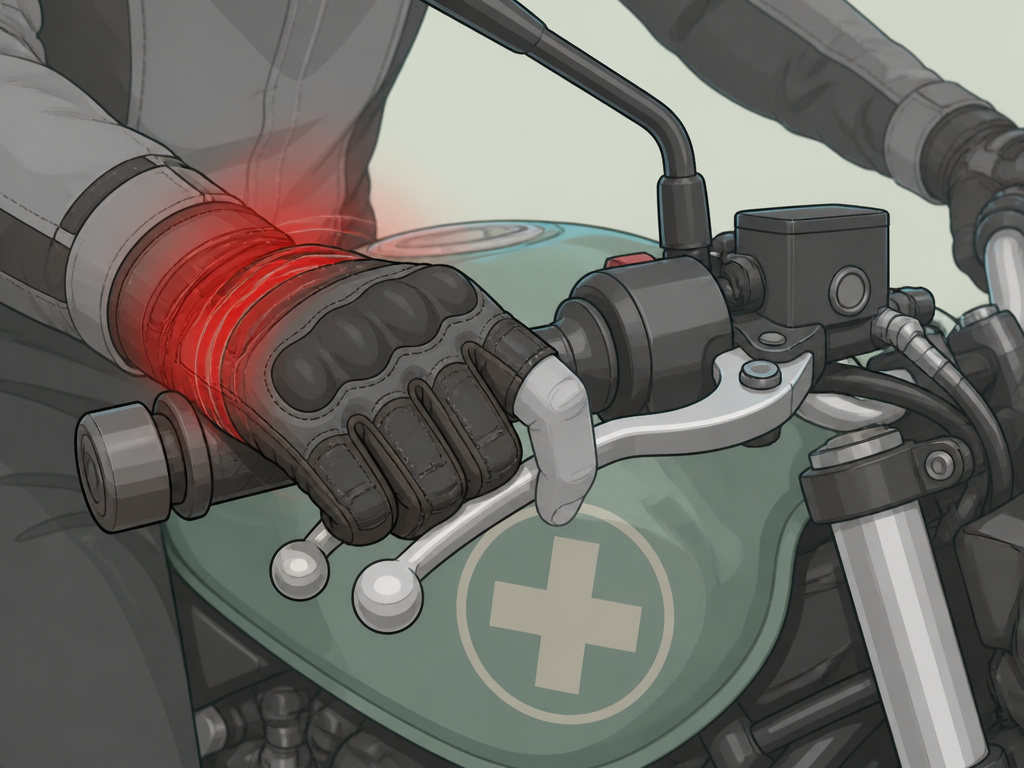
You can adjust your bike and perfect your posture, but some pain signals a deeper problem.
See a doctor or physiotherapist if:
- Numbness or tingling persists for hours or days after you get off the bike.
- You have weakness in your grip or you start dropping things.
- The pain is sharp, localized to a specific tendon (like the base of your thumb), or wakes you up at night.
- Simple adjustments make no difference after a few rides.
These could be signs of conditions like carpal tunnel syndrome, tendonitis, or an underlying nerve issue. A doctor can provide a definitive diagnosis and treatment, which might include splints, physical therapy, or corticosteroid injections. Pushing through nerve pain can cause permanent damage.
Easy to miss: Pain that’s only in your clutch (left) hand. This often points to a specific tendon issue aggravated by the pull-and-hold action, not just general vibration. It might need a medical diagnosis, not just a lever adjustment.
How can mental focus reduce wrist pain?
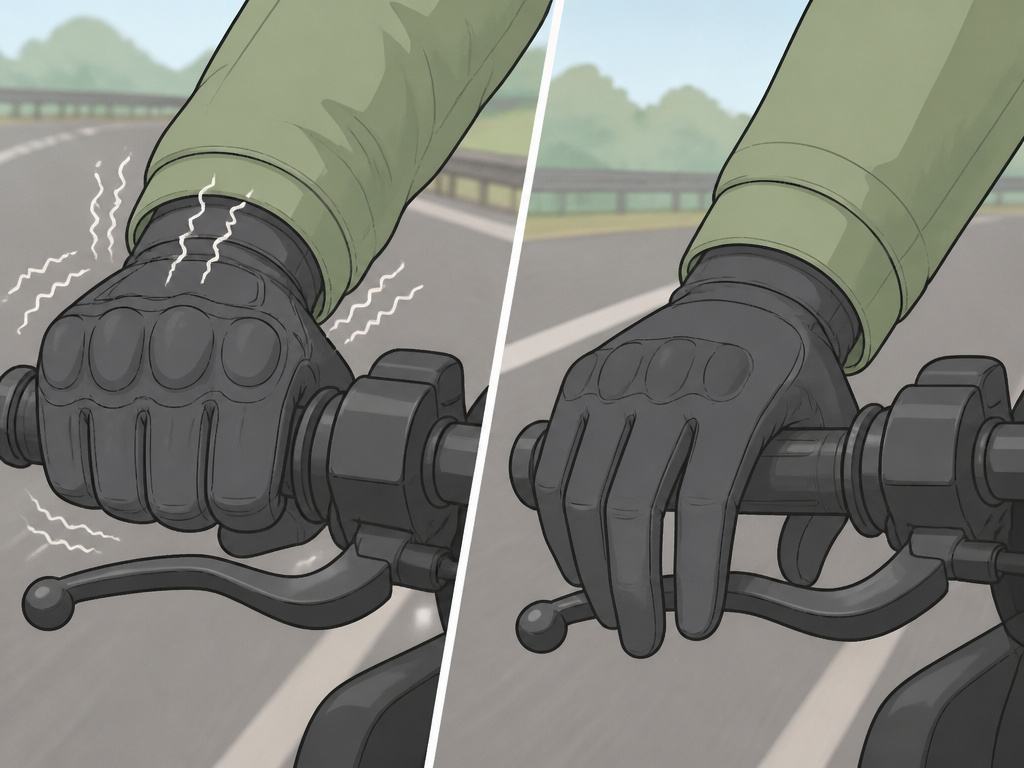
Your mental state directly affects your posture and grip. Stress and distraction cause you to tense up, locking your elbows and bearing down on the handlebars. This transfers more vibration directly into your wrists and hands. A study of 884 occupational motorcyclists shows that musculoskeletal disorders are prevalent, and a separate survey found over 50% of riders report hand and arm discomfort, which can be worsened by a rigid riding style. Focus on keeping your breathing steady and your gaze up the road. Consciously relax your shoulders and maintain a light, flexible grip on the bars. This mental practice reduces the static load on your wrists, allowing your body to absorb bumps and vibration more effectively instead of fighting them.
Frequently Asked Questions
Why do my wrists hurt when I ride a motorcycle?
Wrist pain usually comes from a combination of poor posture (resting your weight on your hands), incorrect bike ergonomics (forcing a bent wrist), and handlebar vibration. The vibration physically fatigues muscles and nerves, while the posture and ergonomics strain tendons and compress nerves.
What is the 12-second rule on a motorcycle?
The “12-second rule” is a following-distance guideline for motorcycles, recommending you stay at least 12 seconds behind the vehicle in front of you to ensure enough time to react and stop. It is not directly related to wrist pain.
How can I prevent my wrists from hurting when I bike?
The core principles are the same: maintain a neutral wrist, use your core and legs to support your weight, ensure your bike’s handlebar and controls are adjusted to fit you, and take regular breaks to reduce fatigue. For bicycles, saddle fore/aft position is as critical as handlebar height.
What is the 4-second rule for motorcycles?
The “4-second rule” is another following-distance guideline, suggesting a minimum four-second gap between you and the vehicle ahead in poor conditions like rain or fog. Like the 12-second rule, it’s a safety practice, not an ergonomic tip.
Are throttle assists worth it for wrist pain?
For long-distance touring or highway riding, absolutely. A throttle lock or electronic cruise control allows you to relax your right hand completely, eliminating the constant gripping and twisting that leads to fatigue and numb hands. For short commutes, they’re less critical.
Do gloves really help with wrist pain?
They can, but it depends on the cause. Gloves with good palm sliders and strategic padding can dampen impact and pressure points. However, research shows they are largely ineffective at dampening the low-frequency vibration that causes much of the neuromuscular fatigue. Focus on proper glove fit first, then look for targeted padding.
The Bottom Line
Wrist pain isn’t a badge of honor. It’s a solvable problem with a mechanical cause.
Start with your body: straight wrists, bent elbows, a engaged core. Then adjust the machine: rotate the bars, angle the levers, maybe add some tank grips. That fixes maybe 80% of it. The last 20% is about managing the vibration you can’t adjust away — knowing the limits, taking breaks, and considering tools like handlebar risers or throttle locks for the long hauls.
If the pain shows up in the first quarter-hour, you’re looking at a fit issue. If the numbness lingers long after you’ve parked, listen to it. That’s your body flagging a risk that occupational health standards have quantified for decades. Sometimes the fix is in your garage. Sometimes it’s in a doctor’s office. Understanding the difference helps you ride longer and safer.
