
How to Pack a Motorcycle for a Long Trip: Step-by-Step
This post contains affiliate links. As an Amazon Associate, we earn from qualifying purchases.
Packing a motorcycle for a long trip is a balance of physics and foresight. The goal is to keep the combined weight of rider, passenger, and cargo under the bike’s maximum load limit, distribute that weight low and centered, and secure everything so it cannot shift. Ignoring the manufacturer’s weight limits or loading items high on the bike changes its handling, increases stopping distance, and can lead to a loss of control.
That physics lesson is written in every owner’s manual, but the numbers are specific. A Honda NT1100 has a 194 kg (428 lb) total capacity. A Ducati Multistrada V4 allows 470 kg (1,036 lb). Your bike’s limit is not a suggestion; it’s the line where the suspension, brakes, and frame are no longer engineered to work safely. Knowing how to pack a motorcycle for a long trip starts with respecting this limit.
What follows is the system for how to pack a motorcycle for a long trip: how to calculate your load, choose luggage within your motorcycle’s specific weight limits, and physically pack the bike so it feels planted, not ponderous. We will use the specific limits from the manuals and show where brands disagree, because your safety depends on knowing the rules for your specific motorcycle.
Key Takeaways
- Your bike’s maximum load limit is a hard ceiling set by the manufacturer; exceeding it voids your warranty and makes the motorcycle unsafe to operate.
- Pack weight low and centered, with the heaviest items like tools directly over the bike’s center of gravity, to maintain stability in corners and during braking.
- Secure every item so it cannot shift; a loose tank bag or poorly strapped duffel creates a sudden, dangerous weight transfer mid-corner.
- Dry bags and packing cubes are not just for organization; they compress gear and create a solid, stable block of cargo that is easier to secure and balance.
- Test your loaded bike in a parking lot before you leave; if the steering feels heavy or the bike wallows, you need to repack.
Find Your Bike’s Real Weight Limit First
You cannot pack intelligently if you do not know your budget. The most important number is not the luggage capacity, but the Gross Vehicle Weight Rating (GVWR) or maximum load limit. This is the total allowable weight of the motorcycle, rider, passenger, fuel, and all cargo.
The numbers in the manuals are not estimates. They are engineering limits.
The Honda NT1100 owner’s manual states a maximum weight capacity of 194 kg (428 lb) for rider, passenger, and luggage, with an absolute luggage weight not to exceed 21 kg (46 lb). The Yamaha XT1200ZE Super Ténéré has a 204 kg (450 lb) total load limit.
To find your number, you need to do some math. Start with your bike’s wet weight (full of fuel) and subtract it from the GVWR. The result is your usable payload. Then, subtract your weight and your passenger’s weight. What remains is what you can actually pack.
This is not a theoretical exercise. An overloaded motorcycle wears out tires and brakes faster, overheats the engine and transmission, and most critically, handles poorly. The front end gets light, making steering vague. The rear suspension sags, reducing ground clearance and compromising the geometry designed to keep you upright in a turn.
| Motorcycle Model | Total Weight Capacity | Luggage Weight Limit | Key Restriction |
|---|---|---|---|
| Honda NT1100 | 194 kg (428 lb) | 21 kg (46 lb) | Avoid large fork/handlebar fairings |
| Yamaha XT1200ZE | 204 kg (450 lb) | Not specified | Never attach heavy items to handlebar/fork |
| Ducati Multistrada V4 | 470 kg (1,036 lb) | 30 kg (66 lb) total | Speed limits with luggage: 180 km/h (112 mph) or 160 km/h (100 mph) |
Where this goes sideways: Assuming “close enough” is good enough. If your bike’s limit is 450 lbs and you, your gear, and your passenger hit 455 lbs, you are officially overloaded. The suspension is working beyond its design, the brakes are insufficient, and your insurance could deny a claim if they discover the violation after an accident. Weigh yourself, your passenger, and your packed luggage on a bathroom scale. It takes ten minutes and removes the guesswork.
The Gear You Actually Need (and What to Leave)
The core of how to pack a motorcycle for a long trip is an exercise in brutal editing. The space you have is fixed. The weight limit is fixed. Every item must justify its place by serving at least two purposes or being critical to safety.
Your essential packing list breaks into three categories: riding gear, camp/hotel gear, and tools. Riding gear is what you wear; it does not go in the bags. Camp/hotel gear is your shelter and comfort. Tools are your mechanical insurance.
Riding Gear (Worn, Not Packed):
- Helmet: ECE 22.06 or equivalent certification. A well-fitted mid-priced helmet beats a poorly fitted flagship every time.
- Jacket & Pants: Armored and preferably with a waterproof liner. Mesh with real CE armor is safer in heat than leather you leave behind.
- Gloves: Two pairs. A summer pair and a waterproof insulated pair. Your hands are the first point of contact in a fall.
- Boots: Must protect the ankle and shin. Short boots are sneakers with a logo.
- Baselayers: Moisture-wicking. Cotton is a sponge and will chill you.
Camp/Hotel & Personal Gear:
- Shelter: Tent, sleeping bag, pad (if camping). Opt for compact, lightweight backpacking gear.
- Clothing: Pack for three days, not three weeks. Merino wool or synthetic layers that can be washed and dried overnight. One “civilian” outfit.
- Rain Gear: A dedicated waterproof suit that goes over your riding gear. Do not rely on your jacket’s liner in a prolonged storm.
- Toiletries: Miniatures. A quick-dry towel.
Tools & Repair Kit (Non-Negotiable):
- Bike-specific toolkit (often under the seat).
- Tire repair kit (plug strings, CO2 cartridges, or mini compressor).
- Multitool, duct tape, zip ties, a length of paracord.
- Spare fuses, clutch/brake lever (if prone to breaking).
- Electrical tape and a few feet of wire.
Common mistake: Packing for the “what if.” That extra pair of shoes, the heavy hardcover book, the full-size toiletry bottles. They add pounds and bulk, forcing you to pack higher on the bike. A pressure spot you notice in ten minutes will be a real problem at two hours; an item that seems “handy” at home becomes dead weight by day three.
The repair kit is the one place not to skimp. A $30 tire plug kit and a $50 mini compressor can save a $300 tow and a ruined day. Build this kit during your road trip planning phase, not the night before you leave.
Choosing and Using Motorcycle Luggage
Your luggage is your mobile closet. The right types of motorcycle luggage turn a pile of gear into a secure, aerodynamic load. The wrong choice turns it into a parachute.
Saddlebags/Panniers: These are the foundation. Hard cases (like Givi or OEM options) offer security and weather protection. Soft panniers (like Kriega or soft luggage systems) are lighter and more flexible. Hard cases have a defined shape, which makes packing a puzzle. Soft bags conform to your gear, but you must be meticulous about securing them to the bike so they do not flap.
- Best for: Bulky, heavy items. Keeps weight low and symmetrical.
- Weight Rule: For example, the Ducati Multistrada V4 manual specifies a maximum of 10 kg (22 lb) per side bag. Balance them within a pound or two.
Tail Bag/Rack Pack: Sits on the passenger seat or luggage rack. This is your primary zone for heavy, dense items because it places weight directly over the rear axle, close to the bike’s center.
- Best for: Tools, tire repair kit, chain lube.
- Weight Rule: Keep it as far forward on the seat as possible. A bag hanging off the back acts as a lever, lifting the front end.
Tank Bag: Offers easy access to frequently needed items like phone, wallet, map, or sunscreen. Magnetic bags are quick but can scratch paint. Strapped bags are more secure.
- Best for: Light, frequently accessed items.
- Weight Rule: For example, the Multistrada V4 limits a tank bag to 5 kg (11 lb). Even a light bag changes how the steering feels; a heavy one makes the front end sluggish.
Handlebar or Fork Bags: A Warning.
This is a clear point of contention between aftermarket practice and manufacturer rules. Manufacturers disagree on this point: the Yamaha XT1200ZE manual states “Never attach any large or heavy items to the handlebar, front fork, or front fender,” while the Honda NT1100 manual says the fitting of large fork-mounted or handlebar-mounted fairings is not recommended. Weight on the forks drastically changes steering geometry and damping, leading to unstable, unpredictable handling, especially under braking. I avoid them entirely.
When selecting the best motorcycle luggage, prioritize secure mounting and waterproofing over extra pockets. A leaking bag or one that comes loose at highway speed defeats the purpose.
The 4-Step Packing Sequence That Stops the Wobble

Packing is a sequence, not a random pile. This is the physical process that ensures balance and accessibility.
Step 1: Pack the Bags on the Ground.
Lay your empty bags out in your living room. Pack each bag as its own unit, using packing cubes or dry bags inside to organize and compress.
- Saddlebags: Distribute similar weight categories side-to-side. Put your clothing cube in the left, your camp kitchen in the right. Weigh them before they go on the bike.
- Tail Bag: Pack your heaviest, densest items here first. Tools, repair kit, chain lube. This becomes the core of your load.
- Tank Bag: Snacks, electronics, documents. Keep it light.
Step 2: Mount the Bags Empty.
Secure all your empty luggage to the bike. Adjust straps, check mounting points, and ensure nothing flaps. This verifies your mounting system works before the bags are heavy.
Step 3: Load the Heavy Core.
Place your pre-packed tail bag onto the seat or rack and secure it. This is your anchor weight. Then, lift and secure your pre-packed and pre-weighed saddlebags. The goal is symmetrical weight from the start.
Step 4: Fill the Gaps & Secure Everything.
With the main bags secured, you can now add lighter, bulkier items like your sleeping bag or tent. These often go on top of the tail bag or in a duffel across the saddlebags. Use Rok Straps or a cargo net for the final layer. Tug hard on every strap. Nothing should move.
I learned this sequence after a trip where I packed one saddlebag at a time on the bike. The bike listed to one side in the garage. I had to unpack and start over. Now I treat the bags like building blocks—each one balanced and complete before it touches the motorcycle.
Test before you ride. Sit on the loaded bike. Does it feel balanced left to right? Roll it forward and back. Does the cargo shift? Apply the front brake firmly. Does the weight lurch forward? If anything feels off, repack. A wobbly feeling at 30 mph in a parking lot becomes a terrifying tank-slapper at 70 mph on the interstate.
Packing for Two-Up: Sharing the Load
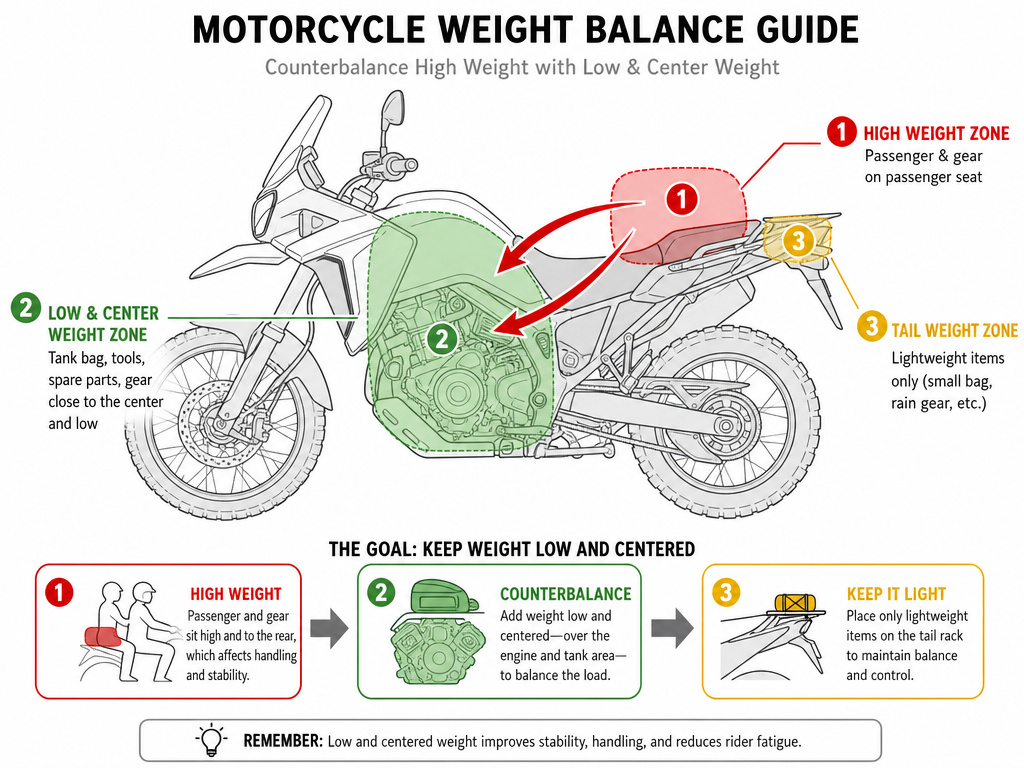
Adding a passenger changes everything. Their weight is high and behind the axle, which already lightens the front end. Your cargo capacity is now split three ways: you, them, and gear.
First, recalculate your weight budget. If your bike has a 450 lb limit and you and your passenger weigh 350 lb combined, you have only 100 lb for all gear, not the 150 lb you had solo. This demands even more severe editing of your packing list.
The Passenger’s Role.
Your passenger can wear a small backpack with their personal items—a water bladder, their gloves, a light layer. This takes a few pounds off the bike and puts it on a person, where it has less effect on handling. They should not wear a large, heavy backpack; it restricts their movement and can throw off their balance.
Repositioning the Load.
With two-up, keeping weight low and forward is even more critical. The passenger’s weight is already high and rearward. You must counter this by packing the heaviest cargo as far forward as possible. This might mean using a tank bag for slightly heavier items (within its limit) or ensuring the tail bag is pushed all the way forward onto the seat, not hanging off the back.
Suspension and Tire Pressure.
This is mandatory. Adjust your rear preload for the combined weight. Most modern bikes have a dial or knob for this—consult your manual. Also, increase your tire pressures to the manufacturer’s recommended “fully loaded” setting, usually found on a sticker on the swingarm or in the manual. The bike will handle more predictably and you will avoid overheating the tires.
The rules for motorcycle luggage weight limits are not relaxed with a passenger; they are more important than ever.
Manufacturer Rules You Cannot Ignore
The manual is law. Beyond weight limits, manufacturers impose specific rules for riding with luggage. Ignoring them can void warranties and create real danger.
Speed Restrictions.
This is where brands disagree, so you must know your bike’s specific rule.
- Ducati imposes numerical limits. The Hypermotard 950 must not exceed 180 km/h (112 mph) with side bags and top case. The Multistrada V4 has a tiered system: 180 km/h (112 mph) with two luggage types, dropping to 160 km/h (100 mph) with all three (top case, tank bag, and side bags).
- Yamaha and the Honda NT1100 give qualitative warnings to “use extra care” and “ride at a safe speed” but do not specify a number.
The takeaway is to check your specific manual: Ducati imposes numerical speed limits with luggage, while Honda (for the NT1100) and Yamaha give qualitative warnings to “use extra care” and “ride at a safe speed” without specifying a number. High speed with a top case, which acts like a sail, can induce wobbles. Respect the most conservative rule that applies to you.
Accessory and Modification Warnings.
The Honda NT1100 manual contains a blanket warning: non-Honda accessories or modifications “can make it unsafe, may also void your warranty, and make your vehicle illegal to operate on public roads.” This is a legal shield for them, but it makes a real point: bolting on untested luggage racks or heavy electrical accessories can stress mounting points not designed for it.
Before you buy that best motorcycle hard case or set of best motorcycle panniers, verify the mounting kit is approved for your model and that you are not exceeding any per-case weight limits specified by the luggage manufacturer, which may be lower than your bike’s total limit.
How to do laundry on a motorcycle trip
Packing light means planning to wash clothes during your journey. Carrying a small supply of travel detergent and a universal sink stopper allows you to wash essentials in a hotel or campground sink. Quick-drying synthetic fabrics are ideal, as they can be rinsed at night and often dry by morning. When packing wet items, use a separate waterproof bag to keep the rest of your gear dry. Remember to distribute the clean and damp laundry weight evenly in your luggage to maintain the motorcycle’s balance and stability, keeping the load low and close to the center of the bike.
Frequently Asked Questions
What is considered a long motorcycle trip?
Long trip is any journey where you will be away for multiple days, requiring you to carry luggage for lodging, clothing, and repairs. Distance is less important than duration and self-sufficiency. A three-day 500-mile trip requires more planning and packing than a single-day 700-mile blast.
How do you pack clothes on a motorcycle trip?
Use packing cubes or roll clothes tightly to save space. Pack for a three-day cycle: two riding outfits (base layers), one casual outfit, and socks/underwear for each day. Choose quick-dry synthetic or merino wool fabrics that can be washed in a sink and dried overnight. The goal is repetition, not a unique outfit for every day.
Where do you put heavy items on a motorcycle?
Heavy items like tools, a tire repair kit, or chain lube go as low and as close to the motorcycle’s center of gravity as possible. This typically means in the bottom of saddlebags or in a tail bag positioned forward on the passenger seat. Never pack heavy items high up or in a tank bag, as this raises the center of gravity and makes the bike feel top-heavy and unstable.
How much weight can you put on a motorcycle luggage rack?
There is no universal answer. The capacity depends on your specific motorcycle model and the rack itself. Consumer luggage racks may have a very low limit, while heavy-duty OEM racks might handle more. You must check your motorcycle’s owner’s manual and the rack manufacturer’s specifications. Exceeding this limit can crack the rack or the subframe it attaches to.
What is the most common motorcycle packing mistake?
Overpacking. Riders consistently bring too much “just in case” gear. This forces them to pack items high and loose, creating a tall, unstable load that sways in corners and strains mounting points. The second most common mistake is failing to secure the load properly, leading to shifting cargo that changes the bike’s balance while riding.
The Bottom Line
Packing a motorcycle is a test of discipline. The space is limited, the weight budget is fixed, and the physics are unforgiving. Your bike’s manual gives you the numbers—the maximum load limit, the luggage weight caps, sometimes even a speed restriction. Those are your boundaries.
Within them, your job is simple: pack less than you think you need, secure it so it becomes part of the bike, and keep the weight low. The reward is a motorcycle that handles predictably, a journey that is about the ride and not the baggage, and the confidence that comes from knowing your setup is safe.
Start with your manual’s weight limit. Build a minimalist touring packing list. Choose luggage that mounts securely. Then follow the sequence: pack on the ground, load the heavy core low, and secure everything twice. That process turns a daunting task into a routine, and a routine is what keeps you rolling mile after mile.
