
How to Charge a Motorcycle Battery: Step-by-Step
This post contains affiliate links. As an Amazon Associate, we earn from qualifying purchases.
How to charge a motorcycle battery requires matching three things: the battery type (AGM, lithium, or lead-acid), the correct charger, and a strict safety sequence. For a standard 12V AGM battery, use a smart charger set to 1-3 amps, connect positive first with the charger off, and charge until the voltage reads at least 12.6V. Never use a car charger or a constant-current trickle charger on a sealed AGM battery.
The voltage threshold is not a suggestion when you consider how to charge a motorcycle battery. A battery reading below 12.6 volts is actively sulfating—lead sulfate crystals are forming on the plates and reducing its capacity. Letting a battery sit discharged accelerates sulfation and reduces its lifespan. This isn’t about convenience. It’s about preventing a $150 replacement.
What follows is the sequence that matches factory service manuals. This section explains the mandatory safety gear, the one connection mistake that can fry your bike’s electronics, and how to read the conflicting advice from Harley-Davidson and Indian Motorcycle on storage charging. You will also get the specific charger models each manufacturer actually names.
Key Takeaways
- Disconnect the battery from the bike first. Factory manuals from Harley-Davidson and others mandate removal to prevent acid damage to chassis parts.
- Use a modern smart charger, not a constant-current trickle charger. For AGM batteries, Harley-Davidson explicitly warns against old-school trickle chargers, recommending automatic, constant-monitoring units.
- Charge in a well-ventilated area, every time. Batteries release explosive hydrogen gas during charging; a spark from a furnace or water heater can ignite it.
- The voltmeter is your guide. Harley-Davidson advises charging if the voltage is below 12.6V, while another of their documents uses a threshold of below 12.7V. Let it stabilize for an hour after charging; a healthy battery will hold at least 12.7V.
- Storage frequency depends on temperature. Harley says monthly below 60°F; Indian says every two weeks in the vehicle. In a warm garage, err on the side of every two weeks.
Before You Start: The Non-Negotiable Safety Gear
This is not optional PPE. The sulfuric acid inside a battery will permanently scar skin and blind eyes. The hydrogen gas it vents is explosive. The terminals carry enough current to weld metal.
Harley-Davidson’s service procedure lists the exact kit: a protective face shield, rubberized gloves, and protective clothing. Not safety glasses—a full shield. The difference is that glasses won’t stop a vertical splash from a boiling cell. You also need a well-ventilated space, away from any open flame, spark, or pilot light.
Where this goes sideways: Charging a battery still in the bike because “it’s easier.” If the battery vents or leaks, the sulfuric acid runoff will corrode wiring harnesses, frame paint, and engine cases. The repair bill will dwarf the cost of a new battery. Harley’s manual states this directly: “Electrolyte leakage will damage motorcycle parts.”
Grab your gloves and shield. Get the battery out.
How to Charge a Motorcycle Battery: Step-by-Step Safety
A dead battery feels like a single problem. It’s actually two: the lack of charge and the reason it died. We’ll solve the first one here. The second one requires a battery test with a multimeter after it’s charged.
- Disconnect and Remove the Battery. Turn the ignition off. Always disconnect the negative (-) terminal first. This prevents a short circuit if your wrench accidentally touches the frame while loosening the positive terminal. Lift the battery out carefully. This is the rule from every OEM manual we reviewed.
- Clean the Terminals. Corrosion is a resistor. It slows charging and prevents a clean, shiny metal connection. Scrub the terminals and cable ends with a wire brush or sandpaper until they’re shiny metal.
-
Perform a Voltmeter Test. This tells you how dead it is. Set your multimeter to DC volts and touch the probes to the corresponding battery terminals.
Voltage Reading State of Charge Action Required 12.7V 100% Battery is charged. Reinstall. 12.6V 75% Charge to top off. 12.3V 50% Charge immediately. 12.0V 25% Deep discharge. Charge, then test. 11.8V or below 0% Severely discharged. May be damaged. If your reading is below 12.6V, proceed to charging. If it’s at 11.8V or lower, the battery may have permanent damage, but a slow charge is worth an attempt.
-
Connect the Charger — With It OFF. This is the most common mistake. Ensure your smart charger is unplugged from the wall and its power switch is off. Connect the red positive (+) clamp to the positive terminal. Then connect the black negative (-) clamp to the negative terminal. Double-check the polarity. Reversing these will destroy most modern chargers and can ruin your battery.
- Set the Charger and Plug It In. Place the charger away from the battery, then plug it into the wall and turn it on. For a typical 12-20 Ah motorcycle AGM battery, a 1-2 amp setting is ideal. A higher amp setting than recommended can damage the battery.
- Monitor and Complete the Charge. A smart charger will switch to a float/maintenance mode when done. This can take several hours depending on the battery’s state of charge and the charger’s amperage. If the battery case feels hot to the touch, unplug the charger immediately. Let it cool before resuming.
- Disconnect and Retest. Once the charger indicates “full” or “float,” turn it off and unplug it. Disconnect the negative clamp first, then the positive. Wait an hour, then take a final voltage reading. A fully charged, healthy AGM battery should hold at least 12.7 volts.
The part nobody mentions: After a full charge, gently tap the sides of the battery. This dislodges tiny air bubbles trapped on the cell plates, which can slightly increase the electrolyte’s contact area and the battery’s measured voltage. It’s a small thing, but it’s in the Harley-Davidson dry-charge battery procedure for a reason.
If the battery passes the final voltage test, clean the terminals once more, apply a light coat of dielectric grease, and reinstall it in the bike—positive terminal first.
Choosing the Right Charger: Smart vs. Dumb

All chargers are not the same. Using the wrong type is the fastest way to turn a recoverable battery into a paperweight.
A smart charger (or maintainer) is a microprocessor-controlled unit. It applies a bulk charge, then switches to an absorption phase, and finally a float/maintenance mode that prevents overcharging. This is what you want.
A dumb charger, often called a constant-current or trickle charger, applies a fixed current until you unplug it. It will eventually overcharge the battery, boiling off electrolyte and cooking the plates.
Here is the critical conflict straight from the manuals: One Harley-Davidson document states, “The use of constant current chargers (including trickle chargers) to charge sealed AGM batteries is not recommended.” Another, older Harley manual says a “trickle charger… With a 1 amp charging rate (or less) may be used.”
Which do you follow? The newer advice. AGM batteries are intolerant of overcharge. The risk with a dumb trickle charger is too high. Spend the extra $25 on a smart charger.
| Charger Type | How It Works | Best For | Risk If Used Wrong |
|---|---|---|---|
| Smart Charger | Automatic multi-stage charging; switches to float. | All modern batteries (AGM, Lithium). | Almost none. The safest, set-and-forget option. |
| Trickle Charger | Constant, low-amperage current until unplugged. | Old, serviceable lead-acid only. | Overcharges and destroys sealed AGM batteries. |
| Car Battery Charger | High-amperage (10-50A) for large batteries. | Cars, trucks. | Will fry a motorcycle battery in under an hour. |
Manufacturers have specific picks. Indian Motorcycle recommends the BatteryMINDer 2012 AGM 2-AMP charger (part 2830438). Ducati approves the TecMate BatteryMate 150-9 and Optimate Pro 4 for lead-acid batteries. For a general, reliable smart battery charger, a NOCO Genius or Battery Tender brand unit covers most bikes.
Battery Types: AGM vs. Lithium vs. Lead-Acid
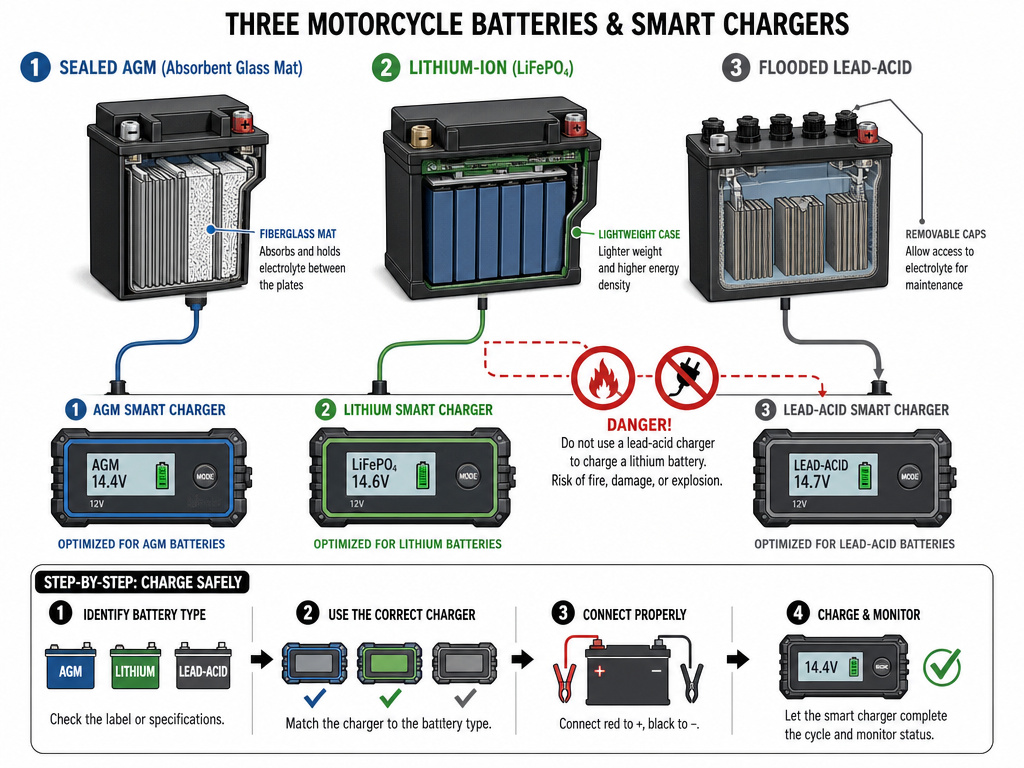
The charging procedure changes completely based on what’s inside the case. Hooking a lithium battery to a lead-acid charger can cause a fire.
Sealed AGM (Absorbent Glass Mat): This is the standard in nearly all modern motorcycles. The electrolyte is suspended in a fiberglass mat, making it spill-proof. It must be charged with a smart charger designed for AGM or “sealed” batteries. Maximum charge voltage should not exceed 15 volts.
Lithium-Ion (LiFePO4): Found in performance and adventure bikes to save weight. It requires a dedicated lithium charger. Ducati’s protocol is strict: for their lithium batteries, you must use the Ducati-approved charger (part no. 69929011AZ) regardless of the battery’s voltage. For Ducati Lithium-Ion batteries, if the static voltage is equal to or higher than 8 Volts, fully charge the battery before installing.
Flooded Lead-Acid: The old serviceable type with removable caps. You can check and refill the electrolyte level with distilled water. These are more forgiving of simple chargers but still prefer a smart unit.
I swapped a lead-acid for a lithium battery on a touring bike to test the weight claim. The weight savings from a lithium battery on a heavy touring motorcycle may not be noticeable. The lithium battery was also noticeably weaker cranking the engine on a 45°F morning. For the cost and the need for a special charger, the benefit for most riders is marginal. A quality AGM is the default pick.
If you’re deciding between them, our comparison of battery types breaks down the real-world trade-offs beyond the marketing.
When and How to Charge During Storage
A battery on a parked bike is not asleep. It’s slowly dying from self-discharge and the tiny draw of the bike’s computer and alarm. The rate depends on temperature.
Harley-Davidson’s official stance: Charge the battery every month if stored below 60°F (16°C). Charge it more frequently if stored above 60°F. Indian Motorcycle’s official stance: Charge the battery every two weeks if stored in the vehicle. So who is right? Both, for their specific context. The Indian advice is for a battery stored in the vehicle. The Harley advice gives a temperature variable. If your bike is in a cold garage, monthly is fine. If it’s in a heated space above 60°F, lean toward the two-week rule.
The best practice for winter storage is to remove the battery, keep it in a cool, dry place, and connect a battery tender. A smart tender will maintain it indefinitely without risk of overcharge.
Troubleshooting: When Charging Doesn’t Work
You followed the steps, but the charger won’t kick on, or the battery voltage won’t rise. Here are the likely culprits.
- Charger shows an error or won’t start: This usually means the battery voltage is too low for the charger to recognize it as a battery. Some smart chargers have a “repair” or “force” mode for this.
- Battery voltage rises but won’t hold a charge: The battery charges to 12.7V, but drops to 12.2V within an hour of disconnecting the charger. This indicates a dead cell or permanent sulfation. The battery is finished.
- Battery gets hot quickly: Stop charging. Excessive heat during charging means internal short circuits. The battery is defective and potentially dangerous.
- Charger runs for days without going to float: The battery may have an extremely high internal resistance due to deep sulfation. It’s absorbing a tiny trickle of current but will never reach full capacity. After an extended period, if the voltage hasn’t risen to an acceptable level, the battery may not be recoverable.
A note on warranties: Ducati’s analysis of warranty claims, documented in an NHTSA technical service bulletin on batteries, found that true manufacturing faults almost always appear within the first 3 months. Batteries that fail after that period were often just deeply discharged and could be returned to service with a full charge. Before you buy a new one, try a full charge.
Can You Use a Car Battery Charger on a Motorcycle
Using a standard car battery charger on a motorcycle is risky. The higher amperage output of many car chargers is not designed for motorcycle batteries and can cause overheating. The fact sheet states that if a battery becomes hot, gassing or spewing of electrolyte can occur, and you must turn off the charger immediately. Manufacturer guidance shows specific motorcycle batteries have a maximum bench charge rate, such as 1 amp or 3 amp maximums. Exceeding these rates or the maximum voltage of 15 volts can cause permanent damage. Always charge in a well-ventilated area while wearing the recommended protective gear.
How to Jump Start a Motorcycle with a Car
This prevents the car’s higher-output alternator from damaging the motorcycle’s electrical system during the connection. This final ground connection should not be made directly to the motorcycle’s negative terminal to minimize sparking near the battery. Once the motorcycle starts, disconnect in reverse order, removing the negative connection first.
Frequently Asked Questions
Can a completely dead motorcycle battery be recharged?
Maybe, but don’t get your hopes up. A “dead” battery reading 0 volts (or below 10V) has likely suffered permanent sulfation or a collapsed cell. You can attempt a slow charge at 1 amp for 24+ hours. If the voltage doesn’t rise above 12V after that, or if the battery gets hot, it’s not recoverable. A battery at 11.8V (0% charge) has a much better chance.
What is the best way to charge a motorcycle battery?
The best way is with a modern smart charger, with the battery removed from the motorcycle, following the safety sequence of connecting positive first with the charger off. This method prevents damage to the bike and the battery.
Will AutoZone recharge my battery for my motorcycle?
Many AutoZone stores will test and charge a battery for free. However, they typically use bench chargers that may not be the ideal smart chargers for AGM batteries. For a one-time emergency charge, it’s fine. For the health of your battery long-term, using your own high-quality smart charger is better.
Do motorcycle batteries need a special charger?
Yes, but “special” just means correct for the chemistry. An AGM battery needs a smart charger with an AGM mode. A lithium battery absolutely requires a lithium-specific charger. Using an automotive lead-acid charger on a motorcycle AGM or lithium battery can damage it.
Can I charge the battery without removing it from the bike?
You can, but you shouldn’t. Every major manufacturer’s service manual instructs you to remove the battery first. The risk of acid leakage damaging your motorcycle’s wiring and frame is real. If you must charge it in-place, ensure the area is well-ventilated, connect the negative charger clamp to a bare metal point on the frame or engine (not the battery terminal), and be prepared to clean up any spills immediately.
Before You Go
One rule cuts through all the complexity: If your multimeter reads below 12.6 volts, put it on a smart charger. Letting it sit below that threshold is what kills batteries, not age.
Invest in a good charger—it will pay for itself by sparing you one replacement battery. For most riders, a smart charger designed for motorcycle batteries is the right tool. Plug it in, walk away, and your battery will be ready when you are.
All instructions here assume a battery that hasn’t been physically damaged. If yours is swollen, cracked, or leaking, do not charge it. Replace it. No procedure can fix a broken container.
