
Do You Need a Speedometer on a Motorcycle?
This post contains affiliate links. As an Amazon Associate, we earn from qualifying purchases.
In the UK, you need a speedometer on a motorcycle unless it fits an exemption, such as a bike of 100cc or less first used before 1 April 1984. Later bikes must read both mph and km/h. In the US, the federal standard only governs a speedometer if one is fitted, so your state’s rules decide.
That state-level split is where the do you need a speedometer on a motorcycle trouble starts, because a bike that’s legal in one place can fail inspection in the next. Construction law, inspection manuals and accuracy rules all live in different documents, and they don’t line up. A bike can pass one and break another on the same afternoon.
What follows: the UK dates and engine sizes, the US federal and state picture, what inspections actually look at, how accurate the gauge has to be, and what to do when the needle dies on the way home.
Key Takeaways
- The UK sets 1 April 1984 as the cut-off: bikes first used on or after it need a gauge that reads both mph and km/h.
- US federal standard FMVSS 123 only regulates a speedometer if one is fitted, so state law decides whether you need one at all.
- The UK motorcycle MOT manual has no speedometer section, so a pass certificate tells you nothing about your gauge.
- Accuracy rules under UNECE Regulation 39 forbid reading below true speed, but the motorcycle tolerance figures I could find are unverified and the sources split.
- Before you buy a new gauge, check the drive first, then the wiring, then the gauge itself.
Do You Need a Speedometer on a Motorcycle Legally?
In the UK, yes, for almost every road bike. In the US, your state makes the call, because the federal rule only kicks in once a gauge is already on the bike.
FMVSS 123 (49 CFR 571.123) covers motorcycles with handlebars, except bikes built and sold only for law enforcement. The standard’s display rules apply only if a speedometer is provided. When a speedometer is fitted, published summaries of Table 2 call for illumination whenever the headlamp is on, plus visibility to a seated rider in daylight.
I’ll level with you. I spend my time testing helmets and gloves, not dash electronics. But I read a regulation the way I read a CE label: slowly, hunting for the part the sales pitch skipped.
Here’s how the sources I could check line up:
| Jurisdiction | Speedometer required? | How solid is the source? |
|---|---|---|
| UK (reg. 35, 1986) | Yes, with exemptions | Official “as made” text |
| US federal (FMVSS 123) | Only regulated if fitted | Official federal text |
| Indiana (IC 9-19-7-2.5) | Implied for bikes made from 1956 on | Current status unconfirmed |
| Hawaii (HAR 19-133.2-38) | mph marks needed to pass inspection | Motorcycle coverage unclear |
| South Carolina (H.3152) | Proposed only | Bill, not enacted law |
Two caveats sit in that table. Indiana’s source page couldn’t be retrieved, and Hawaii’s rule doesn’t say whether it covers motorcycles. Treat both as leads to confirm with your state’s DMV.
The Federal Rule Covers the Gauge, Not the Requirement
Federal Motor Vehicle Safety Standard 123 exists, in its own words, to “minimize accidents caused by operator error in responding to the motoring environment.” It does that by standardizing where controls and displays sit and how they work. It even defines a viewing axis perpendicular to the center of the speedometer, seen from the rider’s normal eye position.
What the standard leaves out is any order to fit a speedometer in the first place.
That gap matters for aftermarket gear. If you bolt a digital or GPS unit onto a US bike as its speedometer, the Table 2 lighting rule applies, so it needs to be lit whenever the headlamp is on. Small detail. Real rule.
Indiana and South Carolina Pull in Opposite Directions
Indiana code IC 9-19-7-2.5, per the research summary I worked from, says a motorcycle made before January 1, 1956 doesn’t need a speedometer. Read the other way, anything built from 1956 on does. I couldn’t confirm the section is still in force, so check the current Indiana Code before you lean on it.
South Carolina is the opposite story. South Carolina bill H.3152 proposes that every motor vehicle on a highway carry a speedometer kept in good working order. A proposal isn’t law, and I wouldn’t plan your wiring around one.
The UK Rule Turns on 1 April 1984 and 100cc
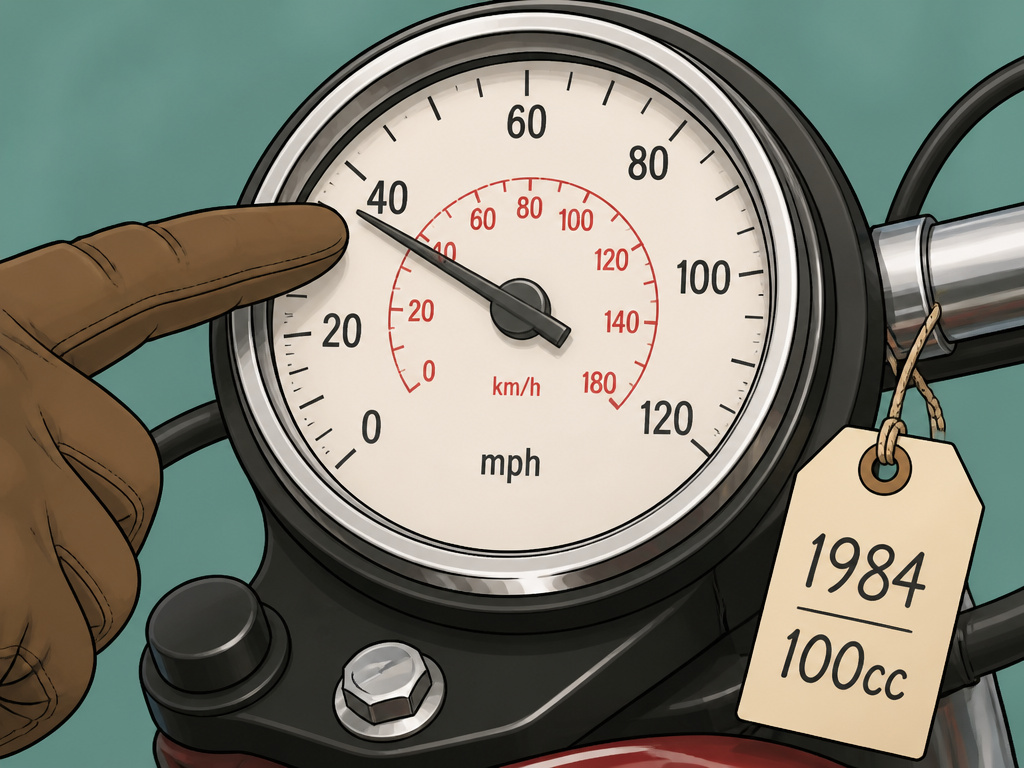
Road Vehicles Regulations 1986 regulation 35 opens bluntly: every motor vehicle shall be fitted with a speedometer. Bikes first used on or after 1 April 1984 need one that shows both mph and km/h, either at the same time or by flicking a switch.
Then come the exemptions, and that’s where your bike actually lives. Think of the headline rule as the board and the exemptions as the joinery. You judge the piece by the joints.
Paragraph (2) lists the exemptions. I’m working from a summary of that paragraph, so read the full text if your bike sits near a line:
- Motorcycles first used before 1 April 1984 with an engine of 100cc or less.
- Any vehicle with a top speed of 25 mph or less.
- Vehicles first used before 1 October 1937, which covers the true veterans and almost nothing else on the road.
Run real bikes through those rules and the answers get specific fast:
| Bike | Speedometer needed? | Must show mph and km/h? |
|---|---|---|
| 1983, 125cc | Yes | No, first used pre-1984 |
| 1983, 100cc | No, exempt | Not applicable |
| 1985, 100cc | Yes | Yes |
| Top speed 25 mph or less | No, exempt | Not applicable |
| First used before 1 Oct 1937 | No, exempt | Not applicable |
The 1983 pair trips owners up. Same year, a few cc apart, opposite answers.
A km/h-only import is the other trap. Post-1984 UK bikes need both scales, so a dash marked only in kilometres breaks the construction rule even with a perfectly healthy needle. If you’re bringing one in, I’d sort the dual-scale face before the bike ever touches the road.
Will a Dead Speedo Fail an MOT or State Inspection?
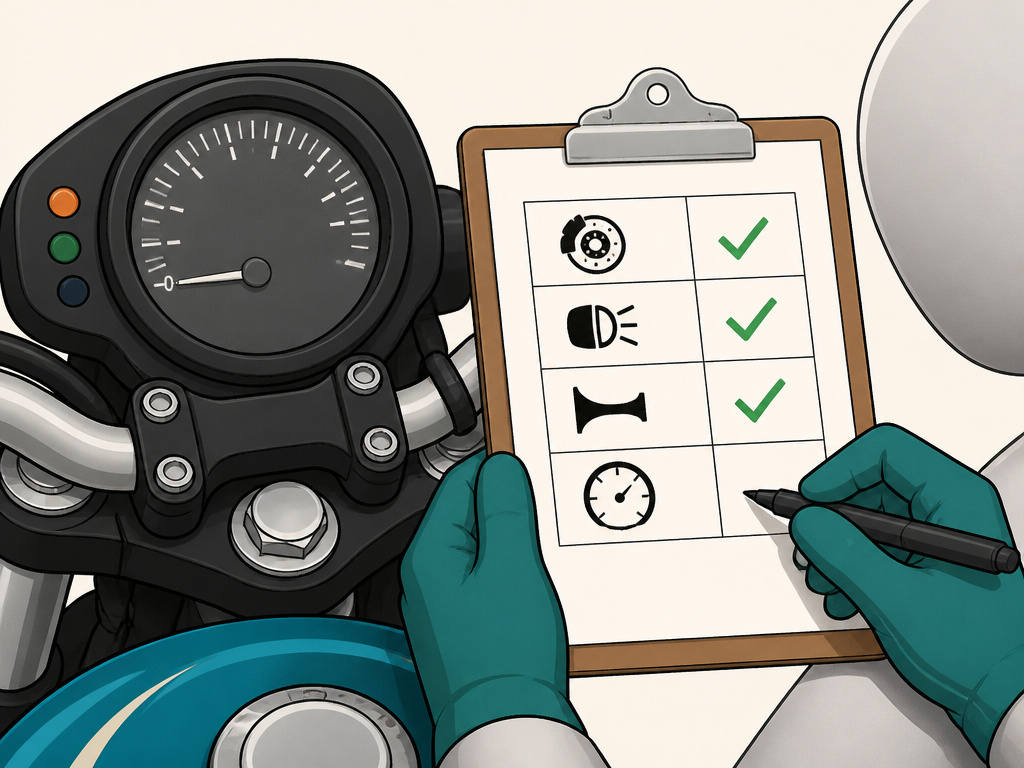
You’d expect the MOT to catch a dead speedometer. In the UK, it won’t. The DVSA motorcycle MOT inspection manual covers identification, brakes, steering, lamps and electrical, wheels and suspension, structure, the horn and exhaust noise. Section 3 isn’t in use at all.
None of it is a speedometer section.
So a bike can leave the test centre with a fresh MOT and still breach reg. 35 on every mile home. The test and the construction law are separate documents, and nobody wrote them to match.
Easy to miss: Treating a fresh MOT as proof your speedometer is legal. The tester never looked at it, so a roadside stop is the first time anyone checks.
Imports and one-off builds get a different check. The MSVA scheme (Motorcycle Single Vehicle Approval, the individual inspection for bikes that didn’t arrive through normal type approval) includes a Section 04 for the speedometer, per the research summary. The current manual applies from 15 September 2025. Your gauge gets examined once, at approval, and never again at MOT.
Hawaii takes the stricter line. The Hawaii speedometer-odometer inspection rule says the speedometer-odometer gets inspected for proper operation, and indicated mileage goes on the certificate. A speedometer in a vehicle under 25 years old must show mph. No certificate gets issued if the odometer is dead or the speedometer lacks mph gradation marks.
One gap: the rule text doesn’t say whether it covers motorcycles. I’d call the inspection station before riding in on a km/h-only dash.
The odometer side bites hardest when you sell. Here’s what a dead or swapped unit costs you:
- Your mileage history breaks. Hawaii writes the reading onto every inspection certificate, so a frozen number stands out against the last one on file.
- A buyer can’t match wear to mileage, so they assume the worst.
- If you swap a gauge, record the old reading in writing with the date, and hand that note over with the bike. A paper trail settles the question before the buyer asks it.
- Expect haggling.
How Accurate Does a Motorcycle Speedometer Have to Be?
UNECE Regulation 39, the international accuracy standard, says the speed on your gauge must never be lower than your true speed. The working formula is 0 <= V1 – V2 <= 0.1 x V2 + a constant. V1 is what the gauge shows; V2 is what you’re actually doing.
In plain terms, the gauge can read high by up to ten percent of true speed plus a fixed allowance. It can never read low.
Fair warning. I pulled that formula from secondary summaries, not the R39 text itself, and the constant is where the sources split:
| Source | Mopeds and small bikes | Motorcycles |
|---|---|---|
| 2001 WP.29 proposal for R39 | +4 km/h (L1/L2 mopeds) | +8 km/h (L3-L5) |
| Hong Kong rules | +4 km/h (50cc or less, or 50 km/h design speed or less) | +8 km/h (all others) |
| Earlier 2000 draft | +4 km/h across the board | +4 km/h across the board |
Notice the boundary moves. The WP.29 proposal splits by vehicle class, while Hong Kong splits by engine size or design speed. Neither figure has been checked against the consolidated R39 text, and I wouldn’t quote either one in front of a magistrate.
All three sources agree on direction, though. The formula allows error above true speed and none below, so makers have every reason to set the gauge high. That’s why your dash reads optimistic, and why a GPS keeps showing a lower number.
Gearing changes break this. On bikes that take the speed signal from the gearbox output, a sprocket swap changes how many wheel turns you get per turn of the output shaft. Fit a bigger rear sprocket and the wheel turns slower for the same shaft speed, so the gauge over-reads by more.
Go the other way and the gauge drops below true speed, which is exactly what R39 forbids. If you’re changing front and rear sprockets, find out where your speed signal comes from first. A wheel-mounted sensor ignores gearing completely.
Common mistake: Fitting taller gearing on a bike with a gearbox-driven gauge and trusting the old numbers. The gauge now reads low, the reverse of how it left the factory, and you’re faster than it says from the very first ride.
GPS is the cross-check I’d use. It calculates speed from changes in position over time, so gearing and tire size don’t touch it. It lags when you accelerate hard and loses signal under bridges and heavy tree cover. Electronics aren’t my home turf, so treat a GPS reading as a sanity check on a steady road at a steady throttle.
Riding Home on a Dead Needle: Tachs, Traffic and Tickets
The needle drops to zero halfway home. The engine still pulls, the lights still work, and there’s a string of speed limits between you and your garage.
Your tachometer is the best backup you’ve got. In any one gear with the clutch fully out, engine rpm and road speed move together. The gearbox and chain lock the crank to the rear wheel at a fixed ratio, so holding a gear at a known rpm means holding a known speed.
Learn those numbers while the gauge still works. Note the rpm at the limits you ride most, in the gear you ride them in. It takes one commute.
Judging by ear is worse. A loose helmet roars at highway speed and buries the engine note you were using as a gauge. In a properly fitted lid you hear the pitch climb as revs rise; in a sloppy one you hear wind and your own pulse. Fit beats price tag, even here.
Where this goes sideways: Judging speed by sound right after an upshift. The note drops the moment you change gear while the bike keeps accelerating, so it sounds slower just as your speed keeps climbing.
Matching traffic flow keeps you from standing out. Flow tells you what everyone else is doing. The sign is what the officer reads.
As for tickets, the only source I found that deals with a broken speedometer in a speeding stop is South Carolina’s proposed bill. It would let a driver charged with going 20 mph or less over the limit swap the speeding charge for an equipment offense with a small fine, if they can prove the speedometer wasn’t working. It’s proposed, not enacted. I’ve found nothing showing a dead gauge works as a defense anywhere else.
If my speedo died mid-trip, I’d ride home in a gear I know, at revs I’ve already matched to a speed, in the slow lane. Then the bike would stay parked until it’s fixed. Guessing for a week is how a commute turns into a court date.
One more trap if your bike has motorcycle cruise control: check the owner’s manual on whether it still engages with the speed reading gone. Don’t find out on the motorway.
The 4-Step Check Before You Buy a New Gauge
Three things kill a speedometer: the drive, the wiring, and the gauge itself. Check them in that order, cheapest first.
Cable-Driven Gauges
Older bikes spin the needle with a cable driven off the front wheel or the gearbox. A dying cable makes the needle wag and bounce at a steady speed while the odometer ticks over in fits. A snapped one leaves both dead: needle parked at zero, odometer frozen.
Sensor-Driven Gauges
Newer bikes use a wheel speed sensor that sends pulses to the instrument cluster. The electronics turn the pulse rate into speed: faster wheel, faster pulses. When the sensor or its wiring fails, the speed readout sits at zero or goes blank while the rest of the screen stays lit.
Before you start: The exhaust stays hot long after a ride, and sensors and cables run close to it on plenty of bikes, so let it cool or wear gloves. Spinning a wheel by hand with the bike on its side stand tips it over; use a paddock stand. Disconnect the battery before unplugging or splicing sensor wiring, or a short will pop a fuse at best.
- Look at the drive end first. Find where the cable or sensor meets the wheel or gearbox. A popped-off cable or a sensor caked in chain lube is the cheapest fix there is; skip this and you’ll replace a gauge that was fine.
- Spin the cable core. Unscrew a cable at the gauge end and turn the wheel. If the inner core spins, the gauge is the suspect; if it doesn’t, the cable or drive is. Skip it and you’re guessing between two parts.
- Trace sensor wiring connector by connector, looking for green corrosion or a pinched run near the forks. Miss this and you’ll buy a sensor to fix a corroded plug.
- Only then shop for a gauge or retrofit. Do it in the wrong order and you own two gauges and the same fault.
If the original can’t be saved, plenty of motorcycle gadgets promise speed from a wheel sensor or GPS, and a bicycle computer with a wheel magnet is the low-tech version. On a US bike, a unit fitted as the speedometer has to meet the FMVSS 123 lighting rule, so wire its backlight to come on with the headlamp. In the UK, any replacement on a post-1984 bike needs both mph and km/h.
I can’t vouch for the software side of these units. My testing lives in helmets and gloves, and I’d want weeks of riding on one before trusting its number.
Vintage, Custom and Track Bikes Play by Different Dates
Age buys exemptions. Little else does.
In the UK, a bike first used before 1 October 1937 is exempt, and so is a pre-1984 bike of 100cc or less. Indiana, per the summary I worked from, exempts motorcycles made before 1 January 1956.
Custom builders, take note. The UK exemptions key off first-use date, engine size and top speed. Pulling the gauge off a modern bike for clean bars changes none of those, so the requirement still applies.
If the bike wears a number plate, assume road speedometer rules apply to it, however stripped-down it looks.
Race bikes are another world. MotoGP machines, according to one video explainer, show speed on the racing dashboard instead of a dedicated gauge, because riders have no time to look down at those speeds. None of the regulations I’ve read address closed-course race bikes, so I won’t pretend to know what your track day requires. Ask the organiser.
Why is a speedometer important for motorcycle safety?
A speedometer gives you a number to check your instincts against. On a bike, with wind noise and no cabin around you, speed is easy to misjudge. A glance at the gauge before a corner, a junction or a stretch with a lower limit tells you whether your feel for the road matches reality.
The rule makers see it the same way. FMVSS 123 exists to minimize accidents caused by operator error in responding to the motoring environment, and it standardizes displays so a rider can read them without hunting. If a speedometer is fitted, it has to be visible to a seated rider in daylight and lit whenever the headlamp is on.
There is a legal side too. UK rules require a speedometer on most motor vehicles, so knowing your true speed helps you stay inside the limit. One caution: gauges are allowed to read a little high but never low, so your real speed is usually slightly under the number shown.
Frequently Asked Questions
Can you get a ticket for riding without a speedometer?
In the UK, a post-1984 road bike without a working, dual-scale speedometer breaks reg. 35. In the US, it depends on your state’s equipment law. South Carolina has a bill proposing a dedicated “Improper Equipment – Speedometer” offense, but it’s a proposal, not enacted law.
Is 80 mph on a motorcycle fast?
That depends on the posted limit where you’re riding. If your gauge meets R39-style accuracy rules, an indicated 80 means your true speed is at or below 80, never above it. A gauge thrown off by gearing changes breaks that guarantee.
Does a phone GPS app count as a speedometer?
The UK rule says a vehicle must be “fitted with a speedometer,” and a phone in your pocket isn’t fitted to anything. Whether a mounted phone counts isn’t addressed in the texts I’ve read. Treat it as a backup, not a legal fix.
How do I add a speedometer to a motorcycle?
Choose a wheel-sensor or GPS unit, mount it where you can read it from the seat, and wire the backlight to the headlamp circuit if you’re in the US. In the UK, pick one that shows both mph and km/h for a post-1984 bike. Check it against GPS on a steady road before trusting it.
Do I need mph or km/h on my speedometer?
UK bikes first used on or after 1 April 1984 need both. Hawaii wants mph gradations on vehicles under 25 years old to pass inspection. A km/h-only import risks failing in both places.
Before You Go
So, do you need a speedometer on a motorcycle? In the UK, yes, unless your bike hits one of a few narrow exemptions. In the US, the federal standard only governs a gauge you already have, and your state does the rest.
Do one thing this week. Pull your registration papers, find the first-use date and engine size, and check them against the 1 April 1984 line. If your bike falls after it and the dash lacks either scale, you’ve got a construction-rule problem the MOT will never flag. US riders: read your state’s equipment statute, not a forum thread.
All of this assumes a road-registered bike. Track-only machines and true veterans sit outside most of it.
Bottom line: if your bike is road-registered and post-1984 in the UK, or registered in a state that requires one, fix a dead speedo before the next ride; if it’s a pre-1937 veteran or a track-only build, the gauge is your call.
