
Dirt Bike Elbow Guards Explained: How to Choose
This post contains affiliate links. As an Amazon Associate, we earn from qualifying purchases.
Dirt bike elbow guards are CE-certified limb protectors designed to reduce soft tissue injuries like bruising, cuts, and minor fractures from low-to-moderate energy impacts. Their performance is defined by the European standard EN 1621-1:2012, which sets two protection levels based on maximum transmitted force. Level 2 offers higher protection (under 20 kN mean force) than Level 1 (under 35 kN), but may be thicker and less flexible.
That force threshold is the single most important number on the label. It tells you what the guard is engineered to handle based on standardized impact tests. Everything else – the brand, the strap system, the venting – is secondary to that certified performance level. This is a core concept when getting dirt bike elbow guards explained.
What follows is a breakdown of the standard, a step-by-step sizing guide using real manufacturer specs, and the maintenance rules that keep the certification valid, which is central to getting dirt bike elbow guards explained. This guide focuses on understanding what you are buying and how to use it correctly, not on brand preference.
Key Takeaways
- The CE EN 1621-1:2012 certification is essential; Level 2 protectors transmit under 20 kN of force, offering higher protection than Level 1’s 35 kN limit.
- Measure your arm circumference precisely, using the manufacturer’s specified point (often just below the elbow), as a guard that is too large creates a dangerous riding condition.
- Inspect guards before every ride and replace them every three years under normal use, or immediately after any significant impact, per manufacturer guidelines.
- Clean only with tap water and a soft cloth; detergents, solvents, or machine washing damage materials and void the safety certification.
- Elbow guards are part of a system; they are intended to reduce soft tissue injuries but cannot mitigate against major fractures or spinal injuries.
What Do CE EN 1621-1 Level 1 and Level 2 Actually Mean?
The label is a legal declaration under Regulation (EU) 2016/425, which governs Personal Protective Equipment (PPE), a key point when you compare dirt bike elbow guards. The “CE” mark means the guard has been tested by a notified body against the EN 1621-1:2012 standard. That standard defines everything.
EN 1621-1:2012 Level 1 protectors shall have an overall mean transmitted force below 35 kN, with no single strike exceeding 35 kN in high-risk area I or 50 kN in areas II and III. Level 2 protectors must have an overall mean below 20 kN, with no single strike over 20 kN in area I or 30 kN in areas II and III.
Those kiloNewtons (kN) are the measurable force that passes through the protector to your body during a standardized 50-joule impact test. Lower is better. The jump from 35 kN to 20 kN is significant – it represents a guard that absorbs and disperses more energy.
| Protection Level | Overall Mean Force Must Be Below | Max Single Strike (Area I) | Max Single Strike (Areas II & III) |
|---|---|---|---|
| CE EN 1621-1 Level 1 | 35 kN | 35 kN | 50 kN |
| CE EN 1621-1 Level 2 | 20 kN | 20 kN | 30 kN |
You will see this on product pages. The Fox Launch Pro Elbow Guards are CE EN1621-1 Level 1. The Alpinestars Bionic Pro Plasma Elbow Protectors are CE EN1621-1:2012 Level 2. The Leatt Elbow Guard Flexmesh is CE EN1621-1:2012 Level 1, Type A (where Type A denotes standard dimensions, and Type B offers a wider protective area).
You are buying a higher performance ceiling, which often means more material between you and the ground.
How to Measure for a Perfect Fit (And Why Getting It Wrong Is Dangerous)
Sizing charts are a mandatory part of the safety system. Leatt’s manual states it directly: choosing a guard that is too large “can result in a dangerous riding condition if it does not correctly cover the area of protection.”
The protector must stay centered over your elbow bone during a crash. If it slides, you lose the certified zone of protection. Here is how the major brands tell you to measure.
Where to Measure:
- Alpinestars recommends measuring the circumference of your forearm just below the elbow for their Bionic Pro Plasma guards.
- Fox/RevZilla guidance states bicep circumference is measured 3 inches above the elbow, and forearm circumference at the thickest part of the forearm.
- Most universal charts, like those for Scott or Leatt, ask for arm circumference at the midpoint around the elbow joint.
Match Your Numbers to the Chart:
Do not guess. Use a soft tape measure and compare your exact centimeter reading to the manufacturer’s size chart. Here is how three popular models break down for a medium (M) size:
| Elbow Guard Model | Size M Measurement | What It Covers |
|---|---|---|
| Fox Launch Pro | Bicep: 27.9-30.5 cm, Forearm: 26.7-27.9 cm | Specific bicep and forearm ranges |
| Scott Grenade Evo | Arm Circumference: 26-29 cm | Single arm circumference range |
| Leatt Elbow Guard Flexmesh | Arm Circumference: 27-31 cm | Single arm circumference range |
If your measurement is at the top of one range and the bottom of another, size down for a snug fit. The guard will stretch slightly with wear, but it should not rotate freely on your arm when the straps are secured.
The 3-Year Rule and When to Replace Your Guards
Your helmet has a expiry date. Your elbow guards have a service life, and it is shorter than you think. The materials degrade over time and with use.
Manufacturers are clear on this, though their triggers differ: Scott recommends replacement ‘three (3) years after the purchasing date,’ while Leatt recommends replacement ‘every three (3) years under normal use conditions’ and after any collision or sign of damage. This policy acknowledges that the safety performance certified in a lab cannot be guaranteed indefinitely on a product that lives in your gear bag.
Where sources disagree: Scott recommends replacement “three (3) years after the purchasing date” for optimum safety. Leatt recommends replacement “every three (3) years under normal use conditions” and immediately after any collision or sign of damage.
Both agree on the three-year timeline. The difference is in the trigger: a strict calendar date versus a guideline coupled with an impact inspection. The conservative approach is to follow both: mark your calendar and inspect relentlessly.
Inspect before every ride.
This takes ten seconds.
- Look for cracks, deep scratches, or deformation in the hard shell or plastic caps.
- Check that all straps and buckles secure firmly and aren’t frayed.
- Press on the internal padding. If it feels crushed, brittle, or doesn’t spring back, it’s done.
- Look for stitching that is pulling out or fabric that is tearing.
If you see any of that, stop using them. The certification is no longer valid. This is why integrating elbow guards into your broader motocross gear checklist is a smart habit.
Proper Cleaning and Storage: What Not to Do

You will sweat. You will encounter mud. Your instinct will be to toss them in the washing machine or hit them with a heavy-duty cleaner. Do not do that.
Cleaning chemicals are the enemy. Leatt’s warning is unambiguous: “Common substances applied to this product (solvent, cleaners, hair tonics, etc.) can cause damage that may be invisible to the user and compromise the effectiveness/safety of your Leatt product.”
The approved method is simple:
- Wipe the surface with a damp cloth (tap water only).
- Use a soft brush dampened with water to clean debris from perforations.
- Air dry away from direct heat or sunlight.
Never use detergent. Never use a washing machine. Air dry away from direct heat or sunlight. For guards with removable protectors like the Alpinestars Bionic Pro Plasma, you can take the Nucleon PLASMA insert out to clean the sleeve more thoroughly – but the insert itself still only gets a wipe-down.
Storage matters too. Do not store heavy objects on top of them, as this can permanently deform the protective materials. A dry, ventilated space is best. This care extends the functional life of your gear, just as proper maintenance does for other key components like your dirt bike’s hand guards.
How Elbow Guards Work With Your Other Protective Gear
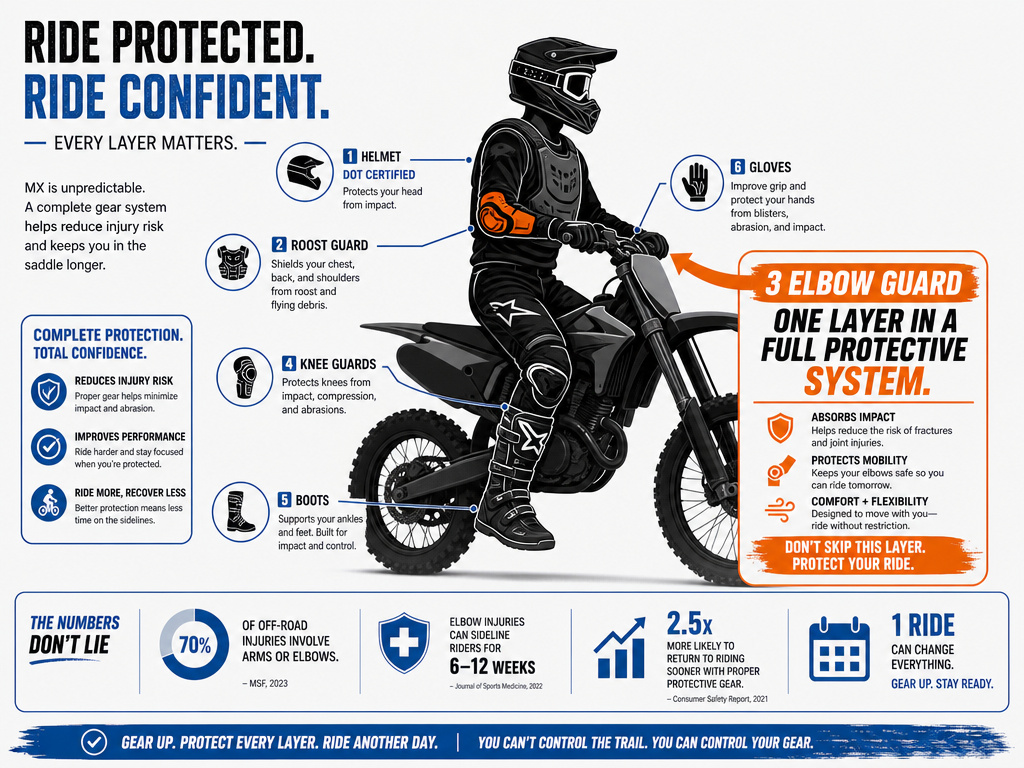
Elbow guards are a component, not a standalone solution. The manuals state this clearly. Leatt notes their guards “are intended to reduce the severity or incidence of soft tissue injuries” and “may reduce the severity and/or incidence of some more serious injuries such as minor fractures.” The next sentence is critical: they “cannot significantly mitigate against major injuries, such as serious fractures.”
Their job is to manage the specific, localized impact to your elbow joint in a typical fall. They are not designed to protect your forearm bones from a direct, high-energy hit or to protect you in a high-speed collision.
This is why they are part of a system. You need them in addition to, not instead of:
- A DOT/ECE-certified helmet
- A roost guard or chest protector for your torso and back
- Knee protection (guards or braces)
- Motocross boots with ankle support
- Dirt bike gloves
Think of your protection in layers. The elbow guard is one dedicated layer for one joint. It should integrate comfortably under or over your jersey and not interfere with your roost guards or chest protector.
What do the certifications on specific elbow guards mean?
Looking at specific models reveals what their certifications actually promise. For instance, the Fox Launch Pro Elbow Guards are certified to EN1621-1 Level 1. The Alpinestars Bionic Pro Plasma Elbow Protectors carry a more stringent Level 2 certification. A model like the Leatt Elbow Guard Flexmesh is certified as Level 1, Type A, meaning it has standard dimensions for an average user. These labels are the specific result of impact tests where transmitted force must stay below defined limits. Your choice should start by understanding these ratings, then checking the manufacturer’s specific sizing guide for that model to ensure a snug fit that does not shift.
How do hard shell and soft elbow guards differ?
The EN 1621-1:2012 standard defines two main types of protectors based on coverage area. Type A offers standard dimensions, while Type B provides a wider area of protection. This relates directly to the design. A hard shell guard with a plastic cap is often Type B, extending further to shield more of the forearm and bicep. A softer, flexible guard might be Type A, focusing protection directly over the elbow bone. The standard also defines performance Levels 1 and 2, with Level 2 requiring the guard to transmit less force from an impact. Both hard and soft designs can achieve either level, so the certification is your key metric, not just the material you can see.
Frequently Asked Questions
What is the purpose of an elbow guard?
The purpose is to reduce soft tissue injuries – bruising, contusions, cuts, and abrasions – to the elbow joint during a fall. Certified guards (CE EN 1621-1) are also tested to potentially reduce the severity of minor fractures from low-to-moderate energy impacts. They are not designed to prevent major fractures or injuries from high-speed crashes.
What is the best elbow protection for motocross?
The “best” is the highest level of certified protection that fits you perfectly and is comfortable enough to wear every ride. For most aggressive riders, this means a CE EN 1621-1 Level 2 guard from a brand like Alpinestars, Leatt, or Fox. Comfort and fit are critical; an uncomfortable guard left in the truck offers zero protection.
How do I know what size elbow guard to get?
You measure. Use a soft tape measure and follow the specific brand’s instructions. For most, this means measuring the circumference of your arm at the midpoint of your elbow joint. Compare your measurement in centimeters to the brand’s official size chart – do not guess or go by t-shirt size. A snug fit is snug without cutting off circulation and should not shift when you move your arm.
Are integrated armor jackets better than separate elbow guards?
It depends on the jacket. A high-quality pressure suit with integrated CE Level 1 or 2 armor can offer excellent, non-shifting protection and simplify gearing up. However, standalone elbow guards often provide more robust, burly protection specifically focused on the joint and allow for more ventilation and layering flexibility.
Before You Go
Trust the label, not the logo. The CE EN 1621-1 certification with its Level 1 or Level 2 rating is the only objective measure of an elbow guard’s impact performance. Everything else is fit, comfort, and durability.
Measure twice, buy once. An extra five minutes with a tape measure prevents the dangerous fit issues that make a guard useless in a crash. And once you have them, maintain them like the safety equipment they are – inspect, clean with water, store properly, and replace on schedule.
Finally, remember what they are for. A set of elbow guards is excellent at their job: turning a season-ending elbow injury into a rough weekend. But they are one part of your protective equipment ensemble. Pair them with a chest protector, knee braces or guards, and proper boots. That is how you build a defense that allows you to push harder and walk away from the mistakes.
