
Motorcycle Chest Protector Pros and Cons: Is It Worth It?
This post contains affiliate links. As an Amazon Associate, we earn from qualifying purchases.
Motorcycle chest protectors are CE-certified impact armor for your torso, designed to reduce the force of a blow from a 50J impact. The core trade-off is straightforward: you gain measurable impact protection for your sternum, ribs, and back at the cost of added bulk, heat, and potential mobility restriction. The real decision isn’t about needing protection, it’s about matching the protector’s certified performance level to the specific risks of your riding.
That 50J figure isn’t marketing. It’s the test energy defined in the European standard EN 1621-3, using a “Kerbstone” impactor to simulate a real-world strike. A protector that passes gets a CE mark, but that’s just the starting line. The standard has two performance levels, and the gap between Level 1 and Level 2 is where the real safety calculation happens. Most off-the-shelf models are Level 1; Level 2 is rarer, heavier, and signifies it passed a more rigorous force distribution test. Understanding motorcycle chest protector pros and cons is key to choosing between these levels.
What follows is a breakdown of what that certification actually means for your ribs, how to spot the difference between adequate and superior protection, and the honest physical compromises you make when you strap one on. We’ll cut through the generic “safety vs. Comfort” talk and get into specs, fit, and the one maintenance rule every manual prints but riders ignore, all central to the motorcycle chest protector pros and cons.
Key Takeaways
- Look for the EN 1621-3:2018 standard on the label. Level 2 offers higher protection than Level 1, but most common models like the Leatt Chest Protector 3.5 are certified Level 1.
- A proper fit is essential. Armor that shifts off your sternum in a riding tuck provides zero protection. Adjust all straps snugly before every ride.
- Clean only with tap water. Using detergents or laundry soap degrades the foam’s impact-absorbing properties, a fact buried in every OEM manual.
- Chest protectors are for impact attenuation, not abrasion. They cannot prevent fractures from extreme forces or crushing injuries, a critical disclaimer in the certification documents.
- Replace the unit every three years, as recommended by manufacturers like Leatt. The foam padding deteriorates with age, sweat, and UV exposure, silently reducing its effectiveness.
The EN 1621-3 Standard: Level 1 vs. Level 2 Explained
Forget “CE certified.” That’s the bare minimum. The meaningful spec is EN 1621-3:2018, the European standard for motorcycle chest protectors. It defines everything: test methods, impact energy (50 joules), and crucially, two performance levels.
According to the standard EN 1621-3:2018, if a protector passes only the force attenuation test, it displays performance level 1. If it also passes the force distribution test, it displays performance level 2. Level 2 is deemed to provide better protection.
Force attenuation is simple: how much energy does the pad absorb? The test drops a weight. Level 1 means the transmitted force through the protector stays below a threshold, for a chest protector, that’s a mean transmitted force of less than 18 kN from a 50J impact.
Force distribution is harder. It measures how well the protector spreads that remaining force over a larger area. A concentrated punch is more dangerous than a diffuse push. Passing both tests earns a Level 2 rating. It’s a stricter benchmark.
Here’s the confusing part. The Leatt 3.5 Chest Protector manual states it is certified to EN 1621-3:2018 Level 1. Its test results show a mean transmitted force below 18kN and a mean distributed force below 15kN. This is a specific case where sources disagree: the Leatt 3.5 Chest Protector, with mean transmitted force <18kN and mean distributed force <15kN, is certified as EN 1621-3:2018 Level 1, while the Leatt 3DF AirFit Evo Chest Protector, with the same force values, is certified as EN1621-3 Level 2. The takeaway: Level 2 is the goal, but you can’t compare models by force numbers alone, trust the printed certification level on the label.
| Protection Level (EN 1621-3:2018) | Tests Passed | What It Means for You | Example Model |
|---|---|---|---|
| Level 1 | Force Attenuation Only | Reduces peak impact force. Adequate for most recreational riding. | Leatt Chest Protector 3.5, Alpinestars A-4 Plasma |
| Level 2 | Force Attenuation + Force Distribution | Reduces force AND spreads it out. Better for high-risk or competitive riding where hit energy is greater. | Leatt 3DF AirFit Evo (claimed) |
Where this goes sideways: Buying a protector for a “Level 2” price that only has a Level 1 certification sticker. The label on the protector itself is the legal truth, not the website description.
The Physical Trade-Offs: Pros You Can Feel, Cons You Can’t Ignore
The motorcycle chest protector pros and cons are straightforward: the pros are tangible, like a hard shell and dense foam between your ribs and the handlebar, a rock, or the ground. The cons are what you live with for every minute of the ride.
First, the good. The primary job is to reduce the severity of blunt force trauma to your chest and spine. For the sternum and ribs, that means lowering the risk of fractures that can puncture lungs. For the back, it’s about shielding vertebrae. It’s not just for crashing, a chest protector is also a roost guard, deflecting rocks and debris kicked up by other riders off-road.
Now, the reality you wear.
- Bulk and Heat: You’re adding a layer of plastic and foam over your core, your body’s main radiator. Even heavily vented models like the Leatt 3.5 trap heat. In stop-and-go traffic on a summer day, you’ll feel it.
- Mobility: Can you move? Yes. Can you move as freely? No. The best designs are articulated, but a rigid plate over your sternum inevitably restricts how far you can curl forward into an aggressive tuck or twist for a shoulder check.
- Fit and Integration: This is the big one. A protector must work with your jacket or jersey. Some are meant to be worn over a jersey, others under a jacket. An armor vest worn under a loose textile jacket can bunch up. Worn over a leather race suit, it might not fit at all.
Common mistake: Wearing a chest protector loose for comfort. If it can slide more than an inch side-to-side when you’re in your riding posture, the armor won’t be over the bones it’s meant to protect when you need it.
The noise factor is rarely mentioned. A loose hard shell can flap and rattle at speed, a constant distraction. The straps can chafe on long rides if they aren’t padded or perfectly adjusted. These aren’t deal-breakers, but they’re the daily tax you pay for that layer of safety.
What a Chest Protector Actually Protects You From (And What It Doesn’t)
Manufacturers are legally required to tell you the limits, and they do, in the fine print. The EU Type Examination Certificate for the Leatt 3.5 states it clearly: protectors “give a limited protection and cannot significantly mitigate against major injuries, such as serious fractures resulting from extreme impact forces or torsion/flexion/bending/crushing injuries.”
Let’s translate. A CE-certified chest protector is designed to mitigate specific, measurable trauma from a defined energy level (50J). Think of a fall from a stationary bike onto a rounded curb (the “Kerbstone” impactor). It can mean the difference between a broken rib and a bruised one, or a cracked sternum and a severe, life-threatening crush injury.
It does not protect against:
- Abrasion: The hard shell might slide, but it’s not designed for a long pavement slide like a leather jacket or abrasion-resistant textile.
- Extreme Force: A high-speed impact with a car, tree, or the ground at racing speeds involves energies far beyond 50J. The protector will help, but it’s not a force field.
- Crushing or Bending: If the bike lands on you, the protector isn’t a structural cage. It can’t prevent internal injuries from compression.
This is why understanding the back protector pros and cons is also critical. Many chest protector units include a back pad, certified to EN 1621-2. The Leatt 3.5’s back protector is Level 1, tested to transmit less than 9kN. It’s an important component, but it’s not a substitute for a dedicated, full-coverage motorcycle back protector you might integrate into a jacket.
The protection is real, but it’s a specific tool for a specific job. It’s not a magic suit.
How to Fit a Chest Protector So It Actually Works
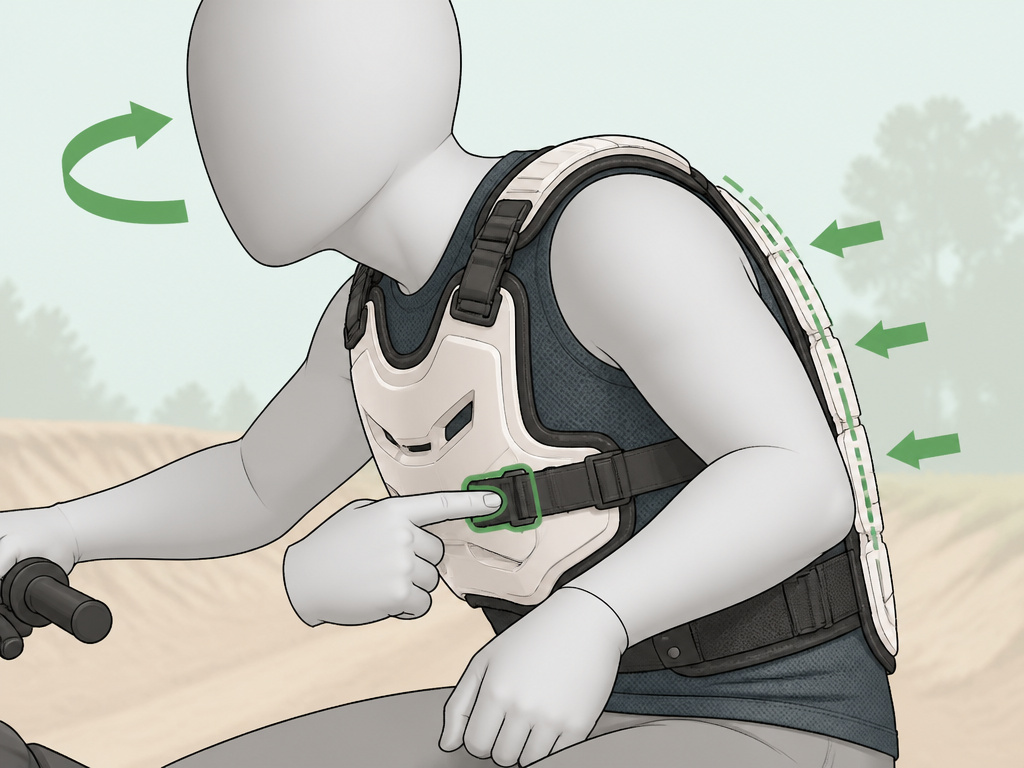
If it doesn’t fit, it doesn’t work. It’s that simple. An armor plate over your lung instead of your rib is useless.
- Start with the Right Size. Manufacturers base this on weight, not height. The Leatt 3.5 is for riders weighing 70-90kg (154-198lbs). If you’re at the edge of a range, size up. A protector that’s too small won’t cover the critical zones.
- Position the Plates. The front plate must center on your sternum. The top should sit just below your clavicle, not riding up into your throat. The back plate must cover your spine from the base of your neck to the top of your hips.
- Tighten the Straps in Order. Do the waist/rib straps first, snug but not suffocating. Then do the shoulder straps. You should be able to take a deep breath without strain. Finally, connect any front closure.
- Do the Motion Test. Get into your riding position, bend forward, tuck your elbows, turn your head left and right. Nothing should pinch or slide out of place. Reach for imaginary handlebars. The armor should stay put.
- Wear It with Your Jacket. Put on the outer layer you’ll ride with. Zip it up. Get back on the bike (or simulate it). Does the protector bunch or roll? Does it feel different? This is the only test that matters.
The part nobody mentions: The foam breaks in. A new protector feels stiff and bulky. After several rides, the padding compresses slightly and conforms to your body. Don’t judge the fit on the first try in your living room.
A well-fitted protector disappears when you’re riding. You’ll notice it when you stop, but in the action, it should just be part of your kit. If it’s constantly nagging you with pressure points or slippage, the fit is wrong.
Level 1 in the Wild: A Look at Popular Models
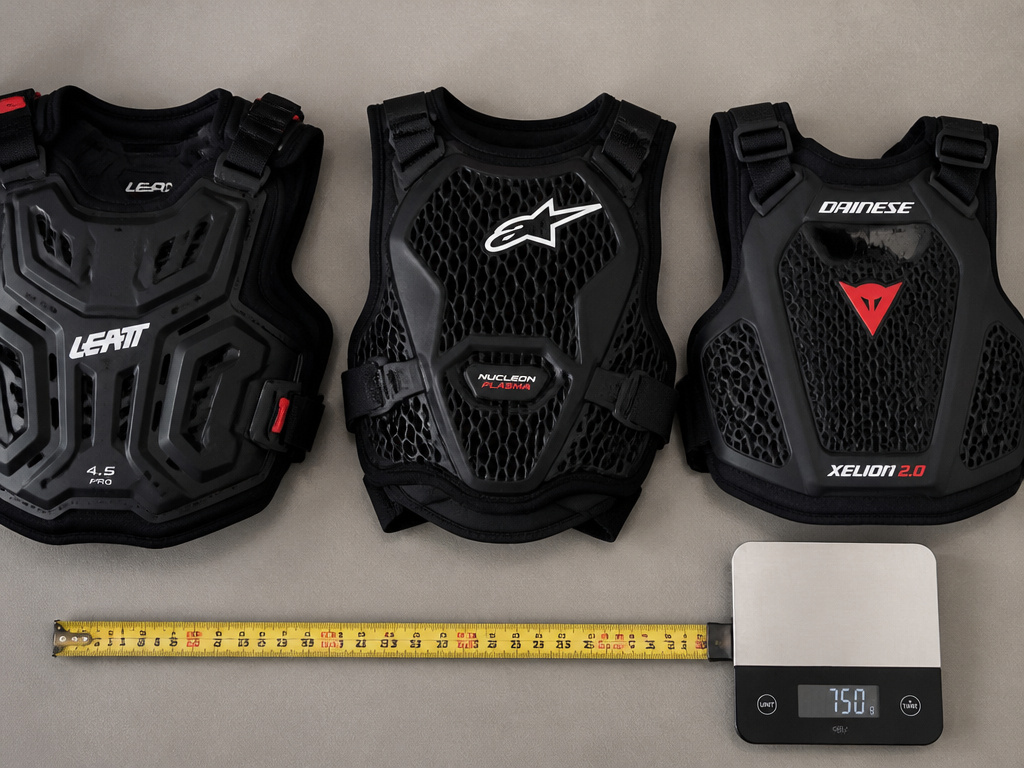
Most riders end up with a Level 1 protector. They’re the market standard. Here’s how three major brands implement the standard, based on their official specs.
The Leatt Chest Protector 3.5 is the archetype. Its EU Type Examination Certificate lists an external shell of black HDPE, internal padding of TPU 98A and EVA foam, and it’s fixed with eleven stainless steel 316 screws. It weighs from 750g (1.65lbs). It’s a straightforward, no-frills hard-shell design.
The Alpinestars A-4 Plasma Chest Protector takes a different material approach. Its back protector uses Nucleon PLASMA, a bio-based viscoelastic compound. It’s still certified to EN 1621-3:2018 Level 1 for the chest and EN 1621-2:2014 Level 1 for the back.
The Dainese Pro-Armor Chest 2PCS 2.0 uses a material called Xelion 2.0. It’s also certified Level 1 to EN 1621.3.
What’s the difference? Mainly weight, ventilation pattern, and strap design. The protection certification is the same: Level 1. Your choice here is about comfort, brand preference, and how it layers with your other gear. For more details on specific models and performance, our guide to the best chest protectors breaks down more options.
Care, Maintenance, and the Three-Year Clock
You wouldn’t ignore maintenance on your bike. Your armor needs the same attention. The manuals are brutally clear.
Cleaning: Use a damp cloth. Only use tap water. The Leatt manual is explicit: “Never use cleaners or detergents, or launder the protector, the product will be damaged by the cleaning process and chemicals and the level of protection provided severely reduced.” Soap residues break down the foam’s chemical structure on a microscopic level.
Storage: Keep it in a cool, dry place out of direct sunlight. UV radiation degrades plastics and foam over time. Don’t leave it in a sealed, damp gear bag.
Inspection: Before each ride, check for cracks in the hard shell, compression damage to the foam (does it bounce back when you press it?), and fraying straps or broken buckles.
Replacement: Leatt Corporation recommends that the Leatt product is replaced every three (3) years. This isn’t a sales tactic. The foam loses its resiliency, the plastics can become brittle, and the stitching weakens. You can’t see this degradation. The three-year mark is a conservative, safety-first guideline. If you crash in it, replace it immediately, even if it looks fine.
This maintenance schedule is what separates gear that’s alive from gear that’s just taking up space in your closet. It’s the least sexy part of owning armor, and the most important.
What are the modern improvements over older chest protector designs?
Modern chest protectors are built to a specific, rigorous standard, EN 1621-3, which older gear often lacked. This standard defines clear performance levels. Level 1 means the protector passed a force attenuation test. Level 2, a more recent and higher benchmark for superior protection, means it passed both the force attenuation and an additional force distribution test. This dual-test requirement for Level 2 is a key modern improvement, ensuring the impact energy is spread over a wider area to reduce the risk of localized injury. Modern protectors are also tested under realistic conditions, including after wet conditioning, to ensure materials perform when soaked with sweat or rain. While they still offer limited protection and cannot prevent all major injuries, today’s certified gear provides a defined and tested level of safety that was not consistently available in the past.
Frequently Asked Questions
Are chest protectors worth it for a motorcycle?
For off-road, motocross, or adventure riding where impacts with the ground and debris are common, yes, absolutely. For street riding, the value is more situational and depends on the rider’s assessment of risk. The protection is measurable, but you must accept the trade-offs in comfort.
What is the best chest protector for motorcycle riding?
There is no single “best.” The right choice balances certified protection level (aim for Level 2 if available), fit, and ventilation for your riding style. For lightweight trail riding, some riders may consider a roost guard. For higher levels of protection, riders may consider systems certified to higher performance levels. Always prioritize fit over features.
Are chest protectors necessary?
Necessary? No, your motorcycle will start without one. Advisable? For any riding where a frontal or side impact to your torso is a real risk, it’s a very smart addition. They are mandatory in most sanctioned motocross competitions. On the street, think of it like a motorcycle back protector, an upgrade that significantly improves your odds in a specific type of crash.
Can you wear a chest protector with an airbag vest?
This is the compatibility question. It depends on the specific models. Some airbag vests are designed to be worn over a chest protector, while others are meant to be the outermost layer. Wearing a rigid chest protector under an airbag vest can hinder the vest’s proper deployment or cause it to inflate incorrectly. You must consult the manuals for both products. Never assume they are compatible.
The Bottom Line
A motorcycle chest protector is a tool for managing a specific risk: blunt force trauma to your core from a 50J impact. The pros, certified impact reduction, are backed by a published standard. The cons, heat, bulk, cost, are physical and financial.
Your decision point is the certification label. EN 1621-3:2018 Level 1 is the baseline. If you can find and afford a verified Level 2 model, that’s the upgrade worth making. Beyond that, fit dictates function. A perfectly fitted Level 1 protector beats an ill-fitting Level 2 every time.
Finally, trust the manufacturer’s fine print over the marketing copy. These devices offer “limited protection.” They are a brilliant, potentially life-saving layer in a complete safety system that starts with riding skill and includes a helmet, jacket, gloves, and boots. Buy one for the right reasons, fit it perfectly, maintain it religiously, and replace it on schedule. That’s how you make the pros outweigh the cons.
